
EMD, Lifshitz, and Hyperscaling Violation
The extremal Reissner—Nordström AdS brane gave us a sharp lesson: finite density can reorganize the low-energy theory into an emergent near-horizon geometry. In the minimal Einstein—Maxwell model, that geometry is
with local criticality, , and a finite extremal horizon area. The finite entropy density at is both technically useful and physically suspicious. It says that the simplest charged horizon has an enormous degeneracy in the strict classical large- limit. That may be a good intermediate regime, but it is unlikely to be the final word on a stable ground state of quantum matter.
The natural next step is to let the bulk couplings run. In top-down reductions from string theory, the low-energy bulk often contains scalar fields whose values determine effective gauge couplings and potentials. Bottom-up holography packages this possibility into Einstein—Maxwell—Dilaton models. They are the simplest arena in which charged black branes can flow to a much broader family of IR scaling geometries:
The exponent measures the relative scaling of time and space. The exponent measures hyperscaling violation, meaning that thermodynamic quantities scale as though the number of spatial dimensions were not , but
This page is about what those words actually mean, how they arise from gravity, and how not to over-interpret them.
Throughout, denotes the number of boundary spatial dimensions. The boundary spacetime dimension is , and the bulk dimension is . We use a radial coordinate for the scaling region, with larger corresponding to deeper infrared scales. Conventions vary heavily in this subject; the invariant statements are the scaling laws, not the name of the radial coordinate.
Scaling before gravity
Section titled “Scaling before gravity”At a scale-invariant quantum critical point with dynamical exponent , the basic scaling is
Thus
A thermal state cuts off critical correlations at the thermal length
If the critical degrees of freedom fill all spatial dimensions in the ordinary way, then the entropy density scales like one thermodynamic degree of freedom per thermal correlation volume:
This is ordinary hyperscaling. For a relativistic CFT, , and we recover
Hyperscaling violation changes this counting rule. The entropy behaves as though the critical low-energy degrees of freedom occupied only
spatial dimensions:
Equivalently, the free energy density scales as
These formulas are among the most useful outputs of the hyperscaling-violating geometry. They are also among the easiest formulas to misuse. The exponent is not automatically proof of a Fermi surface, not automatically proof of hidden fractionalized matter, and not by itself a transport theory. It is a scaling diagnostic.
The Lifshitz metric
Section titled “The Lifshitz metric”The simplest gravitational geometry with and no hyperscaling violation is the Lifshitz metric
It is invariant under
When , this is just in Poincare-like coordinates. When , Lorentz symmetry is gone. Time and space scale differently.
The field-theory interpretation is direct. Low-energy excitations, if one may speak of them kinematically, obey the scaling relation
For , this is the familiar nonrelativistic scaling. For large , time scales far more strongly than space. In the formal limit, one approaches the idea behind local criticality: temporal scaling survives while spatial scaling becomes increasingly weak. The Reissner—Nordström throat from the previous page is the cleanest version of that idea, though it is not merely an ordinary finite- Lifshitz geometry with dialed to infinity.
There is a useful lesson here. A nonrelativistic scaling exponent is not a small deformation of a CFT. It requires new bulk matter. Pure Einstein gravity with a cosmological constant gives AdS, hence . To support , the bulk stress tensor must know that time and space are being treated differently.
Hyperscaling-violating metrics
Section titled “Hyperscaling-violating metrics”The standard hyperscaling-violating metric is
Under the scaling transformation
the metric transforms as
Thus the metric is not scale invariant when . It is only scale covariant. It rescales by an overall Weyl factor.
This is exactly what the name says. The theory has a scaling regime, but the metric does not transform as an honest fixed-point metric. The overall factor carries the hyperscaling violation. Holographically, this factor is usually produced by a scalar field that runs logarithmically in the radial direction.
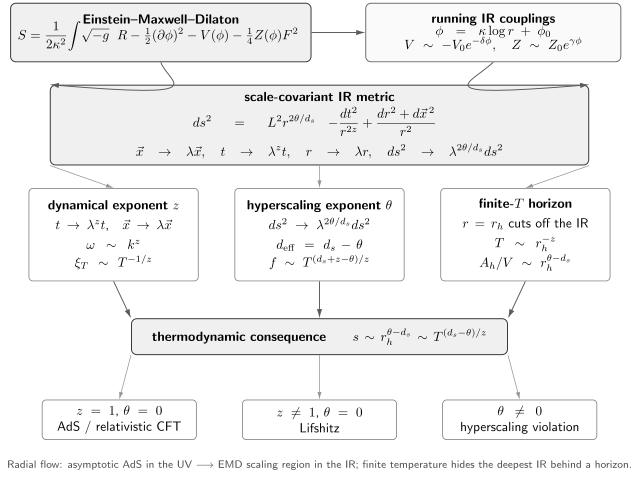
Einstein—Maxwell—Dilaton models generate IR scaling geometries in which controls the relative scaling of time and space, while controls the anomalous Weyl rescaling of the metric. A finite-temperature horizon at gives and , hence .
A quick way to understand the entropy law is to inspect the area density of a constant-, constant- slice. From the spatial part of the metric,
so a horizon at has area density
Since the blackening factor gives
we find
That derivation is so short that it is worth remembering. The exponent is nothing mysterious in the bulk: it changes the radial dependence of the spatial volume element.
Finite-temperature scaling geometry
Section titled “Finite-temperature scaling geometry”A finite-temperature version of the metric can be written schematically as
with
in the simplest scaling solutions. The horizon is at
The temperature is proportional to
up to a dimensionless coefficient depending on and the normalization of time. The entropy density is
Putting these together gives again
Thermodynamic stability imposes a simple first test. If , then the specific heat should not diverge with the wrong sign as . A common requirement is
For , this says
if the zero-temperature entropy is to vanish. The Reissner—Nordström throat evades this finite- discussion because it has and a finite extremal horizon area.
Einstein—Maxwell—Dilaton theory
Section titled “Einstein—Maxwell—Dilaton theory”The simplest bulk action that naturally produces these geometries is
Here:
- is the dilaton, a real scalar field.
- is its potential.
- is a field-dependent Maxwell coupling.
- is the bulk gauge field dual to the boundary current .
The effective gauge coupling is
The Maxwell equation is
For a homogeneous finite-density ansatz with only turned on, this becomes a radial Gauss law:
The conserved quantity
is the electric flux through a radial slice. Near the UV boundary it is proportional to the charge density of the field theory. In the interior, the same flux supports the charged scaling geometry.
The essential new ingredient relative to the RN-AdS brane is that may run. The electric field can therefore be distributed differently along the radial direction, and the IR no longer has to be the rigid throat of minimal Einstein—Maxwell theory.
Why exponential couplings give scaling solutions
Section titled “Why exponential couplings give scaling solutions”In the IR of many EMD solutions, the dilaton runs logarithmically:
If the potential and gauge coupling are exponential at large ,
then the running dilaton turns these functions into powers of :
This is the basic mechanism. The metric, gauge field, scalar kinetic term, potential term, and Maxwell term can all scale as powers of . The equations of motion then reduce to algebraic relations among the powers. Solving those relations fixes , , the running coefficient , and the normalization of the electric field in terms of the action parameters.
In bottom-up work one often reverses the logic: choose a desired pair , then infer what kind of exponential and would support it. In top-down work, the functions and are fixed by the compactification or truncation, and the possible IR exponents are outputs.
Null-energy constraints
Section titled “Null-energy constraints”A useful first diagnostic is the bulk null energy condition. If the matter supporting the metric obeys
for every null vector , then Einstein’s equations imply constraints on and . For the metric convention used above, the two standard inequalities are
and
These are not the full story of consistency, but they are very good at catching nonsense.
A commonly studied region has
Then the first inequality further requires
For Lifshitz with , the null-energy condition reduces to
in this common branch. That is why holographic Lifshitz examples usually have .
There are additional constraints one may impose for specific physical reasons. For example, if one wants the entanglement entropy not to violate the area law by more than a logarithm, one is naturally led to
That condition is not the same as the null-energy condition. It is an extra diagnostic tied to the structure of low-energy degrees of freedom.
Important limits
Section titled “Important limits”The exponents organize many familiar geometries.
| Geometry or regime | Exponents | Main feature |
|---|---|---|
| Relativistic CFT | , | , |
| Lifshitz criticality | , | nonrelativistic scale invariance, |
| Hyperscaling-violating IR | , | effective dimension |
| Fermi-surface-like thermodynamics | and logarithmic entanglement heuristic | |
| RN-AdS throat | in spirit | local criticality and finite extremal entropy |
| Conformal-to- or geometry | , with fixed | local-critical-like response with |
The Fermi-surface entry deserves care. A free Fermi liquid in spatial dimensions has a codimension-one manifold of gapless excitations. Thermodynamically this behaves as though only the direction normal to the Fermi surface scales, giving
If , the formula reproduces this when
This is a useful mnemonic and a deep hint, especially because holographic entanglement entropy also shows a logarithmic area-law violation at . But it is not a theorem that every holographic background with contains gauge-invariant Fermi surfaces. Holographic large- matter can imitate some Fermi-surface scalings without being a Landau Fermi liquid.
The anomalous charge exponent
Section titled “The anomalous charge exponent Φ\PhiΦ”Thermodynamics is not the whole theory. At finite density, charge transport and charge response can involve another exponent, often denoted , which measures anomalous scaling of charge density or of the bulk gauge field.
A simple scaling assignment is
For ordinary conserved currents in an ordinary CFT, one does not expect an anomalous current dimension. But hyperscaling-violating finite-density phases are not ordinary CFTs, and the gauge field profile in EMD solutions can scale anomalously. This matters for conductivities.
For example, an incoherent conductivity in a scaling regime often has the form
up to model-dependent assumptions. We will not use this formula heavily yet, because transport at finite density has an additional complication: if translations are exact, electric current overlaps with conserved momentum, and the DC conductivity is singular. That is the subject of the next transport pages.
For now the lesson is simple:
The geometry as an RG flow
Section titled “The geometry as an RG flow”A realistic holographic model is not just the scaling metric by itself. The full geometry should look schematically like
The UV AdS region defines the microscopic CFT and the operator dictionary. The finite density deformation introduces a scale, often set by . At energies below that scale, the radial geometry may approach an EMD scaling solution.
Thus the scaling metric is an intermediate or deep IR fixed regime, not usually the whole spacetime. This matters because many EMD scaling metrics are singular if extended all the way to the IR. Whether such singularities are acceptable depends on whether they can be resolved, hidden behind a finite-temperature horizon, or embedded into a controlled top-down construction. Bottom-up models are useful precisely because they isolate the scaling logic, but the price is that consistency must be checked rather than assumed.
A clean mental picture is:
The horizon cuts off the IR and turns scaling dimensions into temperature powers.
Worked derivation: entropy from the metric
Section titled “Worked derivation: entropy from the metric”Let us derive the entropy scaling carefully once, because the same reasoning appears all over holographic quantum matter.
Start from
At the horizon , the induced spatial metric is
Therefore
The entropy density is
Now determine the temperature. Near ,
and regularity of the Euclidean cigar fixes
Thus
Substituting into the entropy gives
Notice that this derivation did not depend on the detailed normalization of . It only used scaling.
What these geometries are good for
Section titled “What these geometries are good for”EMD scaling geometries are powerful because they provide controlled, strongly coupled examples of compressible quantum matter with tunable IR scaling. They let us ask questions such as:
- What thermodynamic power laws are possible in large- finite-density matter?
- How does a charged horizon differ from a cohesive charged bulk star or condensate?
- Which exponents are compatible with energy conditions and stable low-temperature entropy?
- How do irrelevant translation-breaking operators control resistivity?
- Can holographic matter imitate some Fermi-surface diagnostics without quasiparticles?
The answer to the last question is especially subtle. The exponent can make thermodynamics look Fermi-surface-like, while the large- spectral function may still lack ordinary gauge-invariant quasiparticles. This is exactly the kind of place where holography is useful: it separates assumptions that are usually bundled together in weak-coupling intuition.
Common pitfalls
Section titled “Common pitfalls”Pitfall 1: Treating and as material fitting parameters with no model. A pair of exponents is not a theory. A theory also needs operator content, charge scaling, momentum relaxation, stability, and a UV completion or at least a controlled bottom-up embedding.
Pitfall 2: Confusing hyperscaling violation with ordinary explicit breaking of scale invariance. The geometry still has a scaling covariance. The metric rescales by an overall Weyl factor; the IR is not just a random non-scale-invariant background.
Pitfall 3: Saying proves a Fermi surface. It suggests Fermi-surface-like thermodynamics and entanglement scaling. It does not by itself identify gauge-invariant fermionic quasiparticles.
Pitfall 4: Forgetting the role of the UV. The scaling metric is usually an IR region. The UV AdS region fixes the field-theory dictionary and determines which perturbations are sources, vevs, or irrelevant deformations.
Pitfall 5: Ignoring momentum conservation when discussing conductivity. A finite-density scaling geometry does not automatically give a finite DC resistivity. Translation symmetry must be broken, or one must study the incoherent current.
Exercises
Section titled “Exercises”Exercise 1: Scaling of the hyperscaling-violating metric
Section titled “Exercise 1: Scaling of the hyperscaling-violating metric”Consider
Show that under
the metric transforms as
Solution
The time term transforms as
The radial term transforms as
The spatial term similarly gives
Only the overall factor changes:
Therefore
Exercise 2: Entropy scaling
Section titled “Exercise 2: Entropy scaling”Using the finite-temperature metric
with horizon and , derive
Solution
At the horizon, the induced spatial metric is
The area density is therefore
The entropy density is proportional to horizon area density:
Since
we have
Thus
Exercise 3: Null-energy inequalities in
Section titled “Exercise 3: Null-energy inequalities in ds=2d_s=2ds=2”For , the null-energy inequalities are
and
Assume and . What additional upper bound on follows from the first inequality?
Solution
If , then
For the product
to be nonnegative, we must have
Therefore
The second inequality is automatically satisfied in much of this branch if and , since then
Exercise 4: Running dilaton and power-law couplings
Section titled “Exercise 4: Running dilaton and power-law couplings”Suppose
and
Show that is a power of . What is the power?
Solution
Substitute the running scalar into the coupling:
This becomes
Using
we obtain
The power is .
Exercise 5: Fermi-surface-like entropy
Section titled “Exercise 5: Fermi-surface-like entropy”A compressible system in spatial dimensions has entropy density
at low temperature. If a hyperscaling-violating geometry has , what value of reproduces this scaling?
Solution
The hyperscaling-violating entropy law is
For , this becomes
To reproduce , we need
Therefore
This is why is often called Fermi-surface-like. It reproduces the entropy scaling of a codimension-one manifold of gapless modes. It does not, by itself, prove the presence of Landau quasiparticles.
Exercise 6: When does the zero-temperature entropy vanish?
Section titled “Exercise 6: When does the zero-temperature entropy vanish?”Assume and
Find the condition on for the entropy density to vanish as .
Solution
As , the power law
vanishes if
Here
Since , this is positive exactly when
Therefore
If , the entropy approaches a constant. If , the entropy diverges as , signaling a thermodynamic pathology in the simplest interpretation.
Further reading
Section titled “Further reading”For the role of EMD models in the scaling atlas of holographic compressible phases, see Hartnoll, Lucas, and Sachdev, Holographic Quantum Matter, especially the sections on charged horizons and critical compressible phases. For a condensed-matter-facing discussion of the Reissner—Nordström metal, EMD scaling geometries, Lifshitz scaling, hyperscaling violation, and conformal-to- metals, see Zaanen, Liu, Sun, and Schalm, Holographic Duality in Condensed Matter Physics, chapter 8. For textbook coverage of dilatonic systems and hyperscaling violation in gauge/gravity duality, see Ammon and Erdmenger, Gauge/Gravity Duality, section 15.5. For entanglement diagnostics of hyperscaling violation and the special role of , see Rangamani and Takayanagi, Holographic Entanglement Entropy, chapter 9.