
Entanglement Wedge Reconstruction
Guiding question. If a bulk excitation lies outside the causal wedge of a boundary region , in what precise sense can it nevertheless be reconstructed from the CFT degrees of freedom in alone?
Main lesson. In semiclassical AdS/CFT, the boundary region does not merely know the bulk points that can causally signal to or from . It knows the larger entanglement wedge . More precisely, after choosing a semiclassical code subspace, every bulk operator in the appropriate algebra of has a boundary representative supported on :
Here is the holographic encoding map, denotes the bulk degrees of freedom in , and the equality is an equality inside the code subspace, not an identity on the full CFT Hilbert space. This page explains what the statement means, why JLMS implies it, and why it is the modern form of bulk subregion duality.
1. From causal reconstruction to entanglement wedge reconstruction
Section titled “1. From causal reconstruction to entanglement wedge reconstruction”The previous page described the conservative form of subregion reconstruction. Given a boundary spatial region , its domain of dependence defines the bulk causal wedge
Operators in are reconstructible by causal methods such as AdS-Rindler HKLL. This is powerful, but it is not the full story. In holography the entropy formula associates to an HRT surface, or quantum extremal surface when bulk entropy is included. The corresponding entanglement wedge is
where is the relevant HRT/QES surface. Usually
and the inclusion can be strict. Entanglement wedge reconstruction says that the larger region is the true bulk dual of the boundary region , at least for low-energy observables in a fixed semiclassical code subspace.
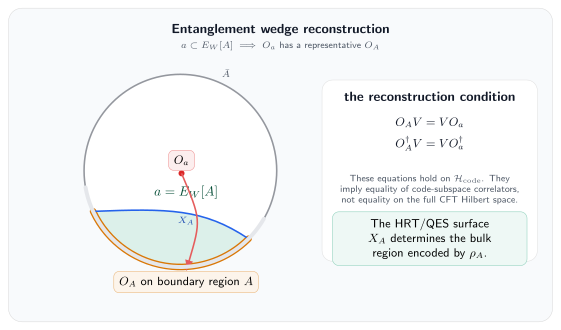
Entanglement wedge reconstruction: a bulk operator supported in has a boundary representative acting only on the degrees of freedom in . The equality is a code-subspace equality. It is not a claim that and are identical operators on the full Hilbert space.
This is one of the cleanest places where holography departs from an ordinary local field theory. In a nongravitational QFT, the algebra associated with a subregion is microscopic input. In holography, the subregion algebra is emergent and redundant: different boundary regions can encode the same bulk operator, much as different surviving pieces of an error-correcting code can recover the same logical qubit.
2. The code-subspace formulation
Section titled “2. The code-subspace formulation”The sharp statement requires separating two Hilbert spaces:
- the exact CFT Hilbert space ;
- a much smaller semiclassical bulk code subspace .
The code subspace contains states obtained by acting with a controlled number of low-energy bulk operators on a chosen semiclassical background, or on a controlled family of nearby backgrounds. The encoding map is an isometry
For a boundary decomposition , define the boundary restriction channel
If the bulk code subspace factorized as , the simplest version of entanglement wedge reconstruction would say: the channel preserves all information in the subsystem . In the Heisenberg picture, this becomes operator reconstruction.
For every operator on , there exists an operator on the boundary region such that
for every . Equivalently,
The same equation should also hold for if is not Hermitian. This condition guarantees that all code-subspace correlators agree:
The real bulk theory is more subtle than a tensor product because gauge constraints, gravitational dressing, edge modes, and the area operator introduce an algebra with a center. The more accurate statement uses operator algebras: the algebra of bulk observables in is represented on boundary region , while the commutant algebra is represented on . This refinement is the subject of the later page on operator-algebra quantum error correction, but the simple tensor-product picture is enough to understand the main theorem.
3. What exactly is being reconstructed?
Section titled “3. What exactly is being reconstructed?”There are three related, but distinct, notions of reconstruction.
3.1 State reconstruction
Section titled “3.1 State reconstruction”A recovery channel reconstructs the reduced bulk state on from the reduced boundary state on :
for all code states . This is a Schrödinger-picture statement.
3.2 Operator reconstruction
Section titled “3.2 Operator reconstruction”The adjoint channel maps bulk operators to boundary-supported operators:
Then
This is the form most directly used in bulk physics.
3.3 Algebra reconstruction
Section titled “3.3 Algebra reconstruction”The strongest useful statement is not merely that each operator can be recovered separately, but that products and adjoints are also recovered:
This multiplicative structure is what lets us treat the reconstructed operators as a genuine bulk algebra, rather than as a collection of unrelated observables. In exact finite-dimensional QEC this structure is exact. In holography it is approximate, controlled by , the code-subspace size, gravitational backreaction, and nonperturbative effects.
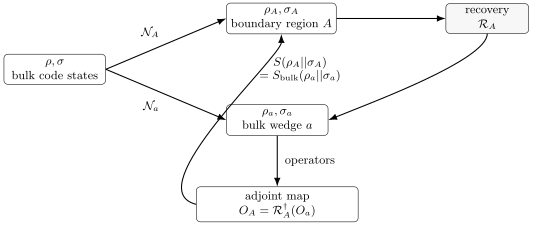
The boundary restriction traces out after encoding the code state into the CFT. If relative entropy in equals relative entropy in the bulk wedge algebra , then has lost no distinguishability about . Quantum information theory then supplies a recovery map , and its adjoint gives boundary operators supported on .
4. JLMS as the engine behind reconstruction
Section titled “4. JLMS as the engine behind reconstruction”The JLMS relation says, schematically, that boundary and bulk modular Hamiltonians agree in the entanglement wedge after including the area term. In a fixed code subspace one may write
where is the boundary modular Hamiltonian and is the bulk modular Hamiltonian in . Taking differences between two nearby code states cancels the area contribution in relative entropy and gives
This equality is extremely strong. Relative entropy measures distinguishability. Under any quantum channel , relative entropy obeys monotonicity:
So if the boundary restriction channel preserves the relative entropy between all relevant bulk states, then restricting to has not discarded information about the wedge algebra. In finite-dimensional quantum information theory, equality of relative entropy is equivalent to the existence of a recovery channel. This is the conceptual core of the Dong-Harlow-Wall argument.
The logic is:
Thus entanglement wedge reconstruction is not a mysterious strengthening of HKLL. It follows from the quantum-corrected entropy formula plus the information-theoretic meaning of relative entropy.
5. The Petz map and modular reconstruction
Section titled “5. The Petz map and modular reconstruction”The existence theorem is abstract, but it can be made more explicit. Let be the channel from code states to boundary region , and let be a reference code state. The Petz recovery map has the schematic form
The twirled Petz map improves robustness by averaging over modular time:
The detailed functional form of is less important here than the physics: recovery is built from modular flow. This is why modular Hamiltonians and relative entropy are not decorative abstractions. They are the operators that know how to undo the apparent loss of information caused by tracing out .
In simple symmetric cases, such as an AdS-Rindler wedge, the recovery formula reduces to familiar HKLL-type reconstruction. For a general boundary subregion, the modular flow is highly nonlocal and not usually available in closed form. Entanglement wedge reconstruction is therefore primarily an existence and structural theorem, not a universal practical smearing formula.
6. Redundant boundary representations and no-cloning
Section titled “6. Redundant boundary representations and no-cloning”One of the most surprising consequences is non-uniqueness. The same bulk operator may have several boundary representatives. If and entanglement wedge nesting gives
then any operator in can be represented both on and on :
Hence
The difference is a perfectly good CFT operator, but it annihilates the code subspace in the sense of all matrix elements between code states. The two representatives can act very differently on high-energy CFT states outside the semiclassical code subspace.
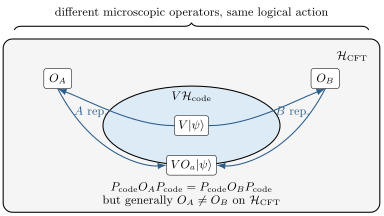
Redundant reconstruction is not cloning. Two boundary operators and may have different microscopic support and different action outside the code subspace, while agreeing on all code-subspace matrix elements. The equality is , not as exact CFT operators.
This resolves the apparent conflict with the no-cloning theorem. Holography does not create independent copies of a bulk degree of freedom. It creates multiple logical representations of the same encoded observable. A useful analogy is a repetition or secret-sharing code: after erasure of some physical qubits, the logical bit can still be recovered from the survivors, but the logical bit was never duplicated into independent microscopic bits.
7. Complementary recovery
Section titled “7. Complementary recovery”Entanglement wedge reconstruction has a complementary form. If lies in the entanglement wedge of , it is reconstructible on . If lies in the entanglement wedge of , it is reconstructible on . The two reconstructions should be compatible:
as boundary operators with disjoint support, matching the bulk commutation of spacelike-separated wedge algebras.
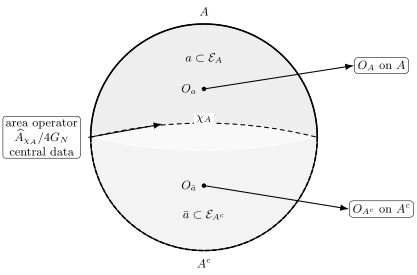
Complementary recovery assigns the wedge algebra of to and the complementary wedge algebra to . Quantum mechanically, the entropy surface can carry central data such as area and edge-mode information, which is why the most precise language is operator-algebra quantum error correction.
The HRT/QES surface sits at the interface between the two wedge algebras. Quantum mechanically it carries the area operator and edge-mode structure. This is why the most precise formulation is not ordinary subsystem QEC but operator-algebra QEC. The algebra associated with and the algebra associated with share a center, roughly generated by geometric data of the entangling surface such as the area.
For many calculations one can ignore this center and work in a fixed-area or fixed-background sector. But for quantum-corrected entropy, black hole interiors, and islands, the center is not optional. It is where the area term in the entropy formula lives.
8. Why the entanglement wedge is larger than the causal wedge
Section titled “8. Why the entanglement wedge is larger than the causal wedge”Causal-wedge reconstruction asks what can be rebuilt by causal propagation from . Entanglement wedge reconstruction asks what information is encoded in after using the full quantum state and the error-correcting structure of the duality.
The difference is clearest in examples where is small but reaches behind a causal horizon. A bulk point outside the causal wedge may not be accessible by a simple HKLL smearing kernel supported in , but it can still be encoded in in a more nonlocal way, using modular flow or recovery-channel operations.
There is no violation of causality. Reconstructing an operator from does not mean an observer in can send or receive local signals from that bulk point. It means the reduced CFT state on contains enough fine-grained quantum information to represent the corresponding logical observable.
This distinction is crucial later. After the Page time, the entanglement wedge of the Hawking radiation can include an island inside the gravitating region. That does not mean the interior can send local signals into the radiation bath. It means the radiation Hilbert space contains a logical representation of certain interior operators.
9. Code-subspace dependence and the size of the theorem
Section titled “9. Code-subspace dependence and the size of the theorem”The reconstruction theorem is powerful because it is precise, but it is not unlimited. The following qualifications are not footnotes; they are part of the statement.
9.1 A fixed semiclassical code subspace is required
Section titled “9.1 A fixed semiclassical code subspace is required”The representative is usually constructed relative to a chosen code subspace. If the state changes so much that the dominant HRT/QES surface changes, the entanglement wedge changes. A single boundary operator may not reconstruct the same bulk observable across both phases.
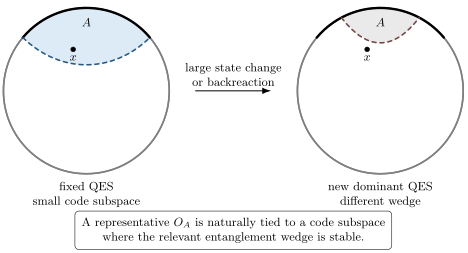
Entanglement wedge reconstruction is stable inside a code subspace where the relevant QES does not jump. If a large excitation or a large change of state changes the dominant QES, the wedge of changes and so does the reconstruction problem. This is why the theorem is naturally formulated for controlled semiclassical code subspaces.
9.2 The reconstruction is approximate
Section titled “9.2 The reconstruction is approximate”Bulk effective field theory is approximate, and so is the encoding of its local algebras. Corrections come from finite , finite code-subspace size, gravitational constraints, and nonperturbative effects. One should not expect exact local bulk operators in the full CFT Hilbert space.
9.3 The code subspace cannot be arbitrarily large
Section titled “9.3 The code subspace cannot be arbitrarily large”If the code subspace includes too many independent bulk excitations in , their entropy and backreaction can alter the extremal surface. In rough terms, the code subspace must be small compared with the area budget that defines the wedge. This is the same physical constraint behind the holographic entropy bound.
9.4 Gravitational dressing matters
Section titled “9.4 Gravitational dressing matters”Gauge-invariant bulk operators in gravity must be dressed. The dressing can be chosen to reach the boundary in different ways, and this choice interacts with subregion reconstruction. Entanglement wedge reconstruction is best understood as a statement about gauge-invariant dressed observables or about relational observables within the code subspace, not about naive pointlike fields in an exact factorized Hilbert space.
10. Islands as entanglement wedge reconstruction of radiation
Section titled “10. Islands as entanglement wedge reconstruction of radiation”The island formula is a later development, but its interpretation is already visible here. Let be a nongravitating radiation region. If the QES prescription gives
then the island is part of the entanglement wedge of the radiation. Entanglement wedge reconstruction says that operators in should have logical representatives acting on .
This is the modern meaning of the slogan “the interior is encoded in the radiation.” It is not a statement about local signals or classical records. It is a subregion-duality statement:
inside a suitable code subspace, with reconstruction potentially very complex. The same machinery that reconstructs a bulk operator from a boundary interval also explains why late Hawking radiation can encode interior degrees of freedom after the Page transition.
11. Common pitfalls
Section titled “11. Common pitfalls”Pitfall 1: “Entanglement wedge reconstruction is just HKLL with a better kernel.”
No. HKLL is a causal, perturbative bulk-field reconstruction method. Entanglement wedge reconstruction is a quantum-error-correcting statement. In special cases the two coincide, but in general the entanglement wedge requires modular flow or recovery-channel ideas, not a simple local smearing kernel.
Pitfall 2: “If is reconstructible on and , the CFT has cloned the bulk operator.”
No. and agree only on the code subspace. They are different physical CFT operators whose difference has vanishing matrix elements between encoded low-energy states.
Pitfall 3: “The reconstruction is an exact operator identity.”
No. The exact CFT has no globally valid local bulk operator algebra. The statement is approximate and code-subspace dependent.
Pitfall 4: “Being in means one can communicate causally with .”
No. Causal accessibility is governed by . Entanglement wedge inclusion is an information-theoretic statement about the encoding of logical observables.
Pitfall 5: “The entanglement wedge is defined once and for all by geometry only.”
At leading order it is geometric, but quantum mechanically it is defined by generalized entropy. Bulk entropy, state dependence of QESs, and competing saddles matter.
12. Summary
Section titled “12. Summary”Entanglement wedge reconstruction is the modern statement of subregion duality:
Its conceptual ingredients are:
- the RT/HRT/QES definition of ;
- the JLMS equality of boundary and bulk relative entropy;
- monotonicity and equality conditions for relative entropy;
- quantum error correction and recovery channels;
- complementary reconstruction on and ;
- code-subspace control.
This is the bridge from holographic entropy to bulk reconstruction. The next pages make this bridge more explicit by describing holography as quantum error correction, tensor-network toy models, and operator-algebra quantum error correction.
Exercises
Section titled “Exercises”Exercise 1. Matrix-element reconstruction
Section titled “Exercise 1. Matrix-element reconstruction”Assume . Show that for all code states ,
Why is this weaker than the statement ?
Solution
Insert the identity :
The statement only constrains matrix elements between vectors in the image of . It says nothing about how acts on CFT states orthogonal to the code subspace. Thus is a representative of the logical operator , not an operator equal to on the full microscopic Hilbert space.
Exercise 2. Redundant reconstruction and no-cloning
Section titled “Exercise 2. Redundant reconstruction and no-cloning”Suppose and are two boundary representatives of the same logical bulk operator :
Show that has vanishing matrix elements between code states. Explain why this avoids a no-cloning paradox.
Solution
Subtracting the two equations gives
Therefore for any code states ,
The two boundary operators are not independent copies of the logical observable. They are different microscopic representatives that agree on the encoded subspace. Outside the code subspace they can act differently, so there is no duplication of an unknown quantum state into two independent physical systems.
Exercise 3. Relative entropy and recovery in a classical toy model
Section titled “Exercise 3. Relative entropy and recovery in a classical toy model”Let be a classical random variable, and suppose a channel keeps only . Show that if
for two distributions and , then the conditional distributions agree:
whenever the probabilities are nonzero. Interpret this as a classical version of recoverability.
Solution
Use the chain rule for relative entropy:
If the first term already equals the full relative entropy, then
Each relative entropy term is nonnegative, so every term with must vanish. Hence . The discarded variable can be recovered statistically from using a conditional distribution independent of whether the original state was or . The quantum version replaces this conditional distribution by a recovery channel such as the Petz map.
Exercise 4. Wedge nesting and multiple representatives
Section titled “Exercise 4. Wedge nesting and multiple representatives”Assume entanglement wedge nesting: if , then . If a bulk operator is localized at , explain why it can be reconstructed both on and on . What equality relates the two representatives?
Solution
Since , entanglement wedge reconstruction gives an operator supported on such that
Since , wedge nesting implies , so there is also an operator supported on with
Therefore
The two representatives agree as logical operators on the code subspace, even though they may be different CFT operators microscopically.
Exercise 5. A toy QES transition and reconstruction
Section titled “Exercise 5. A toy QES transition and reconstruction”Consider two candidate quantum extremal surfaces for a boundary region , with generalized entropies
where . Find the transition value of . Explain why a bulk point that lies in for the first saddle but not for the second may not have a single reconstruction valid across the transition.
Solution
The dominant surface is the one with smaller generalized entropy. The transition occurs when
Thus
For the first saddle dominates; for the second saddle dominates. If a point is inside only in the first phase, then the algebra reconstructible from changes at . A boundary operator designed to reconstruct that point in the first code subspace need not reconstruct it in a code subspace that crosses the QES transition. This is a simple model of code-subspace dependence.
Further reading
Section titled “Further reading”- X. Dong, D. Harlow, and A. C. Wall, “Reconstruction of Bulk Operators within the Entanglement Wedge in Gauge-Gravity Duality,” arXiv:1601.05416.
- D. L. Jafferis, A. Lewkowycz, J. Maldacena, and S. J. Suh, “Relative entropy equals bulk relative entropy,” arXiv:1512.06431.
- A. Almheiri, X. Dong, and D. Harlow, “Bulk Locality and Quantum Error Correction in AdS/CFT,” arXiv:1411.7041.
- J. Cotler, P. Hayden, G. Penington, G. Salton, B. Swingle, and M. Walter, “Entanglement Wedge Reconstruction via Universal Recovery Channels,” arXiv:1704.05839.
- C.-F. Chen, G. Penington, and G. Salton, “Entanglement Wedge Reconstruction using the Petz Map,” arXiv:1902.02844.
- D. Harlow, “TASI Lectures on the Emergence of the Bulk in AdS/CFT,” arXiv:1802.01040.