
ER=EPR and Traversable Wormholes
Guiding question. When does entanglement have a geometric interpretation, and how can an apparently nontraversable Einstein–Rosen bridge become traversable without violating causality?
The thermofield double state taught us a sharp lesson: a pure entangled state of two noninteracting holographic CFTs can have a connected two-sided black-hole geometry. The connection is an Einstein–Rosen bridge. It is behind horizons, grows with time, and is not traversable. The left and right exterior observers can be entangled, but they cannot send a signal through the wormhole.
The phrase ER=EPR is a proposal to elevate this lesson into a broader organizing principle. In its most conservative form, it says that certain patterns of quantum entanglement are represented in the bulk by wormhole-like connectivity. In its boldest form, it suggests that entanglement and spacetime connectivity are two aspects of the same quantum-gravitational structure. The safe version for calculations is narrower:
The word special is doing a lot of work. A generic Bell pair is not a smooth classical bridge in Einstein gravity. A generic high-entropy entangled state need not have a nice semiclassical interior. A thermofield double, by contrast, is highly structured: it has the right spectrum, correlations, modular properties, and low enough complexity to admit an eternal black-hole description.
This page has three goals. First, it explains the ER=EPR idea in the controlled two-sided AdS setting. Second, it explains why the ordinary Einstein–Rosen bridge is nontraversable. Third, it shows how a carefully chosen coupling between the two boundaries can produce negative averaged null energy and open a traversable wormhole. The surprise is that this traversable wormhole is not a causality-violating shortcut; in the boundary theory it is a quantum teleportation protocol written in gravitational language.
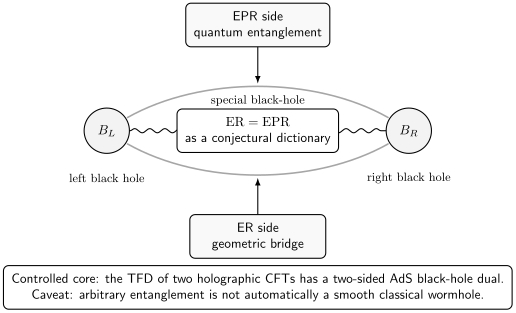
The conservative ER=EPR lesson from the thermofield double: a special entangled state of two black-hole systems can be represented by a two-sided geometry with an Einstein–Rosen bridge. The bridge is a geometric encoding of correlations, not an independent signal channel.
1. From EPR correlations to Einstein–Rosen bridges
Section titled “1. From EPR correlations to Einstein–Rosen bridges”The initials in ER=EPR refer to two 1935 ideas. Einstein and Rosen introduced a bridge-like solution of general relativity, now called an Einstein–Rosen bridge. Einstein, Podolsky, and Rosen emphasized the puzzling nonlocal correlations of quantum entanglement. Modern holography places both in a common framework.
For two identical holographic CFTs, the thermofield double is
Each side is thermal:
The full two-sided state is pure, and its holographic dual is the maximally extended AdS black hole. The two asymptotic regions are dual to the two CFTs. The bridge between them is not a tube in an external ambient space; it is the black-hole interior of the two-sided spacetime.
The TFD already suggests a slogan:
But the slogan becomes misleading if it is read too literally. Entanglement entropy tells us how many correlations exist between the two sides. The detailed state tells us whether those correlations are organized into a smooth semiclassical geometry. Two states can have the same entanglement entropy and very different interiors.
For example, acting on the TFD with a very complicated unitary on one side preserves the spectrum of and hence preserves , but it can drastically change two-sided correlators and the geometric interpretation of the bridge. Entanglement is necessary for the two-sided geometry, but not sufficient for a smooth, short, semiclassical bridge.
2. What ER=EPR does and does not claim
Section titled “2. What ER=EPR does and does not claim”A useful hierarchy is:
The ER=EPR proposal is strongest in states that are already known to have gravitational duals. The TFD is the benchmark. Related examples include entangled black holes, multiboundary wormholes in AdS, and certain states prepared by Euclidean path integrals. In these cases the wormhole is a useful semiclassical saddle.
There are several levels of interpretation.
Conservative statement
Section titled “Conservative statement”In holographic theories, some entangled states of separated quantum systems have bulk descriptions in which the entanglement is geometrized as an Einstein–Rosen bridge.
This statement is essentially a lesson of the TFD and multiboundary AdS geometries.
Stronger conjecture
Section titled “Stronger conjecture”Whenever two black holes are entangled in the right way, their entanglement may be represented by some kind of ER bridge. The bridge may be highly quantum, Planckian, stringy, or not well approximated by a smooth classical metric.
This is much more ambitious. It should not be used as a substitute for a calculation.
Dangerous overstatement
Section titled “Dangerous overstatement”Every entangled pair of particles is connected by an ordinary classical wormhole.
This is not a useful statement in semiclassical gravity. If a microscopic Bell pair has any ER-like description, it is not a macroscopic solution of Einstein’s equation with a smooth throat. Treating it as one leads to nonsense.
The reliable lesson for black-hole information is subtler: interior geometry is tied to entanglement structure, but the map from entanglement to geometry is highly constrained. Entropy alone is too crude. One also needs correlation functions, modular structure, complexity, and the code-subspace organization of the state.
3. The ordinary ER bridge is nontraversable
Section titled “3. The ordinary ER bridge is nontraversable”The eternal AdS black hole looks like a bridge, but it is not a traversable tunnel. A causal curve entering from the left exterior crosses the left horizon and reaches the future singularity. It cannot emerge at the right boundary. Similarly, a signal from the right cannot cross to the left.
This nontraversability is visible from both sides of the duality.
On the gravity side, the Penrose diagram has two exterior regions separated by horizons. The future singularity blocks causal passage through the bridge. The wormhole exists on spacelike slices, but a spacelike connection is not a causal channel.
On the boundary side, the Hamiltonian is factorized:
For any left operator and right operator ,
under the uncoupled time evolution generated by . The two CFTs can be entangled, but they do not interact. Entanglement alone cannot transmit a message.
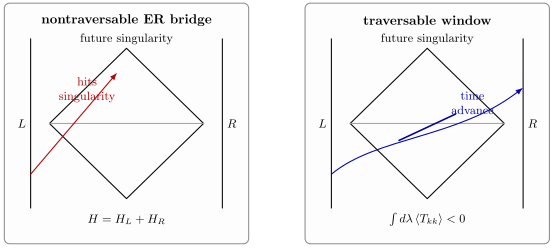
In the ordinary eternal black hole, a signal thrown in from one exterior cannot cross to the other boundary. A suitable boundary coupling can create negative averaged null energy near the horizon, producing a time advance that opens a traversable window.
This is the same reason ordinary quantum teleportation requires a classical channel. An EPR pair by itself does not let Alice signal to Bob. Alice must also communicate measurement information. In the wormhole story, the extra ingredient is a physical coupling between the two boundaries.
4. Double-trace coupling and negative null energy
Section titled “4. Double-trace coupling and negative null energy”The Gao–Jafferis–Wall construction makes the two-sided wormhole traversable by briefly coupling the two CFTs. Schematically, one deforms the Hamiltonian by
with a double-trace interaction of the form
or, in conventions adapted to the TFD time-reflection symmetry,
The precise sign of matters. For the right sign, the interaction produces a quantum stress tensor near the horizon with negative averaged null energy along the relevant horizon generator:
Classically, ordinary positive energy focuses null geodesics and tends to make wormholes harder to traverse. Negative null energy has the opposite effect: it can defocus or advance null rays. In the two-sided black hole, this time advance can let a signal that would have hit the singularity emerge at the opposite boundary.
A useful schematic relation is
where is the null shift experienced by a horizon-crossing signal. The sign convention depends on coordinates, but the physical statement is invariant: negative averaged null energy opens a causal window.
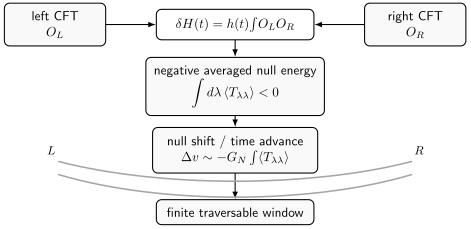
The double-trace coupling injects a controlled quantum effect rather than an ordinary positive-energy shock. With the appropriate sign, the induced stress tensor produces negative averaged null energy on the horizon and shifts null rays so that a message can escape to the other boundary.
There is no violation of causality. The coupling is an explicit interaction between the two boundary systems. In the boundary theory, Alice and Bob have installed a communication channel. The bulk statement is that, in the entangled state dual to a wormhole, that boundary channel has a geometric description as a traversable bridge.
5. The traversability window and backreaction
Section titled “5. The traversability window and backreaction”The traversable window is not unlimited. Suppose a message is inserted from the left at time , the double-trace coupling is applied around , and the message is detected on the right at . Near a black-hole horizon, boosts grow exponentially. A signal sent too early is highly blueshifted near the horizon and can create large gravitational backreaction.
Parametrically, the relevant boost factor is controlled by
The scrambling time
therefore reappears. A signal inserted much earlier than the scrambling time before the coupling can carry so much boosted energy that it significantly backreacts and may close the wormhole it was trying to use. Likewise, trying to send too many quanta through the wormhole produces backreaction that reduces or eliminates traversability.
Thus traversability is controlled by a competition:
The existence of a traversable window is robust, but the capacity of the wormhole is limited. This limitation is the bulk version of the fact that the corresponding teleportation protocol has finite resources.
6. Traversable wormholes as teleportation
Section titled “6. Traversable wormholes as teleportation”The most important interpretation of the traversable wormhole is quantum teleportation. The ingredients line up almost too well:
| Teleportation language | Two-sided black-hole language |
|---|---|
| Shared EPR resource | TFD entanglement between and |
| Alice acts on her system | Message thrown into one exterior |
| Classical communication | Explicit — coupling |
| Bob recovers the state | Signal emerges from the other boundary |
| No faster-than-light signaling | No traversability without coupling |
The double-trace interaction is not merely a metaphorical classical channel; in many formulations it implements a coherent version of the measurement-and-communication step of teleportation. The bulk message traveling through the wormhole and the boundary teleportation protocol are two descriptions of the same process.
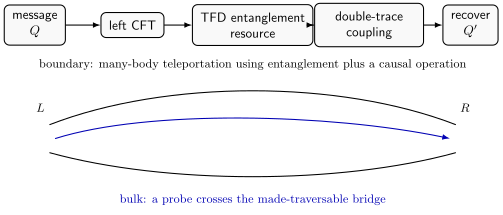
The traversable wormhole protocol is the geometric dual of teleportation. The entangled two-sided state supplies the quantum resource, while the double-trace coupling supplies the communication channel. Without the coupling, the bridge is present but nontraversable.
This is conceptually important because it demystifies the apparent magic. The signal does not exploit entanglement to beat causality. It uses entanglement plus an interaction. The surprise is not that teleportation works; the surprise is that, for holographic systems in the right state, teleportation can be experienced by the infalling excitation as motion through a smooth spacetime bridge.
In nearly AdS gravity and SYK-like systems, this equivalence can be made especially explicit. The Schwarzian boundary mode encodes the gravitational backreaction. The double-trace coupling changes the boundary trajectory, and the two-sided correlator becomes large in precisely the regime where the bulk signal becomes traversable.
A schematic diagnostic is the two-sided commutator or correlator. Without coupling, causal signaling is absent:
With the interaction inserted,
for times inside the traversable window. The nonzero commutator is not acausal; it is generated by the explicit interaction in the Hamiltonian.
7. Relation to the information problem
Section titled “7. Relation to the information problem”ER=EPR entered the black-hole information discussion partly because of the firewall paradox. The AMPS argument says that, after the Page time, a late Hawking mode must be correlated with the early radiation for unitarity, while semiclassical smoothness seems to require to be entangled with an interior partner . Naively, monogamy of entanglement forbids both.
ER=EPR suggests a different mental picture: perhaps the entanglement between a black hole and its radiation has a geometric avatar. But by itself this slogan is not a full resolution. The modern precise statements involve quantum error correction, entanglement wedges, and islands:
The island is part of the entanglement wedge of the radiation region . This is a reconstruction statement, not a classical traversable wormhole statement. Nevertheless, traversable-wormhole protocols provide a powerful operational analogy. If one couples the radiation to the remaining black hole in a suitable way, interior information can become recoverable in a process that has a traversable-wormhole description in certain models.
The conceptual triangle is:
In ER=EPR language, entanglement can create a bridge-like relation. Traversability requires an additional operation. In island/QEC language, the information may be encoded in the radiation, but extracting it requires reconstruction, often an extremely complex operation.
8. Geometry, entanglement, and complexity
Section titled “8. Geometry, entanglement, and complexity”The TFD has a large entanglement entropy between the two sides. But after times of order the thermal scale, this entropy is already essentially constant. The Einstein–Rosen bridge, however, continues to grow for a very long time. Therefore bridge length is not measured by entanglement entropy alone.
A rough slogan is:
This is why ER=EPR naturally leads into holographic complexity. Entanglement creates the possibility of connectivity, but the growth of the interior appears to be controlled by the complexity of the entangled state. Acting with a precursor operator on one side can create a shockwave in the bulk. The switchback effect in complexity has a geometric counterpart in the way shockwaves modify the wormhole interior.
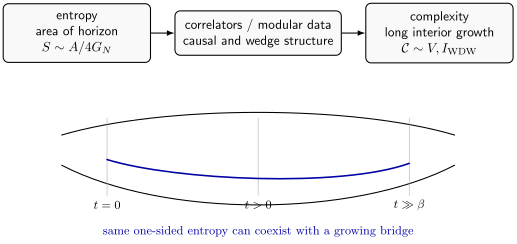
Entanglement entropy measures only part of the geometric story. In the TFD, the mutual entanglement between the two sides is time independent under , while the bridge can grow under . Interior growth is more naturally associated with complexity than with entropy alone.
This distinction prevents a common misconception. ER=EPR is not the claim that every unit of entanglement entropy becomes one unit of wormhole length. The mapping between quantum data and geometry is more structured: entropy controls areas, correlation functions probe geodesics and causal structure, modular data controls wedges, and complexity is expected to control the long wormhole interior.
9. What traversability teaches us
Section titled “9. What traversability teaches us”The traversable-wormhole story is valuable because it turns a speculative slogan into an operational experiment. We can ask whether a message inserted on one side can be recovered on the other. In the boundary theory, the answer is controlled by a Hamiltonian coupling and ordinary quantum mechanics. In the bulk, the answer is controlled by null energy, backreaction, and causal structure.
The lessons are:
- Entanglement is not enough for signaling. A nontraversable bridge is compatible with strong entanglement because the boundary systems remain dynamically decoupled.
- Traversability requires a coupling. The double-trace deformation is the boundary manifestation of the operation that opens the wormhole.
- Negative energy is allowed but constrained. Quantum effects can violate classical energy conditions, but not arbitrarily.
- The protocol is teleportation. The geometric passage through the wormhole is dual to a teleportation-like process using entanglement plus communication.
- Capacity is limited by backreaction. Sending too much information through the wormhole can close it.
- The information problem needs more than ER=EPR. Islands and QEC give sharper statements about what radiation reconstructs and when.
10. Common pitfalls
Section titled “10. Common pitfalls”Pitfall 1: “ER=EPR means every Bell pair has a classical wormhole.”
A Bell pair may have a highly quantum ER-like interpretation in an ambitious version of the conjecture, but it is not a smooth Einstein-Rosen bridge described by classical geometry.
Pitfall 2: “The ordinary TFD wormhole lets the two CFTs communicate.”
It does not. The two CFTs are entangled but dynamically decoupled. Their operators commute under the uncoupled Hamiltonian.
Pitfall 3: “Traversable wormholes violate causality.”
The Gao–Jafferis–Wall wormhole becomes traversable only after adding an explicit boundary coupling. The boundary theory already contains a causal communication channel.
Pitfall 4: “Negative energy means arbitrary exotic matter.”
The negative averaged null energy is generated by controlled quantum effects in a specific entangled state and coupling. It is constrained by backreaction, quantum inequalities, and consistency of the boundary theory.
Pitfall 5: “The island is just a traversable wormhole to the radiation.”
The island formula is an entropy and reconstruction statement. A traversable-wormhole protocol may give an operational way to recover interior information in some models, but an island is not itself a local signal path.
11. Exercises
Section titled “11. Exercises”Exercise 1. Entanglement without signaling
Section titled “Exercise 1. Entanglement without signaling”Consider two quantum systems with Hilbert space and uncoupled Hamiltonian . Show that a unitary operation performed only on the left cannot change the reduced density matrix on the right.
Solution
Let the initial state be and let Alice apply . The new right density matrix is
Using cyclicity of the partial trace over operators acting only on ,
Thus entanglement alone does not allow signaling. This is the boundary reason why the ordinary ER bridge is nontraversable.
Exercise 2. Boundary coupling and nonzero commutators
Section titled “Exercise 2. Boundary coupling and nonzero commutators”Let
For a right operator , compute its time derivative at and explain why the interaction permits left data to influence right observables.
Solution
The Heisenberg equation gives
Since commutes with right operators,
Therefore
The right observable now depends on the left operator . This is not acausal; it follows from the explicit interaction term in the Hamiltonian.
Exercise 3. Negative null energy and time advance
Section titled “Exercise 3. Negative null energy and time advance”Suppose the shift of a null coordinate is schematically
Explain why negative averaged null energy can open a traversable window, and why positive-energy messages can close it.
Solution
If
then the schematic formula gives . Depending on the coordinate convention, this positive shift is a time advance relative to the null ray that would otherwise hit the singularity. A sufficiently large advance lets the signal escape to the other exterior.
A positive-energy message contributes positive stress tensor. It therefore reduces the negative-energy effect, or produces the opposite shift. If the message energy is too large, its gravitational backreaction can eliminate the traversable window. This is the bulk expression of finite channel capacity.
Exercise 4. Teleportation dictionary
Section titled “Exercise 4. Teleportation dictionary”In ordinary teleportation, Alice and Bob need an entangled pair and a classical communication channel. Identify the analogues of these two ingredients in the traversable-wormhole setup.
Solution
The shared entangled pair is replaced by the thermofield double entanglement between the two CFTs. The classical communication channel is replaced by the explicit double-trace interaction between the two boundaries. The message inserted on one side can be recovered on the other only when both ingredients are present. This is why the traversable wormhole does not violate causality.
Exercise 5. Why entropy is not bridge length
Section titled “Exercise 5. Why entropy is not bridge length”The TFD evolved with has thermal reduced density matrices on both sides at all times. Explain why the entanglement entropy between and remains constant while the wormhole interior can grow.
Solution
The two-sided evolution is unitary:
The right density matrix evolves as
Since von Neumann entropy is invariant under unitary conjugation,
Thus the entanglement entropy between the two sides is time independent. The growth of the wormhole interior therefore cannot be measured by entanglement entropy alone. It is more naturally associated with complexity or related fine-grained data of the state.
12. Further reading
Section titled “12. Further reading”- J. Maldacena and L. Susskind, Cool horizons for entangled black holes.
- P. Gao, D. L. Jafferis, and A. C. Wall, Traversable Wormholes via a Double Trace Deformation.
- J. Maldacena, D. Stanford, and Z. Yang, Diving into traversable wormholes.
- J. Maldacena, Eternal black holes in anti-de Sitter.
- J. Maldacena, S. H. Shenker, and D. Stanford, A bound on chaos.
- A. R. Brown and L. Susskind, The Second Law of Quantum Complexity.
The next pages use this discussion in two directions. The page on the black-hole interior studies state dependence and interior operators. The page on holographic complexity explains why the bridge continues to grow even after ordinary entanglement measures have saturated.