
Ensemble Averaging, Baby Universes, and JT Gravity
Guiding question. When Euclidean wormholes make a gravitational answer look like an ensemble average, is the bulk theory literally averaging over boundary Hamiltonians, or is the ensemble language a calculational shadow of a deeper quantum-gravity Hilbert space?
The previous page introduced the factorization puzzle: connected Euclidean saddles seem to correlate decoupled boundaries, while a fixed boundary theory obeys exact factorization. This page explains the main framework in which such correlations are not paradoxical. In ensemble-averaged holography, the bulk path integral computes averaged observables such as
not the product of partition functions in one fixed theory. A connected Euclidean wormhole is then interpreted as an ensemble covariance,
which is perfectly allowed.
The cleanest controlled example is Jackiw–Teitelboim gravity. Pure JT gravity, summed over Euclidean topologies, is described by a double-scaled random matrix integral. This does not mean that every AdS/CFT dual is an ensemble. It means that some gravitational path integrals naturally compute ensemble-averaged quantities, and JT gravity gives a precise laboratory for studying how wormholes, baby universes, spectral statistics, and factorization fit together.
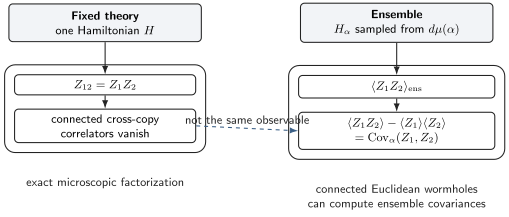
A fixed theory and an ensemble answer different questions. A fixed Hamiltonian gives exact factorization for decoupled copies. An ensemble average over can produce nonzero covariances such as , naturally represented by connected Euclidean wormholes.
1. Fixed theory, ensemble, and covariance
Section titled “1. Fixed theory, ensemble, and covariance”Let label theories in an ensemble with probability measure . For each member we have a Hilbert space and Hamiltonian, schematically
The ensemble average is
For a single fixed member , two decoupled copies factorize:
But after averaging over ,
in general. The difference is the covariance of the random variables and :
Thus an ensemble-averaged theory can have connected multi-boundary observables without contradicting factorization in each fixed member. This is the simplest mathematical resolution of the Euclidean-wormhole tension.
The important interpretive question is then:
Does a given gravitational path integral compute a fixed-theory answer, an ensemble average, or an approximation that hides the distinction?
JT gravity gives a case where the ensemble interpretation is not merely suggestive but quantitatively sharp.
2. JT gravity as an ensemble of spectra
Section titled “2. JT gravity as an ensemble of spectra”The Euclidean JT path integral has the schematic topological expansion
where
for a genus- surface with asymptotic boundaries. The constant is the extremal entropy term in the JT action and controls the genus expansion: every handle costs a factor of .
Saad, Shenker, and Stanford showed that this all-genus expansion is reproduced by a double-scaled random matrix integral. In the matrix-integral language,
and JT computes ensemble averages of products of such traces:
The equality is not merely a slogan. The Weil–Petersson volumes appearing in JT amplitudes obey recursion relations that match the topological recursion of the matrix model. The result is an exact perturbative dictionary between Euclidean JT topology and random-matrix spectral statistics.
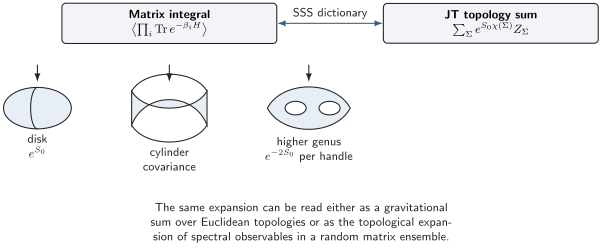
Pure JT gravity organizes -boundary amplitudes by topology. The same expansion is reproduced by a double-scaled matrix integral computing ensemble averages of . The cylinder is the geometric avatar of a connected spectral covariance.
The leading one-boundary answer is the disk. In common conventions the leading spectral density takes the universal Schwarzian/JT form
where is the Schwarzian coefficient. The precise normalization depends on conventions, but the lesson is invariant: the JT disk computes the smooth, leading large-density approximation to the spectrum. Higher topologies encode spectral correlations and eventually the random-matrix ramp and plateau.
3. The cylinder as a connected correlator
Section titled “3. The cylinder as a connected correlator”Consider two thermal circles with inverse temperatures and . The matrix model gives
In JT gravity, the disconnected product is represented by two disks. The connected contribution is represented by a Euclidean cylinder connecting the two asymptotic boundaries:
This is not a violation of quantum mechanics. It is the expected covariance of spectral observables in an ensemble. For instance, writing
we have
The connected part measures correlations in the same spectrum. In a fixed theory those correlations are present as spectral correlations, but they do not appear as a nonfactorizing product between two independent copies. The wormhole knows about the ensemble average, not about a literal interaction between the two boundary systems.
4. Spectral form factor: ramp, plateau, and wormholes
Section titled “4. Spectral form factor: ramp, plateau, and wormholes”A particularly useful diagnostic is the spectral form factor
It probes correlations between energy levels. In chaotic systems, the connected spectral form factor displays the famous slope–ramp–plateau structure. The early-time slope is controlled by the smooth density of states; the ramp reflects universal level repulsion; the plateau reflects the discreteness of the spectrum.
In JT gravity and its matrix-integral completion, these features have geometric avatars:
The plateau is especially important. A finite quantum system has a discrete spectrum, so the spectral form factor cannot decay forever. Perturbative genus expansions can see the ramp but are not, by themselves, enough to produce the exact plateau. The matrix integral supplies a nonperturbative completion in which eigenvalue discreteness is built in.
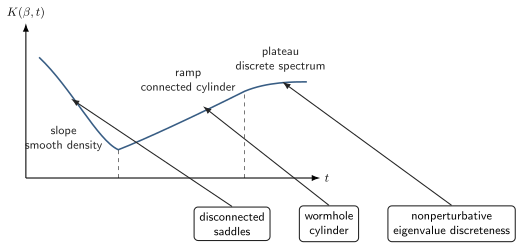
The spectral form factor links random-matrix physics and Euclidean wormholes. The connected cylinder captures the ramp, while the plateau requires nonperturbative information about the discreteness of the spectrum. The diagram is schematic; the precise time scales depend on the ensemble and normalization.
This is one reason JT gravity is so valuable. It shows how a gravitational sum over topologies can reproduce detailed quantum-chaotic spectral statistics. But it also reveals the danger: a semiclassical wormhole contribution often computes an averaged quantity, and averaged quantities do not obey the same factorization properties as fixed-theory quantities.
5. Baby universes as the Hilbert-space language of ensembles
Section titled “5. Baby universes as the Hilbert-space language of ensembles”The ensemble interpretation can be rephrased in a more gravitational language using baby universes. The idea is old, but the modern AdS/JT setting gives it a sharper operational meaning.
A baby universe is a closed component of spacetime that can branch off from, or connect to, asymptotic regions in a Euclidean path integral. Instead of saying that wormholes directly couple different boundary theories, one can introduce a baby-universe Hilbert space and operators that create asymptotic boundaries.
In this language, gravitational amplitudes are expectation values in a state :
If the operators commute, they can be simultaneously diagonalized. Their common eigenstates are often called -states:
If the Hartle–Hawking baby-universe state is a superposition or mixture over , then
This is exactly an ensemble average.
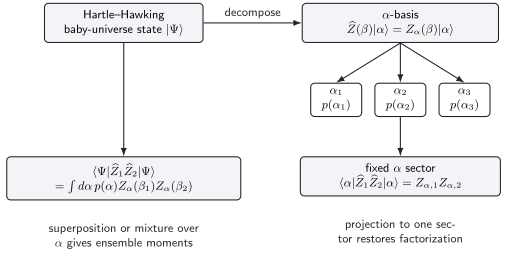
In the baby-universe description, asymptotic-boundary operators are diagonal in -states. A Hartle–Hawking state that is not an -eigenstate computes an ensemble average over effective boundary theories. Projection onto one -sector gives fixed values .
This language clarifies the connection between wormholes and ensembles. A connected wormhole is not necessarily a mysterious force between decoupled boundaries. It can be the statement that both boundaries are probing the same hidden baby-universe sector .
The analogy is simple. Suppose a hidden random variable is sampled once, and two observers measure functions and . Conditional on , the measurements factorize. But after averaging over , they are correlated:
Baby universes provide a gravitational realization of this logic.
6. Alpha states and fixed theories
Section titled “6. Alpha states and fixed theories”The -state perspective is useful because it separates two questions that are often conflated.
First, what does the gravitational path integral state compute? If the state is Hartle–Hawking-like and has support over many sectors, it computes ensemble moments.
Second, what does a single exact boundary theory compute? That should correspond, if the baby-universe language applies, to a fixed sector or to a more microscopic completion that effectively selects fixed data.
In an -state,
so factorization is restored.
In a superposition or mixture over ,
unless the distribution is trivial or the two observables are uncorrelated across the ensemble.
This is the cleanest version of the baby-universe resolution of the factorization puzzle. But it also relocates the hard question: in an ordinary non-ensemble AdS/CFT duality, what selects the fixed data, and how is that selection represented in the bulk?
7. Null states and the Marolf–Maxfield lesson
Section titled “7. Null states and the Marolf–Maxfield lesson”Modern baby-universe discussions also emphasize the role of the gravitational inner product. Naively, one might try to build many states by adding many asymptotic boundaries or closed universes. But the gravitational path integral defines an inner product, and that inner product can make many naive states null.
A schematic version is as follows. Suppose one tries to define states by inserting asymptotic boundary conditions. The inner product matrix is computed by a gravitational path integral:
If has zero eigenvalues, then some linear combinations are null and must be quotiented out. The physical Hilbert space is not the naive vector space of all topological boundary insertions; it is
where is the null subspace.
This point matters for black-hole information. A gravitational path integral can look as if it creates too many independent states or too many independent topological sectors. But after quotienting by null states, the physical state space can be smaller and more consistent with unitarity or finite-dimensional boundary expectations.
The moral is not that baby universes automatically solve every factorization problem. The moral is that topology change must be discussed together with the physical inner product, not merely as a sum of classical manifolds.
8. Annealed versus quenched quantities
Section titled “8. Annealed versus quenched quantities”Ensemble averages are treacherous because nonlinear operations do not commute with averaging. The two most common averages are:
and
The first is the annealed free energy; the second is the quenched free energy. They are generally different. Since is concave,
and therefore, for ,
The same distinction appears in entropy calculations. For a random density matrix ,
This is crucial in replica-wormhole physics. The entropy involves a logarithm,
so one must be careful about whether the gravitational replica path integral computes an annealed, quenched, or fixed-theory quantity. Many apparent paradoxes arise from silently replacing one with another.
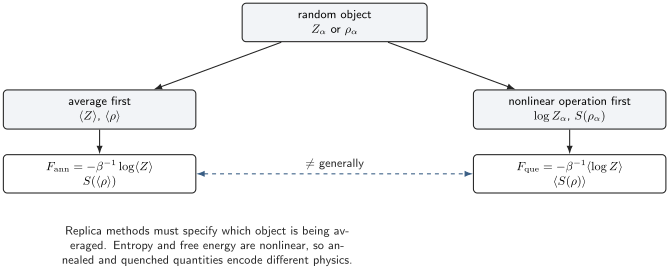
Averages and nonlinear operations do not commute. The annealed free energy uses , while the quenched free energy uses . Fine-grained entropy has the same danger: is not the same as .
9. Relation to replica wormholes and islands
Section titled “9. Relation to replica wormholes and islands”Replica wormholes compute entropies, not ordinary two-boundary partition functions. Nevertheless, the same conceptual infrastructure appears.
For a radiation density matrix , the entropy is obtained from
In gravity, the path integral for includes saddles with nontrivial topology connecting replica copies. After taking the limit, these saddles yield the island formula.
The ensemble question is then: are replica wormholes computing the entropy of a fixed theory, an ensemble-averaged entropy, or a good semiclassical approximation to a fixed-theory answer?
The modern view is nuanced.
- In pure JT gravity, the matrix-integral dual strongly suggests an ensemble interpretation.
- In standard AdS/CFT with a fixed microscopic CFT, exact factorization should hold, so connected Euclidean wormholes require additional nonperturbative interpretation.
- In many island calculations, the leading semiclassical result for the Page curve is expected to be robust even if the precise ensemble/fixed-theory completion is subtle.
The key reason is that the island formula is a statement about the dominant generalized-entropy saddle in a semiclassical regime. It can correctly capture the leading fine-grained entropy while leaving open the microscopic mechanism that enforces exact factorization in a fixed UV-complete dual.
10. Eigenbranes, half-wormholes, and fixed-spectrum refinements
Section titled “10. Eigenbranes, half-wormholes, and fixed-spectrum refinements”Several modern ideas attempt to move beyond the simple ensemble story.
One approach is to condition the matrix integral on additional microscopic data. In JT language, eigenbranes are related to fixing eigenvalues of the random matrix. Fixing more spectral data pushes the ensemble closer to a particular member, and the gravitational description acquires new brane-like ingredients.
Another approach is the half-wormhole idea. In simple models inspired by SYK, connected wormholes can survive in a fixed-coupling description, but additional saddles also appear. These half-wormholes are sensitive to the specific microscopic couplings and restore factorization in the fixed theory. After averaging, the coupling-sensitive half-wormholes vanish, leaving the smoother wormhole contribution.
These ideas are not yet a universal solution for all AdS/CFT factorization puzzles. But they teach an important lesson:
The semiclassical wormhole is often only the smooth, averaged part of a more refined nonperturbative answer.
A fixed theory can contain extra microscopic phases, branes, null-state identifications, or saddles that are invisible in the coarse semiclassical approximation.
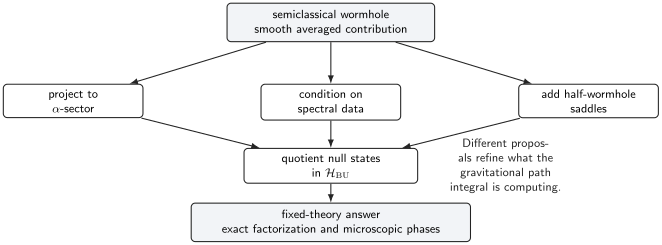
Ways to refine the ensemble story. The semiclassical wormhole often captures a smooth averaged contribution. A fixed theory may require projection to an -sector, conditioning on spectral data, adding half-wormhole-like saddles, or quotienting null states in the baby-universe Hilbert space.
11. What JT gravity proves, and what it does not prove
Section titled “11. What JT gravity proves, and what it does not prove”JT gravity proves a remarkable statement: a precisely defined sum over Euclidean topologies can reproduce a random matrix ensemble. It also gives a controlled setting where Euclidean wormholes compute connected spectral correlations rather than contradicting quantum mechanics.
But several statements would be too strong.
First, JT gravity does not prove that every theory of quantum gravity is dual to an ensemble. Ordinary AdS/CFT examples, such as maximally supersymmetric Yang–Mills dual to string theory on asymptotically AdS backgrounds, are believed to be fixed theories.
Second, the matrix-integral completion of pure JT is not unique in the same way a full UV-complete string compactification is. It is a powerful nonperturbative completion of a low-dimensional gravitational path integral, not a universal definition of quantum gravity.
Third, baby universes do not automatically imply observable randomness in low-energy couplings. Whether -parameters are physical, fixed by boundary conditions, gauged, or absent depends on the theory and on the allowed observables.
Fourth, ensemble averaging is not a loophole in unitarity. Each ensemble member can be perfectly unitary. What changes is that averaged quantities may look mixed, correlated, or nonfactorizing in ways that a single fixed theory would not.
12. Why this matters for black hole information
Section titled “12. Why this matters for black hole information”The black hole information problem forces us to distinguish three levels of description:
- Semiclassical geometry: useful but often computes coarse or averaged quantities.
- Generalized entropy saddles: powerful enough to reproduce Page-curve behavior.
- Exact microscopic Hilbert space: required for exact factorization, exact unitarity, and the fine structure of late-time observables.
Euclidean wormholes and baby universes live precisely at the interface between these levels. They explain why gravitational path integrals can know about spectral correlations and Page-curve physics, while also warning us not to overinterpret every connected saddle as an exact observable of a fixed boundary theory.
The safest summary is:
JT gravity shows that wormholes naturally compute ensemble moments. Baby-universe language explains those moments as expectation values over -sectors. Fixed AdS/CFT duals must recover factorization by selecting, conditioning, or otherwise refining the gravitational answer.
That is why ensemble averaging is not a side topic. It is one of the sharpest probes of what the gravitational path integral is actually computing.
Common pitfalls
Section titled “Common pitfalls”Pitfall 1: “A wormhole means the two boundary theories interact.”
No. In the ensemble interpretation, the connected wormhole computes a covariance over theories or spectra. It does not introduce a dynamical interaction between two decoupled boundary Hamiltonians.
Pitfall 2: “JT gravity proves AdS/CFT is always an ensemble.”
No. Pure JT is special. It has a matrix-integral description, but familiar higher-dimensional AdS/CFT dualities are expected to be fixed theories. The puzzle is how their bulk path integrals encode that fixed-theory nature.
Pitfall 3: “Averaging destroys unitarity.”
No. An ensemble of unitary theories is still an ensemble of unitary theories. Averaged observables may not look like observables in one fixed unitary theory, but that is a statement about averaging, not about nonunitary time evolution.
Pitfall 4: “The island formula depends on literal ensemble averaging.”
Not quite. Replica wormholes and islands are clearest in models with ensemble-like features, but the leading island saddle is expected to capture robust semiclassical entropy physics more generally. The exact fixed-theory interpretation remains subtler.
Exercises
Section titled “Exercises”Exercise 1: Factorization before and after averaging
Section titled “Exercise 1: Factorization before and after averaging”Let and be two observables in a theory labeled by . Suppose that for fixed the two-copy observable factorizes:
Show that the ensemble-averaged connected correlator is the covariance of and .
Solution
The ensemble average gives
The one-point averages are
Therefore
This is the basic ensemble interpretation of a connected two-boundary wormhole.
Exercise 2: Topological weights in JT gravity
Section titled “Exercise 2: Topological weights in JT gravity”For a connected orientable surface of genus with asymptotic boundaries, the Euler character is
Compute the weight for a disk, a cylinder, a pair of pants, and a genus-one surface with one boundary.
Solution
A disk has , so
A cylinder has , so
A pair of pants has , so
A genus-one surface with one boundary has , so
Adding a handle lowers by and therefore costs .
Exercise 3: Annealed versus quenched free energy
Section titled “Exercise 3: Annealed versus quenched free energy”For positive random , prove that
where
with .
Solution
The logarithm is concave, so Jensen’s inequality gives
Multiplying by with reverses the inequality:
Thus
The inequality becomes sharp when fluctuations of over the ensemble are important.
Exercise 4: Alpha-state factorization
Section titled “Exercise 4: Alpha-state factorization”Assume commuting baby-universe operators with eigenstates satisfying
Show that connected two-boundary correlations vanish in a fixed -state but not in a general superposition or mixture over .
Solution
In a fixed -state,
and
The connected part is zero.
For a diagonal mixture with weights ,
while
The difference is the covariance over , which is generally nonzero.
Exercise 5: Entropy and averaging
Section titled “Exercise 5: Entropy and averaging”Give a simple reason why
in general. Illustrate with an ensemble of two pure orthogonal states.
Solution
Take
with equal probabilities. Each state is pure, so
But the averaged density matrix is
so
This elementary example shows why averaged density matrices and averaged entropies are different objects. Replica-wormhole entropy calculations must keep track of this distinction.
Further reading
Section titled “Further reading”- P. Saad, S. H. Shenker, and D. Stanford, “JT gravity as a matrix integral”.
- D. Stanford and E. Witten, “JT gravity and the ensembles of random matrix theory”.
- D. Marolf and H. Maxfield, “Transcending the ensemble: baby universes, spacetime wormholes, and the order and disorder of black hole information”.
- A. Blommaert, T. G. Mertens, and H. Verschelde, “Eigenbranes in Jackiw–Teitelboim gravity”.
- P. Saad, S. H. Shenker, D. Stanford, and S. Yao, “Wormholes without averaging”.
- A. Almheiri, T. Hartman, J. Maldacena, E. Shaghoulian, and A. Tajdini, “The entropy of Hawking radiation”.