
The Decoupling Limit
The previous page derived the most visible geometric fact behind the canonical duality: the near-horizon region of the extremal D3-brane solution is
This page explains the more delicate physical step. We do not simply declare that the D3-brane throat is interesting. We take a limit in which the throat becomes an independent dynamical system, the asymptotically flat region becomes a decoupled free sector, and the open-string theory on the branes becomes four-dimensional super-Yang–Mills theory.
The logic is:
Since the same free flat-space sector appears on both sides, the nontrivial sectors are identified:
This is the D3-brane decoupling argument for AdS/CFT.
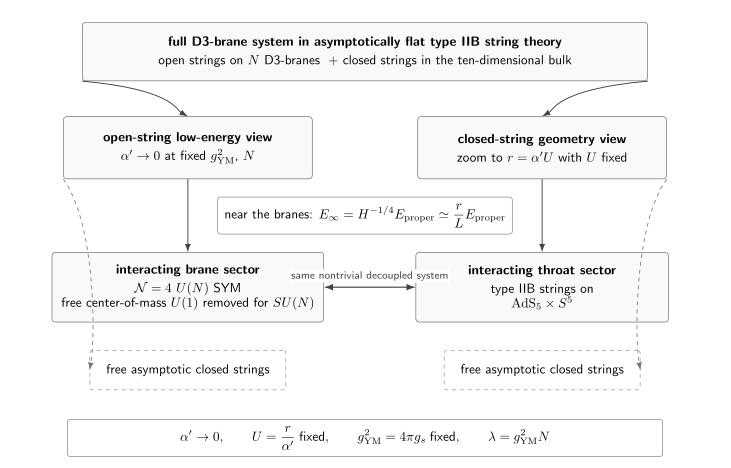
The decoupling limit isolates the interacting low-energy sectors of one D3-brane system. In the open-string description, massive string modes and dynamical bulk gravity decouple, leaving SYM on the branes plus a free flat-space closed-string sector. In the closed-string description, the near-horizon throat remains as type IIB string theory on , while the same free asymptotically flat closed-string sector decouples. Removing this common free factor gives the canonical AdS/CFT statement.
Why this matters
Section titled “Why this matters”The near-horizon metric alone does not yet give AdS/CFT. It only says that a region of the D3-brane supergravity solution looks like . The duality requires a stronger statement: that the physics of this throat can be isolated, and that the isolated throat is equivalent to a non-gravitational quantum field theory.
The decoupling limit is the bridge between these claims.
It answers three questions at once.
First, why does the boundary theory not include ordinary four-dimensional gravity? Because the interactions between the brane degrees of freedom and the asymptotically flat ten-dimensional gravitons vanish in the low-energy limit.
Second, why is the bulk theory not the full asymptotically flat D3-brane spacetime? Because the near-horizon throat separates from the asymptotically flat region and becomes its own spacetime.
Third, why does the full string theory survive in the throat, even though we are taking a low-energy limit? Because the gravitational redshift down the throat keeps finite-energy throat excitations in the low-energy spectrum as measured from infinity. At finite , string-scale local physics in the throat is not thrown away; it becomes string theory on AdS.
That last point is easy to miss. The low-energy limit removes massive string modes from the flat-space open-string description, but it does not say that the AdS throat is automatically classical supergravity. Classical supergravity requires the additional conditions
with quantum and stringy corrections suppressed. The exact decoupled throat theory is type IIB string theory on with units of five-form flux.
The full D3-brane system
Section titled “The full D3-brane system”Start with type IIB string theory in ten-dimensional asymptotically flat spacetime containing coincident D3-branes. The system has several kinds of degrees of freedom.
There are open strings ending on the branes. Their endpoints carry Chan–Paton labels, so for coincident branes their light modes are matrix-valued fields living in the four D3-brane directions.
There are also closed strings moving in the ten-dimensional bulk. Their massless modes include the graviton, dilaton, antisymmetric tensor fields, and Ramond–Ramond fields.
Finally, open and closed strings interact. Open strings can join and split. Closed strings can be emitted by brane excitations. Closed strings can scatter off the branes. The full system is not initially a field theory by itself or a pure throat geometry by itself. It is one coupled string-theoretic system.
The decoupling limit isolates the low-energy physics of this system in two equivalent descriptions.
The open-string low-energy limit
Section titled “The open-string low-energy limit”The open-string description is the most direct from the brane worldvolume point of view.
The string length is
Massive open-string oscillator modes have masses of order
At energies satisfying
only the massless open-string modes remain. Taking
at fixed worldvolume energy makes this separation exact.
For a stack of D3-branes, the surviving open-string modes form the field content of four-dimensional super-Yang–Mills theory:
all in the adjoint representation of .
The gauge coupling is held fixed. In the convention used throughout this course,
so the open-string limit keeps
Equivalently, the ‘t Hooft coupling
is fixed. Later we may take and large, but the decoupling limit itself is not the same thing as the classical gravity limit.
Why bulk gravity decouples on the open-string side
Section titled “Why bulk gravity decouples on the open-string side”The massless closed strings in the asymptotically flat bulk also survive as low-energy particles. Why do they not remain interacting with the D3-brane gauge theory?
The ten-dimensional gravitational coupling scales as
With fixed, taking gives
Thus the asymptotically flat closed-string sector becomes a free ten-dimensional bulk sector. Its interactions with itself vanish, and its interactions with the brane fields are suppressed by powers of the same gravitational coupling. Schematically,
The part of describes the center-of-mass motion of the brane stack and is also free. The interacting worldvolume theory is usually taken to be the sector:
This is why the canonical correspondence is usually written with SYM. The free center-of-mass sector is harmless for most local observables and is omitted from the interacting AdS/CFT dictionary.
The closed-string low-energy limit
Section titled “The closed-string low-energy limit”Now describe the same D3-brane system from the closed-string geometry side.
The extremal D3-brane metric is
with
Using , this becomes
There are two kinds of low-energy closed-string excitations.
The first are ordinary massless closed strings far from the branes in the asymptotically flat region. These become the same free ten-dimensional bulk sector described above.
The second are excitations deep in the D3-brane throat. These remain in the low-energy spectrum because of gravitational redshift. For a static excitation at radius ,
In the near-horizon region,
so
As , finite local energies are redshifted to arbitrarily small energies as measured by the time coordinate at infinity. Therefore the low-energy closed-string limit keeps the near-horizon throat.
This is the closed-string counterpart of the open-string statement that the low-energy brane theory survives.
The correct scaling variable:
Section titled “The correct scaling variable: U=r/α′U=r/\alpha'U=r/α′”The decoupling limit is often written using the variable
This is not a random change of notation. The quantity has dimensions of energy and has a direct open-string interpretation.
Imagine moving one D3-brane a distance away from the stack. An open string stretched between the separated brane and the stack has mass
Thus, up to the conventional factor ,
is the energy scale of a stretched-string excitation, or equivalently a W-boson mass on the Coulomb branch of the worldvolume gauge theory. Keeping fixed means keeping gauge-theory energy scales fixed while the string length goes to zero.
The D3-brane decoupling limit is therefore
In this limit,
so we zoom into the near-horizon region. But we do not merely set . We keep the energy-like variable finite.
The throat metric in the decoupling limit
Section titled “The throat metric in the decoupling limit”Substitute
into the harmonic function:
As at fixed and fixed ,
so
The constant in disappears. This is the precise sense in which the asymptotically flat region is removed from the interacting sector.
Now divide the metric by , which is the natural unit for the string worldsheet sigma model. Since
and
we find
Equivalently, using
up to the same convention for , this becomes the Poincaré form
with
Thus the decoupling limit does not give a small neighborhood of a horizon. It blows up the near-horizon region into a complete AdS throat measured in string units.
Why string theory survives in the throat
Section titled “Why string theory survives in the throat”A possible puzzle is now visible.
On the open-string side, massive open-string oscillators decouple because their masses scale like . Why do stringy excitations not also disappear from the throat?
The answer is that the throat has an infinite redshift. A local string-scale excitation has
At radius
the near-horizon redshift gives
Since
we obtain
This is finite at fixed and fixed . Therefore string-scale local excitations in the throat remain as finite-energy states of the decoupled theory.
This is why the exact statement is not
The exact statement is instead
Classical supergravity appears only after imposing the additional strong-coupling and large- conditions that suppress stringy and quantum corrections.
The flat region separates
Section titled “The flat region separates”On the closed-string side, the low-energy spectrum contains both throat excitations and massless closed strings in the asymptotically flat region. Why do these two sectors decouple from one another?
One way to see the answer is geometric. The extremal D3-brane throat has infinite proper length in the near-horizon limit. Signals traveling between the asymptotically flat region and the deep throat are redshifted, and the low-energy absorption probability of a wave from the flat region into the throat is suppressed by positive powers of the energy.
For example, for low-frequency modes the absorption probability has the schematic form
with the precise power depending on the mode and angular momentum. In the decoupling limit, at fixed asymptotic energy ,
Thus the communication between the flat region and the throat shuts off. The closed-string low-energy limit becomes
The free bulk sector is the same sector that appeared on the open-string side.
Equating the nontrivial sectors
Section titled “Equating the nontrivial sectors”We have now described the same low-energy limit in two languages.
The open-string description gives
The closed-string description gives
Since both limits come from the same original system, and since the free flat-space factor is common, the interacting sectors must be two descriptions of the same physics:
Equivalently, for the interacting nonabelian theory,
This is the canonical AdS/CFT duality.
What is fixed, and what can later be varied?
Section titled “What is fixed, and what can later be varied?”It is useful to separate the decoupling limit from the later approximation limits.
The decoupling limit keeps
fixed while sending . This produces the exact proposed dual pair.
After this, one can choose a regime of the duality.
At fixed and fixed , the bulk description is full type IIB string theory on a curved background with radius
If
then the curvature radius is large in string units, and corrections are suppressed.
If
then bulk quantum loops are suppressed. More precisely, the five-dimensional gravitational coupling satisfies
so classical gravity is the leading term in a expansion.
The familiar classical supergravity regime is therefore
If one also wants weak ten-dimensional string perturbation theory, one asks for
These are not assumptions of the exact duality. They are assumptions that make the bulk easy to compute with.
Why D3-branes are special
Section titled “Why D3-branes are special”The same logic can be applied to D-branes, but D3-branes are special because their worldvolume Yang–Mills coupling is dimensionless.
For D-branes, the Yang–Mills coupling has schematic dimension
Only for is it dimensionless. This is one reason the D3-brane low-energy theory can be conformal, and why the near-horizon geometry is exactly AdS rather than a more general domain-wall-like geometry with a running effective coupling.
For , decoupling limits still exist and are extremely important, but the resulting theories are generally nonconformal. Their gravitational descriptions are not simply AdS spaces in the same way. This course focuses first on the D3-brane case because it gives the cleanest realization of holography.
The UV/IR lesson in the decoupling limit
Section titled “The UV/IR lesson in the decoupling limit”The variable
has the interpretation of an energy scale. Since
large corresponds to small , near the AdS boundary:
Small corresponds to large , deep in the bulk:
Thus the decoupling limit already contains the first version of the holographic UV/IR relation:
and
This statement will become more precise when we introduce holographic renormalization. For now, is the cleanest way to see why the radial coordinate is tied to gauge-theory energy.
The role of the AdS boundary
Section titled “The role of the AdS boundary”Before the decoupling limit, the D3-brane geometry has an ordinary asymptotically flat infinity at .
After the decoupling limit, the isolated throat has an AdS conformal boundary. This boundary is not the same physical region as the original flat-space infinity. It is the upper end of the throat after the zoom.
This point is worth repeating because it prevents a persistent confusion:
The original flat-space modes form a free sector and are discarded from the interacting duality. The CFT is associated with boundary conditions at the conformal boundary of the isolated AdS throat.
This is why the duality is not a statement about a brane sitting inside a larger ten-dimensional laboratory. It is a statement about the autonomous low-energy theory obtained after the decoupling limit.
A compact derivation
Section titled “A compact derivation”The whole argument can be compressed into the following chain.
On the open-string side,
removes massive string modes. At fixed and fixed , the brane worldvolume theory becomes
while ten-dimensional gravity becomes free because
On the closed-string side,
zooms into the D3-brane throat. The metric becomes
which is in string units. The flat-space closed-string sector decouples from the throat.
Therefore,
Dictionary checkpoint
Section titled “Dictionary checkpoint”The decoupling limit gives the following translations.
Common confusions
Section titled “Common confusions”“The decoupling limit is just the near-horizon approximation.”
Section titled ““The decoupling limit is just the near-horizon approximation.””Not quite. The near-horizon approximation is the geometric step , where . The decoupling limit is a physical scaling limit:
It explains why the near-horizon region becomes an autonomous theory and why the asymptotically flat region decouples.
“Since , the bulk cannot contain string theory.”
Section titled ““Since α′→0\alpha'\to0α′→0, the bulk cannot contain string theory.””The flat-space massive string modes decouple at fixed asymptotic energy, but throat string modes are redshifted. At finite , local string excitations in the throat have finite boundary energy. The decoupled bulk theory is type IIB string theory on AdS, not automatically classical supergravity.
“The field theory is dual to the entire D3-brane geometry.”
Section titled ““The field theory is dual to the entire D3-brane geometry.””No. The field theory is dual to the isolated near-horizon throat. The full asymptotically flat D3-brane spacetime contains an extra flat-space sector that decouples in the limit.
“The AdS boundary is where the original branes sit.”
Section titled ““The AdS boundary is where the original branes sit.””No. The branes sit at in the original transverse coordinates, which maps to the Poincaré horizon of the throat. The AdS boundary is the upper end of the isolated throat after the decoupling zoom.
“Large is part of the decoupling limit.”
Section titled ““Large NNN is part of the decoupling limit.””Not necessarily. The decoupling limit defines the exact dual pair. Large is a later approximation that suppresses bulk quantum loops. Large is another later approximation that suppresses stringy curvature corrections.
“The part of is the interesting holographic theory.”
Section titled ““The U(1)U(1)U(1) part of U(N)U(N)U(N) is the interesting holographic theory.””The overall describes the free center-of-mass motion of the brane stack. The interacting holographic theory is the nonabelian sector. This is why the canonical boundary theory is usually written as SYM.
Exercises
Section titled “Exercises”Exercise 1: Massive open strings decouple
Section titled “Exercise 1: Massive open strings decouple”A massive open-string oscillator has
Show that at fixed field-theory energy , such a state decouples as .
Solution
The relevant dimensionless ratio is
At fixed ,
as . Therefore massive open-string oscillators become infinitely heavy relative to the energies kept in the low-energy theory. Only the massless open-string modes remain, giving the worldvolume gauge theory.
Exercise 2: The ten-dimensional gravitational coupling
Section titled “Exercise 2: The ten-dimensional gravitational coupling”Use
and fixed to show that ten-dimensional gravitational interactions vanish in the open-string decoupling limit.
Solution
At fixed ,
Thus
Gravitational interactions in the asymptotically flat bulk are controlled by powers of . Therefore the bulk closed-string sector becomes free and decouples from the brane theory in the low-energy limit.
Exercise 3: Derive the decoupled throat metric
Section titled “Exercise 3: Derive the decoupled throat metric”Start from
where
Set and take at fixed and fixed . Show that
Solution
With ,
As ,
Therefore
Also,
Then
and
Finally,
Combining the three terms gives the desired metric.
Exercise 4: Why has dimensions of energy
Section titled “Exercise 4: Why UUU has dimensions of energy”A string stretched a distance has tension
Show that its mass is proportional to .
Solution
The mass of a stretched string is tension times length:
Using
we get
Thus is an energy scale up to the conventional factor . This is why keeping fixed is natural from the gauge-theory point of view.
Exercise 5: String-scale throat excitations remain finite
Section titled “Exercise 5: String-scale throat excitations remain finite”A local string-scale excitation has
Using
show that remains finite at fixed and .
Solution
Substitute the scalings:
The factors of cancel:
At fixed and fixed , this is finite. Therefore string-scale local excitations in the throat are not removed by the decoupling limit. They become part of type IIB string theory on .
Further reading
Section titled “Further reading”- J. Maldacena, The Large Limit of Superconformal Field Theories and Supergravity.
- O. Aharony, S. S. Gubser, J. Maldacena, H. Ooguri, and Y. Oz, Large Field Theories, String Theory and Gravity.
- J. Polchinski, TASI Lectures on D-Branes.
- J. Polchinski, Introduction to Gauge/Gravity Duality.
- N. Itzhaki, J. Maldacena, J. Sonnenschein, and S. Yankielowicz, Supergravity and the Large Limit of Theories with Sixteen Supercharges.
The next page collects the parameter map of the duality: how , , , , , , and translate between the gauge theory and the bulk.