
Quantum Extremal Surfaces
The RT and HRT formulas are classical gravitational formulas. They compute the leading large- contribution to boundary entanglement entropy:
But the bulk is not exactly classical. Even when the geometry is weakly curved, there are quantum fields in the bulk, and those fields can be entangled across the surface . The classical area term is therefore only the first term in a quantum expansion.
The correct object is the generalized entropy:
A quantum extremal surface is a surface that extremizes , not just area. The quantum-corrected holographic entropy is
This formula is the quantum successor of RT/HRT.
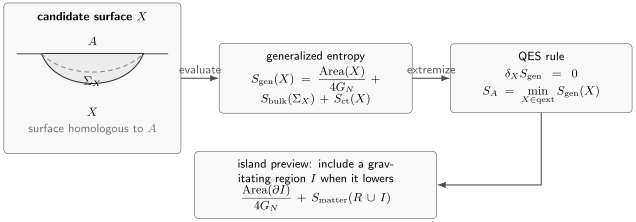
A classical HRT surface extremizes area. A quantum extremal surface extremizes generalized entropy . The surface can shift because bulk quantum fields are entangled across the candidate entanglement wedge .
Why quantum extremal surfaces are needed
Section titled “Why quantum extremal surfaces are needed”Classical RT/HRT is the leading saddle in the bulk semiclassical expansion. In standard large- gauge theory examples,
But the boundary entropy also has subleading pieces of order , , and so on. These corrections come from bulk quantum fields, graviton loops, stringy corrections, and higher-derivative terms in the effective gravitational action.
The most universal correction is bulk entanglement. If the boundary region is dual to a bulk region , then bulk fields inside can be entangled with bulk fields outside . This entropy contributes to the entropy of .
Thus the classical formula
must be replaced by a formula that counts both geometry and bulk quantum information.
The FLM correction
Section titled “The FLM correction”At the first subleading order around a classical RT/HRT surface , the Faulkner–Lewkowycz–Maldacena correction gives
Here is the classical homology region satisfying
The term is the ordinary von Neumann entropy of the bulk effective field theory in that region. This is not a decorative correction. It is required by the fact that the bulk itself is a quantum system.
Why can we evaluate the bulk entropy on the classical surface at this order? Because the classical surface is already extremal. If the true quantum surface shifts by an amount of order , the corresponding change in the area term begins only at the next order. Therefore the first correction is simply the bulk entropy across the classical surface.
Generalized entropy
Section titled “Generalized entropy”For a candidate codimension-two surface anchored on and homologous to , choose a bulk region such that
The generalized entropy is
The local term is important. Bulk entanglement entropy is ultraviolet divergent. Its divergences are local geometric functionals of the surface and are absorbed into the renormalization of Newton’s constant and higher-derivative gravitational couplings.
Thus the finite object is not “bare area plus finite bulk entropy.” It is a renormalized combination:
For Einstein gravity at leading order, the gravitational part is simply . In higher-derivative gravity, the area term is replaced by an appropriate gravitational entropy functional, such as the Wald–Dong functional, plus quantum corrections.
The QES condition
Section titled “The QES condition”A quantum extremal surface satisfies
Equivalently, deformations in either independent normal direction leave the generalized entropy stationary:
For Einstein gravity plus bulk quantum fields, this condition has the schematic form
where is the trace of the extrinsic curvature vector of .
Classically, is absent and the condition reduces to
which is the HRT extremality condition. Quantum mechanically, the surface is pushed by the shape dependence of bulk entanglement.
After finding all relevant quantum extremal surfaces, one chooses the one with smallest generalized entropy:
So the rule is: extremize first, then minimize.
Perturbative displacement of the surface
Section titled “Perturbative displacement of the surface”Let be a small normal displacement away from a classical HRT surface. Suppose
and
Then
The QES condition gives
so
Thus the QES is usually displaced from the classical surface by order . However, near a phase transition between competing surfaces, an order- bulk entropy term can change which surface dominates. This is why quantum effects can be qualitatively important even when the semiclassical expansion is good.
Quantum entanglement wedges
Section titled “Quantum entanglement wedges”Once the surface becomes quantum-corrected, the entanglement wedge must also be updated.
Let be the selected quantum extremal surface. Let be a bulk region satisfying
The quantum entanglement wedge is the bulk domain of dependence of this region:
The subregion dictionary becomes
At leading order, reduces to the classical entanglement wedge. At subleading order, the surface and wedge can shift. In black-hole settings, the shift can be dramatic because a different QES topology can dominate.
Relation to JLMS and the first law
Section titled “Relation to JLMS and the first law”The JLMS relation says, schematically, that within a semiclassical code subspace,
Taking variations gives
This is the variation of generalized entropy:
Thus QES is not an arbitrary embellishment of RT. It is what the modular Hamiltonian and bulk relative-entropy dictionary require once bulk quantum fields are included.
Islands as a preview
Section titled “Islands as a preview”Quantum extremal surfaces are the mechanism behind entanglement islands. In island problems, the region homologous to a boundary or radiation region can include a disconnected gravitational region. The entropy is still computed by extremizing generalized entropy.
A schematic island formula is
This is not a different principle. It is the QES prescription applied to a setup involving a gravitating region and a nongravitating radiation region. The next page will treat islands and black-hole information more carefully.
Dictionary checkpoint
Section titled “Dictionary checkpoint”| Classical entanglement dictionary | Quantum-corrected dictionary |
|---|---|
| RT/HRT surface | quantum extremal surface |
| area functional | generalized entropy |
| classical entanglement wedge | quantum entanglement wedge |
| classical extremality | quantum extremality |
| leading large- entropy | entropy including bulk quantum corrections |
The essential formula is
Common confusions
Section titled “Common confusions”“QES is just the RT surface plus a tiny shift.”
Section titled ““QES is just the RT surface plus a tiny shift.””Often it is perturbatively close to the RT/HRT surface. But when multiple candidate surfaces compete, an order- bulk entropy term can change which surface wins. This is the mechanism behind many quantum phase transitions of entanglement wedges.
“Bulk entropy is separately finite.”
Section titled ““Bulk entropy is separately finite.””No. Bulk entanglement entropy is UV divergent. The finite physical object is the renormalized generalized entropy as a whole.
“Extremize means minimize.”
Section titled ““Extremize means minimize.””No. First find surfaces that extremize . Then choose the one with smallest generalized entropy among the allowed extrema.
“QES is only about islands.”
Section titled ““QES is only about islands.””No. QES is the general quantum correction to holographic entanglement entropy. Islands are one dramatic application.
Exercises
Section titled “Exercises”Exercise 1: Classical limit
Section titled “Exercise 1: Classical limit”Show that the QES condition reduces to the HRT condition when and remains order .
Solution
The QES condition is
Multiplying by gives
If is finite as , the second term vanishes, leaving
This is the HRT extremality condition.
Exercise 2: QES displacement
Section titled “Exercise 2: QES displacement”Using
find the leading displacement .
Solution
Differentiate:
Setting this to zero gives
Exercise 3: Why FLM evaluates bulk entropy on the classical surface
Section titled “Exercise 3: Why FLM evaluates bulk entropy on the classical surface”Explain why the shift of the surface does not affect the entropy at order .
Solution
The displacement is . The area functional has no linear term around the classical extremal surface, so the area change from the displacement is quadratic:
The bulk entropy changes by
Therefore, through order , one evaluates on the classical surface. This is the FLM formula.
Exercise 4: Renormalized generalized entropy
Section titled “Exercise 4: Renormalized generalized entropy”Why is it misleading to say that generalized entropy is “area plus finite bulk entropy”?
Solution
Bulk entanglement entropy across a surface is UV divergent. Its divergences are local on the surface and are absorbed into the renormalization of and higher-curvature couplings. The split into geometric and bulk terms can be scheme-dependent. The finite physical quantity is the renormalized generalized entropy as a whole.
Further reading
Section titled “Further reading”- T. Faulkner, A. Lewkowycz, and J. Maldacena, Quantum corrections to holographic entanglement entropy.
- N. Engelhardt and A. C. Wall, Quantum Extremal Surfaces: Holographic Entanglement Entropy beyond the Classical Regime.
- D. L. Jafferis, A. Lewkowycz, J. Maldacena, and S. J. Suh, Relative entropy equals bulk relative entropy.
- X. Dong, Holographic Entanglement Entropy for General Higher Derivative Gravity.
- A. C. Wall, A proof of the generalized second law for rapidly changing fields and arbitrary horizon slices.