
Holographic Conductivity
Why this matters
Section titled “Why this matters”Conductivity is where the finite-density dictionary becomes a laboratory. A boundary electric field is a source for the conserved current ; the induced current is the response. In holography, this source-response problem becomes a classical boundary-value problem for a bulk gauge-field perturbation.
The basic chain is
This page explains that chain carefully. It also explains a crucial finite-density subtlety: in a translationally invariant system, the electric current overlaps with conserved momentum, so the DC conductivity is infinite unless momentum can relax or one isolates an incoherent part of the current.
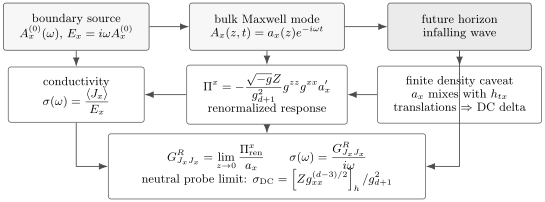
The practical holographic conductivity workflow. The boundary value sources , the radial canonical momentum gives the response, and infalling regularity at the horizon fixes the retarded correlator. At finite density with exact translations, overlaps with momentum, producing a zero-frequency delta function.
Linear response and the Kubo formula
Section titled “Linear response and the Kubo formula”Turn on a weak boundary gauge-field source
In gauge , the boundary electric field is
Linear response says
Ohm’s law is
Therefore
The sign convention depends on Fourier convention. In this course we use , so the formula above is the standard one.
Bulk setup
Section titled “Bulk setup”Take a bulk Maxwell sector
The function is a gauge kinetic coupling. In simple Einstein–Maxwell theory, . In bottom-up models or consistent truncations, can depend on neutral scalar fields and strongly affect transport.
To compute the longitudinally homogeneous optical conductivity, perturb
For a neutral background, or in a probe limit where metric fluctuations can be ignored, the Maxwell equation becomes
The radial canonical momentum conjugate to is
The retarded Green function is obtained by evaluating the renormalized response-to-source ratio at the boundary:
In Fefferman–Graham or coordinates, replace by . The formula is the same idea: canonical momentum divided by boundary value.
Infalling boundary condition
Section titled “Infalling boundary condition”The retarded correlator is selected by an infalling condition at the future horizon. Near a nonextremal horizon, introduce the tortoise coordinate such that outgoing and infalling waves behave as
The retarded prescription chooses the infalling wave:
in a radial coordinate where the horizon is at .
This condition is not a decorative detail. Without it, the same differential equation would compute a different Green function.
Horizon formula in the low-frequency limit
Section titled “Horizon formula in the low-frequency limit”For a diagonal metric
with as functions in this notation, the infalling condition gives near the horizon
Plugging this into the canonical momentum yields the low-frequency membrane expression
This formula applies to the decoupled Maxwell fluctuation. It is often called a membrane-paradigm result: the low-frequency response can be read from horizon data.
For example, in a neutral AdS black brane with , the answer is simply
in appropriate units. In fact, electromagnetic self-duality in four bulk dimensions makes the optical conductivity frequency independent in the simplest Maxwell theory.
Radial flow of conductivity
Section titled “Radial flow of conductivity”It is useful to define a radial conductivity
The Maxwell equation becomes a first-order radial flow equation for . The horizon condition sets the initial value, and the boundary value gives the field-theory conductivity:
In the strict limit and for a decoupled Maxwell mode, the radial flow often becomes trivial, so the horizon value equals the boundary value. At finite frequency, the flow is nontrivial: the conductivity is not determined by the horizon alone.
The finite-density momentum problem
Section titled “The finite-density momentum problem”At finite charge density, the current usually overlaps with momentum . In a translationally invariant system, momentum is conserved. A uniform electric field accelerates the charged fluid forever. Therefore the DC conductivity contains a delta function:
and by Kramers–Kronig,
Here is charge density, is energy density, and is pressure.
This is not an exotic holographic effect. It is ordinary hydrodynamics. If translations are exact and the current carries momentum, the DC conductivity is infinite.
In the bulk, this appears because the gauge perturbation couples to a metric perturbation in charged backgrounds. The coupled system computes the full electric response, including momentum drag.
There are three common ways to get a finite DC conductivity:
- work at zero density, where need not overlap with momentum;
- study a probe sector whose charge does not significantly backreact on the momentum-carrying background;
- break translations explicitly or spontaneously, for example with lattices, axions, disorder, massive gravity, Q-lattices, or brane defects.
The clean translationally invariant finite-density answer is not “a finite number.” It is a distribution with a zero-frequency delta function plus a regular part.
Incoherent conductivity
Section titled “Incoherent conductivity”Even in a translationally invariant finite-density system, one can define a current orthogonal to momentum:
This current does not drag the conserved momentum. Its conductivity is finite and physically meaningful. In holography, the corresponding bulk fluctuation is a gauge-invariant combination of and metric perturbations.
The precise formula depends on the model, but the conceptual point is important:
The membrane paradigm often computes the latter cleanly in the low-frequency limit.
A concrete neutral example: Maxwell in AdS Schwarzschild
Section titled “A concrete neutral example: Maxwell in AdS4_44 Schwarzschild”Consider
For a Maxwell perturbation , the equation is
The canonical momentum is
At the horizon, infalling behavior gives
up to a sign depending on whether the radial coordinate increases toward or away from the horizon. The conductivity is
The fact that this simple answer holds for all in this model is special to four bulk dimensions with constant Maxwell coupling. It is not true in generic backgrounds.
Conductivity and the AdS throat
Section titled “Conductivity and the AdS2_22 throat”In charged near-extremal backgrounds, the low-frequency optical conductivity is often controlled by the AdS throat discussed on the previous page. The logic is the same as for scalar and fermion correlators:
- identify the IR mode in the AdS region;
- compute its IR Green function ;
- match it to the UV region;
- extract the boundary current correlator.
Schematically,
The exponent of the nonanalytic frequency dependence is determined by the AdS dimension of the IR operator that couples to the current. In many simple Einstein–Maxwell systems, the current mixes with metric perturbations, so the actual IR eigenmodes are not just the bare Maxwell fluctuation .
This is why one should be cautious about saying “the conductivity scales like ” without specifying the model and the gauge-invariant perturbation.
Practical computation recipe
Section titled “Practical computation recipe”For a standard optical-conductivity calculation:
- Choose the background. Decide whether it is neutral, charged, probe, backreacted, translationally invariant, or momentum relaxing.
- Choose perturbations. At , start with . In a charged backreacted background, include the coupled metric perturbation and possibly scalar perturbations.
- Build gauge-invariant variables. Remove residual diffeomorphism and gauge redundancy.
- Impose infalling conditions. Near the future horizon, choose the infalling solution.
- Integrate to the boundary. Solve the linear ODE system analytically in limits or numerically in general.
- Read source and response. Expand near the boundary and compute renormalized canonical momenta.
- Apply the Kubo formula. Use .
- Check Ward identities. Especially at finite density, verify momentum-related poles and contact terms.
This is the same GKPW logic as before, now in the real-time linear-response setting.
Dictionary checkpoint
Section titled “Dictionary checkpoint”The core conductivity dictionary is
| Boundary transport object | Bulk object |
|---|---|
| electric field | time-dependent boundary value |
| current response | radial canonical momentum |
| retarded correlator | infalling bulk solution response/source ratio |
| optical conductivity | |
| DC membrane conductivity | horizon data in the low-frequency limit |
| infinite clean finite-density DC conductivity | momentum conservation and gauge-metric mixing |
A useful formula to remember is
A useful warning to remember is
Common confusions
Section titled “Common confusions”“The horizon formula always gives the full conductivity.”
Section titled ““The horizon formula always gives the full conductivity.””No. Horizon data determine certain low-frequency transport coefficients, especially for decoupled modes or carefully chosen incoherent currents. At finite frequency, the radial evolution from the horizon to the boundary matters.
“Finite charge density automatically means finite DC conductivity.”
Section titled ““Finite charge density automatically means finite DC conductivity.””Usually the opposite. If translations are exact and , the electric field accelerates momentum forever, producing an infinite DC conductivity.
“The bulk Maxwell field is the physical photon.”
Section titled ““The bulk Maxwell field is the physical photon.””No. In standard AdS/CFT, the boundary is a global symmetry. The bulk gauge field is dual to the global current. One can weakly gauge the boundary symmetry as an extra operation, but that is not automatic.
“The conductivity is always universal.”
Section titled ““The conductivity is always universal.””No. Some quantities are universal in special two-derivative settings or due to electromagnetic self-duality. Generic frequency-dependent conductivity depends on the full radial geometry and bulk couplings.
“One can ignore metric perturbations at finite density.”
Section titled ““One can ignore metric perturbations at finite density.””Not in a backreacted charged background with exact translations. The Maxwell perturbation generally couples to metric perturbations because electric current carries momentum.
Exercises
Section titled “Exercises”Exercise 1: Derive the Kubo formula
Section titled “Exercise 1: Derive the Kubo formula”Assume
Derive the expression for .
Solution
Ohm’s law gives
Using ,
Therefore
Exercise 2: Horizon membrane conductivity
Section titled “Exercise 2: Horizon membrane conductivity”For a decoupled Maxwell fluctuation in a diagonal metric, use the infalling relation
and
to derive the horizon formula for .
Solution
Substitute the infalling derivative into the canonical momentum:
Using and ,
Thus
Evaluating at the horizon gives
Exercise 3: Why is the clean finite-density DC conductivity infinite?
Section titled “Exercise 3: Why is the clean finite-density DC conductivity infinite?”Use the fact that momentum is conserved and that a finite charge density gives a nonzero overlap between electric current and momentum.
Solution
At finite density, part of the electric current is simply the motion of the charged fluid. In relativistic hydrodynamics,
Thus
If translations are exact, is conserved at zero spatial momentum. A uniform electric field accelerates this conserved momentum and produces a response that does not decay. In frequency space this gives
and therefore a delta function in .
Exercise 4: Conductivity in neutral AdS Maxwell theory
Section titled “Exercise 4: Conductivity in neutral AdS4_44 Maxwell theory”For the neutral AdS black brane, the Maxwell equation is
Show that the near-horizon infalling condition implies at low frequency.
Solution
Near the horizon, infalling behavior gives
up to the sign convention for . The canonical momentum is
Therefore
Depending on the radial orientation convention, the Kubo sign compensates this sign. The magnitude of the conductivity is
In this special four-dimensional bulk Maxwell theory, electromagnetic self-duality extends this low-frequency result to all frequencies.
Further reading
Section titled “Further reading”- D. T. Son and A. O. Starinets, Minkowski-space correlators in AdS/CFT correspondence.
- P. Kovtun, D. T. Son, and A. O. Starinets, Holography and hydrodynamics: diffusion on stretched horizons.
- N. Iqbal and H. Liu, Universality of the hydrodynamic limit in AdS/CFT and the membrane paradigm.
- S. A. Hartnoll, Lectures on holographic methods for condensed matter physics.
- C. P. Herzog, Lectures on Holographic Superfluidity and Superconductivity.
- S. A. Hartnoll and C. P. Herzog, Ohm’s Law at strong coupling: S duality and the cyclotron resonance.