
The Island Formula
Guiding question. How can the fine-grained entropy of a nongravitating radiation region be computed by adding a region inside the gravitating black-hole spacetime?
The previous page set up the clean modern experiment: an evaporating black hole coupled to a nongravitating bath. The radiation region is an ordinary subsystem of that bath, so its von Neumann entropy is a sharply defined quantity,
The island formula says that this entropy is not always computed by the naive matter entropy . In a gravitational fine-grained entropy calculation, one must also allow candidate gravitating regions , called islands, to be included in the entropy region:
The empty island is included among the candidates. At early times it usually dominates, reproducing the Hawking answer. At late times a nonempty island can dominate. The Page curve is then a saddle transition in the generalized entropy.
It is better to write the formula as
For Einstein gravity,
up to the usual counterterms that make the generalized entropy finite. For higher-derivative gravity, the area term is replaced by the appropriate gravitational entropy functional. For two-dimensional dilaton gravity, it is replaced by the dilaton contribution at the island endpoints.
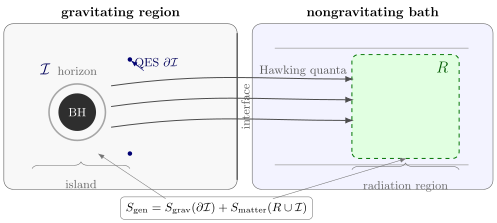
The entropy of a nongravitating radiation region is computed by allowing candidate gravitating regions to be included in the entropy functional. The island boundary contributes a gravitational entropy term, while is the ordinary matter entropy of the union on the semiclassical background.
The island formula is not a local signal-propagation rule. It does not say that Hawking quanta visibly carry classical messages from the interior. It says that the fine-grained entropy of is computed by a gravitational saddle whose entanglement wedge can include a region in the black-hole spacetime.
1. From QESs to islands
Section titled “1. From QESs to islands”The island formula is the quantum extremal surface prescription applied to Hawking radiation.
For a usual holographic boundary region , the quantum-corrected entropy is computed by
where is a quantum extremal surface and is the bulk region between and . This is the quantum upgrade of RT/HRT: one extremizes generalized entropy rather than area alone.
In an evaporating black-hole setup, is not a subregion of the original gravitating boundary theory. It lives in a nongravitating bath. But is entangled with a gravitational system, and computing its fine-grained entropy requires the gravitational entropy prescription. The corresponding QES may enclose a disconnected region in the gravitating spacetime. That region is the island.
Thus islands are not a separate postulate unrelated to holographic entropy. They are what QESs become when the entropy region is the Hawking radiation.
2. The ingredients of the formula
Section titled “2. The ingredients of the formula”The compact expression
contains several distinct ingredients.
The radiation region
Section titled “The radiation region RRR”The region is chosen in the nongravitating bath. It may be a half-line, a finite interval, a pair of bath regions in a two-sided setup, or an auxiliary memory that stores emitted quanta. Since is nongravitating, its reduced density matrix is an ordinary quantum-mechanical object.
The candidate island
Section titled “The candidate island I\mathcal II”The island is a region in the gravitating spacetime. It is not chosen arbitrarily. It must arise from a quantum extremal surface and satisfy the appropriate homology or Cauchy-slice condition with .
The island boundary
Section titled “The island boundary ∂I\partial \mathcal I∂I”In bulk dimensions, is codimension two. In two-dimensional gravity it consists of points. This boundary contributes the gravitational entropy term.
The matter entropy
Section titled “The matter entropy Smatter(R∪I)S_{\rm matter}(R\cup\mathcal I)Smatter(R∪I)”This is the entropy of the union of the bath region and the island in the effective matter theory. It is not the sum , because and can be highly correlated.
The counterterms
Section titled “The counterterms”The matter entropy is UV divergent near the island boundary. These divergences are absorbed into the renormalization of gravitational couplings. The finite object is the generalized entropy,
In many formulas the counterterms are suppressed, but the renormalized interpretation is essential.
3. Extremize first, then minimize
Section titled “3. Extremize first, then minimize”The notation is shorthand for a two-step prescription.
First, impose quantum extremality:
For Einstein gravity this is
The geometric variation of the area is balanced by the quantum variation of the matter entropy. In two-dimensional dilaton gravity, this becomes a balance between the dilaton gradient and the endpoint dependence of the matter entropy.
Second, compare all allowed extrema and choose the smallest generalized entropy. The no-island saddle is one of the allowed candidates.
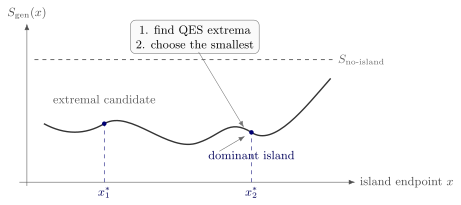
The island prescription is not “choose any region that lowers the entropy.” One first finds stationary points of under variations of the island boundary. The physical entropy is the smallest generalized entropy among the no-island saddle and all quantum-extremal island saddles.
This order is crucial. A region that lowers the entropy but is not extremal is not an allowed saddle. Conversely, an island saddle may be perfectly valid but fail to dominate.
4. The no-island saddle
Section titled “4. The no-island saddle”The empty island gives
This is the semiclassical Hawking answer. In the pair-creation cartoon, outgoing Hawking modes in are entangled with interior partners that are not in . As more radiation is collected, the matter entropy of grows.
For an evaporating black hole that begins in a pure state, this monotonically growing answer cannot remain the final fine-grained entropy forever. If the black hole evaporates completely and the microscopic evolution is unitary, the complete radiation should purify. The no-island saddle is therefore expected to be correct before the Page time but not after it.
A useful schematic notation is
where is the entropy obtained by tracing over interior partners in the semiclassical geometry.
5. The island saddle
Section titled “5. The island saddle”A nonempty island saddle gives
where satisfies the QES equation. The location of is model-dependent; in many evaporating black-hole examples it is near the horizon in a suitable semiclassical description. The invariant statement is that the island is included in the entanglement wedge of the radiation.
The island can reduce the entropy because the matter entropy is now computed for , not for alone. In the Hawking-pair cartoon, many interior partners of radiation modes are now included in the same entropy region as the outgoing modes. Entanglement that previously crossed the boundary of can become internal to .
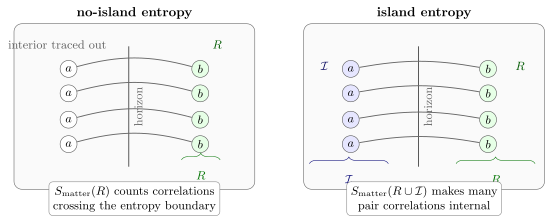
Without an island, the radiation modes in are entangled with interior partners outside the entropy region. With an island, many of those partners lie inside , so the entropy of can be much smaller than the entropy of alone. This is fine-grained entropy bookkeeping, not a local signal from the island to the bath.
The price is the gravitational entropy of the island boundary. For an island boundary near a black-hole horizon, this cost is of order the black-hole entropy. The island answer is therefore roughly bounded by the remaining black-hole generalized entropy, as expected from a unitary Page curve.
6. The Page transition as a saddle switch
Section titled “6. The Page transition as a saddle switch”The island formula turns the Page curve into a semiclassical saddle transition.
At early times, the radiation entropy is small and the no-island saddle dominates:
At late times, the no-island entropy has grown large, and the island saddle becomes dominant:
The transition time is determined approximately by
The physical entropy is the lower envelope,
The ellipsis matters: more complicated geometries can have multiple islands and multiple QES saddles.
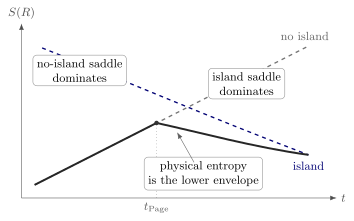
The no-island saddle reproduces the growing Hawking entropy. The island saddle carries an area cost but avoids counting many interior-partner correlations across the entropy boundary. The physical entropy is the lower envelope of the generalized-entropy saddles, producing a Page curve.
This picture also explains why the Page transition is not a violent local event at the horizon. It is a change in the dominant saddle for a nonlocal fine-grained entropy.
7. A toy entropy model
Section titled “7. A toy entropy model”A two-saddle toy model captures the logic. Suppose
while the island saddle is approximately
where denotes finite matter terms and model-dependent offsets. Then
The Page time is
This is not a precise evaporation law. Real fluxes, greybody factors, backreaction, and matter entropies are more complicated. The toy model isolates the structural idea: the no-island answer grows with emitted radiation, while the island answer is controlled by the remaining generalized entropy of the black hole.
8. Why the matter entropy is essential
Section titled “8. Why the matter entropy is essential”The matter entropy is not a decorative correction. It determines both the QES location and the dominance of a saddle.
The extremality equation is schematically
In evaporating black holes, the matter entropy can have large gradients because the radiation has accumulated over a long time and because near-horizon boosts relate late outgoing modes to early interior partners. These large entropy gradients can produce QESs that are not small perturbations of classical extremal surfaces.
The matter entropy also controls whether an island is useful. If contains very little radiation, including an island may not reduce the union entropy enough to compensate for the area cost. If contains radiation after the Page time, the mutual information between and a candidate island can be large, and the island saddle can dominate.
9. The entanglement wedge of radiation
Section titled “9. The entanglement wedge of radiation”When the island saddle dominates, the radiation entanglement wedge contains the island:
In schematic lower-dimensional drawings one writes
but the meaning is not ordinary spatial inclusion. The bath region is nongravitating; is a region in the gravitating spacetime. The statement is that the degrees of freedom in are encoded in the radiation in the entanglement-wedge-reconstruction sense.
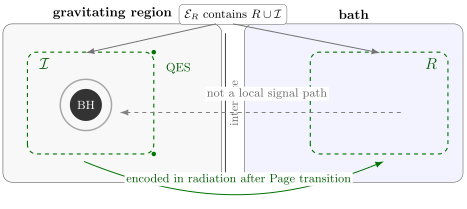
After the Page transition, the dominant radiation entanglement wedge includes the island. Island operators can then have representations on the radiation degrees of freedom in the quantum-error-correcting sense of entanglement wedge reconstruction. This is not a statement about a local causal path from the island to the bath.
This interpretation imports the caveats of the reconstruction module. The reconstruction can be nonlocal, code-subspace dependent, and computationally difficult. The island formula is an information-theoretic statement about entropy and encoding, not a simple decoding algorithm.
10. The island is not literally part of
Section titled “10. The island is not literally part of RRR”The formula includes , but this should not be misread as saying that is an ordinary subset of the bath. It is not.
The correct statement is
not
The first is an entanglement-wedge statement. The second would be an ordinary spatial statement. Confusing them leads to many misleading slogans, such as “the interior has moved into the radiation.” The interior has not moved. Rather, the fine-grained entropy and reconstruction map know that the radiation encodes an island.
11. Homology and complementarity
Section titled “11. Homology and complementarity”The island prescription has a homology-like constraint. The region and the QES boundary must bound the appropriate bulk domain on a Cauchy slice of the semiclassical geometry. This prevents arbitrary disconnected regions from being inserted by hand.
For a closed total system in a pure state, one also expects
The gravitational entropy prescriptions for and its complement must be compatible with this equality. In Page-curve setups, the island for appears when has become large enough that its complement is more economically described by the remaining black-hole degrees of freedom. This is the gravitational version of the ordinary Page-theorem intuition: the entropy of a subsystem is controlled by the smaller effective side of the purification.
But the island formula is not merely Page’s theorem in words. The nontrivial content is that semiclassical gravity supplies a concrete generalized-entropy saddle that computes the fine-grained entropy.
12. Replica wormholes in one paragraph
Section titled “12. Replica wormholes in one paragraph”The later replica-wormhole page will derive the formula more systematically, but the slogan is simple. To compute one computes Rényi entropies,
and analytically continues . In gravity, the replicated path integral includes saddles in which the replicas are connected through the gravitating region. These are replica wormholes.
In the limit, the fixed locus of the replica symmetry becomes the QES boundary , and the replica derivation produces the island formula. Thus islands are not a phenomenological patch added to Hawking’s calculation; they are the expression of new gravitational replica saddles.
13. How the formula avoids the small-corrections problem
Section titled “13. How the formula avoids the small-corrections problem”A small local correction to every Hawking pair is not enough to produce a Page curve. If each outgoing mode remains almost maximally entangled with an interior partner, the radiation entropy keeps growing.
The island formula is not such a small pairwise correction. It changes the dominant fine-grained entropy saddle. Before the Page time, the entropy boundary cuts the Hawking pairs in the usual way. After the Page time, the entropy region includes an island containing many interior partners, so the global entropy bookkeeping changes by an amount of order the black-hole entropy.
This is why the island correction can be large for while local effective field theory near the horizon remains a good approximation in suitable regimes. Fine-grained entropy is a nonlocal observable, and gravitational path integrals can change its answer nonperturbatively.
14. What the formula does and does not establish
Section titled “14. What the formula does and does not establish”The island formula does provide a controlled semiclassical method for computing Page curves in important models of evaporating black holes.
It does connect the Page curve to the same generalized-entropy, QES, and entanglement-wedge technology used throughout holography.
It does imply that after the Page transition, some interior or near-horizon degrees of freedom are encoded in the radiation in the sense of entanglement wedge reconstruction.
But it does not by itself give a simple microscopic decoding algorithm. It does not say that information is locally visible in the radiation. It does not eliminate all questions about factorization, ensemble averaging, the microscopic meaning of replica wormholes, or realistic asymptotically flat evaporation.
The right lesson is balanced: islands are a major advance because they make the Page curve calculable in semiclassical gravity. They are not the end of every black-hole-information question.
15. Common pitfalls
Section titled “15. Common pitfalls”Pitfall 1: “The island is where the radiation physically travels.”
No. The island is included in the entropy wedge of the radiation. This is an encoding statement, not a local propagation statement.
Pitfall 2: “The island formula says is just the smaller of and the black-hole area.”
Only in rough cartoons. The actual prescription requires , quantum extremization, homology, and minimization over saddles.
Pitfall 3: “Any region that lowers the entropy is an island.”
No. A valid island must arise from a quantum extremal surface satisfying .
Pitfall 4: “The island is always deep behind the horizon.”
The coordinate location is model-dependent. The invariant statement is entanglement-wedge inclusion.
Pitfall 5: “The formula violates causality.”
It does not. Entanglement wedge reconstruction is nonlocal quantum encoding, not superluminal signaling.
Pitfall 6: “The Page transition is a dramatic event experienced by an infalling observer.”
The Page transition is a change in the dominant entropy saddle for a fine-grained observable. It need not be a local shock at the horizon.
Exercises
Section titled “Exercises”Exercise 1. The lower envelope
Section titled “Exercise 1. The lower envelope”Consider two candidate entropies
with , , and . Compute the Page time and the physical entropy in the two-saddle approximation.
Solution
The transition occurs when
Thus
The physical entropy is the lower envelope:
The cusp is an artifact of the strict semiclassical saddle approximation. Finite- or finite- effects are expected to smooth the transition.
Exercise 2. Extremization versus minimization
Section titled “Exercise 2. Extremization versus minimization”Suppose a one-parameter candidate island endpoint has generalized entropy
with . Find the quantum extremal endpoint. Under what condition does this island beat a no-island entropy ?
Solution
Extremization gives
Therefore
At the extremum,
The island dominates if
The point is the two-step logic: first find a stationary point, then compare its generalized entropy with the no-island saddle.
Exercise 3. Entropy of a union
Section titled “Exercise 3. Entropy of a union”Why does the island formula contain rather than ?
Solution
Entropy is not additive for correlated regions. In general,
where
is the mutual information. The island mechanism relies on large correlations between the radiation and the island. Replacing the union entropy by a sum would erase precisely the correlations that lower the entropy after the Page time.
Exercise 4. A JT gravity endpoint equation
Section titled “Exercise 4. A JT gravity endpoint equation”In a JT model, suppose an island has one endpoint and generalized entropy
Write the QES condition.
Solution
The endpoint is quantum extremal when
Therefore
The dilaton gradient plays the role of the geometric area variation, while the second term is the response of the matter entropy to moving the island endpoint.
Exercise 5. Why the island formula is not a local correction to Hawking pairs
Section titled “Exercise 5. Why the island formula is not a local correction to Hawking pairs”Explain how adding an island can change by without requiring an order-one local modification of each Hawking pair near the horizon.
Solution
The entropy of the radiation is a nonlocal fine-grained observable. In the no-island saddle, the entropy region contains the outgoing modes but not their interior partners, so many pair correlations cross the entropy boundary. In the island saddle, many of those interior partners are included in , so they are part of the same entropy region as the outgoing radiation. Those correlations become internal to and no longer contribute to the entropy.
Thus the large change in comes from a different gravitational entropy saddle, not from a large local change in the short-distance state near the horizon.
Exercise 6. Valid islands
Section titled “Exercise 6. Valid islands”Why is it not enough to choose an arbitrary disconnected region behind the horizon and call it an island? State two necessary conditions for a valid island saddle.
Solution
First, the island boundary must satisfy the QES equation,
Second, the island must satisfy the appropriate homology or Cauchy-slice condition with the radiation region . It must arise as part of a legitimate entropy saddle, not as an arbitrary inserted region.
Finally, even a valid island saddle contributes to the physical entropy only if its generalized entropy is smaller than the other allowed saddles, including the no-island saddle.
Further reading
Section titled “Further reading”- Geoffrey Penington, Entanglement Wedge Reconstruction and the Information Paradox.
- Ahmed Almheiri, Netta Engelhardt, Donald Marolf, and Henry Maxfield, The Entropy of Bulk Quantum Fields and the Entanglement Wedge of an Evaporating Black Hole.
- Ahmed Almheiri, Thomas Hartman, Juan Maldacena, Edgar Shaghoulian, and Amirhossein Tajdini, The Entropy of Hawking Radiation.
- Netta Engelhardt and Aron C. Wall, Quantum Extremal Surfaces: Holographic Entanglement Entropy beyond the Classical Regime.
- Ahmed Almheiri, Raghu Mahajan, Juan Maldacena, and Ying Zhao, The Page Curve of Hawking Radiation from Semiclassical Geometry.