
Black Holes and Black Branes
Black holes are not a decorative complication in AdS/CFT. They are the way thermal many-body physics appears geometrically.
In ordinary quantum field theory, a thermal state is described by a density matrix
In holography, the same thermal state is often described by a bulk saddle with a horizon. The horizon temperature is the field-theory temperature, and the horizon area is the field-theory entropy:
This is one of the first places where the duality stops sounding like a slogan. A strongly coupled thermal plasma, with many interacting quantum degrees of freedom, becomes a classical spacetime with a horizon.
This page introduces two geometries that appear constantly in AdS/CFT:
- global AdS black holes, dual to thermal states of a CFT on ;
- planar AdS black branes, dual to homogeneous thermal states of a CFT on .
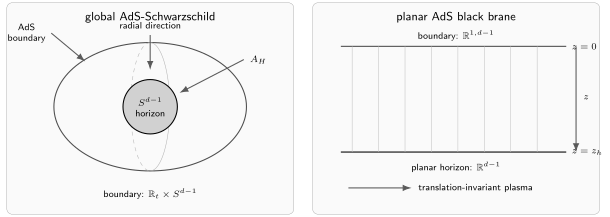
Global AdS black holes and planar AdS black branes are thermal bulk saddles with different boundary frames. Spherical horizons describe thermal CFTs on , while planar horizons describe thermal plasmas on . Horizon data become boundary thermodynamic data.
Why horizons are natural in holography
Section titled “Why horizons are natural in holography”A finite-temperature CFT state has entropy. In a large- holographic theory, the thermal entropy is typically of order for adjoint gauge theories:
On the gravity side, the quantity of order is the inverse Newton constant in AdS units:
Therefore a classical area law
has precisely the right large- scaling to describe a deconfined plasma of many boundary degrees of freedom.
This is not merely dimensional analysis. A black brane has a regular horizon, a Hawking temperature, a free energy, and hydrodynamic perturbations. These map to the temperature, thermodynamic potential, and transport behavior of the boundary theory. Later, quasinormal modes of the horizon will become poles of retarded Green’s functions.
For now, keep the following translation in mind:
Einstein gravity with negative cosmological constant
Section titled “Einstein gravity with negative cosmological constant”In this unit we work in classical Einstein gravity with negative cosmological constant. The bulk action is schematically
The vacuum Einstein equation is
Pure AdS is one solution. Black holes and black branes are other solutions with the same asymptotic AdS boundary behavior. They differ in the interior: instead of a smooth center or a zero-temperature Poincaré horizon, they contain an event horizon at finite radial position.
A useful family of static black solutions is
where
Here is the metric on a -dimensional space of constant curvature :
The spherical and planar cases are the essential ones for this foundations course. The horizon radius is the largest positive root of
Equivalently,
Temperature from the horizon
Section titled “Temperature from the horizon”Near a nonextremal horizon, the metric looks like Rindler space. This gives a universal formula for the Hawking temperature.
For a static metric of the form
with a simple zero at , the temperature is
For the family above,
Using
we obtain
This single formula teaches a lot. For planar horizons, , so
For spherical horizons, , so
Small spherical black holes behave roughly like asymptotically flat Schwarzschild black holes, with . Large AdS black holes behave differently, with . This difference is one reason large AdS black holes can be thermodynamically stable.
Entropy from area
Section titled “Entropy from area”The Bekenstein–Hawking entropy is
For
the horizon area is
where
Thus
For a planar horizon, is infinite, so the useful quantity is entropy density. In the common coordinate convention below, it is
Because , this gives
as required by conformal invariance in boundary spacetime dimensions.
The planar black brane in Poincaré coordinates
Section titled “The planar black brane in Poincaré coordinates”For many holographic computations, the most convenient thermal geometry is the planar black brane:
with
The boundary is at . The horizon is at
The Hawking temperature is
The entropy density is
This is the workhorse geometry for strongly coupled thermal plasmas. It is homogeneous and isotropic along the boundary spatial directions , so it is dual to a translation-invariant thermal state of a CFT on flat space.
Near the boundary,
so the boundary conformal frame is flat Minkowski space:
The blackening factor only becomes important in the interior. This is exactly what one expects from the UV/IR relation: the near-boundary ultraviolet region knows about the spacetime where the CFT lives, while the deeper bulk knows about the state.
Thermodynamics of the planar brane
Section titled “Thermodynamics of the planar brane”A CFT on flat space has no intrinsic scale. At temperature , dimensional analysis gives
Conformal invariance also implies a traceless stress tensor:
For a homogeneous thermal state,
so tracelessness gives
Therefore
The planar black brane reproduces this structure. In the standard Einstein-gravity normalization, holographic renormalization gives
The entropy density follows from thermodynamics:
Using
one recovers
So the same quantity is computed in two ways:
This is the first concrete black-hole lesson of AdS/CFT.
The AdS black brane and strongly coupled SYM
Section titled “The AdS5_55 black brane and strongly coupled N=4\mathcal N=4N=4 SYM”For the canonical AdS/CFT example, the planar black brane is a five-dimensional geometry:
The temperature is
Using the AdS parameter map,
so the entropy density of strongly coupled large- SYM is
The counts adjoint degrees of freedom. The follows from conformal invariance in four spacetime dimensions. The numerical coefficient is genuine strong-coupling information.
Global AdS black holes
Section titled “Global AdS black holes”The global Schwarzschild-AdS metric is
with
Its conformal boundary is
Thus global AdS black holes are dual to thermal CFT states on a spatial sphere. This is different from the planar brane, which is dual to the CFT on flat space.
The horizon radius is determined by
so
The temperature is
This function has a minimum. Differentiating gives
The minimum occurs at
with
For , there are two black-hole branches:
- a small black hole with ;
- a large black hole with .
The small branch has negative specific heat. The large branch has positive specific heat. The positive specific heat of large AdS black holes is one of the qualitative differences between AdS and asymptotically flat space.
Why large AdS black holes can be stable
Section titled “Why large AdS black holes can be stable”In asymptotically flat spacetime, a Schwarzschild black hole has
As it loses energy, it gets hotter, so its heat capacity is negative. This makes equilibrium with a heat bath unstable.
In AdS, large black holes instead have
As the black hole gains energy and grows, it gets hotter. This positive heat capacity makes large AdS black holes stable in the canonical ensemble.
A useful intuition is that AdS behaves like a gravitational box. The conformal boundary reflects excitations back into the bulk, and large black holes can equilibrate with their surroundings. This “box” picture is not a substitute for boundary conditions, but it is a good first guide.
Hawking–Page transition: the first phase transition
Section titled “Hawking–Page transition: the first phase transition”Global AdS has another saddle with the same boundary topology: thermal AdS. It is simply Euclidean global AdS with periodically identified Euclidean time. It has no horizon.
At low temperature, the dominant saddle is thermal AdS. At sufficiently high temperature, the dominant saddle is a large AdS black hole. The transition between them is the Hawking–Page transition.
For the spherical Schwarzschild-AdS black hole, the free energy is proportional to
Thus the free energy changes sign at
The transition temperature is therefore
In AdS/CFT, this becomes a phase transition of the boundary theory on . In large- gauge theories, it is often interpreted as a confinement/deconfinement-type transition:
The phrase “confinement/deconfinement” should be used with care for a conformal theory on a compact sphere. The more robust statement is about the scaling of the free energy with :
The black-hole phase has order entropy, exactly as expected for a deconfined adjoint plasma.
Planar branes as the large black-hole limit
Section titled “Planar branes as the large black-hole limit”The planar black brane can be obtained as a local large-radius limit of a large spherical AdS black hole. For a large global black hole,
A small patch of the horizon looks approximately flat. In that patch, the sphere is approximated by , and the spherical black hole becomes a planar black brane.
This is why the two metrics have similar high-temperature thermodynamics. For a large global black hole,
For the planar brane,
The planar brane is therefore the natural description of the thermodynamic limit of the boundary CFT.
Horizon versus boundary
Section titled “Horizon versus boundary”A common beginner confusion is to imagine that the CFT “lives on the horizon.” It does not.
The CFT lives on the conformal boundary. In the planar black brane metric,
is the boundary, while
is the horizon.
The horizon is part of the bulk interior. Its area computes the entropy of the boundary state, but the boundary degrees of freedom are not literally located on the horizon in the same geometric sense that a field lives on a spacetime manifold.
A better statement is
This distinction matters later. Boundary observables are defined by asymptotic behavior near the conformal boundary, while real-time dissipative physics is controlled by conditions at the horizon.
Euclidean preview
Section titled “Euclidean preview”The next page will discuss Euclidean AdS and thermal circles more systematically, but the essential idea is already visible.
Near a nonextremal horizon, the Euclidean metric takes the approximate form
where is the surface gravity. This is polar-coordinate flat space if and only if
Therefore the inverse temperature is
For metrics of the form
the surface gravity is
so
This is the geometric origin of the temperature formulas used above.
Dictionary checkpoint
Section titled “Dictionary checkpoint”The black-hole dictionary introduced on this page is:
| Boundary quantity | Bulk quantity |
|---|---|
| thermal density matrix | black-hole or black-brane saddle |
| temperature | Hawking temperature of the horizon |
| entropy or entropy density | horizon area divided by |
| CFT on | global AdS black hole |
| CFT on | planar AdS black brane |
| high-temperature deconfined phase on | large AdS black hole |
| thermal response and dissipation | horizon boundary conditions |
The important conceptual shift is that state data in the boundary theory become interior geometry in the bulk.
Common confusions
Section titled “Common confusions”“A black brane is just a black hole with a funny name.”
Section titled ““A black brane is just a black hole with a funny name.””A black brane has a horizon extended along noncompact spatial directions. Its horizon topology is planar, usually . A global AdS black hole has a compact spherical horizon, . The difference matters because the boundary theories live in different conformal frames: flat space versus the cylinder.
“The CFT lives on the horizon.”
Section titled ““The CFT lives on the horizon.””No. The CFT lives on the conformal boundary. The horizon is a bulk feature that encodes thermal entropy and dissipative dynamics of the boundary state.
“All AdS black holes are thermodynamically stable.”
Section titled ““All AdS black holes are thermodynamically stable.””No. Small spherical AdS black holes have negative specific heat. Large spherical AdS black holes and planar black branes are thermodynamically stable in the standard canonical setting.
“The planar black brane has a Hawking–Page transition.”
Section titled ““The planar black brane has a Hawking–Page transition.””Not in the same way as the global spherical black hole. The Hawking–Page transition relies on comparing thermal AdS and a spherical black hole with boundary . For the planar boundary , conformal invariance and infinite volume lead to a different thermodynamic structure.
“The horizon is visible in the UV of the CFT.”
Section titled ““The horizon is visible in the UV of the CFT.””The horizon is deep in the bulk, so it is more naturally tied to infrared and thermal physics. Boundary UV data are controlled by the near-boundary expansion. This separation is not absolute, but it is a good first guide.
Exercises
Section titled “Exercises”Exercise 1: Temperature of the planar black brane
Section titled “Exercise 1: Temperature of the planar black brane”Consider
Show that the temperature is
Solution
For a metric of the form
with a simple zero of at , Euclidean smoothness gives
Here
so
At the horizon,
Therefore
Exercise 2: Conformal scaling of entropy density
Section titled “Exercise 2: Conformal scaling of entropy density”Using
and
show that the entropy density scales as .
Solution
From the temperature relation,
Substitution gives
Thus
This is exactly what dimensional analysis predicts for a conformal field theory in spacetime dimensions.
Exercise 3: Minimum temperature of a spherical AdS black hole
Section titled “Exercise 3: Minimum temperature of a spherical AdS black hole”For a global Schwarzschild-AdS black hole,
Find the radius where is minimized.
Solution
Differentiate:
Setting this to zero gives
Therefore
The minimum temperature is
Exercise 4: Hawking–Page temperature
Section titled “Exercise 4: Hawking–Page temperature”Assume the free energy of a spherical AdS black hole is proportional to
Use the temperature formula to show that the free energy changes sign at
Solution
The free energy changes sign when
Thus . Substituting into
gives
Exercise 5: Traceless stress tensor and equation of state
Section titled “Exercise 5: Traceless stress tensor and equation of state”A homogeneous thermal CFT has
Use tracelessness to show that
Solution
For a CFT in flat space with no anomaly,
Taking the trace gives
Therefore
This is the conformal equation of state. The planar black brane reproduces it holographically.
Further reading
Section titled “Further reading”- S. W. Hawking and D. N. Page, Thermodynamics of Black Holes in Anti-de Sitter Space.
- E. Witten, Anti de Sitter Space, Thermal Phase Transition, and Confinement in Gauge Theories.
- O. Aharony, S. S. Gubser, J. Maldacena, H. Ooguri, and Y. Oz, Large Field Theories, String Theory and Gravity.
- S. A. Hartnoll, A. Lucas, and S. Sachdev, Holographic Quantum Matter, especially the thermal black-brane setup.