
Entanglement, Chaos, and Diffusion
Transport coefficients are not the only way to recognize a strongly coupled state. A metal without quasiparticles can have a perfectly ordinary-looking DC conductivity once momentum relaxation has been added. A quantum critical fluid can have hydrodynamic poles even though it has no particle-like excitations. A finite-density state can look metallic in thermodynamics while hiding most of its charge behind a horizon.
So we need diagnostics that ask different questions. Entanglement asks how the wavefunction is organized across space. Chaos asks how quickly local operators grow into complicated many-body operators. Diffusion asks how conserved densities relax after local equilibration has already happened.
The three questions are related, but not identical:
In holography these quantities are all controlled by the same bulk geometry. Entanglement is computed by extremal surfaces, chaos by near-horizon shock waves, and diffusion by long-wavelength bulk perturbations. That common geometric origin is why relations such as are often powerful. It is also why the relations are easy to overstate: the same horizon is not the same as the same observable.
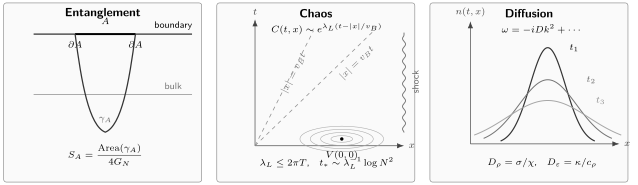
Three complementary diagnostics of holographic quantum matter. Entanglement probes extremal surfaces , chaos probes the butterfly cone and near-horizon shock waves, and diffusion probes hydrodynamic poles . In simple strongly coupled phases these diagnostics are often parametrically linked, but no single one determines the others in full generality.
The diagnostic triangle
Section titled “The diagnostic triangle”The most useful way to organize this page is as a triangle.
The entanglement corner is nonlocal and fine-grained. It is sensitive to the structure of the state, not just to low-frequency transport. In a holographic theory, the leading large- entanglement entropy of a spatial region is geometric:
Here is the Ryu—Takayanagi surface in a time-reflection-symmetric state, or the Hubeny—Rangamani—Takayanagi extremal surface in a time-dependent state. The homology constraint is not decorative: it is what distinguishes fine-grained entropy from a random area functional.
The chaos corner is dynamical but not hydrodynamic. It asks how a simple perturbation spreads through the operator algebra. The basic observable is an out-of-time-order correlator, or equivalently a squared commutator. In a large- chaotic theory one often finds a regime
valid before the scrambling time. The Lyapunov exponent measures growth in time, while the butterfly velocity measures spread in space.
The diffusion corner is hydrodynamic. It is controlled by conservation laws and constitutive relations. A conserved density with current obeys
which gives the pole
Diffusion is late-time physics. Chaos is earlier-time operator growth. Entanglement can be static or time-dependent, and can probe scales that transport never sees. Holography is valuable because it gives one framework in which all three can be computed in controlled large- states without quasiparticles.
Entanglement entropy as a many-body diagnostic
Section titled “Entanglement entropy as a many-body diagnostic”Take a quantum state and divide space into a region and its complement . The reduced density matrix is
and the entanglement entropy is
For a pure state,
For a mixed state this equality need not hold. This is one reason entanglement entropy is more subtle than a local expectation value: it knows about the global state, the bipartition, and the distinction between fine-grained and coarse-grained entropy.
In a holographic theory with a classical Einstein gravity dual, the leading answer is
Here is the number of boundary spatial dimensions, so the bulk has dimension . The extremal surface is codimension two in the bulk and ends on the entangling surface :
The quantum-corrected statement is schematically
where is the bulk entanglement wedge region bounded by and . The first term scales like in a matrix large- theory; the bulk entropy term is subleading at large .
UV area law and thermal volume law
Section titled “UV area law and thermal volume law”For a local QFT, the leading divergence comes from short-distance entanglement near :
The UV cutoff is not a holographic artifact; ordinary local QFT has the same area-law divergence. In the bulk, this divergence comes from the near-boundary part of .
At nonzero temperature, a large enough region also has an IR contribution from the horizon. For a black brane dual to a thermal state,
The second term is the thermal entropy density times the volume of the region. Geometrically, the extremal surface drops toward the horizon and then runs close to it. This is a clean example of UV/IR separation: the boundary divergence comes from the asymptotic AdS region, while the thermal entropy comes from the black hole interior region accessible to the extremal surface.
This statement should not be misread. A horizon area is a coarse-grained entropy of the thermal state. The fine-grained entropy of a complete pure state is still zero. In time-dependent collapse geometries, the homology constraint and the global extremization prescription are essential for keeping this distinction straight.
Hyperscaling violation and hidden Fermi-surface diagnostics
Section titled “Hyperscaling violation and hidden Fermi-surface diagnostics”Entanglement becomes especially sharp in compressible phases. In a scaling regime with dynamical exponent and hyperscaling-violation exponent , the thermal entropy density scales as
This motivates the effective spatial dimension
The same effective dimension appears in extremal-surface calculations. For a region of characteristic size , the IR part of the finite entanglement entropy behaves schematically as
The middle case is the famous logarithmic violation of the area law. A conventional Fermi surface in spatial dimensions also gives an area law multiplied by a logarithm. Thus
is often interpreted as a holographic signature of Fermi-surface-like entanglement, possibly from hidden or fractionalized fermionic degrees of freedom.
The word “signature” matters. A logarithmic violation is suggestive, not a proof. Conversely, some semi-local phases have low-energy spectral weight at nonzero momentum but do not show the same logarithmic entanglement violation. Entanglement and spectral functions are complementary diagnostics, not interchangeable ones.
Mutual information and entanglement plateaux
Section titled “Mutual information and entanglement plateaux”The mutual information between two disjoint regions is
Unlike itself, is UV finite when and are separated. It therefore gives a useful measure of correlations between regions.
In holography, often displays sharp large- transitions. For two separated regions, there may be two candidate extremal-surface topologies for :
and a connected surface that links the two regions. The minimal or extremal surface with smaller area wins. As the separation is increased, the connected surface can cease to dominate, and the leading large- mutual information jumps to zero.
This does not mean the exact mutual information is literally zero. It means the leading classical contribution vanishes; subleading bulk entanglement can remain. The transition is still valuable, because it geometrizes the screening of correlations in strongly coupled matter.
A related phenomenon occurs in thermal states. For sufficiently large boundary regions, the dominant surface can include the black hole horizon together with the surface for the complement. This produces an entanglement plateau and geometrically implements inequalities such as the Araki—Lieb inequality. In practice, these plateau transitions are a powerful reminder that holographic entanglement is an extremization problem with a global homology constraint, not a local area estimate.
Holographic entanglement also obeys inequalities that generic quantum states need not obey. The most important example for this page is the monogamy of mutual information. Define
For classical holographic entanglement entropy,
This means that if is strongly correlated with , it cannot be independently correlated with in an arbitrary way. The inequality is a geometric consequence of the extremal-surface prescription and is one reason entanglement entropy can test whether a state admits a semiclassical bulk dual.
Entanglement growth after a quench
Section titled “Entanglement growth after a quench”Entanglement is not only a static diagnostic. After a homogeneous global quench, a strongly coupled system can locally equilibrate and develop thermal entropy in finite subregions. Holographically, this process is often modeled by an infalling shell that forms a black brane. The relevant HRT surfaces thread the time-dependent geometry and eventually probe the newly formed horizon.
For a large region with linear size much larger than the thermal length, the intermediate-time growth often takes the form
The dimensionless coefficient is the entanglement velocity, sometimes called the tsunami velocity. It characterizes how quickly the thermal entropy contribution invades the region from its boundary. At late times the entropy saturates to
The entanglement velocity is not the same as the butterfly velocity. The butterfly velocity controls the spatial spread of operator growth. The entanglement velocity controls the growth of a nonlocal entropy after a quench. Both can be computed from the same black-brane geometry in simple models, and both are constrained by causality, but they are distinct quantities. This distinction becomes important whenever one tries to infer transport or chaos from entanglement growth alone.
Operator growth and the butterfly effect
Section titled “Operator growth and the butterfly effect”Transport studies two-point functions. Chaos is naturally diagnosed by four-point functions with an unusual time ordering. A common choice is the squared commutator
where and are simple local operators. If remains effectively local and does not overlap with , the commutator is small. If time evolution has grown into a complicated operator with support near the origin, the commutator becomes order one.
In a large- chaotic theory, the early growth commonly takes the form
This formula defines two quantities.
The Lyapunov exponent measures growth in time. The butterfly velocity measures spatial spread. The surface
is the butterfly cone. It is not a quasiparticle light cone. It is the front of operator growth.
The growth cannot continue forever. The scrambling time is roughly
For the commutator becomes order one and the simple exponential approximation breaks down.
The chaos bound and holographic saturation
Section titled “The chaos bound and holographic saturation”In units with , the chaos bound is
Restoring units,
Classical two-derivative Einstein gravity black holes saturate this bound:
The gravitational picture is vivid. An early perturbation sent into a black hole is exponentially blueshifted near the horizon. At late times it creates a gravitational shock wave. The strength of that shock grows like , which is the origin of the maximal Lyapunov exponent. Spatial dependence of the shock wave determines .
For the neutral AdS black brane dual to a relativistic CFT in spatial dimensions, Einstein gravity gives
in units where the boundary speed of light is one. Thus for a -dimensional CFT, ; for a -dimensional CFT, .
In less symmetric scaling geometries, is not fixed by symmetry. In simple finite- critical geometries, dimensional analysis suggests
up to dimensionful scales and model-dependent constants. For , the butterfly velocity is temperature independent. For finite , the butterfly cone narrows at low temperature. In semi-local regimes, spatial propagation is controlled by irrelevant couplings between the throat and the transverse directions, so one must analyze the specific IR completion.
What maximal chaos does not mean
Section titled “What maximal chaos does not mean”The statement is precise, but narrow. It does not say that every relaxation time is . It does not say the DC resistivity is linear in . It does not say all diffusion constants are . It says that a particular higher-point, out-of-time-order diagnostic grows at the fastest rate allowed by general assumptions.
This is exactly why chaos is useful. It supplies a clean measure of strongly coupled many-body dynamics that is not simply another transport coefficient.
Diffusion from conservation laws
Section titled “Diffusion from conservation laws”Hydrodynamics begins after local equilibration. Its slow modes are fixed by conserved quantities, not by quasiparticles.
For a conserved charge density ,
If the state is isotropic and the density varies slowly, the leading constitutive relation is Fick’s law:
Together these give
A plane wave has
This pole is visible in the retarded Green function. In holography, it appears as a quasinormal mode of the corresponding bulk field.
Charge diffusion
Section titled “Charge diffusion”At zero density, or more generally in a sector without overlap with conserved momentum, charge diffusion obeys the Einstein relation
where is the appropriate DC conductivity and
is the charge susceptibility.
At finite density and exact translation invariance, the electric current overlaps with conserved momentum. Then the DC electric conductivity is singular. The diffusive object is not the electric current itself, but an incoherent current orthogonal to momentum. Once translations are explicitly broken, ordinary charge diffusion can reappear at sufficiently late times, but its value depends on the momentum-relaxing mechanism.
Thermal diffusion
Section titled “Thermal diffusion”Thermal diffusion concerns energy or heat. In a system where momentum is relaxed, the thermal diffusivity is often written
where is the specific heat at fixed charge density and is the open-circuit thermal conductivity. In thermoelectric notation,
where is the thermal conductivity at zero electric field, is the thermoelectric conductivity, and is the electric conductivity.
Thermal diffusion is often the diffusion constant most closely linked to chaos in simple holographic incoherent metals. The reason is physical: chaos describes phase randomization and operator growth, and phase evolution is tied to energy fluctuations through the Schrödinger equation. Charge diffusion, by contrast, can be affected by additional microscopic structures, dangerously irrelevant charge-sector couplings, pair creation, particle-hole symmetry, and the definition of the current.
Momentum diffusion
Section titled “Momentum diffusion”In a clean relativistic fluid, transverse momentum diffuses. The shear mode has
with
For a relativistic fluid,
so
At zero chemical potential, . In two-derivative Einstein gravity,
and therefore
This is a clean Planckian-looking diffusion constant, but it is a momentum diffusivity, not an electrical resistivity.
Chaos—diffusion relations
Section titled “Chaos—diffusion relations”The dimensional temptation is obvious. If a system scrambles on a time scale
and spreads operators at speed , then a natural diffusion constant is
Many holographic models sharpen this intuition. In broad families of homogeneous incoherent metals, one finds
where is an order-one number fixed by the IR scaling theory. This is an impressive result because is a hydrodynamic transport coefficient, while and are extracted from operator growth.
But this relation is not a universal theorem. The coefficient is not always one. Charge diffusivity is less robust than thermal diffusivity. Strong spatial inhomogeneity can affect diffusion and butterfly propagation differently. Momentum relaxation can introduce additional long-lived or short-lived modes. If the IR fixed point has dangerously irrelevant deformations, the conductivity and susceptibility can depend on different pieces of data.
A disciplined statement is therefore:
They are most useful when they identify which IR degrees of freedom control thermal transport. They are least useful when treated as a one-line derivation of strange-metal resistivity.
Worked example: neutral Einstein black brane
Section titled “Worked example: neutral Einstein black brane”Consider a neutral thermal state of a relativistic CFT in spatial dimensions. The bulk dual is the planar AdS-Schwarzschild black brane,
with
The entropy density is the horizon area density:
This is exactly the thermal scaling expected for a relativistic CFT.
The chaos data are
The shear diffusivity is
Combining these formulas gives
This is the kind of relation that makes holographic chaos useful: a hydrodynamic diffusion constant is tied to the butterfly data by a simple order-one coefficient. But the coefficient knows about the spacetime dimension and the conformal equation of state. Even in this cleanest example, the relation is not simply .
Finite density, incoherent metals, and throats
Section titled “Finite density, incoherent metals, and AdS2AdS_2AdS2 throats”At finite density, the story becomes richer because charge, energy, and momentum mix.
In a clean finite-density state, electric current overlaps with momentum. This produces the momentum bottleneck discussed earlier: the DC conductivity is infinite even if the local equilibration time is Planckian. Diffusion constants are then better defined in sectors orthogonal to momentum, or after translations have been explicitly broken.
With explicit momentum relaxation, the coupled charge-energy diffusion problem can be written schematically as
where the diffusion matrix is determined by conductivities and static susceptibilities. The physical diffusion constants are the eigenvalues of , not necessarily the individual ratios and .
In charged black branes with an near-horizon throat, the IR fixed point is semi-local: time scales but space does not. In such phases, and diffusion are controlled by the leading irrelevant couplings that connect the throat to the transverse spatial directions. This is why semi-local criticality can give strong dissipation but subtle spatial transport. The local sector is not enough; the irrelevant spatial couplings matter.
For Einstein—Maxwell—dilaton scaling geometries with finite and , thermal diffusion, entropy scaling, and butterfly spreading can often be expressed entirely in terms of IR critical data. This is one of the main reasons the scaling language is so useful: it lets us compare thermodynamics, entanglement, chaos, and transport within one controlled IR ansatz.
A compact dictionary
Section titled “A compact dictionary”| Diagnostic | Boundary definition | Bulk computation | Main caveat |
|---|---|---|---|
| Entanglement entropy | Area of plus bulk entropy | Leading large- area misses subleading bulk entanglement | |
| Mutual information | Competition between connected and disconnected surfaces | Leading large- transitions are sharp approximations | |
| Lyapunov exponent | OTOC growth | Near-horizon shock-wave growth | Does not determine ordinary relaxation times |
| Butterfly velocity | OTOC wavefront | Spatial profile of the shock wave | Not a quasiparticle velocity |
| Entanglement velocity | Time-dependent HRT surfaces | Not identical to | |
| Charge diffusion | when decoupled | Gauge-field quasinormal mode | At finite density it mixes with momentum and energy |
| Thermal diffusion | Metric/heat-current perturbations | Most robust in incoherent regimes | |
| Momentum diffusion | Shear metric perturbation | Translation breaking gaps momentum diffusion |
Common pitfalls
Section titled “Common pitfalls”Maximal chaos is not a theory of linear resistivity. A Lyapunov time of order is a statement about operator growth. A resistivity also needs a susceptibility, a current, momentum relaxation, and a mechanism connecting the relevant current to the chaotic sector.
The butterfly velocity is not the Fermi velocity. In weakly coupled metals these velocities may be related, but in holographic matter is usually a property of the collective IR geometry.
Diffusion is not equilibration. Diffusion occurs after local equilibration has happened. The diffusion pole is a late-time consequence of conservation laws.
Entanglement entropy is not directly measurable transport. It can reveal hidden structure of the state, such as Fermi-surface-like logarithms, but it is not a conductivity.
Area-law violation is suggestive, not definitive. The condition is Fermi-surface-like, but diagnosing real Fermi surfaces also requires spectral, thermodynamic, and charge-counting information.
Large- sharpness can mislead. Holographic mutual-information transitions and entanglement plateaux are sharp at leading classical order. At finite , subleading bulk entanglement smooths and enriches the story.
Exercises
Section titled “Exercises”Exercise 1: Derive the diffusion pole
Section titled “Exercise 1: Derive the diffusion pole”Start from charge conservation and Fick’s law,
Show that the retarded density response has a hydrodynamic pole at .
Solution
Combining the two equations gives
For a Fourier mode
we have
Thus
so
In linear response, poles of retarded Green functions are the collective modes of the system. Therefore the density-density correlator must contain a pole of the form
up to contact terms and normalization conventions.
Exercise 2: Shear diffusion and the butterfly velocity of a neutral CFT
Section titled “Exercise 2: Shear diffusion and the butterfly velocity of a neutral CFT”For a holographic neutral CFT in spatial dimensions, use
Show that
Solution
The shear diffusivity is
Using and ,
Now
Multiplying by gives
The relation is simple, but the coefficient is important. The equality is not the universal statement .
Exercise 3: When does hyperscaling violation give a logarithmic entanglement entropy?
Section titled “Exercise 3: When does hyperscaling violation give a logarithmic entanglement entropy?”Assume the IR part of the extremal-surface functional contains a radial measure whose leading scaling is
For which value of does this integral produce a logarithm? Why is this value associated with Fermi-surface-like entanglement?
Solution
The integral
is logarithmic when the power of is :
Therefore
At this value,
A conventional Fermi surface in spatial dimensions also violates the local-QFT area law logarithmically:
The reason is that the Fermi surface behaves roughly like a continuum of gapless one-dimensional modes normal to the surface. Thus is interpreted as Fermi-surface-like. It is suggestive but not a proof of gauge-invariant fermionic quasiparticles.
Exercise 4: Why Planckian chaos does not imply linear resistivity
Section titled “Exercise 4: Why Planckian chaos does not imply linear resistivity”Suppose a system has maximal chaos,
and suppose a diffusion constant scales as
Explain why this does not by itself imply an electrical resistivity .
Solution
Electrical conductivity is not determined by a time scale alone. In a simple diffusive regime,
so the resistivity is
If
then
This is linear in only if is temperature independent. In many quantum critical or finite-density systems, and can themselves scale with temperature. Moreover, at finite density the electric current may overlap with momentum, producing a Drude contribution controlled by momentum relaxation rather than by the chaotic Lyapunov time.
Therefore maximal chaos is compatible with linear resistivity, but it does not derive it without additional dynamical input.
Exercise 5: Scrambling time from the OTOC
Section titled “Exercise 5: Scrambling time from the OTOC”Let the squared commutator be approximated by
At fixed , estimate the scrambling time at which becomes order one. Then estimate the position of the butterfly front at time .
Solution
At ,
The scrambling time is defined by , so
Taking the logarithm,
and therefore
At fixed time , the butterfly front is where the exponent is order zero:
Thus
Inside this front the commutator has grown large; outside it remains parametrically small in the early exponential regime.
Further reading
Section titled “Further reading”For holographic entanglement entropy, extremal surfaces, entanglement plateaux, bulk entropy corrections, and quench dynamics, see Rangamani and Takayanagi, Holographic Entanglement Entropy, especially chapters 4—9 and 13. For the role of entanglement in holographic quantum matter, logarithmic area-law violation, hyperscaling violation, butterfly velocity, diffusion, and experimental transport diagnostics, see Hartnoll, Lucas and Sachdev, Holographic Quantum Matter, sections 1.8, 4.3.3, 5.8, 5.11, and 8. For the original chaos-bound and black-hole shock-wave literature, see Maldacena—Shenker—Stanford and Shenker—Stanford. For chaos—diffusion relations in holography, see Blake’s work on butterfly velocity and thermal diffusivity, together with later studies of inhomogeneous horizons that clarify the limits of universal diffusion bounds.