
Nonequilibrium Holographic Quantum Matter
Equilibrium is a luxury. Real quantum matter is cooled through transitions, driven by fields, hit by pulses, connected to reservoirs, and asked to relax. Even the cleanest theoretical question,
is already hard when describes a strongly coupled many-body system without quasiparticles. Perturbation theory has no small coupling. Kinetic theory has no long-lived particles. Euclidean methods hide the time ordering we want. Hydrodynamics is powerful, but only after local equilibration has already occurred.
This is one of the places where holography is unusually useful. A strongly coupled real-time problem in the boundary theory becomes a classical initial-boundary value problem in the bulk:
The geometric picture is simple enough to say in one line: driving the boundary theory sends energy and charge into the bulk; if enough energy is injected, a black brane forms or changes; late-time relaxation is governed by the quasinormal modes and hydrodynamic modes of the final black brane. The calculations are not always easy, but the conceptual structure is clean.
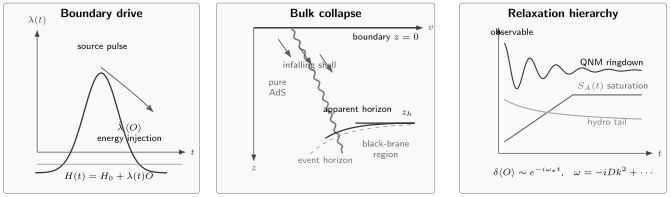
A schematic real-time holographic quench. A boundary source pulse injects energy, producing an infalling bulk shell or scalar pulse. After nonlinear collapse, the late geometry is a black brane. Different observables relax on different schedules: local one-point functions often ring down through quasinormal modes, hydrodynamic variables relax through conserved-density modes, and nonlocal probes such as HRT surfaces can equilibrate later because they reach deeper into the bulk.
The punchline of this page is not that holography magically solves every nonequilibrium problem. It gives a controlled large-, strong-coupling laboratory for problems that are otherwise almost inaccessible: rapid quenches, hydrodynamization, entanglement growth, defect formation, vortex dynamics, steady heat flow, and driven dissipation. The price is also clear: classical gravity is a large- mean-field description with suppressed fluctuations and a very efficient horizon bath.
Real-time dictionary for a driven state
Section titled “Real-time dictionary for a driven state”Let the boundary theory live in spacetime dimensions, where is the number of spatial dimensions. A homogeneous scalar drive can be written as
With this sign convention, the work done per unit volume is
This equation is a Ward identity in disguise. It says that energy is conserved only when the Hamiltonian is time independent. The operator expectation value is not a passive response: in a strongly coupled system it is determined by the full real-time state.
The bulk dual is a scalar field with a prescribed near-boundary behavior. In standard quantization,
where is the dimension of . The leading coefficient is the source; the normalizable coefficient gives the response,
up to conventional normalizations. The source is boundary data for the bulk PDE. The response is read off after solving the bulk dynamics.
A metric source works similarly. A time-dependent boundary metric sources the stress tensor. A boundary gauge field sources a conserved current . The general real-time problem therefore has the structure
In equilibrium we often solve ordinary differential equations in the radial coordinate. In a nonequilibrium homogeneous quench, we solve PDEs in . In an inhomogeneous quench or vortex problem, we solve PDEs in . This is why the subject quickly becomes numerical.
Infalling coordinates and why horizons are friendly
Section titled “Infalling coordinates and why horizons are friendly”For real-time evolution, the most convenient bulk coordinates are usually ingoing Eddington—Finkelstein coordinates. The reason is practical and physical. Infalling coordinates are regular at a future horizon, so the classical equations can evolve through horizon formation without constantly fighting coordinate singularities.
For a homogeneous neutral quench into a planar black brane, a useful toy model is the Vaidya-AdS metric,
with
Here is the boundary and increasing moves into the bulk. If , the geometry is pure Poincare AdS. If is constant, the geometry is a planar AdS black brane with horizon
The final temperature and entropy density are
The function encodes the infalling energy. A sharp quench is modeled by
while a smooth quench might use
The matter supporting this geometry has , so the null energy condition requires
That is exactly what we expect for an infalling positive-energy shell.
This model is not the most general holographic quench. It is a clean geometric caricature of a homogeneous injection of energy. Its virtue is that it separates the main physics from the technical details: a boundary pulse becomes an infalling shell, and the late state is a black brane.
Event horizons and apparent horizons
Section titled “Event horizons and apparent horizons”A time-dependent geometry contains two horizon notions that are easy to confuse.
The event horizon is globally defined. One must know the entire future spacetime to determine which null rays escape to the boundary and which do not. This makes the event horizon conceptually important but numerically teleological.
The apparent horizon or, more generally, a marginally trapped surface, is quasi-local on a time slice. It is often the more useful object in numerical time evolution. Its area gives a natural local measure of entropy production in the classical bulk evolution.
In equilibrium the distinction disappears. In a quench, it matters. The event horizon can start growing before the boundary source has visibly injected energy, because its definition knows the future. The apparent horizon forms when trapped surfaces appear in the chosen slicing.
What does it mean to thermalize?
Section titled “What does it mean to thermalize?”“Thermalization” is a word with too many jobs. In holographic quantum matter, it is better to split it into several sharper notions.
A one-point function equilibrates when quantities such as , , or approach their final thermal values.
A system hydrodynamizes when its stress tensor and currents are well described by hydrodynamic constitutive relations, even if the pressure anisotropy or other non-equilibrium features are still visible. For a relativistic fluid,
where
For a conformal fluid, and .
A nonlocal probe equilibrates when an extended observable reaches its thermal value. Examples include equal-time two-point functions, Wilson loops, and entanglement entropy. In holography these are often computed by geodesics, string worldsheets, or HRT extremal surfaces. Larger boundary regions dip deeper into the bulk, so they can remain sensitive to the pre-quench region after local observables have already settled down.
Finally, a state is fully thermal only when all observables are described by the thermal density matrix at the relevant conserved charges. Classical gravity is excellent at capturing the approach of low-point, large- observables to thermal behavior, but it does not by itself resolve fine-grained finite- questions such as recurrences or exact late-time spectral discreteness.
So the hierarchy is usually
The inequalities are schematic, not a theorem. The order can depend on the observable and the state.
Ringdown and quasinormal modes
Section titled “Ringdown and quasinormal modes”After the nonlinear stage of a homogeneous quench, the final black brane is perturbed but close to equilibrium. The deviations of one-point functions then have the universal form of black-brane ringdown:
The complex frequencies are quasinormal-mode frequencies. Their imaginary parts are negative for a stable black brane:
This is the nonequilibrium version of a theme that has appeared throughout the course. Quasiparticles are replaced by quasinormal modes. The late-time response is not controlled by particles with long lifetimes but by damped collective modes of the horizon.
The hydrodynamic modes are special QNMs whose frequencies vanish as . Examples include diffusion,
and sound,
All other QNMs are nonhydrodynamic. They have frequencies of order the temperature,
in a strongly coupled black-brane state. This is the geometric reason holographic systems often hydrodynamize on a time scale of order : the nonhydrodynamic modes die quickly, leaving only the conserved-density modes.
Hydrodynamization is therefore not the same as “the system has become boring.” It means the surviving degrees of freedom are the ones protected by conservation laws.
Entanglement growth after a quench
Section titled “Entanglement growth after a quench”Entanglement entropy is one of the cleanest probes of the difference between local and nonlocal equilibration. In a time-dependent state, the holographic prescription uses an extremal surface in the Lorentzian bulk:
In a homogeneous global quench, the qualitative behavior for a large region is often:
Here is the final thermal entropy density and is an entanglement velocity. This form should be read as a scaling picture, not a universal exact formula. It says that after an initial transient, entanglement spreads approximately linearly until the region saturates at the thermal entropy expected for its volume.
In Vaidya-AdS, this behavior has a vivid geometric explanation. An HRT surface anchored at boundary time bends into the bulk. At early times it mostly probes the pre-shell geometry. At intermediate times it crosses the shell. At late times it lies in the final black-brane region and can run close to the horizon. Large regions have surfaces that reach deeper, so their saturation time grows with size.
This is also a useful caution. A boundary stress tensor can be thermal while an HRT surface for a large region still remembers the quench. Thermalization is observable-dependent.
Spatial quenches and nonequilibrium steady states
Section titled “Spatial quenches and nonequilibrium steady states”Not every quench is homogeneous. A simple spatial quench connects two reservoirs at different temperatures,
and lets them exchange energy. In one spatial dimension, a CFT gives an especially simple picture: left-moving excitations come from one bath and right-moving excitations from the other. The central region can settle into a nonequilibrium steady state rather than a static equilibrium state.
In relativistic notation, a boosted thermal density matrix has the form
This is the natural structure of a steady state that carries heat current. In higher dimensions the exact CFT simplification is gone, but hydrodynamics gives an analogous picture: a central steady region can form between outgoing waves or shocks.
Holographically, these problems are hard but direct. One solves a time-dependent inhomogeneous Einstein problem with boundary conditions corresponding to the two reservoirs. The late-time state can be interpreted as a boosted black brane or a more complicated flowing horizon geometry. This is one of the cleanest uses of holography as a bridge between hydrodynamics and microscopic strong-coupling dynamics.
The same caveat repeats itself: the steady state is a large- strong-coupling answer. It is not automatically the steady state of a lattice material with impurities, phonons, finite , and long-lived quasiparticles.
Quenches through ordered phases and the Kibble—Zurek mechanism
Section titled “Quenches through ordered phases and the Kibble—Zurek mechanism”Some of the most interesting nonequilibrium problems occur when the system is driven through a phase transition. A canonical example is a normal-to-superfluid transition. Let
measure the distance from the critical point, and suppose that the quench is approximately linear near :
Near a continuous transition, the equilibrium correlation length and relaxation time scale as
Here is the correlation-length exponent and is the dynamical critical exponent. As the system approaches the critical point, the relaxation time diverges. Eventually the system can no longer adjust adiabatically to the changing temperature. The freeze-out time is estimated by
Using , this gives
and the corresponding freeze-out length is
If the ordered phase supports topological defects of dimension , the defect density scales as
For a superfluid in , vortices are point defects, so and
For a superfluid in , vortex lines have , so again per unit transverse area scales like .
Holographic implementation
Section titled “Holographic implementation”A minimal holographic superfluid is described by an Einstein—Maxwell—charged-scalar system,
with
A thermal quench can be modeled by changing the temperature or chemical potential through the critical value. The condensate is extracted from the normalizable boundary coefficient of :
For spontaneous ordering, the source is set to zero and
The bulk dynamics then computes the growth of the condensate, the formation of vortices, and their subsequent motion.
A subtlety is essential. In classical gravity, thermal fluctuations are suppressed by powers of :
But Kibble—Zurek defect formation needs fluctuations to seed different order-parameter phases in different regions. In a purely deterministic homogeneous classical simulation, the condensate can choose the same phase everywhere. Practical holographic studies therefore add small random boundary or initial data, or interpret the noise as standing in for the leading finite- fluctuations.
This is not a failure; it is a reminder of the regime. Classical holography captures strong dissipation and nonlinear order-parameter growth, but genuine thermal noise is a subleading quantum-gravity effect.
Holographic superfluid turbulence
Section titled “Holographic superfluid turbulence”Once vortices form, the system has another nonequilibrium stage: vortex motion, reconnection, annihilation, and possible turbulent cascades.
In a boundary superfluid, a vortex is a zero of the complex condensate around which the phase winds:
In the bulk, the vortex extends into the radial direction. The charged scalar field vanishes along a bulk vortex core, and the gauge field carries the corresponding circulation. At nonzero temperature the vortex interacts with a horizon, which acts as a dissipative bath.
This makes holographic turbulence different from a conservative Gross—Pitaevskii evolution. Energy in the superfluid component can be transferred to the normal component and ultimately to the horizon. That is precisely why the model is interesting for strongly coupled dissipative superfluids.
In two spatial dimensions, vortices and antivortices can annihilate. A turbulent configuration can exhibit an inverse cascade, where energy moves toward larger scales. Holographic simulations can track both the boundary vortex dynamics and the bulk horizon response, giving a simultaneous view of order-parameter dynamics and entropy production.
The limitation is once again large . A classical bulk simulation resolves mean-field vortex dynamics and dissipation, but not all finite- stochastic fluctuations.
Driven states and heating
Section titled “Driven states and heating”A quench has a beginning and an end. A drive can continue forever. Examples include electric fields, periodic sources, rotating phases, and thermal gradients.
A constant electric field in a translationally invariant finite-density system does work at a rate
Unless energy can leave the system, the state heats. In the bulk, energy flows through the gauge field and metric into the horizon. A steady DC conductivity calculation often implicitly assumes either a linear-response limit or an external mechanism that removes the heat.
A periodic drive can be written schematically as
At generic strong coupling, such a drive tends to heat the system. In a holographic model, this heating is geometric: the horizon area grows. However, special driven states can evade simple heating intuition for long times, especially when additional symmetries, integrability-like structures, or large- limits suppress energy absorption.
The careful question is therefore not “does the drive heat?” but rather:
Holography answers this by tracking radial energy flux, horizon growth, and the response of boundary one-point functions.
Numerical workflow for time-dependent holography
Section titled “Numerical workflow for time-dependent holography”The practical computation has a standard rhythm.
First choose a bulk action and boundary sources. For a scalar quench this means specifying . For a thermal or metric quench it means specifying a boundary metric or stress-tensor injection. For a superfluid quench it means evolving the charged scalar and Maxwell field through an instability.
Second choose a coordinate system that is regular at future horizons. Infalling Eddington—Finkelstein coordinates are common because infalling boundary conditions are automatic for regular fields.
Third impose asymptotic AdS boundary conditions. The near-boundary expansion determines the sources and one-point functions. Holographic renormalization supplies the counterterms needed to define finite expectation values.
Fourth evolve the bulk equations. In homogeneous problems this may reduce to nested radial ODEs at each time step. In inhomogeneous problems it is a genuine PDE problem. Spectral methods are common when the fields are smooth; finite-difference or finite-element methods are useful when sharp structures or complicated domains appear.
Fifth monitor constraints and horizons. A reliable simulation checks that the radial constraints propagate correctly, that the apparent horizon behaves sensibly, and that extracted one-point functions satisfy the boundary Ward identities.
Finally analyze observables. A local one-point function may be enough for ringdown. Two-point functions require solving fluctuation equations on the time-dependent background or using geodesic approximations at large operator dimension. Entanglement requires HRT surfaces in a dynamical geometry. Turbulence requires defect tracking and possibly spectra of kinetic energy or vorticity.
What holography teaches about nonequilibrium matter
Section titled “What holography teaches about nonequilibrium matter”Several lessons are robust across many models.
First, horizons geometrize dissipation. A strongly coupled large- state can lose memory of perturbations by dumping energy into a horizon. The boundary sees this as fast relaxation without quasiparticles.
Second, hydrodynamics can appear early. The system need not be isotropic or fully thermal before the stress tensor is well described by hydrodynamic constitutive relations. Hydrodynamization is controlled by the decay of nonhydrodynamic QNMs, not by a literal quasiparticle collision time.
Third, nonlocal observables remember longer. Entanglement entropy and large Wilson loops can probe regions of the bulk that local one-point functions do not see. They can therefore equilibrate later.
Fourth, defects and order-parameter textures are natural in holography. A bulk scalar can condense, vortices can form, and a horizon can dissipate their energy. This makes holography a useful laboratory for dissipative ordered phases.
Fifth, large suppresses fluctuations. Classical gravity is deterministic. Noise, rare events, recurrences, and exact late-time discreteness require quantum corrections in the bulk.
These lessons are not a replacement for microscopic condensed matter modeling. They are controlled examples of strongly coupled nonequilibrium dynamics, and they provide a language for asking sharper questions.
Common pitfalls
Section titled “Common pitfalls”“A horizon formed, so the boundary theory is fully thermal.”
Section titled ““A horizon formed, so the boundary theory is fully thermal.””Not necessarily. Horizon formation is a geometric sign of coarse-grained entropy production and local equilibration, but nonlocal observables can still remember the initial state. Fine-grained thermalization is a stronger statement.
“Hydrodynamization means isotropization.”
Section titled ““Hydrodynamization means isotropization.””No. Hydrodynamics can describe anisotropic stress tensors. Hydrodynamization means the stress tensor is well approximated by hydrodynamic constitutive relations; it does not require all pressures to be equal.
“Vaidya-AdS is the holographic dual of every quench.”
Section titled ““Vaidya-AdS is the holographic dual of every quench.””Nope. Vaidya-AdS is a useful toy model for homogeneous energy injection by null matter. A scalar quench, charged quench, anisotropic quench, or vortex quench generally requires solving the full coupled Einstein—matter equations.
“Classical holography automatically includes thermal noise.”
Section titled ““Classical holography automatically includes thermal noise.””It does not. Classical bulk fields capture leading large- expectation values. Thermal fluctuations are suppressed by and require bulk quantum effects or explicit stochastic sources.
“A short relaxation time proves holography.”
Section titled ““A short relaxation time proves holography.””Also no. Fast relaxation of order is consistent with holographic dynamics, but many systems can have short time scales. Holography is most convincing when it organizes several observables at once: stress response, charge transport, entropy growth, defect dynamics, and scaling.
Exercises
Section titled “Exercises”Exercise 1: Work done by a homogeneous source
Section titled “Exercise 1: Work done by a homogeneous source”Let
Assume the state evolves unitarily with this Hamiltonian. Show that the energy density obeys
for a spatially homogeneous state.
Solution
The total energy is
Taking a time derivative gives
The commutator term vanishes. Therefore
For a homogeneous state, , so
Dividing by the spatial volume gives
The sign would change if one defined the deformation with the opposite sign in the Hamiltonian.
Exercise 2: Temperature of the final Vaidya black brane
Section titled “Exercise 2: Temperature of the final Vaidya black brane”Consider the Vaidya-AdS metric
Suppose approaches a constant at late times. Find the final horizon position and the final temperature .
Solution
At late times,
The horizon is where , so
Thus
For a planar AdS black brane in these conventions, the Hawking temperature is
Since
we have
Using gives
Therefore
Exercise 3: Kibble—Zurek freeze-out scaling
Section titled “Exercise 3: Kibble—Zurek freeze-out scaling”Assume
Derive the freeze-out time and freeze-out length .
Solution
The freeze-out estimate is
Using gives
Rearranging,
Thus
The freeze-out length is
Using the result for ,
Therefore
Exercise 4: Why hydrodynamization can precede thermalization
Section titled “Exercise 4: Why hydrodynamization can precede thermalization”Consider a homogeneous but anisotropic state with stress tensor
Explain how the system can be hydrodynamic even if .
Solution
Hydrodynamics is not the statement that the stress tensor equals the equilibrium perfect-fluid form. It is the statement that the stress tensor is expressible in terms of a small number of slowly varying hydrodynamic variables, such as , , and conserved charge densities, together with a derivative expansion.
Anisotropic pressures can arise from gradient corrections, expansion, shear, or external forcing. For example, the first-order viscous correction contains
which can make different pressure components unequal. If the full stress tensor is well approximated by the hydrodynamic constitutive relation, then the system has hydrodynamized.
Thermal equilibrium is stronger. In equilibrium, gradients vanish and a rotationally invariant state has
Thus a system can hydrodynamize before it isotropizes or fully thermalizes.
Exercise 5: QNM ringdown and the leading late-time mode
Section titled “Exercise 5: QNM ringdown and the leading late-time mode”Suppose a one-point function after a quench has the form
Which mode dominates at late times, assuming its coefficient is nonzero?
Solution
Each term behaves as
The mode with the smallest positive damping rate decays most slowly. Therefore, among modes with nonzero coefficients , the late-time behavior is dominated by the mode satisfying
The late-time signal is approximately
If a hydrodynamic mode is allowed by the channel and has very small , it can dominate because its damping rate vanishes as . At exactly homogeneous , conserved quantities do not decay; nonconserved one-point functions are usually controlled by the lowest nonhydrodynamic QNM.
Further reading
Section titled “Further reading”For the nonequilibrium sections of holographic quantum matter, see Hartnoll, Lucas, and Sachdev, Holographic Quantum Matter, especially the discussion of uniform quenches, spatial quenches, Kibble—Zurek dynamics, turbulence, and the large- caveat. For Vaidya-AdS, global quenches, HRT surfaces, and entanglement growth, see Rangamani and Takayanagi, Holographic Entanglement Entropy, chapter 7. For numerical real-time holography, see Chesler and Yaffe’s characteristic formulation of asymptotically AdS gravitational dynamics, together with later numerical work on holographic superconductors, vortex dynamics, and inhomogeneous quenches.