
What Is Holographic Quantum Matter?
The shortest honest definition is this:
This definition is deliberately modest. It does not say that every strange metal, cuprate, heavy-fermion compound, Dirac fluid, or cold-atom gas is literally dual to a black hole. It says that holography gives a controlled class of quantum systems in which the usual quasiparticle machinery is absent, yet thermodynamics, transport, spectral functions, instabilities, entanglement, and nonequilibrium dynamics can still be computed.
That is already a big deal. Much of many-body physics is built around the idea that complicated systems become simple because their low-energy excitations are long-lived particles. Holographic quantum matter is useful precisely when this kind of simplicity fails.
A rough slogan is
and, at finite temperature,
The slogan is not a derivation. It is a map of the calculation. Boundary observables are computed by solving classical bulk equations in a higher-dimensional spacetime. The radial direction organizes scale, and regularity at a future horizon imposes causal dissipation.
The problem: what replaces quasiparticles?
Section titled “The problem: what replaces quasiparticles?”In a Landau Fermi liquid, the central object is a long-lived excitation near the Fermi surface. Its retarded Green function has a pole close to the real frequency axis:
with
in the low-energy regime where the quasiparticle is meaningful. The pole’s real part gives the excitation energy. The pole’s imaginary part gives the inverse lifetime. The residue measures how strongly the microscopic operator overlaps with the emergent quasiparticle.
This is a fantastically powerful picture because it makes an interacting system look, in the infrared, like a weakly interacting gas of dressed particles. One can then compute transport by asking how those particles carry charge, heat, spin, and momentum.
But some systems do not give us such polite poles. Their spectral functions are broad; their relaxation times are short; their conductivity is not well described by a dilute gas of carriers; their heat and charge currents need not be tied together as in the Wiedemann—Franz law; and their low-energy degrees of freedom may be collective, critical, or entangled in a way that refuses to be decomposed into long-lived particles.
For such systems, the better question is not:
What are the quasiparticles?
It is:
What principle organizes the observables when there are no quasiparticles?
Holography answers with geometry. The organizing principle is not a particle spectrum but a classical gravitational solution, together with its fluctuations.
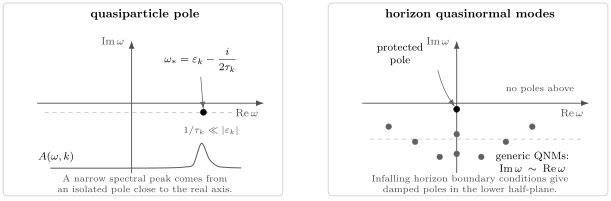
A quasiparticle is diagnosed by an isolated pole close to the real frequency axis, with a decay rate much smaller than its oscillation frequency. In strongly coupled holographic matter at finite temperature, the relevant poles are usually quasinormal modes with ; their imaginary parts encode relaxation into the horizon rather than long-lived particle propagation.
A dynamical diagnostic
Section titled “A dynamical diagnostic”The statement “there are no quasiparticles” is easy to say but hard to prove. A clever duality might always reveal some unexpected variables in which the system looks simple. A more operational diagnostic is to look at time scales.
Suppose a thermal many-body system is perturbed slightly. If it has quasiparticles, the perturbation creates long-lived excitations. Those excitations scatter, and only after many microscopic oscillations does the system lose local phase coherence. In a non-quasiparticle fluid, local equilibration can happen on the shortest natural thermal time scale,
In units with , this is simply
This estimate is often called Planckian, but one should be careful. A time scale of order is not, by itself, a microscopic explanation. It is a sign that the system has no small parameter producing long-lived excitations. Holographic black branes naturally produce this behavior: perturbations fall through the horizon and relax through quasinormal modes with frequencies of order
So holography does not merely say “fast relaxation happens.” It gives a concrete dynamical model for fast relaxation, including frequency-dependent response functions, pole motion, diffusion constants, thermodynamics, and instabilities.
Three equivalent languages
Section titled “Three equivalent languages”Holographic quantum matter is unusually bilingual; really, trilingual. The same object has three descriptions.
| Viewpoint | What the same physics looks like | Typical question |
|---|---|---|
| Condensed matter | A strongly coupled state without long-lived quasiparticles | What are , , , , and the ordered phases? |
| Relativity | A black brane or horizon in an asymptotically AdS-like spacetime | What is the horizon geometry, electric flux, scalar hair, or quasinormal spectrum? |
| Quantum field theory / string theory | A large- strongly coupled QFT state | Which operators, symmetries, sources, and expectation values define the state? |
A charged black brane, for instance, is simultaneously:
This triple reading is the main reason the subject is so fertile. It lets us translate hard questions about many-body dynamics into geometric questions about horizons, and then translate the answer back into field-theory observables.
The historical nickname AdS/CMT is therefore useful but incomplete. The subject began from AdS/CFT tools applied to condensed-matter-like questions, but neither exact conformal invariance nor strict AdS geometry is the whole story. In practice, the UV may be asymptotically AdS to give a clean dictionary, while the IR is deformed by temperature, density, running scalars, disorder, lattices, or condensates. Often the interesting physics is precisely in that deformation.
Why horizons are useful
Section titled “Why horizons are useful”A horizon is a one-way membrane. Classically, waves can fall in but cannot return. In Lorentzian holography this is exactly what retarded response needs: disturbances are absorbed by the future horizon.
Consider a bulk fluctuation with time dependence . Near a nonextremal horizon, the metric locally has a Rindler form. A radial tortoise coordinate can be chosen so that the horizon is at , and a wave behaves as
The two pieces are
Since is the ingoing Eddington—Finkelstein coordinate, regularity at the future horizon selects
This is the infalling boundary condition. It is the gravitational origin of dissipation in retarded correlators.
Once the infalling solution is fixed in the interior, one reads off the near-boundary expansion. For a scalar field dual to an operator ,
in a common convention with boundary at . The coefficient is the source, and is proportional to the expectation value . The retarded Green function is the response divided by the source after imposing infalling behavior in the interior:
The exact proportionality depends on normalization and holographic counterterms. The causal idea does not.
The horizon also explains why entropy and dissipation appear at leading order in classical gravity. The entropy density is the horizon area density divided by :
When energy crosses the horizon, the exterior observer sees irreversible relaxation. In the dual field theory, that energy has dispersed into a huge number of strongly interacting degrees of freedom. In large- matrix theories, the number of such degrees of freedom is often of order .
Quasinormal modes are not quasiparticles
Section titled “Quasinormal modes are not quasiparticles”The poles of the retarded Green function occur when the fluctuation has no source at the boundary but is infalling at the horizon. These are quasinormal modes:
A quasiparticle pole is also a pole, so what is the difference? The difference is the location and the interpretation.
A quasiparticle is long-lived when
A generic holographic quasinormal mode has real and imaginary parts of comparable size:
It is therefore not a stable particle. It is a damped collective relaxation channel. Long-lived poles can still occur in holography, but they require a reason: a conserved density gives hydrodynamic poles; a spontaneously broken symmetry gives Goldstone modes; a Fermi surface can give a pole tied to finite momentum; a weakly broken symmetry gives a parametrically slow mode. Without such protection, the horizon happily eats the perturbation.
This is a recurring lesson: holography does not erase effective field theory. It explains when effective slow variables survive inside an otherwise strongly coupled bath.
The large- control parameter
Section titled “The large-NNN control parameter”Why is the bulk classical? Because the boundary theory is taken in a large- limit. Schematically,
so the gravitational action scales like . The saddle-point approximation becomes reliable as :
On the field-theory side, suitable gauge-invariant operators factorize:
for single-trace operators with standard large- normalization. This is what makes the dual bulk fields classical. Quantum loops in the bulk are corrections.
The large- limit is the friend and the trickster of holographic quantum matter. It gives control. It also suppresses effects that may be important in ordinary materials: localization, mesoscopic fluctuations, certain Goldstone fluctuations, finite- scattering channels, and some quantum corrections tied to Fermi surfaces. Whenever holography is compared to experiment, this must be remembered.
Strong coupling and the classical gravity limit
Section titled “Strong coupling and the classical gravity limit”Large is not enough. A weakly coupled large- vector model can be solvable, but it still often behaves like a theory with weakly interacting excitations. The gravitational dual of the most familiar type emerges when the boundary theory is both large and strongly coupled.
For a matrix gauge theory, the relevant coupling is typically the ‘t Hooft coupling
The clean classical Einstein-gravity regime is roughly
with additional assumptions about the spectrum, truncation, and curvature scales. In this regime, stringy excitations are heavy, quantum gravity loops are suppressed, and a small number of bulk fields can often describe the leading observables.
This is why holography can give a strongly coupled answer without doing a strongly coupled field-theory calculation. The strong boundary dynamics is replaced by weakly coupled classical dynamics in one higher dimension.
The radial direction is scale, not a literal laboratory direction
Section titled “The radial direction is scale, not a literal laboratory direction”The extra spatial direction in the bulk is not an extra direction in the material. It is best thought of as an emergent geometrization of energy scale.
Near the boundary lives the ultraviolet data: sources, operator definitions, microscopic deformations. Deeper in the bulk lives the infrared response. A horizon is an IR object at finite temperature. An throat is an IR scaling region. A cap-off geometry can represent a gap. A domain wall can represent an RG flow between fixed points.
A cartoon dictionary is
This is why geometric statements become RG statements. The shape of the bulk tells us how the theory changes with scale.
What is actually being modeled?
Section titled “What is actually being modeled?”Holographic quantum matter studies several kinds of states.
Quantum critical matter at fixed density
Section titled “Quantum critical matter at fixed density”At a quantum critical point, there is no energy scale other than temperature. For a relativistic CFT in spatial dimensions,
and response functions are constrained by scaling. Holographically, the finite-temperature state is usually a neutral planar black brane. Charge transport can be studied by adding a Maxwell field.
Compressible matter at finite density
Section titled “Compressible matter at finite density”A compressible state has a continuously variable charge density. The boundary chemical potential is encoded in a bulk gauge field , and the charge density is encoded in radial electric flux:
If the flux is sourced by a charged horizon, the charge is called fractionalized. If the flux is sourced by charged bulk matter outside the horizon, the charge is called cohesive. This distinction becomes central in holographic metals, electron stars, and superconductors.
Metallic transport without quasiparticles
Section titled “Metallic transport without quasiparticles”At finite density, transport is shaped by momentum conservation. A clean translationally invariant system can have infinite DC conductivity even with no quasiparticles. The reason is simple: the current overlaps with conserved momentum.
Holography forces this distinction to be clean. Fast local equilibration is not the same as finite DC resistivity. In a clean system, hydrodynamics gives a pole of the form
where is the momentum susceptibility and is the part of the conductivity not tied to momentum drag. If momentum relaxes weakly at rate , this becomes
Momentum relaxation must therefore be included separately, through lattices, disorder, axions, massive gravity, Q-lattices, impurities, or other mechanisms.
Ordered phases
Section titled “Ordered phases”Holographic horizons can become unstable. A charged scalar instability gives a holographic superconductor or superfluid. A finite-momentum instability gives stripes or helices. A Chern—Simons coupling can generate anomalous transport. These are not decorative additions; they are how the strongly coupled normal state gives way to ordered phases.
What holography can claim
Section titled “What holography can claim”Here is the hierarchy of trustworthy claims.
| Claim type | Example | Status |
|---|---|---|
| Exact dual statement | A correlator in a known AdS/CFT pair equals a bulk computation | strongest |
| Top-down mechanism | A consistent truncation produces superconducting hair or an EMD scaling solution | controlled within its regime |
| Bottom-up mechanism | A minimal action realizes incoherent transport or hyperscaling violation | useful effective model |
| Phenomenological analogy | A holographic resistivity resembles a strange-metal trend | suggestive, not microscopic |
| Experimental explanation | A specific material is claimed to be holographic | requires many linked observables, not one fit |
The most common mistake is to skip from the fourth row to the fifth. A linear resistivity curve is not a holographic proof. A broad spectral continuum is not a holographic proof. A Planckian-looking time scale is not a holographic proof. Holography becomes compelling when many constrained quantities hang together: thermodynamics, optical conductivity, heat transport, charge diffusion, pole motion, scaling functions, hydrodynamic modes, and the behavior of ordered phases.
What the word “matter” means here
Section titled “What the word “matter” means here”The word matter is also being stretched. Holographic quantum matter is not usually matter made from electrons moving on a literal lattice with spin degeneracy. It is often a large- quantum field theory with adjoint degrees of freedom, perhaps deformed by temperature, density, lattices, disorder, or relevant operators.
Yet this is not a reason to dismiss the subject. Many of the most useful theoretical models in physics are not microscopic copies of the systems they illuminate. The Ising model does not contain real iron atoms. Hydrodynamics does not remember molecular orbitals. Ginzburg—Landau theory does not derive every Cooper pair from first principles. A good effective model captures the right variables, symmetries, scales, and constraints.
Holography is best viewed in that spirit when applied to quantum materials: it is a controlled laboratory for mechanisms that might otherwise be inaccessible.
A compact dictionary for this page
Section titled “A compact dictionary for this page”| Boundary idea | Bulk idea | Physical role |
|---|---|---|
| operator | field | source and response |
| stress tensor | metric | energy, pressure, momentum, geometry |
| current | gauge field | charge density and conductivity |
| temperature | black-brane horizon | thermal state |
| entropy density | horizon area density | many degrees of freedom |
| retarded correlator | infalling solution | causal response |
| poles of | quasinormal modes | relaxation channels |
| RG scale | radial direction | UV-to-IR organization |
| expansion | bulk loop expansion | quantum corrections to classical gravity |
| strong coupling | weakly curved gravity | computability |
Minimal worked example: pole versus relaxation
Section titled “Minimal worked example: pole versus relaxation”Consider a retarded correlator in a weakly interacting metal. Near a quasiparticle pole,
The spectral function is
If is small, this is a narrow peak. A narrow peak means a long-lived excitation.
Now compare a typical holographic finite-temperature correlator. It has poles
For a generic nonhydrodynamic mode,
The spectral function is not organized by a single long-lived carrier. Instead, it receives weight from damped collective modes. Hydrodynamic modes can still be long-lived at small momentum because conservation laws force them to be:
The distinction is important. Holographic matter can have sharp hydrodynamic structure without having quasiparticles. Conserved densities are not quasiparticles; they are slow variables.
Common misconceptions
Section titled “Common misconceptions”“Holography says all strongly coupled systems are black holes.” No. Holography gives exact duals for special large- theories and useful models for broader classes of strongly coupled dynamics.
“No quasiparticles means no poles.” No. Retarded functions can have poles. The question is whether the poles are parametrically close to the real axis and represent long-lived particle-like excitations.
“Fast relaxation means finite resistivity.” No. At finite density, if momentum is conserved, the DC conductivity can be infinite. Momentum relaxation is a separate ingredient.
“Large is just a technicality.” No. It is the reason classical gravity works, and it is also the reason some finite- effects are suppressed.
“Bottom-up models are untrustworthy.” Also no. They are effective models. They become misleading only when their model status is hidden.
Takeaway
Section titled “Takeaway”The subject begins from a compact but demanding idea:
At finite temperature, the most important gravitational object is a horizon. It gives entropy, imposes infalling boundary conditions, and turns low-energy response into a quasinormal-mode problem. Holographic quantum matter is powerful because it makes this structure calculable. It is trustworthy when the model status, large- control, symmetries, and conservation laws are stated explicitly.
Exercises
Section titled “Exercises”Exercise 1: pole width and lifetime
Section titled “Exercise 1: pole width and lifetime”A retarded Green function near a pole is
Show that the time-domain response decays as for . Explain why is the condition for a well-defined quasiparticle.
Solution
For , the retarded response is obtained by Fourier transforming with the contour closed in the lower half of the complex plane:
The pole is at
The residue gives
up to convention-dependent factors. Thus is the lifetime. If , the excitation oscillates many times before decaying, so it behaves like a particle with a reasonably sharp energy. If , the excitation decays within about one oscillation and is not a good quasiparticle.
Exercise 2: infalling versus outgoing waves
Section titled “Exercise 2: infalling versus outgoing waves”Near a horizon, let be the tortoise coordinate and consider
Using and , identify the infalling and outgoing pieces. Which one is regular at the future horizon for a retarded correlator?
Solution
The two terms are
and
The coordinate is regular on the future horizon, while is singular there. Retarded response is computed by imposing regularity at the future horizon, so one sets
This is the infalling boundary condition.
Exercise 3: quasinormal modes and sources
Section titled “Exercise 3: quasinormal modes and sources”Explain why a quasinormal mode corresponds to a pole of the retarded Green function. Use the schematic relation
Solution
A retarded Green function is obtained by solving the bulk fluctuation equation with infalling behavior at the horizon. Near the boundary, the solution has a source coefficient and a response coefficient. For generic , specifying the source fixes the response.
A quasinormal mode is a nontrivial solution that is infalling at the horizon and normalizable at the boundary. Normalizable means the source vanishes while the response does not. Thus the ratio
blows up at that frequency. This is a pole of the retarded Green function.
Exercise 4: why large looks classical
Section titled “Exercise 4: why large NNN looks classical”Suppose a set of operators obeys factorization,
Explain why this is analogous to a classical limit. What plays the role of quantum corrections in the bulk?
Solution
In a classical theory, products of observables are just products of their values. Fluctuations around the classical value are suppressed. Large- factorization says exactly this for suitable gauge-invariant operators: connected fluctuations are down by powers of .
In the bulk, the leading large- limit is a classical saddle point. Corrections in are quantum loop corrections of bulk fields, including graviton loops. Thus plays a role analogous to an effective Planck constant for the bulk theory.
Exercise 5: evaluate a holographic claim
Section titled “Exercise 5: evaluate a holographic claim”A talk claims: “The material has , therefore it is holographic.” What is wrong with the claim? What additional evidence would make the claim more serious?
Solution
A single power law is not enough. Many mechanisms can produce , including quantum critical scattering, phonons in some regimes, disorder-assisted mechanisms, density-wave fluctuations, marginal Fermi-liquid-like phenomenology, and model-specific holographic mechanisms. A holographic model should be judged by a constrained set of predictions, not one exponent.
A stronger case would compare multiple linked observables: optical conductivity, thermopower, Hall angle, magnetoresistance, thermal conductivity, charge and energy diffusion, specific heat, spectral functions, hydrodynamic pole structure, and the behavior near ordered phases. It should also state the model status: exact duality, top-down truncation, bottom-up EFT, or phenomenological analogy.
Exercise 6: Planckian time is not a smoking gun
Section titled “Exercise 6: Planckian time is not a smoking gun”A material has an experimentally inferred scattering or relaxation time
Explain why this observation is consistent with holographic intuition but does not prove that the material is described by a holographic dual.
Solution
The estimate is consistent with holographic intuition because black-brane perturbations typically relax on the thermal time scale. It also suggests the absence of a small parameter producing long-lived quasiparticles. However, dimensional analysis alone can produce the same time scale in many strongly interacting quantum critical systems, SYK-like models, hydrodynamic regimes, or phenomenological scattering models over a finite temperature window.
A serious holographic comparison would need more than one time scale. It should compare constrained observables: optical conductivity, charge and heat diffusion, thermodynamics, pole structure, response to momentum relaxation, magnetic-field dependence, and behavior near ordered phases. It should also state whether the claim is top-down, bottom-up, or purely phenomenological.
Further reading
Section titled “Further reading”- Sean A. Hartnoll, Andrew Lucas, and Subir Sachdev, “Holographic Quantum Matter,” arXiv:1612.07324. The main reference for the viewpoint of non-quasiparticle matter, horizons, large- control, transport, symmetry breaking, and nonequilibrium dynamics.
- Jan Zaanen, Yan Liu, Ya-Wen Sun, and Koenraad Schalm, Holographic Duality in Condensed Matter Physics. Especially useful for the condensed-matter-facing narrative, large- perspective, Reissner—Nordström strange metals, holographic fermions, superconductors, and top-down/bottom-up contrast.
- Sean A. Hartnoll, “Lectures on Holographic Methods for Condensed Matter Physics,” arXiv:0903.3246. A compact entry point to applied holographic calculations.
- Ofer Aharony, Steven S. Gubser, Juan Maldacena, Hirosi Ooguri, and Yaron Oz, “Large Field Theories, String Theory and Gravity,” arXiv:hep-th/9905111. The classic large-/AdS/CFT review.
- Makoto Natsuume, AdS/CFT Duality User Guide. A clear reference for black branes, real-time response, transport, and practical calculations.
- Martin Ammon and Johanna Erdmenger, Gauge/Gravity Duality: Foundations and Applications. A broad textbook treatment of the dictionary, finite temperature, hydrodynamics, and condensed-matter applications.
The next page gives a compact condensed-matter primer: Fermi liquids, order parameters, quantum criticality, strange metals, and why transport is the arena where holographic ideas most often meet experiments.