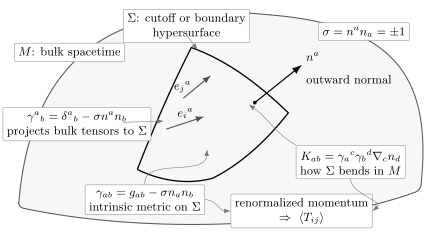
This appendix collects the differential-geometry formulas used repeatedly in the course. It is a working reference, not a replacement for a general relativity textbook. The emphasis is on the conventions needed for AdS geometry, holographic renormalization, Brown–York stress tensors, and extremal surfaces.
Boundary data for a hypersurface Σ \Sigma Σ M M M n a n^a n a γ a b = g a b − σ n a n b \gamma_{ab}=g_{ab}-\sigma n_an_b γ ab = g ab − σ n a n b K a b = γ a c γ b d ∇ c n d K_{ab}=\gamma_a{}^c\gamma_b{}^d\nabla_c n_d K ab = γ a c γ b d ∇ c n d
The metric g a b g_{ab} g ab g a b g^{ab} g ab
V a = g a b V b , V a = g a b V b , g a c g c b = δ a b . V_a=g_{ab}V^b,
\qquad
V^a=g^{ab}V_b,
\qquad
g^{ac}g_{cb}=\delta^a{}_b. V a = g ab V b , V a = g ab V b , g a c g c b = δ a b . The invariant volume element is
d D x ∣ g ∣ , D = d + 1. d^{D}x\sqrt{|g|},
\qquad
D=d+1. d D x ∣ g ∣ , D = d + 1. For Lorentzian metrics with mostly-plus signature, g < 0 g<0 g < 0 ∣ g ∣ = − g \sqrt{|g|}=\sqrt{-g} ∣ g ∣ = − g g > 0 g>0 g > 0 ∣ g ∣ = g \sqrt{|g|}=\sqrt{g} ∣ g ∣ = g
Useful variations are
δ ∣ g ∣ = 1 2 ∣ g ∣ g a b δ g a b = − 1 2 ∣ g ∣ g a b δ g a b , \delta\sqrt{|g|}
=\frac12\sqrt{|g|}\,g^{ab}\delta g_{ab}
=-\frac12\sqrt{|g|}\,g_{ab}\delta g^{ab}, δ ∣ g ∣ = 2 1 ∣ g ∣ g ab δ g ab = − 2 1 ∣ g ∣ g ab δ g ab , and
δ g a b = − g a c g b d δ g c d . \delta g^{ab}=-g^{ac}g^{bd}\delta g_{cd}. δ g ab = − g a c g b d δ g c d . The Levi-Civita connection is torsion-free and metric-compatible:
∇ a g b c = 0 , Γ a b c = Γ a c b . \nabla_ag_{bc}=0,
\qquad
\Gamma^a{}_{bc}=\Gamma^a{}_{cb}. ∇ a g b c = 0 , Γ a b c = Γ a c b . In coordinates,
Γ a b c = 1 2 g a d ( ∂ b g c d + ∂ c g b d − ∂ d g b c ) . \Gamma^a{}_{bc}
=
\frac12g^{ad}
\left(
\partial_bg_{cd}
+\partial_cg_{bd}
-\partial_dg_{bc}
\right). Γ a b c = 2 1 g a d ( ∂ b g c d + ∂ c g b d − ∂ d g b c ) . For a scalar,
∇ a ϕ = ∂ a ϕ . \nabla_a\phi=\partial_a\phi. ∇ a ϕ = ∂ a ϕ . For a vector,
∇ a V b = ∂ a V b + Γ b a c V c . \nabla_aV^b=\partial_aV^b+\Gamma^b{}_{ac}V^c. ∇ a V b = ∂ a V b + Γ b a c V c . For a covector,
∇ a ω b = ∂ a ω b − Γ c a b ω c . \nabla_a\omega_b=\partial_a\omega_b-\Gamma^c{}_{ab}\omega_c. ∇ a ω b = ∂ a ω b − Γ c ab ω c . The scalar Laplacian is
∇ 2 ϕ = 1 ∣ g ∣ ∂ a ( ∣ g ∣ g a b ∂ b ϕ ) . \nabla^2\phi
=
\frac{1}{\sqrt{|g|}}\partial_a
\left(
\sqrt{|g|}g^{ab}\partial_b\phi
\right). ∇ 2 ϕ = ∣ g ∣ 1 ∂ a ( ∣ g ∣ g ab ∂ b ϕ ) . In Poincaré AdSd + 1 _{d+1} d + 1
d s 2 = L 2 z 2 ( d z 2 + η i j d x i d x j ) , ds^2=\frac{L^2}{z^2}\left(dz^2+\eta_{ij}dx^idx^j\right), d s 2 = z 2 L 2 ( d z 2 + η ij d x i d x j ) , this becomes
∇ 2 ϕ = z 2 L 2 ( ∂ z 2 ϕ − d − 1 z ∂ z ϕ + □ ∂ ϕ ) , \nabla^2\phi
=
\frac{z^2}{L^2}
\left(
\partial_z^2\phi
-\frac{d-1}{z}\partial_z\phi
+\Box_{\partial}\phi
\right), ∇ 2 ϕ = L 2 z 2 ( ∂ z 2 ϕ − z d − 1 ∂ z ϕ + □ ∂ ϕ ) , where □ ∂ = η i j ∂ i ∂ j \Box_{\partial}=\eta^{ij}\partial_i\partial_j □ ∂ = η ij ∂ i ∂ j
The course uses
[ ∇ a , ∇ b ] V c = R c d a b V d . [\nabla_a,\nabla_b]V^c
=
R^c{}_{dab}V^d. [ ∇ a , ∇ b ] V c = R c d ab V d . In coordinates,
R a b c d = ∂ c Γ a d b − ∂ d Γ a c b + Γ a c e Γ e d b − Γ a d e Γ e c b . R^a{}_{bcd}
=
\partial_c\Gamma^a{}_{db}
-\partial_d\Gamma^a{}_{cb}
+\Gamma^a{}_{ce}\Gamma^e{}_{db}
-\Gamma^a{}_{de}\Gamma^e{}_{cb}. R a b c d = ∂ c Γ a d b − ∂ d Γ a c b + Γ a ce Γ e d b − Γ a d e Γ e c b . The Ricci tensor and scalar are
R a b = R c a c b , R = g a b R a b . R_{ab}=R^c{}_{acb},
\qquad
R=g^{ab}R_{ab}. R ab = R c a c b , R = g ab R ab . The Einstein tensor is
G a b = R a b − 1 2 R g a b . G_{ab}=R_{ab}-\frac12Rg_{ab}. G ab = R ab − 2 1 R g ab . The vacuum Einstein equation with cosmological constant is
G a b + Λ g a b = 0. G_{ab}+\Lambda g_{ab}=0. G ab + Λ g ab = 0. For AdSd + 1 _{d+1} d + 1
R a b c d = − 1 L 2 ( g a c g b d − g a d g b c ) , R_{abcd}
=
-\frac{1}{L^2}
\left(g_{ac}g_{bd}-g_{ad}g_{bc}\right), R ab c d = − L 2 1 ( g a c g b d − g a d g b c ) , so
R a b = − d L 2 g a b , R = − d ( d + 1 ) L 2 , Λ = − d ( d − 1 ) 2 L 2 . R_{ab}=-\frac{d}{L^2}g_{ab},
\qquad
R=-\frac{d(d+1)}{L^2},
\qquad
\Lambda=-\frac{d(d-1)}{2L^2}. R ab = − L 2 d g ab , R = − L 2 d ( d + 1 ) , Λ = − 2 L 2 d ( d − 1 ) . A D D D
R a b c d = R D ( D − 1 ) ( g a c g b d − g a d g b c ) . R_{abcd}
=\frac{R}{D(D-1)}
\left(g_{ac}g_{bd}-g_{ad}g_{bc}\right). R ab c d = D ( D − 1 ) R ( g a c g b d − g a d g b c ) . For a sphere of radius L L L
R a b = D − 1 L 2 g a b , R = D ( D − 1 ) L 2 . R_{ab}=\frac{D-1}{L^2}g_{ab},
\qquad
R=\frac{D(D-1)}{L^2}. R ab = L 2 D − 1 g ab , R = L 2 D ( D − 1 ) . For AdSD _D D
R a b = − D − 1 L 2 g a b , R = − D ( D − 1 ) L 2 . R_{ab}=-\frac{D-1}{L^2}g_{ab},
\qquad
R=-\frac{D(D-1)}{L^2}. R ab = − L 2 D − 1 g ab , R = − L 2 D ( D − 1 ) . This sign is one of the easiest ways to catch curvature-convention mistakes.
Let Σ \Sigma Σ n a n^a n a
σ = n a n a , \sigma=n^an_a, σ = n a n a , so σ = + 1 \sigma=+1 σ = + 1 σ = − 1 \sigma=-1 σ = − 1
The induced metric is
γ a b = g a b − σ n a n b . \gamma_{ab}=g_{ab}-\sigma n_an_b. γ ab = g ab − σ n a n b . It obeys
γ a b n b = 0. \gamma_{ab}n^b=0. γ ab n b = 0. The corresponding projector is
γ a b = δ a b − σ n a n b . \gamma^a{}_b=\delta^a{}_b-\sigma n^a n_b. γ a b = δ a b − σ n a n b . For tensors intrinsic to Σ \Sigma Σ
D a T b ⋯ c ⋯ = γ a a ′ γ b b ′ ⋯ γ c c ′ ⋯ ∇ a ′ T b ′ ⋯ c ′ ⋯ . D_aT^{b\cdots}{}_{c\cdots}
=
\gamma_a{}^{a'}\gamma^b{}_{b'}\cdots\gamma_c{}^{c'}\cdots
\nabla_{a'}T^{b'\cdots}{}_{c'\cdots}. D a T b ⋯ c ⋯ = γ a a ′ γ b b ′ ⋯ γ c c ′ ⋯ ∇ a ′ T b ′ ⋯ c ′ ⋯ . The extrinsic curvature is
K a b = γ a c γ b d ∇ c n d . K_{ab}
=
\gamma_a{}^c\gamma_b{}^d\nabla_c n_d. K ab = γ a c γ b d ∇ c n d . For hypersurface-orthogonal n a n^a n a
K a b = 1 2 L n γ a b . K_{ab}=\frac12\mathcal L_n\gamma_{ab}. K ab = 2 1 L n γ ab . The trace is
K = γ a b K a b . K=\gamma^{ab}K_{ab}. K = γ ab K ab . For a radial foliation with vanishing shift,
d s 2 = N ( r , x ) 2 d r 2 + γ i j ( r , x ) d x i d x j , ds^2=N(r,x)^2dr^2+\gamma_{ij}(r,x)dx^idx^j, d s 2 = N ( r , x ) 2 d r 2 + γ ij ( r , x ) d x i d x j , and normal along increasing r r r
K i j = 1 2 N ∂ r γ i j . K_{ij}=\frac{1}{2N}\partial_r\gamma_{ij}. K ij = 2 N 1 ∂ r γ ij . If the outward normal points toward decreasing r r r
For
d s 2 = L 2 z 2 ( d z 2 + g i j ( z , x ) d x i d x j ) , ds^2=\frac{L^2}{z^2}\left(dz^2+g_{ij}(z,x)dx^idx^j\right), d s 2 = z 2 L 2 ( d z 2 + g ij ( z , x ) d x i d x j ) , the induced metric on z = ϵ z=\epsilon z = ϵ
γ i j = L 2 ϵ 2 g i j ( ϵ , x ) . \gamma_{ij}=\frac{L^2}{\epsilon^2}g_{ij}(\epsilon,x). γ ij = ϵ 2 L 2 g ij ( ϵ , x ) . For the regulated region z ≥ ϵ z\ge \epsilon z ≥ ϵ
n = − z L ∂ z . n=-\frac{z}{L}\partial_z. n = − L z ∂ z . Therefore
K i j = − z 2 L ∂ z γ i j . K_{ij}
=-\frac{z}{2L}\partial_z\gamma_{ij}. K ij = − 2 L z ∂ z γ ij . For pure AdS, g i j = η i j g_{ij}=\eta_{ij} g ij = η ij
K i j = 1 L γ i j , K = d L . K_{ij}=\frac1L\gamma_{ij},
\qquad
K=\frac dL. K ij = L 1 γ ij , K = L d . Intrinsic curvature on Σ \Sigma Σ
R a b c d = γ a e γ b f γ c g γ d h R e f g h + σ ( K a c K b d − K a d K b c ) . \mathcal R_{abcd}
=
\gamma_a{}^e\gamma_b{}^f\gamma_c{}^g\gamma_d{}^hR_{efgh}
+
\sigma\left(K_{ac}K_{bd}-K_{ad}K_{bc}\right). R ab c d = γ a e γ b f γ c g γ d h R e f g h + σ ( K a c K b d − K a d K b c ) . The Codazzi equation is
D a K a b − D b K = γ b c R c d n d . D_aK^a{}_b-D_bK
=
\gamma_b{}^cR_{cd}n^d. D a K a b − D b K = γ b c R c d n d . These equations are the geometric origin of many radial constraint equations in holography. In particular, the momentum constraint becomes the boundary stress-tensor conservation Ward identity.
The Einstein–Hilbert action contains second derivatives of the metric. With Dirichlet boundary conditions for the induced metric, the correct variational principle requires the Gibbons–Hawking–York term:
S G H Y = 1 8 π G ∫ ∂ M d d x ∣ γ ∣ K , S_{\mathrm{GHY}}
=
\frac{1}{8\pi G}\int_{\partial M}d^dx\sqrt{|\gamma|}\,K, S GHY = 8 π G 1 ∫ ∂ M d d x ∣ γ ∣ K , for the sign conventions used in this course. If a reference uses the opposite normal or opposite definition of K i j K_{ij} K ij
The regulated gravitational action is schematically
S r e g = 1 16 π G ∫ M ϵ d d + 1 x ∣ g ∣ ( R − 2 Λ ) + 1 8 π G ∫ Σ ϵ d d x ∣ γ ∣ K . S_{\mathrm{reg}}
=
\frac{1}{16\pi G}\int_{M_\epsilon}d^{d+1}x\sqrt{|g|}\,(R-2\Lambda)
+
\frac{1}{8\pi G}\int_{\Sigma_\epsilon}d^dx\sqrt{|\gamma|}\,K. S reg = 16 π G 1 ∫ M ϵ d d + 1 x ∣ g ∣ ( R − 2Λ ) + 8 π G 1 ∫ Σ ϵ d d x ∣ γ ∣ K . Holographic renormalization adds local counterterms:
S r e n = lim ϵ → 0 ( S r e g + S c t ) . S_{\mathrm{ren}}
=
\lim_{\epsilon\to0}
\left(S_{\mathrm{reg}}+S_{\mathrm{ct}}\right). S ren = ϵ → 0 lim ( S reg + S ct ) . The unrenormalized Brown–York tensor is the response to the induced metric:
T B Y i j = 2 ∣ γ ∣ δ S r e g δ γ i j . T^{ij}_{\mathrm{BY}}
=
\frac{2}{\sqrt{|\gamma|}}\frac{\delta S_{\mathrm{reg}}}{\delta\gamma_{ij}}. T BY ij = ∣ γ ∣ 2 δ γ ij δ S reg . With the conventions above, its gravitational part is
T B Y i j = 1 8 π G ( K i j − K γ i j ) , T^{ij}_{\mathrm{BY}}
=
\frac{1}{8\pi G}\left(K^{ij}-K\gamma^{ij}\right), T BY ij = 8 π G 1 ( K ij − K γ ij ) , before counterterms. The renormalized holographic stress tensor is obtained from
⟨ T i j ⟩ = 2 ∣ g ( 0 ) ∣ δ S r e n δ g ( 0 ) i j , \langle T^{ij}\rangle
=
\frac{2}{\sqrt{|g_{(0)}|}}\frac{\delta S_{\mathrm{ren}}}{\delta g_{(0)ij}}, ⟨ T ij ⟩ = ∣ g ( 0 ) ∣ 2 δ g ( 0 ) ij δ S ren , with Euclidean/Lorentzian signs handled as in the notation appendix.
For asymptotically AdS spacetimes, the raw Brown–York tensor diverges as the cutoff is removed. Counterterms are not optional; they are required to obtain finite CFT observables.
Fefferman–Graham gauge writes the metric as
d s 2 = L 2 z 2 ( d z 2 + g i j ( z , x ) d x i d x j ) . ds^2
=
\frac{L^2}{z^2}
\left(dz^2+g_{ij}(z,x)dx^idx^j\right). d s 2 = z 2 L 2 ( d z 2 + g ij ( z , x ) d x i d x j ) . The near-boundary expansion has the structure
g i j ( z , x ) = g ( 0 ) i j + z 2 g ( 2 ) i j + ⋯ + z d ( g ( d ) i j + h ( d ) i j log z 2 ) + ⋯ . g_{ij}(z,x)
=
g_{(0)ij}
+z^2g_{(2)ij}
+\cdots
+z^d\left(g_{(d)ij}+h_{(d)ij}\log z^2\right)
+\cdots . g ij ( z , x ) = g ( 0 ) ij + z 2 g ( 2 ) ij + ⋯ + z d ( g ( d ) ij + h ( d ) ij log z 2 ) + ⋯ . The logarithmic term appears in even boundary dimension d d d
For pure Einstein gravity, the lower coefficients are locally determined by g ( 0 ) i j g_{(0)ij} g ( 0 ) ij d > 2 d>2 d > 2
g ( 2 ) i j = − L 2 d − 2 ( R i j [ g ( 0 ) ] − 1 2 ( d − 1 ) R [ g ( 0 ) ] g ( 0 ) i j ) , g_{(2)ij}
=-\frac{L^2}{d-2}
\left(
R_{ij}[g_{(0)}]
-\frac{1}{2(d-1)}R[g_{(0)}]g_{(0)ij}
\right), g ( 2 ) ij = − d − 2 L 2 ( R ij [ g ( 0 ) ] − 2 ( d − 1 ) 1 R [ g ( 0 ) ] g ( 0 ) ij ) , up to the convention in which L L L z z z g ( d ) i j g_{(d)ij} g ( d ) ij ⟨ T i j ⟩ \langle T_{ij}\rangle ⟨ T ij ⟩
For a scalar field,
( ∇ 2 − m 2 ) ϕ = 0. (\nabla^2-m^2)\phi=0. ( ∇ 2 − m 2 ) ϕ = 0. Near the boundary, take ϕ ∼ z α \phi\sim z^\alpha ϕ ∼ z α
α ( α − d ) = m 2 L 2 . \alpha(\alpha-d)=m^2L^2. α ( α − d ) = m 2 L 2 . Thus
α = Δ or α = d − Δ , \alpha=\Delta
\quad\text{or}\quad
\alpha=d-\Delta, α = Δ or α = d − Δ , where
Δ ( Δ − d ) = m 2 L 2 . \Delta(\Delta-d)=m^2L^2. Δ ( Δ − d ) = m 2 L 2 . This is the geometric core of the scalar mass-dimension relation.
A p p p
ω = 1 p ! ω a 1 ⋯ a p d x a 1 ∧ ⋯ ∧ d x a p . \omega=\frac1{p!}\omega_{a_1\cdots a_p}dx^{a_1}\wedge\cdots\wedge dx^{a_p}. ω = p ! 1 ω a 1 ⋯ a p d x a 1 ∧ ⋯ ∧ d x a p . The exterior derivative is
d ω = 1 p ! ∂ b ω a 1 ⋯ a p d x b ∧ d x a 1 ∧ ⋯ ∧ d x a p . d\omega
=
\frac1{p!}\partial_b\omega_{a_1\cdots a_p}
dx^b\wedge dx^{a_1}\wedge\cdots\wedge dx^{a_p}. d ω = p ! 1 ∂ b ω a 1 ⋯ a p d x b ∧ d x a 1 ∧ ⋯ ∧ d x a p . For a gauge field,
F = d A , F a b = ∂ a A b − ∂ b A a . F=dA,
\qquad
F_{ab}=\partial_aA_b-\partial_bA_a. F = d A , F ab = ∂ a A b − ∂ b A a . The Maxwell action can be written as
S M a x w e l l = − 1 4 g F 2 ∫ d d + 1 x − g F a b F a b = − 1 2 g F 2 ∫ F ∧ ∗ F . S_{\mathrm{Maxwell}}
=-\frac{1}{4g_F^2}\int d^{d+1}x\sqrt{-g}\,F_{ab}F^{ab}
=-\frac{1}{2g_F^2}\int F\wedge *F. S Maxwell = − 4 g F 2 1 ∫ d d + 1 x − g F ab F ab = − 2 g F 2 1 ∫ F ∧ ∗ F . The Maxwell equation is
∇ a F a b = 0 \nabla_aF^{ab}=0 ∇ a F ab = 0 or, in form language,
d ∗ F = 0. d*F=0. d ∗ F = 0. The Bianchi identity is
d F = 0. dF=0. d F = 0. For a codimension-two surface X X X h α β h_{\alpha\beta} h α β
A r e a ( X ) = ∫ X d d − 1 σ h . \mathrm{Area}(X)
=
\int_X d^{d-1}\sigma\sqrt{h}. Area ( X ) = ∫ X d d − 1 σ h . A minimal surface extremizes this functional on a static time slice. A covariant HRT surface extremizes the spacetime area functional and has vanishing trace of the extrinsic curvature vector:
K a = 0. K^a=0. K a = 0. For quantum extremal surfaces, the extremized functional is the generalized entropy,
S g e n [ X ] = A r e a ( X ) 4 G N + S b u l k ( Σ X ) . S_{\mathrm{gen}}[X]
=
\frac{\mathrm{Area}(X)}{4G_N}+S_{\mathrm{bulk}}(\Sigma_X). S gen [ X ] = 4 G N Area ( X ) + S bulk ( Σ X ) . The connection variation is
δ Γ a b c = 1 2 g a d ( ∇ b δ g c d + ∇ c δ g b d − ∇ d δ g b c ) . \delta\Gamma^a{}_{bc}
=
\frac12g^{ad}
\left(
\nabla_b\delta g_{cd}
+\nabla_c\delta g_{bd}
-\nabla_d\delta g_{bc}
\right). δ Γ a b c = 2 1 g a d ( ∇ b δ g c d + ∇ c δ g b d − ∇ d δ g b c ) . The Ricci variation is
δ R a b = ∇ c δ Γ c a b − ∇ b δ Γ c a c . \delta R_{ab}
=
\nabla_c\delta\Gamma^c{}_{ab}
-\nabla_b\delta\Gamma^c{}_{ac}. δ R ab = ∇ c δ Γ c ab − ∇ b δ Γ c a c . The Einstein–Hilbert variation has the schematic form
δ ( ∣ g ∣ R ) = ∣ g ∣ G a b δ g a b + boundary term . \delta\left(\sqrt{|g|}R\right)
=
\sqrt{|g|}\,G_{ab}\delta g^{ab}
+\text{boundary term}. δ ( ∣ g ∣ R ) = ∣ g ∣ G ab δ g ab + boundary term . The Gibbons–Hawking–York term cancels the part of the boundary term involving normal derivatives of δ γ i j \delta\gamma_{ij} δ γ ij
If n a → − n a n^a\to -n^a n a → − n a
K i j → − K i j . K_{ij}\to -K_{ij}. K ij → − K ij . This changes the displayed sign of the Brown–York tensor and the Gibbons–Hawking–York term. Physical answers agree only after all conventions are changed consistently.
The cutoff induced metric diverges as
γ i j ∼ L 2 ϵ 2 g ( 0 ) i j . \gamma_{ij}\sim \frac{L^2}{\epsilon^2}g_{(0)ij}. γ ij ∼ ϵ 2 L 2 g ( 0 ) ij . The CFT source metric is the finite conformal representative g ( 0 ) i j g_{(0)ij} g ( 0 ) ij γ i j \gamma_{ij} γ ij
The intrinsic curvature R i j k l [ γ ] \mathcal R_{ijkl}[\gamma] R ijk l [ γ ] K i j K_{ij} K ij γ i j \gamma_{ij} γ ij
The Euclidean action computes e − I E e^{-I_E} e − I E e i S L e^{iS_L} e i S L i i i
For pure Euclidean AdS,
d s 2 = L 2 z 2 ( d z 2 + δ i j d x i d x j ) , ds^2=\frac{L^2}{z^2}\left(dz^2+\delta_{ij}dx^idx^j\right), d s 2 = z 2 L 2 ( d z 2 + δ ij d x i d x j ) , show that the cutoff surface z = ϵ z=\epsilon z = ϵ
K i j = 1 L γ i j K_{ij}=\frac1L\gamma_{ij} K ij = L 1 γ ij when the regulated region is z ≥ ϵ z\ge\epsilon z ≥ ϵ
Solution The induced metric is
γ i j = L 2 z 2 δ i j . \gamma_{ij}=\frac{L^2}{z^2}\delta_{ij}. γ ij = z 2 L 2 δ ij . For the region z ≥ ϵ z\ge\epsilon z ≥ ϵ z z z
n = − z L ∂ z . n=-\frac{z}{L}\partial_z. n = − L z ∂ z . Using
K i j = 1 2 L n γ i j , K_{ij}=\frac12\mathcal L_n\gamma_{ij}, K ij = 2 1 L n γ ij , we get
K i j = 1 2 ( − z L ) ∂ z ( L 2 z 2 δ i j ) = 1 2 ( − z L ) ( − 2 L 2 z 3 δ i j ) = L z 2 δ i j . K_{ij}
=\frac12\left(-\frac{z}{L}\right)\partial_z
\left(\frac{L^2}{z^2}\delta_{ij}\right)
=\frac12\left(-\frac{z}{L}\right)
\left(-\frac{2L^2}{z^3}\delta_{ij}\right)
=\frac{L}{z^2}\delta_{ij}. K ij = 2 1 ( − L z ) ∂ z ( z 2 L 2 δ ij ) = 2 1 ( − L z ) ( − z 3 2 L 2 δ ij ) = z 2 L δ ij . Since
γ i j = L 2 z 2 δ i j , \gamma_{ij}=\frac{L^2}{z^2}\delta_{ij}, γ ij = z 2 L 2 δ ij , this is
K i j = 1 L γ i j . K_{ij}=\frac1L\gamma_{ij}. K ij = L 1 γ ij .
Starting from
∇ 2 ϕ = z 2 L 2 ( ∂ z 2 ϕ − d − 1 z ∂ z ϕ + □ ∂ ϕ ) , \nabla^2\phi
=
\frac{z^2}{L^2}
\left(
\partial_z^2\phi
-\frac{d-1}{z}\partial_z\phi
+\Box_{\partial}\phi
\right), ∇ 2 ϕ = L 2 z 2 ( ∂ z 2 ϕ − z d − 1 ∂ z ϕ + □ ∂ ϕ ) , ignore boundary derivatives near z = 0 z=0 z = 0 ϕ = z α \phi=z^\alpha ϕ = z α
α ( α − d ) = m 2 L 2 . \alpha(\alpha-d)=m^2L^2. α ( α − d ) = m 2 L 2 .
Solution For ϕ = z α \phi=z^\alpha ϕ = z α
∂ z ϕ = α z α − 1 , ∂ z 2 ϕ = α ( α − 1 ) z α − 2 . \partial_z\phi=\alpha z^{\alpha-1},
\qquad
\partial_z^2\phi=\alpha(\alpha-1)z^{\alpha-2}. ∂ z ϕ = α z α − 1 , ∂ z 2 ϕ = α ( α − 1 ) z α − 2 . Dropping boundary derivatives,
∇ 2 ϕ = z 2 L 2 [ α ( α − 1 ) z α − 2 − ( d − 1 ) α z α − 2 ] = α ( α − d ) L 2 z α . \nabla^2\phi
=
\frac{z^2}{L^2}
\left[
\alpha(\alpha-1)z^{\alpha-2}
-(d-1)\alpha z^{\alpha-2}
\right]
=
\frac{\alpha(\alpha-d)}{L^2}z^\alpha. ∇ 2 ϕ = L 2 z 2 [ α ( α − 1 ) z α − 2 − ( d − 1 ) α z α − 2 ] = L 2 α ( α − d ) z α . The equation ( ∇ 2 − m 2 ) ϕ = 0 (\nabla^2-m^2)\phi=0 ( ∇ 2 − m 2 ) ϕ = 0
α ( α − d ) L 2 = m 2 , \frac{\alpha(\alpha-d)}{L^2}=m^2, L 2 α ( α − d ) = m 2 , or
α ( α − d ) = m 2 L 2 . \alpha(\alpha-d)=m^2L^2. α ( α − d ) = m 2 L 2 .
Using
R a b = − d L 2 g a b , R = − d ( d + 1 ) L 2 , R_{ab}=-\frac{d}{L^2}g_{ab},
\qquad
R=-\frac{d(d+1)}{L^2}, R ab = − L 2 d g ab , R = − L 2 d ( d + 1 ) , show that AdSd + 1 _{d+1} d + 1
R a b − 1 2 R g a b + Λ g a b = 0 R_{ab}-\frac12Rg_{ab}+\Lambda g_{ab}=0 R ab − 2 1 R g ab + Λ g ab = 0 with
Λ = − d ( d − 1 ) 2 L 2 . \Lambda=-\frac{d(d-1)}{2L^2}. Λ = − 2 L 2 d ( d − 1 ) .
Solution Substitute the curvature data:
R a b − 1 2 R g a b = − d L 2 g a b + 1 2 d ( d + 1 ) L 2 g a b . R_{ab}-\frac12Rg_{ab}
=
-\frac{d}{L^2}g_{ab}
+\frac12\frac{d(d+1)}{L^2}g_{ab}. R ab − 2 1 R g ab = − L 2 d g ab + 2 1 L 2 d ( d + 1 ) g ab . Thus
R a b − 1 2 R g a b = d ( d − 1 ) 2 L 2 g a b . R_{ab}-\frac12Rg_{ab}
=
\frac{d(d-1)}{2L^2}g_{ab}. R ab − 2 1 R g ab = 2 L 2 d ( d − 1 ) g ab . The Einstein equation is satisfied if
d ( d − 1 ) 2 L 2 g a b + Λ g a b = 0 , \frac{d(d-1)}{2L^2}g_{ab}+\Lambda g_{ab}=0, 2 L 2 d ( d − 1 ) g ab + Λ g ab = 0 , so
Λ = − d ( d − 1 ) 2 L 2 . \Lambda=-\frac{d(d-1)}{2L^2}. Λ = − 2 L 2 d ( d − 1 ) .
R. M. Wald, General Relativity , for a clean modern treatment of curvature, variational principles, and causal structure.
J. D. Brown and J. W. York, Quasilocal Energy and Conserved Charges Derived from the Gravitational Action .
V. Balasubramanian and P. Kraus, A Stress Tensor for Anti-de Sitter Gravity .
S. de Haro, S. N. Solodukhin, and K. Skenderis, Holographic Reconstruction of Spacetime and Renormalization in the AdS/CFT Correspondence .
K. Skenderis, Lecture Notes on Holographic Renormalization .