
Black Branes and Thermodynamics
The previous page identified the neutral AdS black brane as the simplest holographic state of thermal quantum-critical matter. This page does the calculation carefully. The goal is not merely to quote the famous formulas
The goal is to understand why these formulas are almost forced on us by the geometry, and why they are the correct thermodynamic variables of the boundary theory.
Throughout, is the number of boundary spatial dimensions. Thus the boundary theory lives in spacetime dimensions, and the bulk has dimension . We use units
The physical problem
Section titled “The physical problem”A finite-temperature quantum field theory has a thermal partition function
In the Euclidean path-integral formulation, this trace is computed by placing the theory on a Euclidean time circle:
For a relativistic QFT in flat infinite volume, the Euclidean background is
Holography asks for a bulk saddle whose conformal boundary is this thermal spacetime. The simplest such saddle for a deconfined, homogeneous, large- thermal state is the Euclidean AdS-Schwarzschild black brane. Its Euclidean time circle is non-contractible at the boundary but shrinks smoothly in the interior. The geometry is therefore a higher-dimensional version of a cigar.
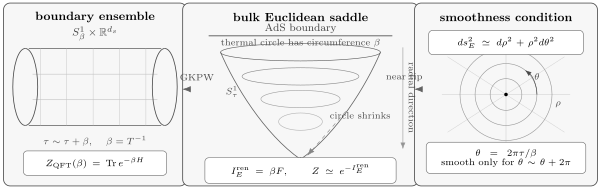
A finite-temperature boundary theory lives on . The Euclidean black brane fills this boundary by a cigar geometry: the thermal circle is finite at the boundary and shrinks smoothly at the horizon. Near a nonextremal horizon, the geometry is locally , so smoothness fixes the period of Euclidean time and therefore the Hawking temperature.
Black holes versus black branes
Section titled “Black holes versus black branes”A black hole has a compact horizon. In four asymptotically flat dimensions the Schwarzschild horizon is an . In global AdS, the Schwarzschild-AdS horizon is similarly spherical, with topology .
A black brane has a planar, translationally invariant horizon. The spatial horizon topology is
or, after putting the boundary theory in a box, a very large torus . The horizon area is infinite in infinite volume, so the natural quantities are densities:
This is exactly what we want for quantum matter. Condensed-matter thermodynamics is usually about extensive systems and their intensive densities, not isolated finite black holes.
The difference is more than vocabulary. Compact black holes have long-range gravitational self-interactions that make their thermodynamics look unusual from the standpoint of ordinary extensive systems. Planar black branes, by contrast, behave much more like ordinary thermodynamic media. Their entropy, energy, and free energy are extensive in the boundary volume, and their thermodynamic relations take the familiar density form.
The Lorentzian black brane
Section titled “The Lorentzian black brane”The neutral planar AdS black brane in is
where
The conformal boundary is at
and the horizon is at
The coordinate increases toward the infrared of the boundary theory. Thus the horizon position is an infrared scale. A smaller means a hotter state; a larger means a colder state.
It is often useful to use the inverse radial coordinate
Then the same geometry is written as
with
In coordinates the boundary is at , and the infrared lies at smaller . Both coordinate systems are common in the literature. This course will usually use when emphasizing boundary RG intuition and when matching older black-brane formulas.
Temperature from Euclidean smoothness
Section titled “Temperature from Euclidean smoothness”The cleanest derivation of the temperature is Euclidean. Wick rotate
The Euclidean metric becomes
Near the horizon, write
Since
the part of the metric is, up to the harmless overall factor ,
Now define a proper radial coordinate by
Then
and
Therefore the near-horizon Euclidean geometry is
where
This is locally flat polar space times , but only if has period . Otherwise the geometry has a conical singularity at . Smoothness requires
so
The Euclidean time period is the inverse temperature. Hence
Equivalently, in coordinates,
This derivation is worth remembering. Holographic temperature is not an arbitrary label attached to a black brane. It is the unique Euclidean periodicity that makes the saddle regular.
The general nonextremal horizon formula
Section titled “The general nonextremal horizon formula”The same idea works for any static nonextremal horizon. Suppose the Euclidean metric near the horizon has the form
where is the horizon and
with . Then define
The two-dimensional part becomes
Smoothness gives
and therefore
For the black brane in coordinates,
Near , the coefficients satisfy
so the general formula again gives
For an extremal horizon the expansion is different. Typically has a double zero rather than a simple zero. The Euclidean cigar turns into an infinite throat, and the smoothness argument no longer fixes a finite period. This caveat will matter later for extremal Reissner-Nordström AdS branes and throats.
Temperature as surface gravity
Section titled “Temperature as surface gravity”In Lorentzian signature, the same temperature can be written as
where is the surface gravity of the horizon. For the static metric above, this gives the same result as the Euclidean computation.
The Euclidean derivation is often more useful in holographic thermodynamics because the thermal partition function is naturally Euclidean. The Lorentzian derivation is often more useful in real-time response, where the future horizon and infalling boundary conditions select the retarded Green’s function.
The two viewpoints agree because they are different analytic continuations of the same regular geometry.
Entropy from horizon area
Section titled “Entropy from horizon area”The Bekenstein-Hawking entropy is
For a planar black brane, the horizon area is infinite, so we compute the entropy density. At , the induced spatial metric along the boundary directions is
Thus
The entropy density is therefore
Using the temperature relation,
we get
This is precisely the scaling expected of a relativistic CFT in spatial dimensions:
The normalization is proportional to
In top-down examples this ratio counts the large number of deconfined degrees of freedom, typically of order for adjoint gauge theories. This is why the entropy is classical in the bulk and leading order in the boundary large- expansion.
Energy, pressure, and free energy
Section titled “Energy, pressure, and free energy”For a homogeneous relativistic thermal state, the stress tensor takes the perfect-fluid equilibrium form
Conformal invariance implies
so
Therefore
For the planar AdS black brane, holographic renormalization gives
and hence
The free energy density is
For a homogeneous system,
so
In terms of temperature,
This is again the CFT scaling
The pressure is positive, so the free energy density is negative relative to the zero-temperature vacuum normalization.
Checking the first law
Section titled “Checking the first law”The first law for densities is
at zero chemical potential and fixed volume. Let us verify it.
From the black brane formulas,
and
Differentiate with respect to :
and
Their ratio is
So
The enthalpy density is
Using ,
But
Thus
This relation will reappear constantly in hydrodynamics and transport.
The Euclidean action and the free energy
Section titled “The Euclidean action and the free energy”The bulk action has three pieces:
The bulk term is the Euclidean Einstein-Hilbert action with negative cosmological constant. The Gibbons-Hawking-York term makes the Dirichlet variational problem well defined: one fixes the boundary metric and varies the bulk metric. The counterterm action cancels divergences as the cutoff surface approaches the AdS boundary.
Schematically,
and
Here is the induced metric on the cutoff boundary and is the trace of its extrinsic curvature. The counterterms are local functionals of and, when needed, boundary values of matter fields.
The semiclassical gravitational partition function is
The thermodynamic relation
therefore gives
For the planar black brane, the renormalized on-shell action gives
Thus
This equality is conceptually important. The same geometry that determines the temperature by smoothness and the entropy by area also determines the free energy by its on-shell action.
Why counterterms are not optional
Section titled “Why counterterms are not optional”The raw gravitational action is divergent because asymptotically AdS spacetime has infinite volume. This is not a bug in holography; it is the bulk image of UV divergences in the boundary field theory.
The standard procedure is holographic renormalization:
- Place a cutoff surface at .
- Evaluate the bulk action plus the Gibbons-Hawking-York term on the regulated geometry.
- Add local counterterms on the cutoff surface.
- Take .
The counterterms remove UV-divergent local pieces and define a finite generating functional. Thermodynamic differences and expectation values then become well defined.
For flat boundary geometry, the leading counterterm is simply proportional to the boundary volume:
For curved boundaries, additional curvature counterterms appear. For matter fields, additional counterterms are needed depending on their near-boundary falloff.
One practical moral is simple: whenever a holographic free energy is quoted, it is the renormalized on-shell action that is meant.
The boundary stress tensor
Section titled “The boundary stress tensor”The same renormalized action gives the expectation value of the boundary stress tensor. Vary the renormalized on-shell action with respect to the boundary metric:
with a sign convention depending on Lorentzian versus Euclidean continuation. Here is the metric on which the boundary QFT lives.
For the planar black brane with flat boundary metric, the result is the diagonal thermal stress tensor already quoted:
where
This is a helpful distinction:
while
The horizon determines entropy. The asymptotic falloff determines energy and pressure. Thermodynamics ties them together.
Planar versus global AdS thermodynamics
Section titled “Planar versus global AdS thermodynamics”The planar black brane is dual to a CFT in infinite flat space. The relevant boundary geometry is
If instead the boundary theory is placed on a spatial sphere,
the bulk saddles include thermal global AdS and spherical Schwarzschild-AdS black holes. Their competition produces the Hawking-Page transition. In the boundary theory, this is interpreted as a confinement/deconfinement transition in suitable large- gauge theories on compact space.
For the planar black brane, there is no analogous finite-volume scale. The only scale is , and the deconfined black-brane saddle dominates the homogeneous thermal physics at any nonzero temperature in the usual infinite-volume CFT setup.
This distinction prevents a common confusion. Not every AdS black object describes the same ensemble:
whereas
The local physics of a very large spherical AdS black hole resembles a planar black brane, but the global thermodynamic phase structure is different.
Coordinate time and proper temperature
Section titled “Coordinate time and proper temperature”The black brane metric is not asymptotically flat. Near the boundary,
The proper time at fixed cutoff is redshifted relative to the coordinate time:
So the local proper temperature associated with a static observer near the boundary is redshifted. In holography, however, the boundary QFT time is the coordinate after stripping off the conformal factor. The physical field-theory temperature is the inverse period of this coordinate time:
Thus, when we quote the Hawking temperature of an AdS black brane as the boundary temperature, we mean the temperature conjugate to the boundary Hamiltonian defined with respect to .
Why the horizon is an infrared object
Section titled “Why the horizon is an infrared object”The radial direction geometrizes scale. Very roughly,
The horizon position therefore corresponds to an energy scale
This is why thermal effects appear as an infrared cutoff in the bulk. In pure Poincaré AdS, the geometry extends indefinitely toward . At finite temperature, the classical exterior geometry ends at .
This does not mean that the boundary theory has no physics below . It means that, for the thermal state and classical exterior observables, the horizon supplies the IR boundary condition. For real-time response, this boundary condition is infalling at the future horizon. For Euclidean thermodynamics, it is smoothness at the cigar tip.
This same idea will recur in increasingly sophisticated forms:
What is universal and what is model-dependent?
Section titled “What is universal and what is model-dependent?”Several facts are universal within classical two-derivative Einstein gravity with asymptotic AdS boundary conditions:
- Euclidean smoothness fixes the temperature.
- Horizon area gives the leading entropy.
- The renormalized on-shell action gives the free energy.
- The boundary stress tensor comes from varying the renormalized action.
- A planar CFT thermal state satisfies .
Other facts are model-dependent:
- The coefficient multiplying in the entropy density.
- The exact free-energy normalization.
- The spectrum of quasinormal modes.
- The values of transport coefficients beyond symmetry constraints.
- The existence of phase transitions or instabilities.
Higher-derivative gravity modifies the entropy functional from the simple area law to the Wald entropy or more general entropy functionals. Matter fields can change the thermodynamics. A chemical potential changes the black brane from neutral to charged. Explicit translation breaking can make the horizon inhomogeneous. None of these complications undermine the basic logic; they refine it.
A worked example:
Section titled “A worked example: ds=3d_s=3ds=3”For a dimensional boundary CFT, the bulk is , and
The temperature is
The entropy density is
The pressure and energy density are
and
For the canonical dual of large- super-Yang-Mills theory, one has
more precisely
Then
and
The numerical coefficients are special to this top-down theory and its strong-coupling, large- limit. The scaling powers and conformal equation of state are not special.
The thermodynamic dictionary
Section titled “The thermodynamic dictionary”For the neutral black brane, the basic entries are:
| Boundary quantity | Bulk quantity |
|---|---|
| Temperature | Euclidean time periodicity required by smoothness |
| Entropy density | Horizon area density divided by |
| Free energy density | Renormalized on-shell Euclidean action divided by |
| Energy density | Boundary stress tensor from near-boundary metric data |
| Pressure | Spatial components of the boundary stress tensor |
| Thermal scale | Horizon depth |
| Deconfined large- degrees of freedom | Classical horizon with area |
This dictionary is the static thermodynamic foundation for everything that follows. Transport will require perturbing the same background.
Common pitfalls
Section titled “Common pitfalls”Pitfall 1: thinking Euclidean time is optional. For thermodynamics, Euclidean time is the cleanest definition of the ensemble. The period is not chosen after the fact; it is fixed by regularity of the saddle.
Pitfall 2: forgetting the difference between densities and extensive quantities. A planar black brane has infinite horizon area in infinite volume. The physical thermodynamic variables are densities such as , , and .
Pitfall 3: confusing the bulk proper temperature with the boundary temperature. In AdS/CFT, the boundary temperature is conjugate to the boundary coordinate time after the conformal factor is removed.
Pitfall 4: using the compact black-hole intuition too literally. Planar black branes obey ordinary extensive thermodynamic relations much more directly than compact asymptotically flat black holes.
Pitfall 5: ignoring counterterms. The gravitational action and stress tensor are divergent before holographic renormalization. A finite free energy means a renormalized on-shell action.
Pitfall 6: applying the cigar argument to extremal horizons without care. Extremal horizons have different near-horizon geometry. They are not ordinary smooth cigars with a finite thermal period.
Exercises
Section titled “Exercises”Exercise 1: Smoothness of a general nonextremal horizon
Section titled “Exercise 1: Smoothness of a general nonextremal horizon”Consider a Euclidean metric whose near-horizon two-dimensional part is
where is the horizon and
with . Derive the temperature.
Solution
Define
Then
The radial term becomes
The angular term becomes
Thus
Smoothness requires . Therefore
and
Exercise 2: Temperature of the planar AdS black brane
Section titled “Exercise 2: Temperature of the planar AdS black brane”For
derive
Solution
Set with . Then
Near the horizon,
and
So
Using the result of Exercise 1,
Exercise 3: Entropy density and the first law
Section titled “Exercise 3: Entropy density and the first law”Using
show that
Solution
Differentiate with respect to :
and
Then
But the black-brane temperature is
Therefore
Exercise 4: Free energy from conformal thermodynamics
Section titled “Exercise 4: Free energy from conformal thermodynamics”Assume a homogeneous thermal CFT has
and
Show that the free energy density is and that .
Solution
The thermodynamic identity at zero chemical potential is
Using ,
The first law gives
It is also useful to use
Since , the enthalpy relation gives
Thus
Substitute into :
Integrating,
Therefore
Exercise 5: Convert between and coordinates
Section titled “Exercise 5: Convert between zzz and rrr coordinates”Starting from
show that
Solution
The temperature in coordinates is
Since ,
The entropy density is
Again using ,
Thus
Exercise 6: The black brane equation of state
Section titled “Exercise 6: The AdS5AdS_5AdS5 black brane equation of state”Set . Use
Find , , and .
Solution
Since
we have
The entropy density is
Equivalently, this is
Conformal invariance gives
Further reading
Section titled “Further reading”- Makoto Natsuume, AdS/CFT Duality User Guide, chapters 3 and 7. A very clear route from Euclidean black-hole thermodynamics to AdS black-brane equilibrium thermodynamics.
- Jan Zaanen, Yan Liu, Ya-Wen Sun, and Koenraad Schalm, Holographic Duality in Condensed Matter Physics, chapter 6. Especially useful for the finite-temperature dictionary and the intuition behind the Euclidean cigar.
- Martin Ammon and Johanna Erdmenger, Gauge/Gravity Duality, chapters 11 and 12. A textbook treatment of finite-temperature holography, holographic thermodynamics, and the transition to linear response.
- Thomas Hartman, Lectures on Quantum Gravity and Black Holes, lectures on Hawking radiation, Euclidean path integrals, and AdS black-hole thermodynamics.