
Magnetic Fields, Hall Transport, and Anomalies
Magnetic fields are an unusually efficient probe of holographic quantum matter. A chemical potential asks whether the theory can carry charge. A magnetic field asks something sharper: how charge, momentum, heat, parity, time reversal, topology, and anomalies talk to one another.
On the boundary, a magnetic field is an external source for the conserved current. In the bulk, the same source is a magnetic component of the Maxwell field. A finite-density state with both electric flux and magnetic flux is therefore described by a dyonic black brane:
That sentence hides two important asymmetries. The charge density is a response: it is the radial electric flux conjugate to the boundary value of . The magnetic field is a source: it is part of the non-normalizable boundary value of the spatial gauge field. Mixing those two facts is the quickest way to get confused about Hall response.
This page has three goals. First, it explains the magnetic-field dictionary and the dyonic black brane. Second, it explains Hall and magnetothermal transport, including the momentum bottleneck, cyclotron poles, and magnetization-current subtraction. Third, it explains how Chern—Simons terms in the bulk encode chiral anomalies and anomaly-induced transport such as the chiral magnetic and chiral vortical effects.
Throughout the first half of the page the boundary theory has two spatial dimensions, with coordinates and . Later we discuss -dimensional anomalous matter. To avoid a notation collision, denotes charge density, while denotes the resistivity matrix.
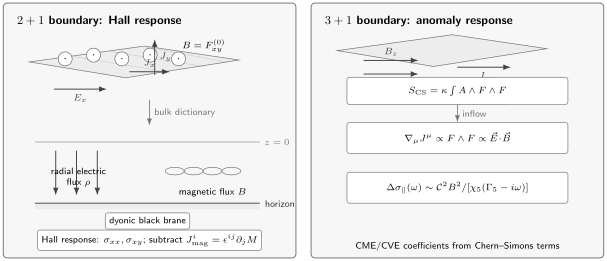
Magnetic response as a holographic source-response problem. The boundary magnetic field is the source , while the charge density is the radial electric flux. Dyonic horizons compute Hall response in dimensions. In one higher boundary dimension, bulk Chern—Simons terms encode anomalous currents such as and .
The magnetic-field dictionary
Section titled “The magnetic-field dictionary”A conserved boundary current is dual to a bulk gauge field . For a bulk action of the schematic form
the near-boundary value of sources :
The boundary electric and magnetic fields are built from this source:
In a translationally invariant -dimensional state, a constant magnetic field can be represented by
This gauge choice is not translationally invariant, but the field strength is. The gauge-invariant source is , not the potential itself.
The expectation value of the current is the canonical radial momentum of the bulk gauge field, plus possible counterterm and topological contributions:
For the charge density,
Thus electric flux near the boundary is a response, while magnetic flux near the boundary is a source. The same bulk field knows about both, but they sit on opposite sides of the holographic source-response relation.
Dyonic black branes
Section titled “Dyonic black branes”The minimal model for a charged -dimensional quantum critical state in a magnetic field is Einstein—Maxwell theory in four bulk dimensions:
A planar dyonic Reissner—Nordström-AdS solution may be written schematically as
The condition is the regular Euclidean gauge at the horizon. The boundary value of is the chemical potential,
and the radial electric flux determines the charge density. The magnetic field enters the stress tensor and therefore the blackening function . At zero temperature, the simple dyonic brane has an near-horizon region, much like the purely electric charged brane. The additional magnetic flux changes the thermodynamics and transport, but it does not remove the basic charged-horizon logic.
The field strength is
This is why the geometry is called dyonic: it carries both electric and magnetic flux. In four bulk dimensions, electric-magnetic duality rotates these two fluxes into one another. On the -dimensional boundary, this is closely related to particle-vortex duality and to the modular transformations that act on the complex conductivity in special theories.
The important physical point is simple. In a magnetic field, the retarded correlator of currents no longer has to be symmetric in spatial indices. Hall response is allowed.
Hall conductivity and the conductivity tensor
Section titled “Hall conductivity and the conductivity tensor”In an isotropic -dimensional state with broken time reversal, the electric conductivity tensor has the form
Equivalently,
The inverse matrix is the resistivity tensor:
In experiments, one often quotes the Hall angle
up to sign conventions. The Hall angle is useful because it compares transverse and longitudinal relaxation. In a simple Drude metal it is controlled by the cyclotron frequency times the scattering time. In a strongly coupled metal, especially one with an incoherent conductivity , the Hall angle can scale differently from the longitudinal conductivity.
The clean limit: Hall drift from force balance
Section titled “The clean limit: Hall drift from force balance”The magnetic field changes the momentum Ward identity. In a fixed background electromagnetic field,
For spatial momentum in a homogeneous state,
The first term is the electric force on charge. The second is the Lorentz force. The magnetic field does no work because
is transverse to the electric field after the force-balance condition is imposed.
In a clean DC steady state there is no external momentum sink. Therefore force balance requires
Solving gives
Thus
for the ideal drift contribution. This current is nondissipative: it is the many-body version of drift. This result is not a statement that the system has no microscopic dissipation. It is a statement that in a clean, homogeneous, static setup the Lorentz force can balance the electric force without entropy production.
This is one of those places where holography is clarifying but also unforgiving. If the system is translationally invariant, the transport coefficients are constrained by momentum conservation. If one wants an ordinary finite longitudinal DC resistivity, one must add a momentum relaxation mechanism, such as disorder, a lattice, axions, or explicit impurities.
Cyclotron poles without quasiparticles
Section titled “Cyclotron poles without quasiparticles”At nonzero frequency, the magnetic field produces collective cyclotron motion. In a relativistic charged fluid with energy density , pressure , charge density , and intrinsic quantum-critical conductivity , the small- cyclotron pole is
with
The denominator is the relativistic momentum susceptibility,
This cyclotron pole is not a quasiparticle cyclotron resonance. It is a hydrodynamic collective mode. Its damping is controlled by the intrinsic ability of the fluid to conduct charge independently of momentum. In a particle-hole-symmetric quantum critical fluid, electron-hole creation and annihilation processes are exactly what make meaningful. In a Galilean single-species metal, by contrast, the electric current is locked to momentum and the analogous intrinsic channel is absent.
With weak momentum relaxation rate , the pole is shifted schematically to
This is the hydrodynamic way to read holographic magnetotransport: the poles of the retarded Green’s functions move in the complex frequency plane as , , , and vary. The calculation in the bulk is a quasinormal-mode problem for coupled gauge-field and metric perturbations,
with infalling horizon boundary conditions and source-response data at the boundary.
Weak momentum relaxation and the Hall angle
Section titled “Weak momentum relaxation and the Hall angle”Suppose momentum relaxes slowly. The hydrodynamic momentum equation becomes
If the current is dominated by momentum drag,
then the DC Drude-like conductivities are
Therefore
This is a clean diagnostic of the momentum bottleneck. The Hall response is not just a property of charged carriers; it is a property of the slow variables that carry current. If momentum is the slow variable, knows about . If there is a large incoherent current, contributes to and can make the longitudinal conductivity scale differently from the Hall angle.
That possibility is one reason holographic magnetotransport has been useful in strange-metal phenomenology. It separates three timescales that are often collapsed together in simple Drude reasoning:
| Quantity | Physical role |
|---|---|
| local equilibration or Planckian scale | |
| momentum relaxation time | |
| intrinsic charge-current relaxation in a magnetic field |
No single one of these is automatically the experimentally measured transport lifetime.
Thermoelectric response and the Nernst signal
Section titled “Thermoelectric response and the Nernst signal”Magnetic fields also mix electric and heat transport. A convenient linear-response convention is
Here
is the heat current. In a magnetic field, each matrix has longitudinal and Hall parts:
The experimentally relevant thermal conductivity is often not but the open-circuit thermal conductivity , defined at :
Similarly, the Seebeck and Nernst effects are open-circuit responses: one imposes and measures the electric field generated by a temperature gradient. This matters because a holographic computation naturally gives the full current response to sources, while an experiment may impose different boundary conditions.
Magnetization currents are not transport currents
Section titled “Magnetization currents are not transport currents”Magnetic fields introduce a subtle but essential distinction. Equilibrium systems can have circulating magnetization currents. In two spatial dimensions,
where is the magnetization density. These currents are real local currents, but they do not transport net charge across the sample. They circulate near boundaries or around inhomogeneities.
For heat transport one must similarly subtract heat magnetization currents,
The transport currents are therefore
This subtraction is not optional. Kubo formulas in a magnetic field can otherwise include equilibrium circulating currents, especially in thermoelectric and thermal Hall coefficients. Modern holographic DC calculations are organized to return transport currents, often by expressing radially conserved electric and heat currents in terms of horizon data after the magnetization pieces have been separated.
A good practical rule is this:
Many apparent disagreements between formulas disappear once this rule is enforced.
Horizon DC formulas
Section titled “Horizon DC formulas”One of the most powerful developments in applied holography is that DC transport can often be computed entirely from horizon data. With magnetic fields and translation breaking, the general story is:
- Perturb the black brane by constant electric fields and thermal sources .
- Solve the constraint equations on the horizon.
- Construct radially conserved electric and heat currents.
- Evaluate those currents at the horizon, where regularity fixes them algebraically or through horizon Stokes equations.
For homogeneous momentum-relaxing models, such as linear axion models, this gives closed-form conductivities depending on horizon entropy density , charge density , magnetic field , axion strength , and horizon couplings. For genuinely inhomogeneous lattices, the horizon problem becomes a forced Stokes flow on the black-hole horizon. The result is still local to the horizon, but solving it may require PDE numerics.
This is a beautiful part of the subject because it turns a strongly coupled boundary transport problem into a classical horizon-fluid problem. It is also a place where model status matters. A homogeneous axion model can capture momentum relaxation efficiently, but it is not a literal lattice. A fully inhomogeneous holographic lattice is more microscopic but technically harder.
Magnetic fields in dimensions
Section titled “Magnetic fields in 3+13+13+1 dimensions”In boundary dimensions, a magnetic field is a vector. It breaks spatial rotations from to about the direction of . The conductivity tensor can now have three structures:
Here is the conductivity along the magnetic field, is transverse to it, and is the Hall conductivity in the transverse plane.
This distinction is crucial for Weyl semimetals and anomalous transport. An axial anomaly produces a special contribution to , not to the ordinary transverse Hall conductivity. The relevant experimental signature is often called negative longitudinal magnetoresistance: the resistivity along decreases as is increased.
Chern—Simons terms and boundary anomalies
Section titled “Chern—Simons terms and boundary anomalies”Now move to a -dimensional boundary theory, dual to a five-dimensional bulk. A bulk Chern—Simons term has the form
Under a gauge transformation ,
According to the holographic dictionary, the boundary variation of the generating functional is the anomaly. In components,
up to normalization conventions for and .
This is anomaly inflow in holographic form. The bulk action is gauge invariant up to a boundary term. The boundary theory is allowed to have an anomalous current because the anomaly is supplied by the bulk topological term.
There is a current-definition subtlety here. The consistent current is obtained by varying the generating functional and obeys Wess—Zumino consistency. The covariant current is obtained by adding a local Bardeen—Zumino polynomial and transforms covariantly under gauge transformations. In condensed matter applications, one often arranges counterterms so that the physical electromagnetic vector current is conserved, while an axial current is anomalous. The distinction is not cosmetic; it changes contact terms and equilibrium currents.
Chiral magnetic and chiral vortical effects
Section titled “Chiral magnetic and chiral vortical effects”An anomalous relativistic fluid has additional nondissipative terms in its constitutive relations. Define
where is the fluid velocity. Then the current can contain
The term is the chiral magnetic effect: a current parallel to a magnetic field. The term is the chiral vortical effect: a current parallel to vorticity. The coefficients are fixed by anomaly coefficients and thermodynamics. In a common single- normalization one has schematically
where is associated with a mixed gauge-gravitational anomaly. The exact-looking numerical coefficients in these formulas depend on normalization, current choice, and frame. The robust statement is that anomaly-induced transport is nondissipative and fixed by topological data, not by an ordinary scattering time.
In the bulk, these coefficients are obtained by solving for perturbations of charged AdS black branes in the presence of Chern—Simons terms. The Chern—Simons term changes the radial conservation law for the current, and the horizon regularity condition fixes the response. This is a rare situation where a macroscopic hydrodynamic coefficient knows directly about a microscopic quantum anomaly.
Weyl semimetals and negative longitudinal magnetoresistance
Section titled “Weyl semimetals and negative longitudinal magnetoresistance”Weyl semimetals provide a condensed-matter setting where anomaly language becomes physically concrete. Near a Weyl point, low-energy fermions behave as chiral relativistic fermions. In a magnetic field, an electric field parallel to pumps charge between nodes of opposite chirality:
Here is the axial current, is an axial charge relaxation rate, is an axial susceptibility, and is an axial chemical potential. In a steady state,
The chiral magnetic effect then gives an additional vector current along the magnetic field,
Thus
At nonzero frequency this becomes a relaxation pole of the schematic form
This is the anomaly-induced origin of negative longitudinal magnetoresistance. It is powerful, but it comes with caveats. In a lattice system the total anomaly must cancel across the Brillouin zone; axial charge is at best approximately conserved at low energies. Disorder, current jetting, sample geometry, and ordinary orbital magnetoresistance can mimic or obscure the effect. Holography is useful here not because it literally derives every Weyl material, but because it gives controlled strongly coupled models where anomaly, relaxation, and hydrodynamics can be separated cleanly.
Hall response, Chern—Simons contact terms, and topology in dimensions
Section titled “Hall response, Chern—Simons contact terms, and topology in 2+12+12+1 dimensions”There is another role for Chern—Simons terms in dimensions. A boundary contact term
contributes a Hall current
This shifts the Hall conductivity by a contact term. In a fully dynamical compact gauge theory, the level is quantized by large gauge transformations. In a holographic CFT with a background global symmetry source, the allowed contact terms depend on the global structure of the symmetry and on whether one gauges the boundary .
This is why statements about should specify the current normalization and contact-term convention. The dissipative longitudinal conductivity is usually insensitive to such shifts, but the Hall conductivity is not.
What magnetic fields teach you
Section titled “What magnetic fields teach you”Magnetic response is valuable because it diagnoses several mechanisms at once.
First, it distinguishes momentum drag from incoherent current. In a clean finite-density system, electric current can overlap strongly with momentum. The Hall angle reveals how the slow momentum mode precesses and relaxes.
Second, it detects particle-vortex or electric-magnetic dualities in dimensions. The dyonic brane is the simplest arena where electric and magnetic flux are treated on nearly equal footing in the bulk, even though they have different source-response roles at the boundary.
Third, it exposes the difference between transport and equilibrium magnetization. Thermal Hall and Nernst calculations are especially unforgiving here.
Fourth, in dimensions it couples directly to anomalies. The parallel conductivity in a Weyl-like system is not just a Drude coefficient; it can be controlled by anomaly-induced charge pumping and axial relaxation.
Common pitfalls
Section titled “Common pitfalls”Pitfall 1: Treating like another density. The boundary magnetic field is a source. The charge density is a response. A dyonic brane carries both kinds of flux, but the dictionary treats them differently.
Pitfall 2: Forgetting momentum conservation. In clean finite-density systems, transport is dominated by slow momentum unless changes the force-balance problem or explicit relaxation is included.
Pitfall 3: Calling every circulating current a transport current. Magnetization currents are local equilibrium currents. Transport coefficients must use currents with magnetization pieces subtracted.
Pitfall 4: Ignoring current definitions in anomalous theories. Consistent and covariant currents differ by local terms. Vector gauge invariance, axial anomalies, and Bardeen counterterms must be fixed before comparing conductivities.
Pitfall 5: Overinterpreting negative magnetoresistance. A enhancement of is the hydrodynamic anomaly signature, but real materials have competing geometric and disorder effects.
Exercises
Section titled “Exercises”Exercise 1: Hall drift from force balance
Section titled “Exercise 1: Hall drift from force balance”Assume a clean homogeneous -dimensional charged fluid in a constant magnetic field. Starting from
show that the DC current is purely transverse and find .
Solution
Multiply the equation by . Using ,
Therefore
Renaming indices gives
The current is perpendicular to , so . In the convention
one finds
The sign may change if one reverses the convention for or the sign of .
Exercise 2: Magnetic fields do no work
Section titled “Exercise 2: Magnetic fields do no work”Use the Ward identity
to show that the magnetic part of the Lorentz force does not inject power.
Solution
The power injected into the fluid by external fields is the force dotted into the velocity associated with charge flow. At the level of electromagnetic work, the local power density is
The magnetic force is transverse to the current:
because is symmetric while is antisymmetric. Therefore a magnetic field can redirect current and momentum, but it cannot by itself perform work. Dissipation comes from the electric field through and from relaxation processes, not from alone.
Exercise 3: Drude Hall angle from momentum relaxation
Section titled “Exercise 3: Drude Hall angle from momentum relaxation”Assume
Derive the drag contribution to and .
Solution
Substitute into the steady momentum equation:
The inverse of is
Thus
Multiplying by gives
Therefore
Exercise 4: Magnetization currents carry no net transport
Section titled “Exercise 4: Magnetization currents carry no net transport”Let
in a two-dimensional sample. Explain why this current is locally nonzero but does not represent transport through the bulk of the sample.
Solution
The current is a curl. Its divergence vanishes identically:
For a cross-section , the integrated current depends only on boundary values of :
This is a boundary or circulating contribution. It can produce local equilibrium currents, especially near edges or in inhomogeneous fields, but it does not move charge from one reservoir to another. Transport coefficients should therefore use
The same logic applies to heat magnetization currents in thermal Hall and Nernst response.
Exercise 5: Anomaly inflow from a Chern—Simons term
Section titled “Exercise 5: Anomaly inflow from a Chern—Simons term”Consider
Show that a gauge transformation produces a boundary variation proportional to .
Solution
Since is gauge invariant under ,
Using ,
Therefore
In holography, this boundary variation is the anomalous variation of the generating functional. Hence the boundary current obeys
with the proportionality fixed by the normalization of the Chern—Simons coupling and the current.
Exercise 6: Axial relaxation and conductivity
Section titled “Exercise 6: Axial relaxation and B2B^2B2 conductivity”Assume an approximate axial charge obeys
If the chiral magnetic current is , derive the anomaly-induced contribution to the DC conductivity parallel to .
Solution
In a steady state,
Thus
The chiral magnetic current is
Therefore
This contribution increases the conductivity along , corresponding to a decrease in longitudinal resistivity when other channels are held fixed.
Further reading
Section titled “Further reading”For the dyonic AdS-RN solution, Hall transport, electric-magnetic duality, magnetotransport, Weyl semimetals, and anomaly-induced negative magnetoresistance, see Hartnoll, Lucas and Sachdev, Holographic Quantum Matter, sections 4.6 and 5.7. For a condensed-matter-facing account of anomaly-induced hydrodynamics, the chiral magnetic effect, and the chiral vortical effect, see Zaanen, Liu, Sun and Schalm, Holographic Duality in Condensed Matter Physics, section 7.4. For textbook discussions of Chern—Simons terms, chiral anomalies, and anomalous transport in gauge/gravity duality, see Ammon and Erdmenger, Gauge/Gravity Duality, sections 12.4 and 15.3.5, and Năstase, Introduction to the AdS/CFT Correspondence, section 1.6.