
Open Problems in Black Hole Information
Guiding question. After Page curves, islands, replica wormholes, entanglement wedge reconstruction, and holographic quantum error correction, what exactly remains open in the black hole information problem?
The modern subject is in a much better state than it was after Hawking’s original argument. We now have controlled semiclassical and holographic settings in which the fine-grained entropy of Hawking radiation is computed by a generalized entropy prescription and follows a Page curve. In those settings the relevant formula is not Hawking’s fixed-background entropy of exterior modes, but the island formula
This is a major achievement. But it is not the same as having a complete microscopic, dynamical, operational, and cosmological resolution of every black-hole-information question. The Page curve is an entropy statement. A full solution should also explain the microscopic Hilbert space, the correct gravitational operator algebras, the black hole interior, factorization in fixed theories, realistic evaporation beyond AdS+bath models, and the complexity of actually decoding the information.
A useful attitude is:
The modern calculation did not make the information problem disappear. It made the remaining questions sharper.
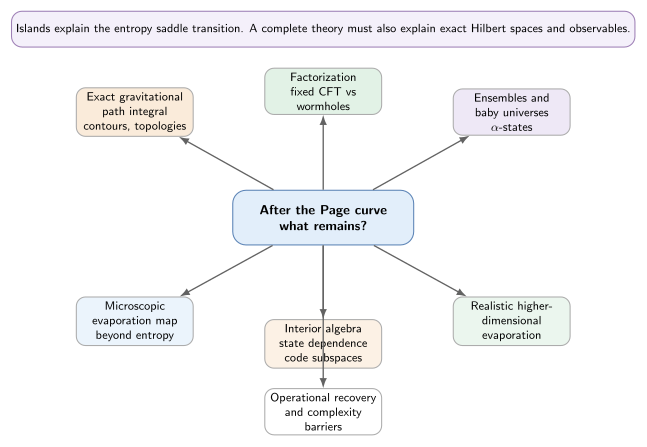
The remaining subject is not one puzzle but a network of connected problems. The island formula controls a fine-grained entropy in certain regimes. The deeper questions concern microscopic Hilbert spaces, gravitational algebras, interiors, factorization, complexity, realistic evaporation, and operational observables.
1. What has been achieved?
Section titled “1. What has been achieved?”Before listing open problems, it is worth being precise about what is no longer mysterious in the same way.
First, the semiclassical Hawking calculation computes the state of outgoing modes in a fixed evaporating geometry and traces over their interior partners. This gives a growing radiation entropy. The modern lesson is that this is not the complete fine-grained gravitational entropy. In a gravitational replica computation, additional saddles can dominate after the Page time.
Second, holographic entropy has a controlled hierarchy:
The island formula is the QES prescription applied to radiation systems where the dominant quantum extremal surface can jump so that a region behind the horizon becomes part of the entanglement wedge of the radiation.
Third, AdS/CFT strongly suggests that black hole formation and evaporation are unitary in theories with a precise holographic dual. The subtle part is no longer merely “can unitarity be true?” but rather “how is unitarity represented in semiclassical spacetime, and which low-energy assumptions fail?”
Fourth, quantum error correction has clarified why bulk locality can coexist with multiple boundary reconstructions. A bulk operator need not have one unique boundary representative. It can be a logical operator in a code subspace, with different reconstructions on different boundary regions. This is not a contradiction; it is the mechanism of subregion duality.
Finally, replica wormholes gave a calculational explanation for the Page curve in important models. The new saddles are not ordinary Lorentzian escape routes from the interior to the radiation. They are saddles in the replicated gravitational path integral used to compute .
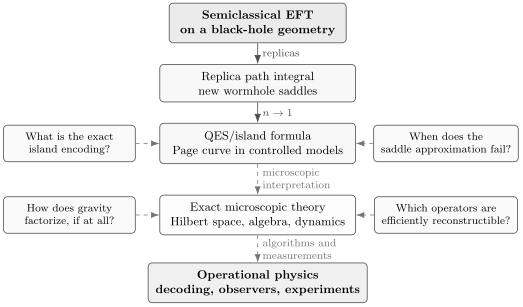
The Page curve in controlled models is a bridge between Hawking’s fixed-background calculation and an exact microscopic description. The open gaps are now more specific: the microscopic interpretation of islands, exact factorization, finite- corrections, efficient decoding, and operational observables.
2. The microscopic meaning of islands
Section titled “2. The microscopic meaning of islands”The island formula says which generalized entropy saddle computes . It does not, by itself, give a microscopic circuit that maps an interior operator into the radiation.
The sharp question is:
What is the UV-complete mechanism by which semiclassical degrees of freedom in an island are encoded in the radiation?
A satisfactory answer should explain at least five things.
- Which algebra is encoded. Is the radiation reconstructing a full local operator algebra in the island, a code-subspace algebra, an approximate algebra, or only certain low-energy observables?
- Which map implements the encoding. Is it an ordinary isometry, an approximate isometry, a non-isometric code, a postselected map, an ensemble-effective map, or something more algebraic?
- How complexity enters. If an operator in the island is reconstructible from the radiation, is the reconstruction exponentially complex? Does this protect the semiclassical interior from ordinary observers?
- What happens at finite . The semiclassical island formula is usually organized in powers of . Exact unitarity and exact factorization are sensitive to effects of order .
- How the story appears in a fixed microscopic theory. In AdS/CFT one would like to see the island encoding directly in a specific CFT Hilbert space, not only in a bulk replica saddle.
One should resist the sloppy phrase “the island is literally inside the radiation.” The better statement is that, in the relevant code subspace and for the relevant algebra, island operators have radiation representatives. That sentence is less flashy, but it is closer to the physics.
3. Factorization and Euclidean wormholes
Section titled “3. Factorization and Euclidean wormholes”In a fixed quantum theory, decoupled systems factorize. If two boundary theories are not coupled, one expects
Yet semiclassical Euclidean gravity can contain connected wormhole saddles joining separate asymptotic boundaries:
In an ensemble average this is natural, because
JT gravity provides a beautiful example: the gravitational path integral is completed by a matrix integral, and connected wormholes compute spectral correlations of the ensemble. The open problem is how to translate this lesson to ordinary fixed AdS/CFT pairs, where the boundary theory is not obviously an ensemble.
Several possibilities remain under active investigation:
- Euclidean wormholes may compute coarse-grained or effective-theory quantities rather than exact fixed-theory observables.
- Additional nonperturbative contributions may restore factorization.
- The correct integration contour may exclude or modify some saddles.
- Baby-universe sectors or -states may be the right intermediate language.
- A fixed microscopic theory may contain fine structure invisible to the semiclassical path integral.
This problem is not a side issue. Replica wormholes, islands, and factorization puzzles are different faces of the same question: what exactly is the gravitational path integral computing?
4. Interior observables and state dependence
Section titled “4. Interior observables and state dependence”The black hole interior is the part of the story where clean formulas become psychologically dangerous. Entropy calculations suggest that after the Page time, parts of the interior lie in the entanglement wedge of the radiation. But an infalling observer also expects a smooth local interior described by semiclassical effective field theory.
The hard question is:
What is the algebra of interior observables, and how is it represented in the microscopic theory?
There are several layers.
At the code-subspace level, different boundary reconstructions of the same logical bulk operator are not problematic. This is ordinary holographic QEC. But black hole interiors push the code to extremes: old black holes, large numbers of possible infalling excitations, backreacting observers, and operations of enormous complexity.
State-dependent proposals, such as mirror-operator constructions, try to build interior partners relative to a chosen equilibrium state or small algebra of simple operators. These proposals capture important features of the expected interior, but they raise difficult questions about linearity, large code subspaces, and what an observer can do after highly nontrivial measurements.
Island reconstruction gives a newer perspective: the post-Page interior partner may be reconstructed from radiation, while still appearing as a local partner mode in the semiclassical description. The challenge is to state this without duplicating degrees of freedom. The correct language is likely algebraic and code-subspace-dependent, not a naive tensor product
Open problems include:
- Is there a universal interior algebra, or only code-subspace-dependent interior algebras?
- What is the largest code subspace in which a smooth interior exists?
- Which form of state dependence is benign, and which form conflicts with linear quantum mechanics?
- Can one describe the experience of an infalling observer who carries a complicated decoder?
- How do singularity resolution and the final evaporation endpoint affect the interior dictionary?
5. Entropy, reconstruction, decoding, and experience are different
Section titled “5. Entropy, reconstruction, decoding, and experience are different”Many confusions in the literature come from compressing several different statements into one phrase: “the information comes out.” These statements are related, but they are not equivalent.
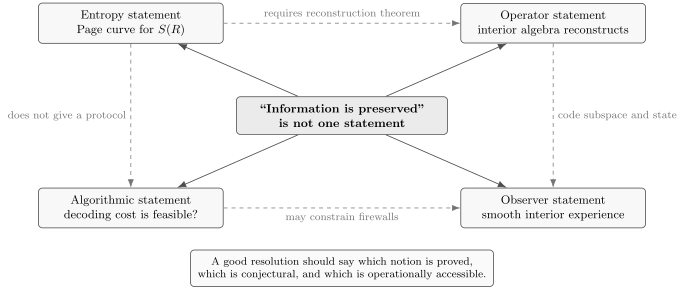
A Page curve, a reconstruction theorem, an efficient decoding algorithm, and a smooth infalling experience are different claims. A convincing research proposal should specify which claim it addresses.
The entropy statement says that the fine-grained radiation entropy follows a Page curve:
The operator statement says that some interior observables have representatives on the radiation algebra:
The algorithmic statement asks whether there is an efficient protocol to find or implement . This is where Harlow–Hayden, Python’s lunch, postselection, and complexity barriers enter.
The observer statement asks what a physical infaller experiences. This is sensitive to backreaction, measurement restrictions, state preparation, and whether the relevant operations fit within the lifetime of the black hole.
A Page curve alone does not give a decoder. A reconstruction theorem alone does not guarantee efficient decoding. Efficient decoding, if possible, does not automatically imply a violent horizon. The art is to keep these distinctions visible.
6. Complexity and operational access
Section titled “6. Complexity and operational access”The modern picture often says that information is present in the radiation but hard to decode. This is not hand-waving; it is a precise kind of distinction. A quantum error-correcting code can store information in a subsystem while making recovery computationally expensive. Similarly, black hole evaporation may be unitary while hiding information in high-complexity correlations.
Several open questions are especially important.
Can one prove useful lower bounds? The Harlow–Hayden argument suggests that decoding old Hawking radiation is exponentially hard under reasonable complexity assumptions. But proving black-hole-specific lower bounds is difficult, especially in models with gravity rather than abstract random circuits.
What is the bulk dual of decoding complexity? The Python’s lunch proposal relates complexity to barriers between quantum extremal surfaces, with estimates of the form
in appropriate settings. The extent and precision of this relation remain open.
What operations are allowed to observers? An observer outside the black hole, an asymptotic boundary theorist, and an infalling laboratory have different access to degrees of freedom. The operational meaning of “decoding the interior” depends on which agent is doing what, in which spacetime, with which resources.
How do complexity and state dependence interact? A reconstruction may be formally available but so complex that it never acts like a semiclassical operation. This may be essential for reconciling island reconstruction with no-drama.
7. Beyond AdS and beyond baths
Section titled “7. Beyond AdS and beyond baths”AdS/CFT gives the cleanest nonperturbative definition of quantum gravity, and AdS+bath models give an especially clean radiation subsystem. But the physical target is broader: asymptotically flat black holes, cosmological horizons, and black holes in our universe.
The flat-space problem is already subtle because radiation lives at future null infinity , where gravitational constraints, BMS charges, soft gravitons, and memory effects complicate the definition of subregion algebras. One can still define useful radiation algebras, wave packets, detector systems, or retarded-time intervals, but the exact factorization is not the same as in a nongravitating bath.
The de Sitter problem is even harder. There is no AdS-like spatial boundary with a standard boundary Hamiltonian. A static patch has a cosmological horizon and entropy,
but the microscopic interpretation of this entropy remains unsettled. Does it count states in a finite-dimensional Hilbert space? Is it observer-dependent? Is there a de Sitter analogue of entanglement wedge reconstruction? Do island-like saddles clarify or confuse quantum cosmology?
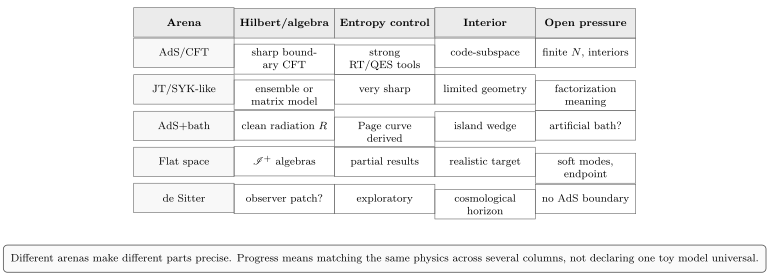
Different arenas make different parts of the problem precise. AdS/CFT is sharp microscopically, JT gravity is sharp calculationally, AdS+bath models are sharp for radiation entropy, flat space is the physical scattering target, and de Sitter raises the deepest cosmological questions.
8. Microstates, fuzzballs, and fine structure
Section titled “8. Microstates, fuzzballs, and fine structure”The island program is a semiclassical entropy calculation. String theory microstate programs address a different but related question: what are the microscopic states counted by ?
For supersymmetric and near-supersymmetric black holes, string theory has produced precise entropy counts and large families of horizonless microstate geometries. These results show that black hole entropy can have a microscopic origin in a UV-complete theory. But generic non-supersymmetric evaporation is much harder.
Important open questions include:
- Can the Page transition be seen directly in a microscopic string construction?
- Are islands a coarse-grained effective description of detailed microstate physics?
- How do fuzzball or microstate-geometry pictures reproduce QES and replica-wormhole calculations, if they do?
- What is the relation between ensemble-like semiclassical path integrals and specific microstate ensembles?
- Which features of black hole information are universal, and which depend on supersymmetry or special compactifications?
A careful comparison should avoid a false dichotomy. Microstate counting, horizonless geometries, QES formulas, and replica wormholes may be answering different layers of the same problem.
9. Finite- and the endpoint of evaporation
Section titled “9. Finite-NNN and the endpoint of evaporation”Most controlled gravitational calculations are asymptotic expansions in or . But exact unitarity, exact factorization, and the endpoint of evaporation are nonperturbative questions.
Effects of order
are invisible in ordinary perturbation theory but can control spectral discreteness, late-time correlations, and exact recovery of information. A major open task is to separate three kinds of effects:
- semiclassical effects captured by QES and replica saddles;
- nonperturbative gravitational effects captured by wormholes or branes in an effective path integral;
- exact UV-complete effects visible only in the microscopic theory.
The endpoint is especially delicate. The Page curve says that fine-grained entropy should decrease if evaporation is unitary and no hidden remnant sector stores information. It does not by itself describe the final Planckian stage, the resolution of the singularity, or the exact final state.
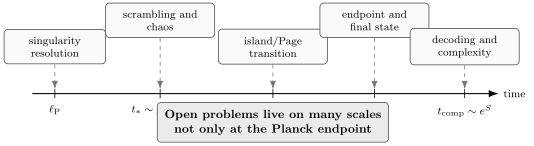
Open problems occur on many scales. The Page transition is not the same as the Planckian endpoint, and efficient decoding may involve timescales exponentially longer than the evaporation time.
10. Gravitational algebras and localization
Section titled “10. Gravitational algebras and localization”The information paradox is often stated using a factorization that is too naive:
In gravity, diffeomorphism constraints, gauge-invariant dressing, boundary charges, and edge modes complicate such a split. The more precise object is an algebra of observables, possibly with a center. Operator-algebra QEC suggests entropy decompositions of the schematic form
where is an area-like central operator and is the entropy associated with the reconstructed bulk algebra.
A complete black hole information theory should explain:
- what algebra is associated with a gravitating region;
- how asymptotic charges and soft modes enter radiation algebras;
- when edge modes are physical and when they are bookkeeping devices;
- how islands are expressed without pretending gravitational subregions factorize like nongravitating subsystems;
- how the area term appears as a central contribution in finite- quantum gravity.
This is likely one of the deepest mathematical frontiers of the subject.
11. The black hole -matrix and realistic observables
Section titled “11. The black hole SSS-matrix and realistic observables”For asymptotically flat black holes, a traditional target is a unitary -matrix mapping data at past null infinity to data at future null infinity:
But gravitational scattering requires dressed states, soft gravitons, BMS charges, and careful infrared definitions. A Page curve is not the same as an explicit -matrix. A complete theory should explain where the information appears in observables, not only in entropy.
There is no contradiction between exact purity and approximate thermality. Low-point correlators of Hawking radiation can look thermal while the exact state is pure. The information may be stored in high-point, nonlocal, or computationally complex correlations. This is why the operational problem is hard: one must specify which observables are being measured and with what precision.
12. A compact status table
Section titled “12. A compact status table”| Theme | What is relatively well understood | What remains open |
|---|---|---|
| Page curve | Islands and replica wormholes reproduce it in controlled settings. | Fully realistic four-dimensional derivations and endpoint physics. |
| Entanglement wedges | QES, JLMS, and QEC give a sharp semiclassical dictionary. | Finite- algebras, large code subspaces, and exact reconstruction. |
| Interior | QEC explains multiple reconstructions in code subspaces. | State dependence, infaller experience, and universal interior maps. |
| Complexity | Harlow–Hayden and Python’s lunch suggest protection mechanisms. | Rigorous decoding lower bounds in realistic gravity. |
| Factorization | Ensemble models explain connected wormholes naturally. | Fixed-CFT bulk path integrals and nonperturbative completion. |
| Microstates | String theory counts and constructs special black hole microstates. | Generic evaporation and relation to islands. |
| Beyond AdS | Partial flat-space and de Sitter island models exist. | Intrinsic radiation algebras, cosmological Hilbert spaces, and observables. |
13. How to choose a research problem
Section titled “13. How to choose a research problem”Because this topic is famous, vague questions sound profound very easily. A good research problem should specify five things.
The model. Is it AdS/CFT, JT gravity, a brane-world model, asymptotically flat gravity, de Sitter, a tensor network, or a random circuit?
The observable. Are you computing entropy, relative entropy, a modular Hamiltonian, an operator algebra, a scattering amplitude, a spectral statistic, or a recovery channel?
The approximation. Is the calculation classical, one-loop, perturbative in , nonperturbative in , finite , or exact in a toy model?
The operational task. Who is the observer? What degrees of freedom can they access? What time, energy, and complexity resources are allowed?
The failure mode. What would make the proposal wrong?
Here are examples of well-posed directions:
- Derive the island formula from a Lorentzian real-time path integral in a specified model.
- Construct an explicit radiation reconstruction map for a post-Page island operator and bound its complexity.
- Show how exact factorization is restored in a fixed holographic CFT while retaining useful semiclassical wormhole saddles.
- Define a radiation algebra at that includes soft-sector constraints and supports a Page-curve calculation.
- Identify the area operator and center in a finite- black hole code.
- Compare a microscopic string microstate ensemble with the QES saddle controlling its coarse-grained entropy.
14. Common pitfalls
Section titled “14. Common pitfalls”Pitfall 1: “The Page curve is solved, therefore the information problem is solved.”
The Page curve is an essential consistency check. The full problem also asks for microscopic dynamics, operator reconstruction, complexity, factorization, and realistic observables.
Pitfall 2: “The island is a local signal channel.”
The island is a region included in an entropy saddle and, in favorable settings, in the radiation entanglement wedge. It does not allow local signals to propagate from behind the horizon to the radiation.
Pitfall 3: “Replica wormholes are ordinary wormholes that particles travel through.”
Replica wormholes are saddles of a replicated Euclidean or semiclassical path integral used to compute entropy. They are not the same as traversable Lorentzian wormholes.
Pitfall 4: “All state dependence is bad.”
Code-subspace dependence is normal in holographic reconstruction. The hard question is which forms of state dependence remain compatible with linear quantum mechanics and operational consistency.
Pitfall 5: “A toy model resolving the paradox resolves the real universe.”
Toy models are valuable because they isolate mechanisms. Their lessons must be translated carefully to fixed AdS/CFT, asymptotically flat evaporation, and cosmology.
15. Exercises
Section titled “15. Exercises”Exercise 1. Four meanings of information recovery
Section titled “Exercise 1. Four meanings of information recovery”Explain the difference between the following four statements:
- follows a Page curve.
- Operators in an island can be reconstructed from .
- The reconstruction can be performed efficiently.
- An infalling observer experiences a smooth horizon.
Which implications are known, which are conjectural, and which are false without extra assumptions?
Solution
The Page curve is an entropy statement. It says that the fine-grained entropy of a chosen radiation system rises and then falls, as expected for a unitary evaporation process with no hidden remnant sector.
Island reconstruction is an operator statement. It says that an algebra of operators in the island has representatives on the radiation, usually within a code subspace and up to controlled errors. This is stronger than an entropy curve, but it depends on the reconstruction theorem and on specifying the algebra.
Efficient decoding is an algorithmic statement. Even if an operator exists on , implementing it may require time or circuit complexity exponential in . Harlow–Hayden and Python’s lunch arguments address this layer.
Smooth infall is an observer statement. It depends on the semiclassical state, backreaction, allowed measurements, and the code subspace. It is not implied by the Page curve alone. The logical chain is therefore not automatic:
Exercise 2. Factorization versus ensembles
Section titled “Exercise 2. Factorization versus ensembles”Suppose a gravitational path integral gives
Explain why this is natural for an ensemble average but puzzling for a fixed pair of decoupled CFTs.
Solution
For a fixed pair of decoupled systems, the Hilbert space and Hamiltonian factorize, so the partition function should factorize:
For an ensemble, however, one computes
A connected wormhole can naturally compute the covariance term. The puzzle is that ordinary AdS/CFT is expected to describe a fixed boundary theory, not an ensemble. Therefore one needs an explanation of what the wormhole contribution means in the fixed theory: coarse graining, omitted nonperturbative terms, baby-universe sectors, a refined path integral, or some other mechanism.
Exercise 3. A toy Page transition
Section titled “Exercise 3. A toy Page transition”Consider a simplified entropy competition
and
with . Compute the transition time and the resulting entropy curve.
Solution
The generalized entropy prescription chooses the smaller of the two candidate saddles after extremization. The transition occurs when
Thus
The entropy is
The transition is a saddle switch. It is not a local event at the horizon. In realistic models the two branches are smoothed by finite- effects and the formulas receive corrections, but the logic of competing saddles is the same.
Exercise 4. Algebraic formulation of the paradox
Section titled “Exercise 4. Algebraic formulation of the paradox”Rewrite the naive factorization
as an algebraic question. What data would one need to define the problem more precisely in quantum gravity?
Solution
Instead of assigning Hilbert-space tensor factors to spatial regions, one should specify an algebra of radiation observables and its commutant or complement. In gravity this algebra must be gauge invariant, so one must specify gravitational dressing, boundary conditions, charges, soft modes, and possible edge modes or centers.
The algebraic question is: what is the relation between , the algebra of black-hole/interior observables, and the asymptotic/boundary algebra of the full theory? If contains representatives of island operators on a code subspace, then the naive tensor product has overcounted independent degrees of freedom.
Thus the data needed include the observable algebra, the center, the allowed code subspace, the gravitational constraints, the dressing convention, and the approximation regime.
Exercise 5. Design a research project
Section titled “Exercise 5. Design a research project”Choose one open problem from this page and turn it into a precise research project. Specify the model, observable, approximation, operational question, and possible failure mode.
Solution
One possible project:
Problem. Define a radiation algebra at future null infinity for asymptotically flat evaporation and test whether a Page-curve calculation is meaningful.
Model. Four-dimensional asymptotically flat semiclassical gravity, perhaps simplified by spherical symmetry or a two-dimensional reduction.
Observable. Rényi entropies or modular quantities for an algebra of outgoing wave packets on , including a controlled treatment of soft modes.
Approximation. Semiclassical expansion with fixed background at early stages, then QES/island corrections. Infrared regulators are kept explicit.
Operational question. What would an asymptotic detector measure, and which modes count as part of the radiation subsystem?
Failure mode. The proposed algebra may fail to be gauge invariant, may secretly include Coulombic data from outside the intended region, or may depend too strongly on an infrared regulator.
That is a sharper question than “do islands work in flat space?”
16. Further reading
Section titled “16. Further reading”- R. Bousso, X. Dong, N. Engelhardt, T. Faulkner, T. Hartman, S. H. Shenker, and D. Stanford, Snowmass White Paper: Quantum Aspects of Black Holes and the Emergence of Spacetime, arXiv:2201.03096.
- A. Almheiri, T. Hartman, J. Maldacena, E. Shaghoulian, and A. Tajdini, The entropy of Hawking radiation, arXiv:2006.06872.
- G. Penington, Entanglement wedge reconstruction and the information paradox, arXiv:1905.08255.
- A. Almheiri, N. Engelhardt, D. Marolf, and H. Maxfield, The entropy of bulk quantum fields and the entanglement wedge of an evaporating black hole, arXiv:1905.08762.
- G. Penington, S. H. Shenker, D. Stanford, and Z. Yang, Replica wormholes and the black hole interior, arXiv:1911.11977.
- A. Almheiri, R. Mahajan, J. Maldacena, and Y. Zhao, The Page curve of Hawking radiation from semiclassical geometry, arXiv:1908.10996.
- A. Almheiri, X. Dong, and D. Harlow, Bulk locality and quantum error correction in AdS/CFT, arXiv:1411.7041.
- D. Harlow, The Ryu–Takayanagi formula from quantum error correction, arXiv:1607.03901.
- D. Harlow and P. Hayden, Quantum computation vs. firewalls, arXiv:1301.4504.
- A. R. Brown, H. Gharibyan, G. Penington, and L. Susskind, The Python’s Lunch: geometric obstructions to decoding Hawking radiation, arXiv:1912.00228.
- P. Saad, S. H. Shenker, and D. Stanford, JT gravity as a matrix integral, arXiv:1903.11115.
- D. Marolf and H. Maxfield, Transcending the ensemble: baby universes, spacetime wormholes, and the order and disorder of black hole information, arXiv:2002.08950.