
Large N, Horizons, and Model Status
The previous two pages introduced the physical ambition of holographic quantum matter and the condensed-matter vocabulary it tries to reorganize. This page explains the control parameters. It answers three practical questions that should be asked before trusting any holographic model of quantum matter:
- Why is a strongly coupled quantum many-body problem replaced by a classical gravitational problem?
- Why do horizons naturally encode thermalization, entropy, and dissipation?
- How should one read the status of a model: exact, top-down, consistently truncated, bottom-up, semi-holographic, or merely analogous?
The short answer is that classical holography needs two simplifications at once:
The first suppresses quantum fluctuations of the bulk fields. The second makes the bulk theory local and gravitational rather than a full string theory with infinitely many light fields. Horizons then arise as the dominant thermal saddles of this classical bulk theory.
Large is a classical limit, not automatically a weak-coupling limit
Section titled “Large NNN is a classical limit, not automatically a weak-coupling limit”It is tempting to hear “large ” and think “mean field,” hence “simple.” That is only partly right.
A useful large- theory has many degrees of freedom per spacetime point. In matrix large- theories, the elementary fields are adjoint matrices,
and gauge-invariant local operators are built from traces such as
These are called single-trace operators. Products such as are multi-trace operators.
The large- limit makes single-trace operators behave like classical collective variables. If they are normalized so that their expectation values are order one, then connected fluctuations are suppressed:
and more generally
with this normalization. Other normalizations shift the powers of , but the invariant statement is the same: connected correlators are parametrically smaller than products of lower correlators.
This is the quantum-field-theory version of a saddle-point limit. If the generating functional can be written schematically as
then as ,
where solves the classical saddle equations. Fluctuations around the saddle are suppressed by powers of .
This does not mean the boundary theory is weakly interacting. A vector large- model often becomes close to a theory of weakly interacting collective fields. A matrix large- theory can remain strongly interacting even though its collective variables are classical. That is the precious combination used in holography: a classical description of dynamics that need not have quasiparticles.
Why single-trace operators become bulk fields
Section titled “Why single-trace operators become bulk fields”The essential holographic dictionary says that for each single-trace operator there is a corresponding bulk field . A boundary source for is the boundary value of :
Here is the number of boundary spatial dimensions, so the boundary spacetime dimension is , and the bulk dimension is . The full statement is the GKPW relation,
At large , the bulk partition function is evaluated by a saddle:
where solves the bulk equations with the prescribed boundary behavior.
The most important bulk field is the metric . Its boundary value sources the stress tensor , so the stress tensor is dual to the graviton:
A conserved boundary current is dual to a bulk gauge field:
A scalar order-parameter operator is dual to a bulk scalar:
This is why bulk gauge symmetries are not optional decorations. A global symmetry in the boundary appears as a local gauge symmetry in the bulk. Boundary spacetime symmetries appear as asymptotic bulk diffeomorphisms. The bulk is a geometrized organization of the boundary’s collective operators and sources.
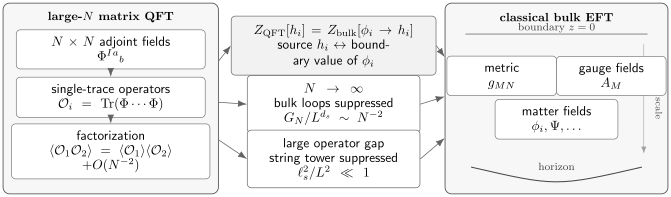
Large- matrix theories have classical single-trace collective variables. The holographic dictionary represents those variables as bulk fields in one higher dimension. Large suppresses bulk loops; a large single-trace operator gap suppresses stringy and higher-derivative corrections. Horizons then encode thermal entropy and dissipation at leading order in .
The two requirements for classical gravity
Section titled “The two requirements for classical gravity”The strongest version of the correspondence is not simply
Large only gives a classical bulk theory. The bulk theory could still be a classical string theory with infinitely many light modes and nonlocal-looking dynamics on the AdS scale. To get a simple gravitational effective field theory, one needs a second simplification.
Requirement 1: suppress bulk quantum loops
Section titled “Requirement 1: suppress bulk quantum loops”For a dimensional bulk with AdS radius ,
Equivalently,
Thus the effective bulk Planck constant is of order . Bulk loop corrections are the same physical expansion as corrections in the boundary theory.
This relation also explains why horizon entropy is large. A horizon area in AdS units gives
A classical black brane has order- entropy because it represents a deconfined large- plasma with order- active degrees of freedom.
Requirement 2: suppress stringy and higher-derivative corrections
Section titled “Requirement 2: suppress stringy and higher-derivative corrections”The second requirement is a gap in the spectrum of single-trace operators beyond the few operators represented by light bulk fields. In top-down examples this gap is controlled by the ratio of the AdS radius to the string length.
For the canonical example,
Thus
while
so massive string states are heavy in AdS units. Higher-derivative corrections are then suppressed by powers of
In a more general holographic theory, one may not know a microscopic string construction. The operational replacement for “large ” is:
This point is often more important than the literal value of a named coupling. The bulk is simple when most single-trace operators are heavy and can be integrated out.
Horizons as thermal large- saddles
Section titled “Horizons as thermal large-NNN saddles”A thermal state in a holographic theory is usually described by a black brane. The simplest neutral planar example is
with
The conformal boundary is at . The horizon is at . Its temperature is
and its entropy density is
This result has two interpretations at once. In the boundary theory, it is the entropy density of a thermal deconfined large- state. In the bulk, it is the Bekenstein—Hawking area density of the horizon. The equality is not an analogy; it is the same thermodynamic quantity written in the two dual languages.
The horizon also encodes dissipation. A perturbation sent from the boundary can fall through the future horizon. Classically, it does not come back. In linear response, this is implemented by infalling boundary conditions. The result is a retarded Green function with poles in the lower half of the complex frequency plane:
Those poles are quasinormal modes. They are the strongly coupled large- replacement for the quasiparticle poles of weakly interacting matter, except when a conservation law or symmetry protects a long-lived mode.
This is the source of much of holographic quantum matter’s power. It gives an explicit, computable class of systems where entropy, transport, and relaxation are controlled by a horizon rather than by a gas of long-lived particles.
What horizons do and do not mean
Section titled “What horizons do and do not mean”A horizon is not a little furnace hidden inside a material. It is the dual description of many boundary degrees of freedom that have become thermally and dynamically inaccessible to a small set of low-energy probes.
Three interpretations are especially useful:
| Boundary statement | Bulk statement | What it buys |
|---|---|---|
| The thermal state has order- entropy. | There is a horizon with area . | Thermodynamics from geometry. |
| Perturbations relax into many degrees of freedom. | Waves obey infalling conditions at the future horizon. | Retarded correlators and QNMs. |
| Charge, energy, or momentum can be hidden in a deconfined sector. | Flux can enter or emanate from a horizon. | Fractionalized and incoherent phases. |
The warning is equally important. If the real system has electrons, strong disorder, a small number of bands, or important lattice-scale degrees of freedom, the leading classical horizon may capture only a mechanism, not a microscopic description.
Top-down, bottom-up, and everything in between
Section titled “Top-down, bottom-up, and everything in between”A holographic calculation is not just an equation. It comes with a model status. The same bulk action can mean different things depending on how it was obtained.
| Status | What is specified? | What is fixed? | What can be concluded? |
|---|---|---|---|
| Exact/top-down duality | A string or M-theory construction and a known boundary theory. | Field content, couplings, charge quantization, operator map. | Controlled statements about that boundary theory. |
| Consistent truncation | A lower-dimensional bulk theory embedded in a full top-down model. | The retained-sector equations are guaranteed to solve the full equations. | Reliable retained-sector dynamics, but omitted modes can still contain instabilities. |
| Bottom-up model | A bulk action chosen from symmetries, fields, and desired IR behavior. | The assumed effective field theory. | Mechanisms, scaling regimes, and robust structures if insensitive to details. |
| Semi-holographic model | A conventional sector coupled to a holographic bath. | The bath dynamics and coupling structure. | Useful models of electrons interacting with non-quasiparticle critical degrees of freedom. |
| Phenomenological analogy | A gravitational result compared with experimental behavior. | Usually little microscopic data. | Intuition and possible organizing principles, not proof. |
The distinction matters most when the model is used to interpret experiments. Suppose a bottom-up model produces linear resistivity. That is a valid result in the model. It becomes a claim about a material only after additional tests: the correct symmetries, density dependence, thermodynamics, optical conductivity, Hall response, disorder dependence, and spectral functions.
Example: reading an Einstein—Maxwell—scalar model
Section titled “Example: reading an Einstein—Maxwell—scalar model”A common bottom-up action is
with
The dictionary is clear:
| Bulk ingredient | Boundary meaning |
|---|---|
| stress tensor and energy transport | |
| conserved current and chemical potential | |
| charged scalar operator, possible order parameter | |
| black brane horizon | thermal state and dissipation |
| scalar hair with source set to zero | spontaneous breaking of the symmetry |
If this action is simply written down because it is minimal and symmetry-allowed, then it is bottom-up. The scalar charge , mass , and gauge coupling are phenomenological parameters. The model can teach a real mechanism: a charged horizon can become unstable to scalar hair, producing a holographic superfluid or superconductor. But without an embedding, it does not tell you which microscopic operator condenses in a particular material.
If the same action is derived as a consistent truncation of a known string compactification, its status improves. The couplings are no longer arbitrary. Some operator identifications become sharper. Yet even then, a stable-looking solution inside the truncation may be unstable to a field outside the truncation. Top-down control reduces ambiguity; it does not remove the need for physical judgment.
Large- artifacts in holographic quantum matter
Section titled “Large-NNN artifacts in holographic quantum matter”Large is the reason the calculations are possible. It is also the source of several artifacts.
Mean-field-like transitions. At leading classical order, order-parameter fluctuations are suppressed. Critical exponents in holographic superconductors are often mean-field exponents unless an IR scaling region modifies them.
Order- entropy. A classical horizon describes a huge deconfined bath. This is appropriate for certain large- theories, but it is not the entropy count of a single-band electron model.
Suppressed bulk quantum effects. Fermion loops, quantum oscillations, Cooper instabilities from bulk Fermi surfaces, and other effects may be corrections. Sometimes such corrections dominate at very low temperature, so the leading classical geometry is not the final IR answer.
Sharp distinction between single-trace and multi-trace data. At , multi-trace effects factorize. At finite , they can mix and fluctuate.
Classical disorder is not full quantum disorder. A random source can be imposed at the boundary and solved for in the bulk, but sample-to-sample fluctuations and localization physics may require effects beyond the leading classical saddle.
These are not reasons to reject holography. They are reasons to read it correctly. A good holographic model is often a controlled large- laboratory for mechanisms that are hard to isolate elsewhere.
A checklist for new holographic models
Section titled “A checklist for new holographic models”When you meet a new holographic model, ask the following questions before interpreting the result.
| Question | Why it matters |
|---|---|
| What is the boundary theory or effective boundary data? | Without this, the model may only be phenomenological. |
| Which symmetries are exact, broken, gauged, or global? | Symmetries determine currents, Goldstone modes, and allowed transport. |
| Which operators are represented by light bulk fields? | The bulk field content is a claim about the important low-energy operators. |
| Is there a large single-trace gap? | Without it, two-derivative gravity may not be reliable. |
| Is the solution stable against omitted fields? | Consistent truncation solves equations, not necessarily stability. |
| What relaxes momentum? | Finite density plus exact translations gives infinite DC conductivity. |
| Which observables are compared? | One exponent is weak evidence; a constrained set of correlators is stronger. |
| What is the order of limits? | , , weak disorder, and small frequency limits may not commute. |
This checklist is one of the main tools of this course.
Common pitfalls
Section titled “Common pitfalls”Pitfall 1: “Large means weakly coupled.” No. Large suppresses fluctuations of collective variables. The saddle itself can be strongly interacting and have no quasiparticles.
Pitfall 2: “Classical gravity means the boundary is classical.” No. Classical bulk dynamics can encode strongly quantum boundary dynamics. The classicality is in the collective large- variables, not in the microscopic boundary degrees of freedom.
Pitfall 3: “A bottom-up action is arbitrary, so it teaches nothing.” Also no. A bottom-up model can sharply identify a mechanism. It becomes dangerous only when the mechanism is oversold as a microscopic explanation.
Pitfall 4: “A consistent truncation proves stability.” It proves that solutions of the truncated equations lift to solutions of the full equations. It does not prove that all omitted fluctuations are stable.
Pitfall 5: “The horizon is the quasiparticle bath.” The horizon is not a collection of quasiparticles. It is the geometric representation of many strongly interacting degrees of freedom into which perturbations can dissipate.
Exercises
Section titled “Exercises”Exercise 1 — Factorization from a large- saddle
Section titled “Exercise 1 — Factorization from a large-NNN saddle”Suppose
and define
Show that the connected two-point function of the normalized operator scales as .
Solution
At large , the saddle approximation gives
Therefore
is order one. The connected correlator of the normalized operator is obtained by another derivative:
Since is order at leading order,
so
Thus the variance of the normalized collective operator vanishes as , which is the factorization property.
Exercise 2 — When is the bulk classical Einstein gravity?
Section titled “Exercise 2 — When is the AdS5×S5AdS_5\times S^5AdS5×S5 bulk classical Einstein gravity?”Use
to identify the limits that suppress stringy corrections and bulk loop corrections.
Solution
Stringy corrections are controlled by the ratio of the string length to the curvature radius. Since
we have
Thus stringy higher-derivative corrections are suppressed when
Bulk loop corrections are controlled by the effective Newton coupling in AdS units:
Thus quantum gravity loops are suppressed when
Both limits are needed for classical two-derivative Einstein gravity:
Exercise 3 — Entropy scaling of a neutral black brane
Section titled “Exercise 3 — Entropy scaling of a neutral black brane”For the neutral planar black brane
show that
Solution
The horizon is at . The area density along the boundary spatial directions is
The Bekenstein—Hawking entropy density is
Using
we get
The Hawking temperature is
so . Therefore
Exercise 4 — Classify three model claims
Section titled “Exercise 4 — Classify three model claims”Classify each claim as top-down, consistent-truncation, bottom-up, semi-holographic, or phenomenological. Briefly justify your answer.
A. A paper studies an Einstein—Maxwell—dilaton action with freely chosen exponential couplings and to realize a desired pair of exponents and .
B. A paper derives a five-dimensional gauged supergravity action from type IIB string theory and proves that every solution of the five-dimensional equations uplifts to a ten-dimensional solution.
C. A paper couples an electron band with dispersion to a large- holographic critical sector and computes the electron self-energy.
Solution
A is bottom-up. The action is chosen to realize a desired infrared scaling structure. It can still be useful, but the parameters are phenomenological unless an embedding is supplied.
B is a consistent truncation inside a top-down construction. The lower-dimensional equations are guaranteed to lift to the full ten-dimensional theory. This is stronger than a generic bottom-up model, although one should still check stability against modes outside the truncation if the physical question requires it.
C is semi-holographic. A conventional electron sector is coupled to a strongly interacting large- bath. This is designed to model how ordinary fermions can inherit non-quasiparticle dynamics from a holographic sector.
Exercise 5 — Why a stable truncation can hide an instability
Section titled “Exercise 5 — Why a stable truncation can hide an instability”Explain how a solution can be stable within a consistent truncation but unstable in the full theory.
Solution
A consistent truncation means that setting the omitted fields to zero is compatible with the full equations of motion. Therefore any solution of the truncated equations is also a solution of the full equations.
Stability is a different question. To test stability, one must allow all small fluctuations around the solution. Some of those fluctuations may belong to fields omitted by the truncation. If one omitted field has an effective mass below the relevant stability bound, or develops a tachyonic quasinormal mode, then the full solution is unstable even though the retained fields show no instability.
Thus consistency of the truncation is a statement about solutions, not about the complete fluctuation spectrum.
Further reading
Section titled “Further reading”For the large- and non-quasiparticle perspective, see Hartnoll, Lucas, and Sachdev, Holographic Quantum Matter. For a condensed-matter-facing account of large-, the AdS/CFT dictionary, bottom-up modeling, and top-down constructions, see Zaanen, Liu, Sun, and Schalm, Holographic Duality in Condensed Matter Physics. For the standard gauge/gravity textbook treatment of the field-operator map, holographic renormalization, finite temperature, and condensed-matter applications, see Ammon and Erdmenger, Gauge/Gravity Duality.