
Quantum Critical Matter
The orientation pages explained the control logic of holographic quantum matter: large gives classical collective variables, a large operator gap gives a local bulk effective theory, and horizons encode thermalization and dissipation. We now start using that logic.
The first target is the cleanest one: neutral quantum critical matter. There is no charge density, no Fermi surface, no lattice, no disorder, and no order parameter condensate. The state is simply a strongly coupled critical theory at temperature . On the boundary side this is the thermal state of a scale-invariant quantum field theory. On the bulk side it is a neutral planar AdS black brane.
This page is deliberately narrow. It explains why a black brane is the natural gravitational image of a finite-temperature critical fan, and why the simplest thermodynamic scalings follow almost before doing any detailed computation. The next page will slow down and compute black-brane thermodynamics more systematically.
Throughout this page, denotes the number of spatial dimensions of the boundary quantum matter. Thus the boundary spacetime dimension is , and the bulk spacetime dimension is .
What a quantum critical point is
Section titled “What a quantum critical point is”A quantum critical point is a zero-temperature critical point reached by tuning a non-thermal coupling. Write the Hamiltonian schematically as
where might be pressure, magnetic field, doping, interaction strength, or some abstract parameter in a theoretical model. A quantum critical point occurs at , where the ground state changes non-analytically in the thermodynamic limit.
Near a continuous quantum critical point, the correlation length diverges:
The characteristic low-energy scale above the ground state vanishes as
Combining these gives
The exponent is the dynamical critical exponent. It tells us how time scales relative to space:
For , time and space scale in the same way. The critical theory may then be relativistic, and in many cases scale invariance enhances to conformal invariance. These conformal fixed points are the simplest starting point for holography.
For , the critical point is non-relativistic. Such cases are extremely important in condensed matter physics, but their holographic duals require Lifshitz, hyperscaling-violating, Schrödinger, or more general geometries. Those appear later. For now we focus on the relativistic case:
The finite-temperature critical fan
Section titled “The finite-temperature critical fan”At , the system has a true phase transition only at . At , the sharp zero-temperature critical point expands into a broad quantum critical region.
The reason is simple. A finite temperature introduces an imaginary-time circle of circumference
in units with . Thus temperature cuts off the time direction. The critical ground state tries to develop correlations over arbitrarily long times, but the thermal state only allows a correlation time of order
The crossover into the quantum critical region occurs when the thermal energy exceeds the detuning scale:
Equivalently,
Inside this fan, the temperature is the dominant infrared scale. Microscopic energy scales and the detuning from are not absent, but they are subleading. The system behaves as if it is governed by the quantum critical fixed point, thermally populated.
This is the first place where holography becomes attractive. Perturbation theory often fails near a strongly interacting quantum critical point. Quasiparticles may be absent. Yet the thermal state still has thermodynamics, response functions, and relaxation. Holography gives a controlled large- way to compute such quantities.
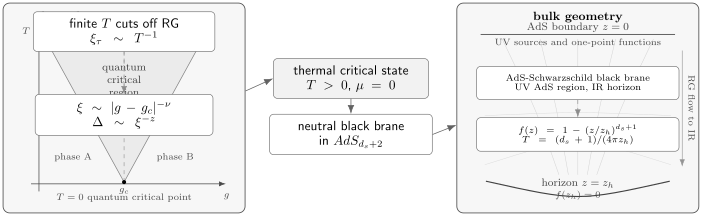
A relativistic quantum critical point at controls a finite-temperature quantum critical fan. In the simplest large- holographic realization, the thermal state of the boundary CFT is dual to a neutral planar AdS black brane. The horizon position is the infrared scale set by temperature, and the radial direction geometrizes RG flow.
Scaling at a relativistic fixed point
Section titled “Scaling at a relativistic fixed point”At a scale-invariant fixed point, observables are strongly constrained by dimensional analysis. For a relativistic CFT in spatial dimensions, the free energy density has dimension energy per volume:
At , there is no intrinsic scale other than . Therefore
where is a theory-dependent positive constant. The pressure is
The entropy density is
The energy density is
Thus a CFT obeys the conformal equation of state
This equation is not an equation of weak coupling. It follows from tracelessness of the stress tensor,
which in a homogeneous thermal state gives
The numerical coefficient is not fixed by symmetry. Holography computes it for particular large- CFTs at strong coupling. In bottom-up models it is often more useful to keep the coefficient symbolic and focus on dimensionless ratios, scaling forms, pole structure, and transport relations.
Detuning away from the fixed point
Section titled “Detuning away from the fixed point”The critical theory is rarely the whole theory. It is usually reached by tuning at least one relevant deformation. Suppose couples to a relevant operator. The singular part of the free energy density obeys the scaling form
For the relativistic case ,
The argument of tells us whether the finite-temperature state sees the fixed point. If
then the state is inside the quantum critical fan. If the argument is large, the system crosses over to one of the neighboring phases.
This scaling form is a useful antidote to a common misconception. The quantum critical region is not a new phase in the strict Landau sense. It is a regime controlled by a zero-temperature fixed point. Its boundaries are crossovers unless additional finite-temperature phase transitions occur.
The neutral holographic model
Section titled “The neutral holographic model”The minimal bulk action for a neutral relativistic CFT is Einstein gravity with a negative cosmological constant:
Here is the AdS radius, is the bulk Newton constant, and contains the Gibbons-Hawking-York term and holographic counterterms. The vacuum solution is Poincaré AdS:
The coordinate is the emergent holographic direction. Small describes the ultraviolet of the boundary theory. Large describes the infrared.
At finite temperature, the dominant homogeneous deconfined saddle with planar symmetry is the AdS-Schwarzschild black brane:
with
The horizon is at
The Hawking temperature is
The thermal scale on the boundary is therefore the inverse horizon depth:
This is one of the most important pieces of intuition in finite-temperature holography. At zero temperature, pure Poincaré AdS extends indefinitely toward the infrared. At nonzero temperature, the geometry ends at a horizon. The RG flow does not literally stop, but for many classical observables the horizon supplies the infrared boundary condition and the dominant thermal scale.
Entropy from the horizon
Section titled “Entropy from the horizon”The Bekenstein-Hawking entropy density is horizon area per unit boundary volume divided by :
For the planar black brane, the induced spatial metric at the horizon is
Thus
and
Using ,
So the black brane reproduces the CFT scaling
The prefactor is large in a classical holographic theory because
This is the same large number of degrees of freedom that made the bulk classical in the first place. The horizon is not a decorative metaphor for entropy; it is the leading large- entropy of the deconfined thermal state.
Energy, pressure, and conformality
Section titled “Energy, pressure, and conformality”The full renormalized on-shell action gives the free energy, and the near-boundary expansion of the metric gives the stress tensor. Without doing the detailed holographic renormalization here, conformal invariance already fixes the equation of state:
Thermodynamics gives
Since ,
For the black brane above, one finds
and therefore
The exact numerical coefficient depends on the normalization of the gravitational action and on the chosen top-down or bottom-up model. The scaling and the relation do not.
What the black brane means physically
Section titled “What the black brane means physically”The black brane is the simplest geometry that does all of the following at once:
- It is asymptotically AdS, so the ultraviolet theory is a relativistic CFT.
- It has a planar horizon, so the boundary state is homogeneous and thermal in infinite volume.
- It has no bulk electric field, so the boundary charge density is zero.
- It has no scalar hair, so no symmetry is spontaneously broken.
- It has a single infrared scale, , set by temperature.
This makes it the holographic workhorse for thermal quantum-critical matter at zero density.
The word “zero density” is important. A neutral CFT can still carry conserved currents. It simply has vanishing expectation value for the charge density:
One may probe its conductivity by turning on a small external electric field, but the equilibrium background itself has no bulk Maxwell flux. The finite-density case requires a charged black brane and will appear later.
The word “thermal” is also important. A black brane is not the ground state. It is the finite-temperature mixed state of the boundary theory. In Lorentzian signature, the horizon is responsible for absorption, dissipation, and retarded boundary conditions. In Euclidean signature, smoothness at the horizon fixes the thermal periodicity.
Strongly coupled does not mean structureless
Section titled “Strongly coupled does not mean structureless”A common caricature says that because a thermal CFT has only the scale , all its physics is trivial dimensional analysis. That is false.
Dimensional analysis fixes simple thermodynamic powers:
But it does not fix:
or the pole structure of real-time correlators. These are dynamical questions. Holography becomes powerful because it converts them into classical wave equations in a black-brane geometry.
The next few pages will repeatedly use this pattern:
For now, the important point is that thermodynamics supplies only the starting point. The real content of holographic quantum critical matter lies in response and relaxation.
Relation to ordinary condensed matter criticality
Section titled “Relation to ordinary condensed matter criticality”In classical thermal critical phenomena, a finite-temperature transition is controlled by long-wavelength fluctuations in space. Time is often emergent only after specifying dynamics.
In quantum criticality, the zero-temperature transition is controlled by fluctuations in spacetime. The imaginary-time direction is part of the critical scaling. This is why a -dimensional quantum critical point often behaves like a -dimensional classical critical point, though with important qualifications when or when Berry phases, gauge fields, disorder, or Fermi surfaces are present.
Holography is especially natural for relativistic quantum critical points because the fixed point is already a conformal field theory. The boundary spacetime symmetries match the isometries of AdS:
At finite temperature, the thermal state breaks Lorentz symmetry by selecting a rest frame. The black brane reflects this: the metric treats and differently through the emblackening factor .
Top-down examples and bottom-up use
Section titled “Top-down examples and bottom-up use”The best-known top-down example is strongly coupled large- super-Yang-Mills theory in dimensions. Its thermal state is dual, in the appropriate limit, to an AdS black brane times an internal . In that example, , and the entropy density scales as
Another important top-down example is ABJM theory in dimensions, whose finite-temperature state is related to black branes in an AdS regime, with .
For condensed matter applications, one often uses the black-brane geometry more abstractly. The goal is usually not to claim that a material is literally super-Yang-Mills or ABJM theory. The goal is to use a controlled large- CFT as a model of strongly coupled quantum critical matter, then ask which lessons are universal, which depend on large , and which depend on the chosen gravitational action.
A careful claim has the form:
A careless claim has the form:
The first can be useful. The second is almost never justified.
Where and hyperscaling violation will enter
Section titled “Where zzz and hyperscaling violation will enter”So far we assumed a relativistic CFT, hence and no hyperscaling violation. Later we will need more general scaling forms. If a critical theory has dynamical exponent , then the temperature has scaling dimension , and the free energy density scales as
The entropy density then scales as
If hyperscaling is violated with exponent , the effective spatial dimensionality becomes , and
This formula is not needed for the neutral black brane, but it foreshadows the scaling geometries used for compressible metallic phases. In those cases the infrared geometry need not be AdS, and the entropy scaling can look much more like strange metallic matter than a relativistic plasma.
What this page has established
Section titled “What this page has established”The neutral black brane is the first nontrivial state in holographic quantum matter because it is the thermal state of a strongly coupled quantum critical theory. Its main lessons are:
- A zero-temperature quantum critical point controls a finite-temperature fan when .
- For a relativistic CFT, , and the thermal entropy density scales as .
- The holographic dual of the homogeneous thermal state is a planar AdS-Schwarzschild black brane.
- The horizon depth is the thermal length scale: .
- The horizon area gives the leading large- entropy.
- Thermodynamics is largely fixed by scaling, but real-time response is dynamical and requires solving bulk fluctuation equations.
That is enough to make the black brane feel less like a mysterious gravitational object and more like the geometric representation of a thermal RG flow cut off by temperature.
Common pitfalls
Section titled “Common pitfalls”Pitfall 1: treating the quantum critical fan as a separate phase. It is usually a crossover regime controlled by the zero-temperature critical point, not a phase with its own local order parameter.
Pitfall 2: confusing strong coupling with a lack of constraints. Strongly coupled critical matter is still strongly constrained by scaling, conservation laws, Ward identities, and thermodynamics.
Pitfall 3: assuming every quantum critical point is relativistic. Many important condensed-matter fixed points have , Fermi surfaces, disorder, or emergent gauge fields. The neutral AdS black brane is the clean starting point, not the whole subject.
Pitfall 4: overinterpreting the top-down example. The black brane dual of super-Yang-Mills is not a microscopic model of a cuprate, heavy fermion compound, or graphene sample. Its value is as a controlled model of strongly coupled thermal critical matter.
Pitfall 5: thinking thermodynamics exhausts the physics. Scaling fixes and up to constants. Transport and spectral functions require real-time dynamics.
Exercises
Section titled “Exercises”Exercise 1: Critical scaling and the gap
Section titled “Exercise 1: Critical scaling and the gap”Suppose
Show that . Explain physically what measures.
Solution
From , we have
Substituting into gives
The exponent measures how energy scales with inverse length. If , then
For , energy scales as momentum and the fixed point may be relativistic. For , time and space scale anisotropically.
Exercise 2: Scaling of the free energy
Section titled “Exercise 2: Scaling of the free energy”For a scale-invariant theory with dynamical exponent in spatial dimensions, derive
Then specialize to a relativistic CFT.
Solution
Under scaling,
A spatial volume scales as , while an energy scales as . A free energy density is energy per spatial volume, so
Temperature has the dimension of energy, so . Choosing gives
The entropy density is
For a relativistic CFT, , so
Exercise 3: Temperature of the neutral black brane
Section titled “Exercise 3: Temperature of the neutral black brane”Consider the Euclidean version of the metric
Show that smoothness at requires
Solution
Near the horizon, write
Then
The part of the Euclidean metric becomes, up to an overall constant ,
Define a radial coordinate by
Then
and
Thus the near-horizon geometry is locally flat polar space,
Smoothness requires , so
Therefore
Exercise 4: Entropy density from the horizon
Section titled “Exercise 4: Entropy density from the horizon”Using the black brane metric above, compute the entropy density and show that it scales as .
Solution
At the horizon , the spatial part of the metric along the boundary directions is
The area per unit boundary spatial volume is therefore
The Bekenstein-Hawking formula gives
Using
we find
Thus
as required for a relativistic CFT in spatial dimensions.
Exercise 5: Equation of state from conformal invariance
Section titled “Exercise 5: Equation of state from conformal invariance”A homogeneous thermal state of a relativistic CFT has stress tensor
Use tracelessness to derive . Then show that if , the thermodynamic relation is consistent with this result.
Solution
Tracelessness means
For the homogeneous stress tensor,
Therefore
Now let
The free energy density is , so
Then
Thus
which matches the conformal Ward identity.
Further reading
Section titled “Further reading”- Subir Sachdev, Quantum Phase Transitions, 2nd ed. The standard reference for quantum critical scaling and the finite-temperature critical fan.
- Sean A. Hartnoll, Andrew Lucas, and Subir Sachdev, Holographic Quantum Matter, sections 2 and 3. A modern review of zero-density quantum matter and quantum critical transport.
- Jan Zaanen, Yan Liu, Ya-Wen Sun, and Koenraad Schalm, Holographic Duality in Condensed Matter Physics, chapters 6 and 7. A condensed-matter-facing account of finite-temperature black branes, thermodynamics, and hydrodynamics.
- Martin Ammon and Johanna Erdmenger, Gauge/Gravity Duality, chapters 11, 12, and 15. A textbook treatment of finite-temperature holography, linear response, and condensed matter applications.