
Single-Trace Operators and Factorization
The previous page explained why the large- expansion of an adjoint gauge theory is organized by topology. Planar diagrams dominate, each handle costs , and the expansion begins to look like a closed-string perturbation series.
This page refines that statement into the first real operator dictionary:
while
This is not merely terminology. It is the field-theory origin of bulk Fock space. At , single-particle states propagate freely, products of single-particle states behave like multiparticle states, and connected interactions are suppressed. At finite but large , those particles interact weakly. The small parameter is .
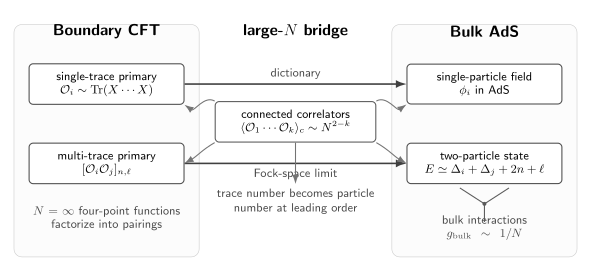
At large , particle-normalized single-trace primaries behave like single-particle operators. Multi-trace primaries such as behave like multiparticle states. Connected -point functions scale as , which is the boundary origin of weak bulk interactions.
Why this matters
Section titled “Why this matters”AdS/CFT is often introduced by saying that each bulk field is dual to a boundary operator . That statement is true but incomplete. A quantum field in the bulk does not merely have one classical profile. It has particles, multiparticle states, interactions, loops, bound states, and scattering amplitudes. The CFT must contain all of this structure.
Large- factorization is the mechanism that makes this possible. It says that, to leading order at large , certain gauge-invariant operators behave almost like independent classical variables or, after a different normalization, like free quantum fields. This is why the bulk can have an approximate Fock space.
The central scaling is
for particle-normalized single-trace operators. Thus
This is exactly the pattern expected from a weakly interacting bulk theory. Two-point functions normalize free propagation. Three-point functions measure cubic interactions. Four-point connected functions measure exchange and contact interactions. Bulk loops are further suppressed by powers of .
What is a single-trace operator?
Section titled “What is a single-trace operator?”In a gauge theory with adjoint fields, a local field can be written as a matrix
Gauge-invariant local operators are made by contracting color indices. The simplest adjoint-sector gauge invariants are traces over color indices:
More generally, one may insert covariant derivatives, field strengths, fermions, or scalars:
The word trace always means trace over color indices. It does not mean spacetime trace, Lorentz trace, or trace over a Hilbert space.
A single-trace operator is a gauge-invariant local operator built from one color trace. A multi-trace operator is a product of two or more such traces at the same spacetime point, properly renormalized:
The colons are a reminder that coincident products of local operators require subtractions. In a CFT, the properly defined product should be decomposed into conformal primaries and descendants, not treated as a naive pointwise product.
A typical double-trace primary is denoted
The labels and indicate radial excitation and spin. Schematically,
The phrase “schematically” is doing real work here. To construct an actual conformal primary, one must choose the coefficients of descendant subtractions carefully. For the holographic interpretation, however, the important point is simple: a double-trace primary is built from two single-trace ingredients.
Two useful normalizations
Section titled “Two useful normalizations”Large- discussions can be confusing because two normalizations are useful for different purposes.
First, define a macroscopic single-trace variable
This normalization is natural when thinking about large- saddle points. Its expectation value is often order one:
Its connected fluctuations are suppressed:
For example,
This is the sense in which large- theories factorize:
Second, define a particle-normalized operator by extracting the fluctuation with a factor of :
up to convention-dependent finite normalization constants. Then
and more generally
This is the normalization most useful for the bulk particle dictionary. It makes two-point functions order one and shows that cubic interactions scale as .
| Normalization | Natural use | Connected scaling |
|---|---|---|
| large- saddle variables | ||
| fluctuation | bulk particle operators |
Both are correct. Confusion comes from mixing them in the same sentence.
Deriving the connected scaling
Section titled “Deriving the connected scaling”The previous page gave the topological scaling of ribbon graphs. A connected genus- diagram with single-trace insertions scales as
when the inserted operators are particle-normalized so that the two-point function is order one. The leading connected contribution is planar, so :
The first nonplanar correction has one handle, , and is suppressed by :
Thus the full large- expansion has the schematic form
where is a function of the ‘t Hooft coupling and other dimensionless parameters.
The important point is that the -dependence is topological. Details of the dynamics affect the functions , but the powers of follow from color-index topology.
Large- factorization
Section titled “Large-NNN factorization”For particle-normalized operators with vanishing one-point functions, the simplest visible form of factorization is the four-point function:
This is the behavior of a generalized free field. It is not necessarily a free field in the microscopic Lagrangian. Rather, it is an operator whose leading large- correlators obey Wick-like factorization.
This distinction is crucial. A strongly coupled large- gauge theory may have no useful perturbative quasiparticles in the usual field-theory variables, but its single-trace gauge-invariant operators can still behave as generalized free fields at leading order in .
From the bulk viewpoint, this is free propagation of particles in a fixed AdS background. The connected correction to the four-point function is the first sign of bulk interactions at tree level.
The bulk interpretation
Section titled “The bulk interpretation”Suppose a single-trace primary has scaling dimension and spin . The state-operator correspondence gives a CFT state on the cylinder,
with cylinder energy
In global AdS, this state is interpreted as a one-particle state of a bulk field with matching quantum numbers. For a scalar field,
and the scalar mass is later related to by
Now consider a double-trace primary. At , the two particles do not interact, so their energies add. The spectrum contains operators with dimensions
Thus
The is the familiar tower of relative motion in AdS: is angular momentum on , and labels radial excitation. At finite but large , interactions shift these dimensions:
These anomalous dimensions are not a nuisance. They are precisely the CFT way of encoding bulk binding energies and scattering phase shifts.
How interactions appear
Section titled “How interactions appear”A bulk effective action for fields dual to single-trace operators often has the schematic form
The overall reflects the number of degrees of freedom in the boundary theory. It is also the statement that
in many holographic examples.
To put the bulk field in canonical normalization, define
Then the action becomes schematically
Therefore
This matches the CFT scaling of connected correlators:
The normalization of individual operators and fields can vary by convention, but the hierarchy is robust.
Single-trace does not automatically mean light
Section titled “Single-trace does not automatically mean light”The single-trace/multi-trace distinction tells us about particle number in the large- bulk. It does not by itself tell us whether the particle is light, heavy, stringy, or part of a simple Einstein gravity theory.
A generic large- gauge theory may have many single-trace operators with low or moderate dimensions, including operators of high spin. In the bulk, that means many light fields. If infinitely many higher-spin single-trace operators remain light, the bulk theory is not well approximated by ordinary Einstein gravity coupled to a small number of matter fields.
A simple local bulk effective field theory in AdS requires more than factorization. It requires a sparse low-dimension single-trace spectrum, or equivalently a large gap to higher-spin single-trace operators:
In the canonical AdS/CFT example, this large gap appears at strong ‘t Hooft coupling. Stringy excitations become heavy in AdS units, leaving a low-energy supergravity sector.
So the logic is:
but
For classical Einstein gravity, one needs still more structure: the low-energy spectrum and interactions must match gravity plus a controlled set of matter fields.
Operator mixing
Section titled “Operator mixing”At finite , single-trace and multi-trace operators with the same quantum numbers can mix. Even at large , mixing is important if dimensions become degenerate.
For example, suppose a single-trace operator and a double-trace operator have the same spin, charges, and nearly the same dimension. Then the physical scaling operators are linear combinations:
The statement “single-trace means single-particle” is therefore a leading large- statement after choosing a basis adapted to the two-point function and dilatation operator. It is not a rigid finite- classification.
There is also a finite- limitation: traces are not all independent. For matrices, trace identities relate sufficiently long traces. This is one of the places where the large- Fock-space picture must eventually break down. The breakdown is not a bug; it is part of how the finite- CFT encodes quantum gravity beyond perturbation theory.
A simple example of factorization
Section titled “A simple example of factorization”For one scalar single-trace primary normalized by
the leading large- four-point function is
where in Euclidean signature.
The leading terms are disconnected pairings. The connected part begins at order :
In the bulk, the disconnected terms are free propagation. The connected terms come from tree-level Witten diagrams: exchange diagrams and contact diagrams. Bulk loop corrections are smaller, typically starting at order in four-point functions.
This is why four-point functions are so important in modern holography. They are the first place where bulk interactions, locality, causality, anomalous dimensions, and effective field theory constraints become visible.
Dictionary checkpoint
Section titled “Dictionary checkpoint”| Boundary statement | Bulk interpretation |
|---|---|
| single-trace primary | single-particle state or bulk field |
| multi-trace primary | two-particle state in global AdS |
| large- factorization | free propagation at leading order |
| cubic bulk coupling | |
| connected four-point function | tree-level bulk interaction |
| genus correction | bulk loop correction |
| double-trace anomalous dimension | bulk binding energy or scattering data |
| finite- trace relations | breakdown of naive perturbative Fock space |
The most important message is that the bulk Hilbert-space picture is not added by hand. It is reconstructed from the large- operator algebra of the boundary theory.
Common confusions
Section titled “Common confusions”“Single-trace” means “elementary.”
Section titled ““Single-trace” means “elementary.””No. A single-trace operator is usually a composite operator in the microscopic gauge theory. It is “elementary” only from the emergent bulk viewpoint, where it creates a single-particle state at leading large .
Multi-trace operators are unimportant.
Section titled “Multi-trace operators are unimportant.”No. Multi-trace operators are essential. They are the CFT representation of multiparticle states. Without them, the bulk would not have a Fock space.
Factorization means the boundary theory is free.
Section titled “Factorization means the boundary theory is free.”No. Large- factorization is not ordinary weak coupling in the microscopic variables. The theory may be strongly coupled in terms of gauge fields. Factorization says that a special set of gauge-invariant operators has Wick-like correlators at leading order in .
The two-point function is suppressed by .
Section titled “The two-point function is suppressed by 1/N21/N^21/N2.”It depends on normalization. For macroscopic operators , connected two-point fluctuations are suppressed. For particle-normalized operators , the two-point function is order one. The latter is the normalization usually used when matching to bulk particles.
Every large- theory has a simple gravity dual.
Section titled “Every large-NNN theory has a simple gravity dual.”No. Large gives a weakly coupled expansion. A simple local Einstein gravity dual requires additional conditions, especially a sparse low-dimension single-trace spectrum and a large gap to stringy or higher-spin states.
Multi-trace products are just ordinary products.
Section titled “Multi-trace products are just ordinary products.”Not quite. Products of local operators at the same point are singular and must be renormalized. In a CFT, one should decompose them into conformal primaries and descendants. The notation denotes this properly organized double-trace primary, not a naive product.
Exercises
Section titled “Exercises”Exercise 1: Two normalizations
Section titled “Exercise 1: Two normalizations”Suppose macroscopic single-trace variables obey
Define particle-normalized fluctuations by
Show that
Solution
Connected correlators are unchanged by subtracting one-point functions, except that one-point pieces are removed. Each insertion of contributes a factor of relative to . Therefore
Using the assumed scaling,
Thus the particle-normalized two-point function is order one, the three-point function is order , and the connected four-point function is order .
Exercise 2: Four-point factorization
Section titled “Exercise 2: Four-point factorization”Let be a scalar single-trace primary with
Write the leading large- form of
Solution
At leading order, large- factorization gives the Wick-like pairings:
The connected part begins at order .
Exercise 3: Cubic coupling from a three-point function
Section titled “Exercise 3: Cubic coupling from a three-point function”Assume particle-normalized single-trace operators obey
If these operators create canonically normalized bulk fields , what is the expected scaling of the cubic bulk coupling ?
Solution
A tree-level cubic Witten diagram is proportional to the cubic coupling after the external fields are canonically normalized. Since the CFT three-point function scales as , the matching implies
This agrees with the canonical-normalization argument from a bulk action with an overall factor .
Exercise 4: Double-trace dimensions
Section titled “Exercise 4: Double-trace dimensions”Let and be scalar single-trace primaries with dimensions and . What is the leading large- dimension of the double-trace primary ?
Solution
At , the corresponding bulk particles do not interact, so their global AdS energies add. Derivatives contribute angular momentum and radial excitation. The leading dimension is
At finite but large , interactions shift this by anomalous dimensions:
Exercise 5: Why a large gap matters
Section titled “Exercise 5: Why a large gap matters”Explain why large- factorization alone does not guarantee a simple Einstein gravity dual.
Solution
Large- factorization gives weak interactions among single-trace excitations, so it suggests a weakly coupled bulk theory. But the bulk theory might contain many light fields, including light higher-spin fields or string-scale excitations. A simple local Einstein gravity dual requires these extra single-trace states to be heavy in AdS units, so that a small low-energy set of fields remains. This is the large-gap condition. In the canonical AdS/CFT example, the gap becomes large at strong ‘t Hooft coupling.
Further reading
Section titled “Further reading”- G. ‘t Hooft, A Planar Diagram Theory for Strong Interactions. The original source of the planar large- expansion.
- O. Aharony, S. S. Gubser, J. Maldacena, H. Ooguri, and Y. Oz, Large Field Theories, String Theory and Gravity. The standard AdS/CFT review, including the relation between single-trace operators and single-particle states.
- I. Heemskerk, J. Penedones, J. Polchinski, and J. Sully, Holography from Conformal Field Theory. A modern perspective on how large , a sparse spectrum, and crossing symmetry lead toward local bulk effective field theory.
- D. Simmons-Duffin, TASI Lectures on the Conformal Bootstrap. Useful background on conformal primaries, OPE data, and large-spin double-trace operators.