
Causal Wedge and HKLL Reconstruction
The previous module developed the geometric side of holographic entropy: RT, HRT, FLM, QES, replicas, and bit threads. We now turn to a different but deeply related question:
Given a boundary quantum state and boundary operators, how does one actually describe a local bulk excitation?
At leading order in the large- expansion, the answer begins with HKLL reconstruction, named after Hamilton, Kabat, Lifschytz, and Lowe. In its simplest form, a free bulk field is represented as a nonlocal boundary operator obtained by smearing the single-trace CFT operator dual to :
The superscript is a warning: this is the leading semiclassical operator in a fixed background. Interactions, gravitational dressing, finite- effects, and the restriction to a code subspace all matter. But HKLL is still the cleanest first example of bulk reconstruction. It shows, explicitly and calculationally, how approximate local bulk physics can emerge from a boundary theory with no literal bulk points.
For a boundary subregion , the most conservative bulk region one can reconstruct by causal propagation is the causal wedge . This page explains causal wedges, derives the logic of HKLL reconstruction, discusses subregion or AdS-Rindler reconstruction, and explains why causal-wedge reconstruction is only the beginning: the full modern answer is entanglement wedge reconstruction.
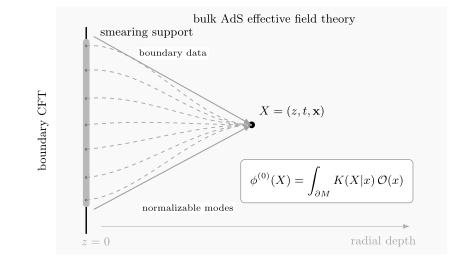
HKLL reconstruction expresses a leading semiclassical bulk field as a nonlocal boundary operator. The smearing support grows as the point moves deeper into the bulk; locality in the bulk is encoded by delicate cancellations among nonlocal CFT operators.
Guiding question
Section titled “Guiding question”How can a boundary CFT, which has no fundamental radial coordinate, encode a local field at a bulk point ?
The answer has two layers.
First, at the level of classical bulk equations and leading large- correlators, the radial direction is reconstructed by solving a bulk wave equation with boundary data. This gives the HKLL smearing formula. It is the AdS analogue of reconstructing a classical field in a spacetime region from appropriate initial or boundary data.
Second, in the full quantum theory, a bulk operator is not literally a fundamental local observable. It is an operator in an approximate bulk effective theory, valid in a code subspace of semiclassical states and represented redundantly on the boundary. That second layer is the subject of JLMS, quantum error correction, and operator-algebra reconstruction. HKLL is the first layer: explicit, useful, and limited.
Boundary domains of dependence
Section titled “Boundary domains of dependence”Let be a spatial region on a boundary Cauchy slice. Its boundary domain of dependence is the set of boundary spacetime points whose physics is determined by initial data on . Equivalently, every inextendible causal curve through a point of intersects .
For example, in the vacuum CFT on Minkowski space, if
then
This is the familiar causal diamond. Boundary operators supported inside are the operators that can be represented using the degrees of freedom in on the slice.
The causal wedge of is the bulk region that can both receive signals from and send signals to this boundary causal diamond:
Here is the bulk causal future of , and is the bulk causal past. Thus a point lies in if a signal from can reach and a signal from can return to .
The boundary of the causal wedge contains two null hypersurfaces, often called causal horizons. Their intersection is a codimension-two surface
called the causal information surface. The area of this surface defines the causal holographic information
The notation deliberately resembles holographic entropy, but is not generally the von Neumann entropy . It is a causal, more coarse-grained geometric quantity.
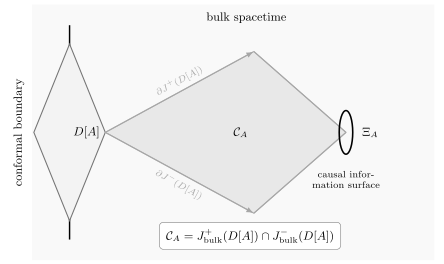
The causal wedge is the intersection of the bulk future and bulk past of the boundary domain of dependence . The causal information surface is where the future and past causal horizons meet.
This definition is intentionally conservative. It only uses causal propagation. If you can send a classical probe from into the bulk and receive a response back in , the interaction region must lie in . HKLL reconstruction of subregions implements a quantum version of this causal intuition.
Global HKLL reconstruction
Section titled “Global HKLL reconstruction”Consider a scalar field in fixed AdS satisfying
The CFT operator dual to has scaling dimension related to the bulk mass by
where is the AdS radius. In standard quantization, the normalizable asymptotic behavior is schematically
up to a conventional normalization. More precisely, is the boundary operator whose correlation functions are obtained by varying the bulk partition function with respect to the non-normalizable boundary source for .
At leading order in large , the bulk field is free on a fixed background. One expands it in normalizable modes:
The boundary operator has an expansion in the same creation and annihilation operators:
The HKLL construction inverts this relation. The boundary modes determine the bulk modes , and therefore there is a smearing kernel such that
This is the central HKLL formula.
The formula is not a statement that a bulk point is localized at one boundary point. Quite the opposite: a local bulk operator is represented by a highly nonlocal boundary operator. The boundary theory encodes radial locality in the pattern of smearing.
A useful Poincare-patch formula
Section titled “A useful Poincare-patch formula”In Poincare AdS,
one standard HKLL representation for a scalar of dimension is
with
This compact expression uses a complexified boundary spatial coordinate. Equivalent real-time representations exist but are often distributional or less compact. The important physical point is that the support size is set by the bulk radial depth . A point near the boundary uses boundary data in a small region; a point deep in the bulk uses more extended boundary data.
The complexified support sometimes looks mysterious. It is mainly a technical device for writing a smearing kernel with compact support. Correlators computed from this expression reproduce the expected bulk Wightman functions after the usual prescriptions are imposed.
Bulk locality from boundary nonlocality
Section titled “Bulk locality from boundary nonlocality”A good bulk operator should approximately commute with other bulk operators at spacelike separation:
In HKLL, this bulk locality arises from CFT identities and cancellations. The boundary operators appearing in the smearing integral are not mutually commuting in a simple pointwise way, but the integrated combination has the right commutator in the semiclassical limit.
This is one of the main lessons of bulk reconstruction:
Bulk locality is not microscopic boundary locality. It is an emergent property of special nonlocal combinations of boundary operators in a special class of states.
The phrase “special class of states” matters. The reconstruction is usually formulated inside a code subspace: a set of CFT states that share a semiclassical background and contain only perturbative bulk excitations around it. If the state is changed so much that the geometry changes macroscopically, the smearing kernel must change as well.
Subregion reconstruction and the causal wedge
Section titled “Subregion reconstruction and the causal wedge”The global HKLL formula uses boundary data from the full boundary. A sharper question is whether a bulk operator can be reconstructed from only a boundary subregion .
For points in the causal wedge , the answer is yes in favorable semiclassical settings. One obtains an AdS-Rindler version of HKLL:
This is the cleanest form of subregion-subregion duality: an operator in a certain bulk subregion is represented by an operator supported only in the corresponding boundary subregion.
A particularly important example is a ball-shaped region in the vacuum CFT. The boundary domain of dependence is a causal diamond. The corresponding bulk region is an AdS-Rindler wedge. The wedge has a horizon, and the HKLL smearing problem is analogous to reconstructing a field in a Rindler wedge from data on its asymptotic boundary.
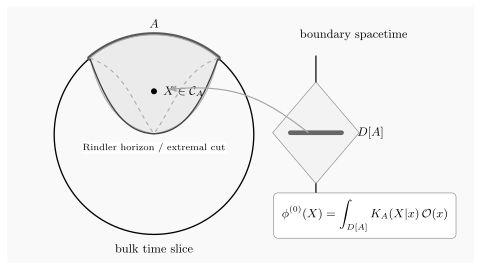
For a ball-shaped boundary region in the vacuum, the causal wedge is an AdS-Rindler wedge. A bulk point can be reconstructed from operators supported in the boundary diamond .
For a ball in the vacuum, the causal wedge and the entanglement wedge coincide. That coincidence is special. In more general geometries and for more general regions, the entanglement wedge is typically larger.
Interactions and multi-trace corrections
Section titled “Interactions and multi-trace corrections”The formula
is the free-field approximation. It cannot be the whole story once the bulk field interacts.
Suppose the bulk has a cubic interaction, schematically
Then the bulk equation is no longer linear:
Solving perturbatively gives
The multi-trace terms are not optional decoration. They are required if the reconstructed bulk operator is to obey the correct interacting equations of motion and have approximately local commutators at spacelike separation. Large- factorization controls this expansion. Single-trace operators create single-particle bulk states; double-trace and higher-trace operators encode multi-particle corrections and interactions.
The precise form of the kernels depends on the background, gauge choice, and interaction. The structural point is universal: bulk locality is restored order by order by adding increasingly complicated boundary operators.
Gauge constraints and gravitational dressing
Section titled “Gauge constraints and gravitational dressing”There is another subtlety that becomes unavoidable in gravity. A strictly local field is not gauge invariant, because the point has no invariant meaning under diffeomorphisms. To define a physical bulk operator, one must specify it relationally or attach a gravitational dressing.
A useful analogy is electrodynamics. A charged local field is not gauge invariant by itself. One can make a gauge-invariant operator by attaching a Wilson line to infinity or by dressing it with its Coulomb field. In gravity, a matter excitation also carries gravitational field lines and must be dressed to an asymptotic frame or to relational reference data.
Thus HKLL should be read carefully:
usually means “the bulk effective-field-theory operator at the point in a chosen semiclassical gauge,” or a dressed version of that operator whose dressing has been specified but suppressed in the notation.
For global reconstruction, one may dress the operator to the asymptotic boundary. For subregion reconstruction on , the dressing should be compatible with the subregion: roughly, it should be anchorable within or within the corresponding entanglement wedge. Otherwise the operator may not be representable on alone.
This is not a mere technicality. Gauge constraints are one reason the exact Hilbert space of quantum gravity does not factorize cleanly into independent spatial regions. Later, operator-algebra quantum error correction will give a sharper language for this issue.
Why the causal wedge is not the final answer
Section titled “Why the causal wedge is not the final answer”Causal-wedge reconstruction is powerful because it is explicit. But it is too conservative.
The boundary density matrix contains more than what can be learned by sending causal probes into the bulk and receiving signals back. The RT/HRT surface, the FLM correction, and the JLMS relative-entropy relation all point to a larger region associated with : the entanglement wedge .
Under standard assumptions, the causal wedge is contained in the entanglement wedge:
The inclusion can be strict. In black hole geometries, for example, causal propagation from a boundary region may fail to probe regions that are nevertheless included in the entanglement wedge by the RT/HRT surface. In such cases HKLL causal reconstruction sees only part of the bulk information in .
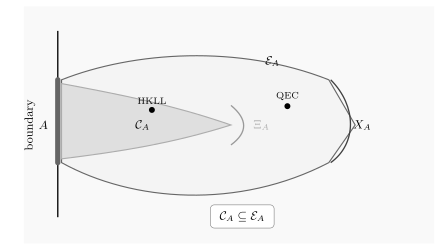
Causal-wedge reconstruction is the first, signal-based form of subregion reconstruction. Modern entanglement wedge reconstruction goes further: operators in , not merely , can be represented on within an appropriate code subspace.
This distinction is central to black hole information. After the Page time, the radiation region can have an entanglement wedge containing an island, even though causal signals from the island do not travel to the radiation bath in any ordinary local way. HKLL causal reconstruction alone could never see that. The island story requires entanglement wedge reconstruction.
Causal holographic information
Section titled “Causal holographic information”The area of the causal information surface,
is a useful diagnostic but not an entropy in the ordinary von Neumann sense.
The RT/HRT entropy is computed from an extremal surface homologous to :
at leading classical order. The causal information surface is instead defined by causal horizons. These two surfaces coincide in special examples, such as ball-shaped regions in the vacuum, but they generally differ.
A good way to remember the difference is this:
while
Entropy is a statement about a density matrix. Causal accessibility is a statement about signals. In gravity these are related, but not identical.
What exactly does HKLL reconstruct?
Section titled “What exactly does HKLL reconstruct?”A compact but accurate statement is:
HKLL reconstructs perturbative bulk effective-field-theory operators in a fixed semiclassical background, as nonlocal boundary operators, order by order in the large- expansion and within a suitable code subspace.
Each phrase is doing work.
Perturbative bulk effective field theory. HKLL describes local fields in the semiclassical bulk. It is not an exact finite- construction of sharply localized quantum-gravity observables.
Fixed semiclassical background. The smearing kernel depends on the metric. In pure AdS, the kernel is known explicitly. In a black hole geometry, a different mode basis and different boundary conditions are required. Across a family of states with large backreaction, there is no single universal smearing kernel.
Nonlocal boundary operators. Bulk locality emerges from boundary nonlocality. A local operator deep in the bulk typically requires a complicated boundary operator with support over an extended time band or subregion domain of dependence.
Order by order in large . Interactions require multi-trace corrections. Quantum gravity corrections eventually limit exact locality.
Within a code subspace. The reconstructed operator agrees with the bulk operator on a restricted set of states. Outside that subspace, the same boundary expression need not have the same bulk interpretation.
Common pitfalls
Section titled “Common pitfalls”Pitfall 1: “A bulk point is encoded at one boundary point.”
Section titled “Pitfall 1: “A bulk point is encoded at one boundary point.””No. A local bulk field is encoded by a nonlocal boundary operator. The boundary point at which a bulk geodesic ends is not the location of the bulk operator in the CFT.
Pitfall 2: “The causal wedge is the dual of the density matrix.”
Section titled “Pitfall 2: “The causal wedge is the dual of the density matrix.””Not quite. The causal wedge is the region accessible by causal propagation from . The density matrix can encode the larger entanglement wedge. The causal wedge is a lower bound on what can reconstruct, not the final answer.
Pitfall 3: “HKLL gives exact local bulk operators.”
Section titled “Pitfall 3: “HKLL gives exact local bulk operators.””No. Exact local observables do not exist in quantum gravity in the same way they do in nongravitational QFT. HKLL gives approximate bulk-local operators in semiclassical perturbation theory.
Pitfall 4: “Different reconstructions must be the same boundary operator.”
Section titled “Pitfall 4: “Different reconstructions must be the same boundary operator.””No. The same logical bulk operator can have different boundary representations on different regions. This is not a contradiction; it is the quantum-error-correcting structure of holography.
Conceptual summary
Section titled “Conceptual summary”The causal wedge is the first geometric answer to subregion reconstruction:
HKLL is the first explicit operator answer:
Together, they teach the basic lesson of bulk reconstruction: bulk locality is emergent, approximate, and encoded nonlocally in the boundary theory.
But they also teach their own limitations. Causal propagation is too weak to capture all information in a reduced density matrix. The next pages upgrade this story from causal wedges to entanglement wedges, from smearing kernels to relative entropy, and from explicit field reconstruction to quantum error correction.
Exercises
Section titled “Exercises”Exercise 1: Mass-dimension relation
Section titled “Exercise 1: Mass-dimension relation”Consider a scalar field in Poincare AdS with metric
Near the boundary, ignore derivatives along the boundary directions and assume . Show that the scalar equation gives
Conclude that the two asymptotic behaviors are and , where .
Solution
For the Poincare metric,
Keeping only the radial part of the Laplacian,
For ,
Therefore
The equation gives
The two roots are conventionally written as and .
Exercise 2: Domain of dependence of a ball
Section titled “Exercise 2: Domain of dependence of a ball”In -dimensional Minkowski space, take
Show that
Solution
A point belongs to if every inextendible causal curve through that point intersects . Equivalently, the past and future light cones from the point must intersect the slice only inside the ball .
A null ray from to the slice can move a spatial distance . The largest possible radial position reached on the slice is therefore
For every causal curve through the point to hit the slice inside , one needs
Thus
The boundary of this diamond is generated by null rays satisfying .
Exercise 3: Causal wedge versus entanglement wedge
Section titled “Exercise 3: Causal wedge versus entanglement wedge”Explain why the causal wedge should be contained in the entanglement wedge , but why equality is too strong to expect in general.
Solution
The causal wedge consists of points that can both send signals to and receive signals from the boundary domain of dependence . If a bulk point is causally accessible from , then boundary operations in can probe it in a direct signal-based way. It would be strange for such a point to lie outside the bulk region encoded by the density matrix .
The entanglement wedge is defined instead using the RT/HRT surface and the associated homology region. It captures information in , not merely information accessible by causal probes. Since density matrices can encode correlations that are not obtainable by sending classical signals, can be larger than .
Equality holds in special symmetric situations, such as ball-shaped regions in the vacuum. In general black hole or time-dependent geometries, causal shadows and horizons can make the causal wedge strictly smaller than the entanglement wedge.
Exercise 4: Why interactions require multi-trace terms
Section titled “Exercise 4: Why interactions require multi-trace terms”Suppose a scalar field satisfies the interacting equation
Explain why a purely single-trace reconstruction
cannot be exact beyond leading order.
Solution
The single-trace term solves the linear homogeneous equation. Acting with on
gives zero away from contact terms because is a Green-function-like solution of the free wave equation.
But the interacting bulk equation has a source term . In the CFT, the operator corresponding to a product of two bulk fields is represented by double-trace operators such as . Therefore the corrected reconstruction must contain terms of the schematic form
These terms reproduce bulk interaction effects in correlation functions and help restore approximate spacelike commutativity order by order in .
Exercise 5: Gravitational dressing
Section titled “Exercise 5: Gravitational dressing”Why is the notation slightly misleading in quantum gravity? What extra information is needed to define a gauge-invariant bulk operator?
Solution
In gravity, spacetime points are not gauge-invariant objects. A diffeomorphism can move the coordinate label , so a field value at a coordinate point is not an observable by itself. To define a physical operator, one must specify the point relationally or choose a gravitational dressing.
The dressing is analogous to the Wilson-line dressing of a charged operator in gauge theory. It specifies how the operator is attached to asymptotic data or to a relational reference frame. Different dressings differ by gravitational field configurations and can affect which boundary region can represent the operator.
Thus in HKLL usually denotes a gauge-fixed or implicitly dressed perturbative bulk operator, valid in a semiclassical code subspace.
Further reading
Section titled “Further reading”- A. Hamilton, D. Kabat, G. Lifschytz, D. A. Lowe, Local bulk operators in AdS/CFT: A boundary view of horizons and locality.
- A. Hamilton, D. Kabat, G. Lifschytz, D. A. Lowe, Holographic representation of local bulk operators.
- A. Hamilton, D. Kabat, G. Lifschytz, D. A. Lowe, Local bulk operators in AdS/CFT: A holographic description of the black hole interior.
- D. Kabat, G. Lifschytz, D. A. Lowe, Constructing local bulk observables in interacting AdS/CFT.
- V. E. Hubeny, M. Rangamani, Causal Holographic Information.
- B. Czech, J. L. Karczmarek, F. Nogueira, M. Van Raamsdonk, The Gravity Dual of a Density Matrix.
- M. Headrick, V. E. Hubeny, A. Lawrence, M. Rangamani, Causality & Holographic Entanglement Entropy.
- X. Dong, D. Harlow, A. C. Wall, Reconstruction of Bulk Operators within the Entanglement Wedge in Gauge-Gravity Duality.
- D. Harlow, TASI Lectures on the Emergence of Bulk Physics in AdS/CFT.