
Entanglement Wedge, JLMS, and Relative Entropy
The previous page introduced HKLL reconstruction and the causal wedge. HKLL makes the first miracle explicit: a leading large- bulk field can be represented as a nonlocal CFT operator. But causal reconstruction is too conservative. It reconstructs only the region that can communicate with the boundary domain of dependence by ordinary causal propagation.
The modern lesson of holography is sharper:
The bulk region encoded by a boundary subregion is not merely its causal wedge. It is its entanglement wedge, and the cleanest diagnostic of this statement is relative entropy.
The key result is the JLMS relation, named after Jafferis, Lewkowycz, Maldacena, and Suh. In its most useful semiclassical form,
where is the bulk entanglement-wedge region bounded by and the appropriate RT/HRT/QES surface. This formula says that the distinguishability of two states using only boundary region is the same as the distinguishability of the corresponding bulk effective states using only the entanglement wedge .
That is a much stronger statement than a slogan like “geometry is entanglement.” It is an operational statement about which experiments can distinguish which states.
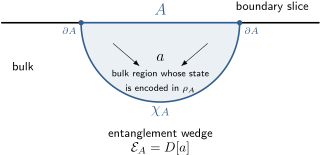
For a boundary region , the entanglement wedge is the bulk domain of dependence , where is bounded by and the RT/HRT/QES surface . The bulk region is the semiclassical subsystem whose distinguishability is measured by .
Guiding question
Section titled “Guiding question”Suppose a bulk excitation lies outside the causal wedge of but inside the entanglement wedge of . Why should operators in know about it?
There are two complementary answers.
First, holographic entropy says that the fine-grained entropy of is computed by a surface and by the bulk state in the region between and . Thus the density matrix is sensitive to the bulk state in that region.
Second, relative entropy makes this sensitivity quantitative. If two bulk states differ inside , then the boundary reduced states on can distinguish them by exactly the same amount, at least within the semiclassical code subspace where JLMS applies. This is the information-theoretic backbone of entanglement wedge reconstruction.
Entanglement wedge: the geometric definition
Section titled “Entanglement wedge: the geometric definition”Let be a spatial region in the boundary CFT. Let be the appropriate entropy surface:
- in a static classical geometry, is the RT surface ;
- in a time-dependent classical geometry, is the HRT surface;
- when bulk quantum corrections are important, is the quantum extremal surface.
The surface must be homologous to . On a bulk Cauchy slice, there is a spatial region satisfying
with orientation understood. The entanglement wedge is
the bulk domain of dependence of .
In the classical RT/HRT limit, the entropy of is
With quantum corrections, the entropy is instead computed by the generalized entropy,
This formula already hints that is not decorative. The boundary entropy depends on the bulk quantum state in .
Causal wedge versus entanglement wedge
Section titled “Causal wedge versus entanglement wedge”The causal wedge is defined by boundary causal access:
The entanglement wedge is defined by fine-grained entropy and domains of dependence:
In many important examples,
For a ball-shaped region in the vacuum CFT, these wedges coincide. This is why AdS-Rindler reconstruction looks so clean. But in black hole geometries, multiboundary wormholes, or disconnected boundary regions after an entanglement phase transition, the entanglement wedge can be much larger than the causal wedge.
The conceptual distinction is important:
- asks what can be reached by causal signals.
- asks what is encoded in the density matrix .
Fine-grained quantum information is not limited to classical signal propagation. This is why the entanglement wedge, not the causal wedge, is the natural region for quantum reconstruction.
Relative entropy as distinguishability
Section titled “Relative entropy as distinguishability”For density matrices and on the same Hilbert space, the relative entropy is
Equivalently, define the modular Hamiltonian of the reference state by
Then
where
and
Relative entropy has three properties that make it ideal for holography.
First, it is nonnegative:
with equality if and only if , assuming the usual support condition.
Second, it is monotonic under coarse graining. If is a quantum channel, then
Tracing out degrees of freedom cannot increase distinguishability.
Third, relative entropy is finite and meaningful even when the entanglement entropy itself is UV divergent, provided the two states are compared on the same algebra. In QFT, is usually divergent, but is often finite for states with the same short-distance structure.
This is why relative entropy is more robust than entanglement entropy alone.
Boundary modular Hamiltonians
Section titled “Boundary modular Hamiltonians”For a boundary region , define
where is the reduced density matrix of the reference state on . Then
For a general region in a general CFT state, is highly nonlocal. There is no simple expression in terms of the stress tensor. But there are important exceptions. For the vacuum of a CFT on Minkowski space and a ball-shaped region
the modular Hamiltonian is local:
This formula is central in the derivation of linearized Einstein equations from the entanglement first law. But JLMS is not restricted to ball-shaped regions. Its power is precisely that it gives a bulk interpretation of modular Hamiltonians that are otherwise almost impossible to write explicitly.
The entanglement first law
Section titled “The entanglement first law”Consider a one-parameter family of states
Expanding relative entropy around , one finds
The vanishing of the first-order term gives the first law of entanglement:
In holography, for a ball-shaped boundary region in the vacuum, this statement becomes a bridge between CFT stress-tensor expectation values and the variation of RT area. Requiring the entanglement first law for all balls implies the linearized Einstein equations around AdS. This is one of the cleanest examples of gravitational dynamics emerging from quantum-information constraints.
But the first law is only the infinitesimal limit. JLMS is stronger: it compares finite relative entropies within a semiclassical code subspace.
The FLM input
Section titled “The FLM input”The FLM formula gives the leading quantum correction to RT/HRT:
Here is the area operator associated with the entropy surface and is the bulk reduced state in the entanglement wedge region .
This formula is the seed of JLMS. Entanglement entropy splits into a geometric area term and a bulk entropy term. The modular Hamiltonian must therefore split in the same way.
More precisely, for states in a code subspace associated with a fixed semiclassical wedge phase, the boundary modular Hamiltonian has the schematic representation
The constant is state independent and is irrelevant in relative entropy. The ellipsis denotes higher-order bulk gravitational corrections and subtleties associated with moving surfaces, gauge constraints, and nonperturbative effects.
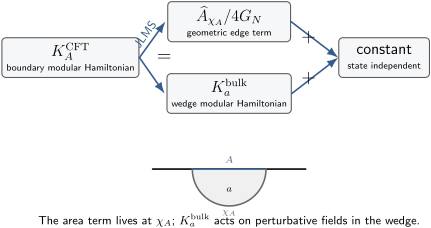
The JLMS modular-Hamiltonian relation says that, inside the semiclassical code subspace, the boundary modular Hamiltonian for decomposes into an area operator localized at plus the bulk modular Hamiltonian of the entanglement wedge region .
Deriving the JLMS relative-entropy equality
Section titled “Deriving the JLMS relative-entropy equality”Let be a reference state and another state in the same code subspace, with the same entanglement wedge phase. Boundary relative entropy is
Using the JLMS modular-Hamiltonian relation,
Using FLM for the entropy variation,
Subtracting, the area terms cancel:
The right-hand side is precisely the bulk relative entropy:
This cancellation is the heart of JLMS. Area contributes to entropy, and area contributes to the modular Hamiltonian, but relative entropy removes the shared geometric bookkeeping and leaves the distinguishability of bulk effective states in the wedge.
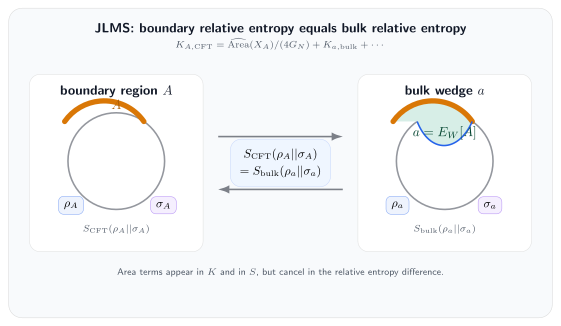
JLMS equates boundary distinguishability in with bulk distinguishability in the entanglement wedge . The equality is not an equality of Hilbert spaces or density matrices; it is an equality of relative entropies in the semiclassical code subspace.
What exactly is equal?
Section titled “What exactly is equal?”The compact slogan
is useful, but it hides several important qualifications.
First, the two relative entropies live in different theories. The left-hand side is computed in the boundary CFT, using reduced density matrices on . The right-hand side is computed in the bulk effective field theory, using reduced states on the entanglement wedge region .
Second, the equality is a code-subspace statement. The states and must be close enough, in the appropriate large- sense, that they are described by the same semiclassical bulk effective theory and the same wedge phase. If a large state change causes an HRT/QES phase transition, the formula must be applied piecewise with the correct dominant saddle.
Third, relative entropy is algebraic. In gravity and gauge theory, local regions do not factorize as naively as tensor products because of constraints and edge modes. A more precise statement uses algebras of observables rather than literal Hilbert-space factors. This becomes essential in operator-algebra quantum error correction.
Fourth, the equality is perturbative in the semiclassical expansion. It captures the robust expansion of the code subspace. Nonperturbative finite- effects can be important in questions such as factorization, baby universes, and exact black hole microstate counting.
These qualifications do not weaken JLMS. They are exactly what make it precise.
Modular flow
Section titled “Modular flow”Given a modular Hamiltonian , the associated modular flow acts on an operator by
For ordinary time evolution, the Hamiltonian is usually local or at least physically familiar. For modular flow, the generator is generally nonlocal. This makes modular flow hard to compute, but also extremely powerful.
JLMS implies that boundary modular flow for is dual to bulk modular flow in the entanglement wedge:
up to the area term and the usual code-subspace qualifications. The area operator is central in the simplest fixed-area sectors, so it does not affect the modular flow of ordinary perturbative bulk operators in .
This statement is particularly transparent for a ball in the vacuum, where modular flow is geometric. But the real power appears for generic regions: the boundary modular Hamiltonian is horribly nonlocal, yet JLMS says its action knows about the bulk modular Hamiltonian of the entanglement wedge.
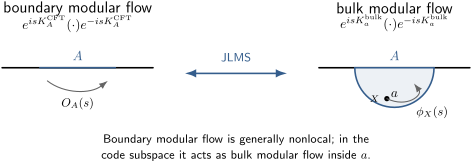
Boundary modular flow generated by acts as bulk modular flow inside , up to the area term and code-subspace corrections. This is one route from JLMS to explicit entanglement-wedge reconstruction.
From JLMS to entanglement wedge reconstruction
Section titled “From JLMS to entanglement wedge reconstruction”Relative entropy is a measure of distinguishability. If two bulk states differ only by an excitation inside , then can be nonzero. JLMS says the boundary relative entropy is equally nonzero. Therefore the boundary reduced state on has enough information to distinguish the excitation.
This motivates the reconstruction statement:
Bulk operators in the entanglement wedge of can be represented as boundary operators supported on .
This is not yet a proof, but it is the correct intuition. The rigorous quantum-information version uses recovery theorems and quantum error correction. Roughly, if tracing out preserves all relative entropies for a certain bulk algebra, then the algebra can be reconstructed on .
In the next pages, this becomes the statement of entanglement wedge reconstruction and then the quantum-error-correcting structure of AdS/CFT.
Entanglement wedge nesting
Section titled “Entanglement wedge nesting”If , then boundary monotonicity gives
Using JLMS, this becomes
where and are the corresponding entanglement wedge regions. For this to hold generally, one expects
This is entanglement wedge nesting. Geometrically, nesting means that as the boundary region grows, the corresponding entanglement wedge cannot shrink or jump in a way that violates inclusion. In classical holography, this property is closely tied to energy conditions and the maximin construction. Quantum mechanically, it is related to quantum focusing and QES behavior.
Nesting is one of the clearest examples where a quantum-information theorem imposes a geometric constraint.
Relation to the Einstein equations
Section titled “Relation to the Einstein equations”For small perturbations around the vacuum and ball-shaped regions, the entanglement first law gives
The left-hand side is computed by the variation of the RT area, while the right-hand side is an integral of the boundary stress tensor. Through the holographic dictionary, this equality for all balls implies the linearized Einstein equations in the bulk.
At second order, relative entropy positivity gives positive canonical energy in the bulk. Thus relative entropy does not merely diagnose reconstruction; it also constrains gravitational dynamics.
This is one reason JLMS is conceptually central. It ties together:
- modular Hamiltonians,
- gravitational constraints,
- entanglement wedges,
- bulk locality,
- and quantum error correction.
The island preview
Section titled “The island preview”The same logic reappears in evaporating black holes. After the Page time, the radiation region can have an entanglement wedge that includes an island behind or near the horizon:
The island formula is then not merely an entropy trick. It is a statement about reconstruction: fine-grained radiation degrees of freedom encode bulk operators in , subject to the same code-subspace and complexity qualifications that already appear in entanglement wedge reconstruction.
This is why JLMS is one of the conceptual bridges between the entropy pages and the island pages. The island formula tells us which surface computes entropy; JLMS and reconstruction tell us what that means operationally.
Common pitfalls
Section titled “Common pitfalls”Pitfall 1: “The entanglement wedge is the same as the causal wedge.”
Section titled “Pitfall 1: “The entanglement wedge is the same as the causal wedge.””No. The causal wedge is defined by causal propagation. The entanglement wedge is defined by fine-grained entropy. They coincide in special symmetric cases, such as a ball in the vacuum, but generally the entanglement wedge is larger.
Pitfall 2: “JLMS says the boundary density matrix equals the bulk density matrix.”
Section titled “Pitfall 2: “JLMS says the boundary density matrix equals the bulk density matrix.””No. The density matrices live in different theories. JLMS equates relative entropies, and equivalently gives a modular-Hamiltonian relation inside the code subspace.
Pitfall 3: “If reconstructs a bulk operator, then signals can be sent from that bulk point to .”
Section titled “Pitfall 3: “If AAA reconstructs a bulk operator, then signals can be sent from that bulk point to AAA.””No. Reconstruction is a statement about encoding in the quantum state and about operator representations. It does not imply causal signal propagation.
Pitfall 4: “The area term is just a number.”
Section titled “Pitfall 4: “The area term is just a number.””In the simplest classical discussion, the area term may look like a c-number. In the quantum theory, it is an operator, and in operator-algebra QEC it is associated with the center of the relevant algebra. Treating it too casually hides important physics.
Pitfall 5: “Relative entropy equality is automatic once entropies match.”
Section titled “Pitfall 5: “Relative entropy equality is automatic once entropies match.””No. Entropy equality alone is much weaker. Relative entropy compares both entropy and modular energy. The modular-Hamiltonian part is what makes JLMS a sharp reconstruction statement.
Summary
Section titled “Summary”The entanglement wedge is the bulk region whose effective quantum state is encoded in a boundary subregion. JLMS makes this statement precise by equating boundary and bulk relative entropies:
Equivalently, the boundary modular Hamiltonian decomposes as
The area term cancels out of relative entropy, leaving the distinguishability of bulk states in the entanglement wedge. This is the information-theoretic reason that bulk operators in can be reconstructed on .
The next page turns this logic into the explicit statement of entanglement wedge reconstruction.
Exercises
Section titled “Exercises”Exercise 1: Relative entropy as modular energy minus entropy
Section titled “Exercise 1: Relative entropy as modular energy minus entropy”Show that
where and means the difference between and .
Solution
Start from
Since ,
Also
so
Now add and subtract the same expression evaluated on :
But
so this expression is zero. Therefore
which is
Exercise 2: JLMS from FLM and modular splitting
Section titled “Exercise 2: JLMS from FLM and modular splitting”Assume
and
Derive
Solution
Boundary relative entropy is
Using the modular splitting,
because the constant cancels in the difference. Using the FLM entropy formula,
Therefore
The right-hand side is the bulk relative entropy
Thus the area variation cancels. This cancellation is the core of the JLMS relation.
Exercise 3: Entanglement wedge nesting from monotonicity
Section titled “Exercise 3: Entanglement wedge nesting from monotonicity”Assume JLMS and suppose . Explain why boundary monotonicity of relative entropy suggests .
Solution
Boundary monotonicity says that tracing out degrees of freedom cannot increase relative entropy. Since , the reduced state on is obtained from the reduced state on by tracing out . Therefore
Using JLMS,
and
Thus
This inequality should hold for arbitrary small perturbative states in the code subspace. The natural geometric way for this to be true is that the smaller bulk algebra is included in the larger one, i.e.
This is entanglement wedge nesting. A complete proof requires the geometric properties of HRT/QES surfaces, but the relative-entropy intuition is the essential reason nesting is expected.
Exercise 4: Why JLMS is stronger than matching entropies
Section titled “Exercise 4: Why JLMS is stronger than matching entropies”Give an example, in words or equations, showing why equality of entanglement entropies is weaker than equality of relative entropies.
Solution
Entanglement entropy is a single number associated with one state. Two different density matrices can have the same entropy. For example, in a finite-dimensional Hilbert space, many different diagonal density matrices can have the same Shannon entropy, and unitary rotations preserve entropy while changing the state.
Relative entropy compares two states and depends on both the entropy difference and the modular energy difference:
Thus matching entropies only says something about . It says nothing by itself about . JLMS is stronger because it states equality of the full distinguishability measure:
This means not merely that the entropies match, but that the boundary region can distinguish perturbative changes in precisely the same way as the bulk entanglement wedge .
Further reading
Section titled “Further reading”- Daniel L. Jafferis, Aitor Lewkowycz, Juan Maldacena, and S. Josephine Suh, “Relative entropy equals bulk relative entropy”.
- Thomas Faulkner, Aitor Lewkowycz, and Juan Maldacena, “Quantum corrections to holographic entanglement entropy”.
- David D. Blanco, Horacio Casini, Ling-Yan Hung, and Robert C. Myers, “Relative Entropy and Holography”.
- Xi Dong, Daniel Harlow, and Aron C. Wall, “Reconstruction of Bulk Operators within the Entanglement Wedge in Gauge-Gravity Duality”.
- Thomas Faulkner and Aitor Lewkowycz, “Bulk locality from modular flow”.