
AdS as a Spacetime
We now cross from the field-theory side to the gravity side. The first object to understand is not a black hole, a string background, or a Witten diagram. It is the spacetime itself: Anti-de Sitter space, usually abbreviated AdS.
AdS/CFT is special because the bulk geometry is not arbitrary. Empty AdS is the gravitational dual of the vacuum state of a conformal field theory, and its symmetry group is exactly the conformal group of the boundary theory. In that sense, AdS is to holography what Minkowski space is to ordinary relativistic QFT: the maximally symmetric arena in which the first definitions are cleanest.
But AdS is not just “Minkowski space with negative curvature.” It has a timelike conformal boundary, a natural cylinder at infinity, a finite coordinate light-crossing time, and a radial direction that later becomes tied to energy scale. All of these features are essential for the holographic dictionary.
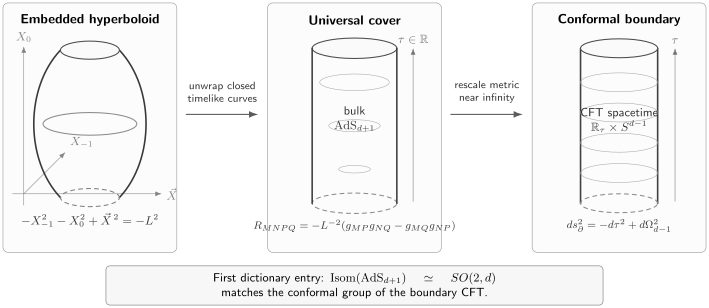
Three equivalent viewpoints on . It can be defined as a hyperboloid in , as a maximally symmetric solution of Einstein’s equations with or as a radial coordinate, or by its conformal compactification whose boundary is the cylinder in global coordinates.
Why this matters
Section titled “Why this matters”On the CFT side, the vacuum on the cylinder is the most natural state produced by radial quantization. On the bulk side, the corresponding geometry is global AdS. This is already a nontrivial match:
The same spacetime also admits Poincaré coordinates whose boundary is :
These are not different dualities. They are different coordinate and conformal-frame descriptions of the same basic geometry. CFTs are naturally sensitive to conformal classes of boundary metrics, not just one chosen representative metric.
The first geometric facts to internalize are:
- is a Lorentzian spacetime of constant negative curvature.
- Its isometry group is , matching the conformal group of a -dimensional CFT.
- Its boundary is not an ordinary finite-distance surface; it is a conformal boundary reached after rescaling the metric.
- In global coordinates, that boundary is .
- In Poincaré coordinates, the boundary looks like Minkowski space.
- The radial direction is geometric in the bulk but becomes associated with scale in the boundary theory.
This page builds these facts carefully.
Definition by embedding
Section titled “Definition by embedding”A compact way to define is as a hyperboloid embedded in a flat auxiliary space with coordinates
and metric
The notation means that the embedding space has two timelike directions and spacelike directions. Anti-de Sitter spacetime is the hypersurface
The parameter is the AdS radius. It sets the curvature scale. If is large compared with every microscopic length scale in the bulk theory, then the spacetime is weakly curved.
This embedding definition is useful because the symmetry group is immediate. The flat metric of is preserved by , and the hyperboloid equation is also preserved by the same group. The identity-connected orientation-preserving part is usually denoted or depending on how much precision is needed. This is the geometric origin of the group match
which is also the conformal group of -dimensional Minkowski space for .
A warning: the two timelike directions belong to the embedding space, not to the physical tangent space of AdS. The induced metric on the hyperboloid has one timelike direction and spacelike directions. AdS is a Lorentzian spacetime, not a two-time physical spacetime.
Global coordinates
Section titled “Global coordinates”The hyperboloid constraint is solved by the global coordinates
Here parameterize a unit , the radial coordinate satisfies , and is dimensionless global time. Substituting into the flat embedding metric gives
If we introduce dimensionful time and radial coordinate
then the same metric becomes
This is the standard global AdS metric. The coordinate is the center of AdS, and is the conformal boundary.
A few features are worth noticing immediately. First, at large ,
Second, spatial slices at fixed have topology , described by a radial direction times . Third, the asymptotic sphere does not shrink or disappear; after an appropriate conformal rescaling it becomes the spatial sphere of the boundary CFT.
The universal cover
Section titled “The universal cover”The embedding coordinates use through and , so the hyperboloid itself identifies
But the curve at fixed and fixed point on is timelike, since
If is periodic, these curves are closed timelike curves. That is not the spacetime usually used in AdS/CFT.
The physical object called global AdS is almost always the universal cover of the hyperboloid, obtained by unwrapping so that
rather than . In this course, means this universal cover unless stated otherwise.
This is a common place where the embedding picture can mislead. The hyperboloid is an elegant definition of the local geometry and the symmetry group, but for causal physics one should remember the universal cover.
Curvature and negative cosmological constant
Section titled “Curvature and negative cosmological constant”AdS is maximally symmetric. With the curvature conventions of this course, its Riemann tensor is
where are bulk indices. Contracting gives
and
Thus AdS has constant negative scalar curvature. In -dimensional Einstein gravity with cosmological constant, the vacuum equation is
Substituting the AdS curvature gives
So AdS is the maximally symmetric vacuum of Einstein gravity with negative cosmological constant.
This statement is simple, but it carries an important conceptual distinction. Negative cosmological constant is not the same as negative energy density in the boundary CFT. The cosmological constant is a parameter in the bulk gravitational equations. The boundary vacuum energy depends on the CFT, the background geometry, and renormalization scheme; for a CFT on a cylinder, there can be a Casimir energy.
Conformal compactification
Section titled “Conformal compactification”The AdS boundary lies at or equivalently . The proper radial distance from finite to infinity is infinite, since
So the boundary is not an ordinary surface at finite proper distance. Nevertheless, it can be brought to finite coordinate distance by a conformal compactification.
Define a compact radial coordinate by
Then
The global AdS metric becomes
The conformal boundary is at
The metric diverges there because of the factor . But if we multiply by the conformal factor
we obtain the rescaled metric
Restricting to gives the boundary metric representative
Thus the conformal boundary of global is
This is exactly the spacetime on which radial quantization naturally places the CFT.
The boundary metric is a conformal class
Section titled “The boundary metric is a conformal class”The previous derivation produced one boundary metric,
But the choice of conformal factor was not unique. If , then the boundary representative changes by a Weyl rescaling:
For this reason, the natural boundary datum of asymptotically AdS geometry is not a single metric but a conformal class
This is a perfect match with conformal field theory: a CFT can be placed on a background metric, but local Weyl rescalings are part of the conformal structure, up to possible anomalies in even boundary dimension.
In later pages, this statement becomes operational. The boundary metric acts as the source for the CFT stress tensor :
On the bulk side, is the leading coefficient in the asymptotic expansion of the bulk metric.
A first look at the Poincaré patch
Section titled “A first look at the Poincaré patch”Global coordinates make the full cylinder boundary visible. The coordinate system most commonly used for computations is the Poincaré patch:
where
The boundary is at . After multiplying by , the induced boundary metric is just the Minkowski metric:
The Poincaré patch does not cover all of global AdS. It covers the region naturally adapted to a CFT on flat Minkowski space. The coordinate is not the global center of AdS; it is a Poincaré horizon.
This metric makes the scale interpretation of the radial coordinate especially transparent. It is invariant under
A boundary scale transformation must be accompanied by a rescaling of the radial coordinate. This is the seed of the UV/IR relation:
while deeper regions of the bulk correspond roughly to lower energy scales.
We will study coordinate systems systematically in the next page. For now, the point is that global and Poincaré coordinates answer different physical questions:
| Bulk coordinates | Boundary frame | Natural use |
|---|---|---|
| global AdS | Hilbert space, states, spectrum | |
| Poincaré AdS | local correlators, flat-space CFT | |
| Fefferman–Graham | arbitrary boundary metric | holographic renormalization |
| Eddington–Finkelstein | black branes and horizons | real-time dynamics |
AdS is a gravitational box
Section titled “AdS is a gravitational box”In asymptotically flat spacetime, outgoing radiation can escape to null infinity. In global AdS, light reaches the boundary in finite global time.
Using the compactified metric
consider a radial null ray with . The null condition gives
so
A radial light ray starting at the center reaches the boundary in
This is finite global coordinate time. If the boundary reflects the signal, it returns to the center after another interval .
This “box” property is part of why thermal equilibrium in AdS is natural. It is also why boundary conditions at infinity are not optional. A field theory in AdS is not fully specified until one states what fields are allowed to do at the timelike boundary.
In holography, those boundary conditions are not arbitrary technical details. They are the sources, states, and deformations of the boundary theory.
Boundary conditions and dynamics
Section titled “Boundary conditions and dynamics”Because the conformal boundary of AdS is timelike, AdS is not globally hyperbolic in the same way Minkowski space is. Initial data on a bulk Cauchy slice do not determine future evolution unless one also specifies boundary conditions at infinity.
This is not a pathology for holography. It is the point.
For a scalar field in AdS, one must specify its allowed near-boundary behavior. Later we will see that near the scalar behaves schematically as
The leading coefficient is interpreted as the source for a CFT operator , while the subleading coefficient is related to the expectation value after holographic renormalization.
Thus the same mathematical feature that makes AdS require boundary conditions is also what makes it holographic: the boundary behavior of bulk fields is boundary QFT data.
Energy, redshift, and the radial direction
Section titled “Energy, redshift, and the radial direction”The global AdS metric
has a timelike Killing vector . A static observer at radius has proper time
Therefore an energy measured with respect to the global time differs from a local proper energy. Near the boundary, the redshift factor becomes large.
In the Poincaré patch, the corresponding intuition is even sharper. The metric
contains an overall warp factor . A fixed proper length in the bulk projects to a boundary length scale controlled by . Small is associated with short-distance boundary physics; large is associated with long-distance boundary physics.
This relation is often summarized as the UV/IR connection. It should be treated as a guiding principle, not as a literal equality between and an RG scale in every coordinate system.
Units and normalization
Section titled “Units and normalization”In this course, will often be set to one in intermediate calculations. Restoring it is usually straightforward by dimensional analysis. For example, the curvature tensors are
A dimensionless bulk mass is written as
and the scalar mass-dimension relation will later be
The ratio , where , controls stringy curvature corrections. The ratio controls the strength of bulk quantum gravity effects. This is why the AdS radius is not merely a coordinate scale: it measures the separation between the curvature scale and microscopic bulk scales.
Dictionary checkpoint
Section titled “Dictionary checkpoint”The geometric statements of this page already contain several entries of the holographic dictionary.
| Bulk statement | Boundary statement |
|---|---|
| has isometry group | the vacuum CFT has conformal group |
| global AdS boundary is | the CFT Hilbert space is naturally defined on the cylinder |
| Poincaré AdS boundary is | the CFT can be studied on Minkowski space |
| radial coordinate approaches boundary | boundary UV region |
| timelike AdS boundary requires boundary conditions | CFT sources and deformations must be specified |
| boundary metric is a conformal class | CFT data are naturally conformal, up to anomalies |
| sets curvature scale | controls the relation between bulk curvature and CFT parameters |
The most important takeaway is this:
Common confusions
Section titled “Common confusions”“AdS has two times because has two times.”
Section titled ““AdS has two times because R2,d\mathbb{R}^{2,d}R2,d has two times.””The two times are in the auxiliary embedding space. The induced metric on the AdS hyperboloid is Lorentzian, with one physical time direction. The embedding is a mathematical construction, not an assertion that the physical bulk has two time dimensions.
“The boundary is at finite distance because the Penrose diagram has finite width.”
Section titled ““The boundary is at finite distance because the Penrose diagram has finite width.””The conformal boundary is at finite coordinate distance only after a conformal rescaling. The proper distance to the boundary is infinite. This is why the boundary is not an ordinary wall, even though diagrams often draw it as a finite line or cylinder.
“Global AdS and Poincaré AdS are different spacetimes.”
Section titled ““Global AdS and Poincaré AdS are different spacetimes.””Poincaré AdS is a coordinate patch of global AdS. The corresponding boundary conformal frames are different: the global frame is the cylinder, while the Poincaré frame is Minkowski space. The choice depends on the question being asked.
“Negative curvature means the spacetime is unstable.”
Section titled ““Negative curvature means the spacetime is unstable.””Constant negative curvature by itself does not imply instability. AdS is the maximally symmetric vacuum of gravity with negative cosmological constant. Stability questions require specifying matter content, boundary conditions, and allowed perturbations. For scalar fields, for example, AdS allows certain negative values without instability, as long as the Breitenlohner–Freedman bound is satisfied.
“The boundary metric is uniquely determined.”
Section titled ““The boundary metric is uniquely determined.””The natural boundary datum is a conformal class of metrics. Choosing one representative, such as or , is a choice of conformal frame.
Exercises
Section titled “Exercises”Exercise 1: Verify the hyperboloid constraint
Section titled “Exercise 1: Verify the hyperboloid constraint”Show that the global coordinate parameterization
with obeys
Solution
Substitute the coordinates:
Also,
Therefore
using .
Exercise 2: Derive the global AdS metric
Section titled “Exercise 2: Derive the global AdS metric”Using the same embedding coordinates, show that the induced metric is
Solution
For the two embedding-time coordinates,
Their contribution is
For the spatial embedding coordinates , with , one has and
Adding the two pieces gives
Since , this becomes
Exercise 3: Find the boundary cylinder
Section titled “Exercise 3: Find the boundary cylinder”Starting from
use to show that the conformal boundary metric is
Solution
If , then
and
Also,
Therefore
Multiplying by gives a finite rescaled metric. Restricting to the boundary gives , so
Exercise 4: Determine the cosmological constant
Section titled “Exercise 4: Determine the cosmological constant”Assume
in bulk dimensions. Use the vacuum Einstein equation
to derive .
Solution
Substitute the curvature tensors:
The coefficient of is
Therefore
Exercise 5: Light reaches the boundary in finite global time
Section titled “Exercise 5: Light reaches the boundary in finite global time”For radial null motion in compactified global AdS,
show that a light ray starting at the center reaches the boundary in .
Solution
For a null ray, . The overall conformal factor does not affect the null condition, so
Thus
The center is at , and the boundary is at . For an outgoing radial light ray,
Further reading
Section titled “Further reading”- J. Maldacena, The Large Limit of Superconformal Field Theories and Supergravity.
- E. Witten, Anti de Sitter Space and Holography.
- O. Aharony, S. S. Gubser, J. Maldacena, H. Ooguri, and Y. Oz, Large Field Theories, String Theory and Gravity, especially the review of AdS geometry.
- M. Henneaux and C. Teitelboim, Asymptotically anti-de Sitter Spaces, for the role of asymptotic conditions.
- K. Skenderis, Lecture Notes on Holographic Renormalization, for the Fefferman–Graham and boundary-metric viewpoint.