
Holography of Information and Asymptotic Observables
Guiding question. In gravity, do the asymptotic metric and boundary charges already know everything about the bulk, and if so, how can bulk effective field theory still look local?
The previous two pages discussed Euclidean wormholes, ensemble averaging, and baby universes. Those puzzles are about which boundary theory the gravitational path integral computes. This page turns to a different but closely related frontier: in any theory with dynamical gravity, the Hamiltonian and conserved charges are surface terms on physical states. That fact gives gravity a form of information storage that has no direct analogue in ordinary local quantum field theory.
There is a tempting slogan:
In gravity, information is holographic because the boundary fields know the bulk.
The slogan is useful only if one handles it with tweezers. It does not mean that a low-energy observer near infinity can instantly read the diary of an infalling astronaut from the tail of the metric. It means something more precise and more subtle:
- gravitational constraints relate bulk excitations to asymptotic fields and surface charges;
- strictly local gauge-invariant bulk operators do not exist without a nonlocal gravitational dressing;
- in AdS/CFT, the exact boundary theory supplies a nonperturbative definition of the gravitational Hilbert space;
- perturbative gravity can still have approximate localized subsystems, so asymptotic charges do not automatically encode all localized microstate information in a practically accessible form.
This page is therefore about a tension, not a slogan. Gravity is less local than nongravitational QFT, but the useful semiclassical description of black holes still relies on an approximate notion of locality. The black hole information problem lives in the space between those two statements.
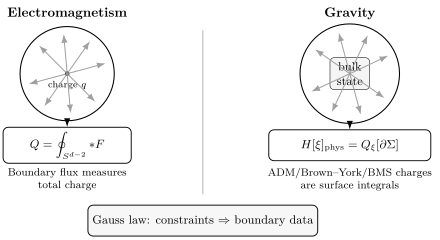
Gauss laws turn constraints into boundary data. In electromagnetism the total charge is measured by the electric flux at infinity. In gravity, ADM/Brown–York/BMS charges are surface integrals of the asymptotic metric. The analogy is powerful, but gravity is stronger: even energy, the generator of time translations, is a boundary charge.
1. The basic tension: locality versus constraints
Section titled “1. The basic tension: locality versus constraints”In an ordinary nongravitational QFT on a fixed background, it is meaningful, at least after the usual UV caveats, to discuss operators localized in spacetime regions. A scalar field operator is not gauge redundant, and spacelike separated operators commute:
This is the operational basis for local subsystems, local measurements, entanglement between regions, and causal propagation.
Gravity changes the story because diffeomorphisms are gauge redundancies. A coordinate point is not an invariant label. The metric itself is dynamical, and the Hamiltonian formulation of general relativity contains constraints. Schematically,
where are the gravitational constraints and is a surface charge. On physical states,
so the generator becomes a boundary term:
For an asymptotic time translation, this is the statement that the Hamiltonian is the ADM energy in asymptotically flat space or the Brown–York boundary energy in asymptotically AdS space. Already at the classical level, the energy inside a region is linked to the long-range gravitational field.
In asymptotically flat gravity, the ADM energy is measured at spatial infinity as
where in asymptotically Cartesian coordinates. The precise expression changes with dimension and boundary conditions, but the structural point is invariant: conserved gravitational charges are surface integrals.
This creates an apparent clash. If the Hamiltonian is a boundary observable, and if the Hamiltonian generates exact time evolution, then perhaps boundary observables know everything. But if boundary observables know everything, how can the bulk look local? Why can a particle hide behind a black hole horizon? Why can two different bulk states have the same exterior geometry for a long time?
The answer is not a single theorem. It is a hierarchy of statements with different strengths:
- Kinematic nonlocality: exact gravitational observables require nonlocal dressing.
- Constraint nonlocality: asymptotic charges measure global quantities such as energy and momentum.
- Dynamical holography: in AdS/CFT, the boundary theory defines the full bulk quantum theory.
- Approximate localization: within perturbative gravity and fixed charge sectors, localized information can still be hidden from exterior measurements up to controlled accuracy.
Confusing these layers is a reliable way to say something too strong.
2. Maxwell first: the friendly Gauss law
Section titled “2. Maxwell first: the friendly Gauss law”The electromagnetic analogy is a useful warm-up. In Maxwell theory,
so the total charge in a spatial region is a boundary flux:
This already means that a charged excitation cannot be completely invisible outside a region. A charged operator must be gauge invariant, and a gauge-invariant charged operator carries an electromagnetic dressing. For example, a charged scalar insertion may be dressed by a Wilson line running to infinity,
The Wilson line is not decorative. It supplies the electric flux required by Gauss’s law.
But Gauss’s law does not say that the outside electric field contains the complete quantum state of the charged object. If two states have the same total charge and the same chosen exterior multipole data, the asymptotic electric field need not distinguish all their internal details. Gauge theory already teaches the right lesson: constraints create long-range correlations, but they do not by themselves trivialize locality.
Gravity is similar, but more severe. Everything gravitates. Even an otherwise neutral excitation carries energy and momentum. Therefore every excitation has gravitational charge. The gravitational analogue of the charged Wilson line is a gravitational dressing: a prescription that ties a would-be local bulk operator to some relational or asymptotic structure.
3. Why a local bulk operator must be dressed
Section titled “3. Why a local bulk operator must be dressed”Consider a scalar field in perturbative gravity around a background metric :
A bare field operator is not diffeomorphism invariant. Under an infinitesimal diffeomorphism generated by ,
To build an observable one must specify the point relationally. Perturbatively, one can write a dressed operator of the schematic form
where the dressing transforms so that the combination is gauge invariant to the desired order:
There are many possible dressings. Two simple idealizations are:
- a line dressing, which is analogous to a Wilson line and ties the operator to the boundary along a chosen curve;
- a Coulomb dressing, which distributes the gravitational field more symmetrically and is adapted to measuring total charges.
Different dressings represent the same local excitation plus different gravitational field configurations. The choice is a gauge-invariant physical choice about where the compensating long-range gravitational field lives.
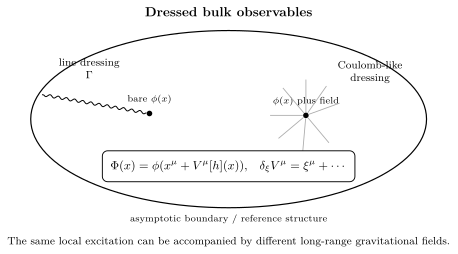
A bare bulk operator is not diffeomorphism invariant. A dressed operator must be anchored relationally or asymptotically. A line dressing resembles a gravitational Wilson line; a Coulomb dressing spreads the long-range field. The excitation is local only after one agrees to ignore or coarse-grain the dressing at the appropriate order.
The most important consequence is that exact gravitational observables do not form a net of strictly local commuting subalgebras like ordinary QFT. Dressed operators at spacelike separation can fail to commute by terms of order , because their gravitational fields overlap at infinity. Symbolically,
in circumstances where the corresponding nongravitational fields would commute exactly. The estimate is schematic; the actual commutator depends on the dressing. But the qualitative lesson is robust: gravitational gauge invariance obstructs exact microscopic locality.
This obstruction is not a bug in the formalism. It is one of the ways holography peeks out of low-energy gravity.
4. The boundary Hamiltonian and boundary unitarity
Section titled “4. The boundary Hamiltonian and boundary unitarity”The strongest version of the asymptotic-observable idea comes from the Hamiltonian. In a diffeomorphism-invariant theory, the bulk Hamiltonian is a constraint plus a boundary term. On physical states,
where is an asymptotic charge. Therefore time evolution is generated by a boundary observable.
Suppose is the exact boundary algebra. If , then for any boundary operator ,
is also generated by boundary data. In an exact AdS/CFT duality this is unsurprising: the boundary CFT Hamiltonian evolves the full boundary Hilbert space, which is the nonperturbative definition of the bulk theory.
The provocative bulk statement is that, because the Hamiltonian is a boundary term, the boundary algebra over time can be complete in a way that would be impossible in a nongravitational theory. This is sometimes called boundary unitarity or the holography of information.
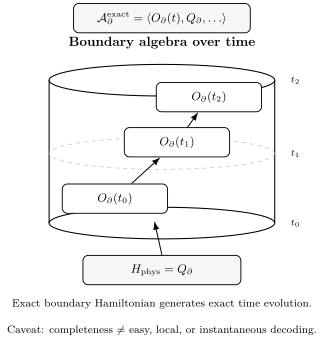
On physical states the gravitational Hamiltonian is a boundary charge. Exact boundary observables, evolved with the exact boundary Hamiltonian, can in principle generate a very large algebra. This is a statement about exact asymptotic observables and time evolution, not about easy or instantaneous decoding by semiclassical observers.
This idea is powerful, but several caveats are essential.
First, in principle is not in practice. Boundary recovery may require exponentially precise measurements, exponentially long times, or operations whose backreaction destroys the semiclassical situation one hoped to probe. This is the same moral that appears in Harlow–Hayden decoding and Python’s lunch: information-theoretic recoverability is not efficient recoverability.
Second, exact boundary completeness does not imply that the semiclassical bulk has no useful notion of causality. A boundary observer may possess a formal algebraic description of the bulk Hilbert space, while still being unable to perform a low-energy local measurement that extracts interior data before causal propagation or evaporation.
Third, the statement depends on the asymptotic structure. AdS has a timelike boundary and a sharp CFT definition. Asymptotically flat quantum gravity is naturally formulated with data at null infinity, and its nonperturbative Hilbert space is less sharply understood. de Sitter space is harder still because there is no ordinary spatial infinity accessible to a global observer.
5. Boundary time bands and Reeh–Schlieder intuition
Section titled “5. Boundary time bands and Reeh–Schlieder intuition”There is another route to boundary recoverability that uses both gravity and quantum entanglement. In a local QFT, the Reeh–Schlieder theorem says, roughly, that the vacuum is so entangled that acting with operators in any open region can approximate a dense set of states. This does not mean that one can send signals acausally; the operations involved are highly nonlocal in energy and not ordinary laboratory manipulations.
In gravitational AdS, one can combine this type of entanglement with the gravitational Gauss law. Boundary correlators in a sufficiently rich time band, together with exact knowledge of the dynamics, can encode information about bulk insertions that look deep in the interior from a semiclassical perspective.
This helps explain why boundary correlators in AdS/CFT can determine bulk physics beyond a naive causal-wedge picture. But it also sharpens the distinction between three statements:
These are not equivalent. Much of modern holography is about understanding when one implies another, and under what assumptions.
Entanglement wedge reconstruction is the cleanest controlled version of the second statement. The island formula is the corresponding statement for Hawking radiation after the Page time. The holography of information is a more general and more delicate claim about exact gravitational asymptotic observables.
6. Asymptotic observables in flat space
Section titled “6. Asymptotic observables in flat space”In asymptotically flat spacetime, the natural observables live at null infinity:
The gravitational -matrix, if well-defined, maps incoming data at to outgoing data at . The asymptotic symmetry group is enlarged from the Poincare group to the BMS group, whose supertranslations and related charges are tied to soft gravitons and gravitational memory.
The schematic conservation law is
where labels an angle-dependent supertranslation charge. More refined versions include hard and soft pieces,
The associated Ward identities are equivalent to soft-graviton theorems. This triangular relation
is one of the most beautiful facts about infrared gravity.
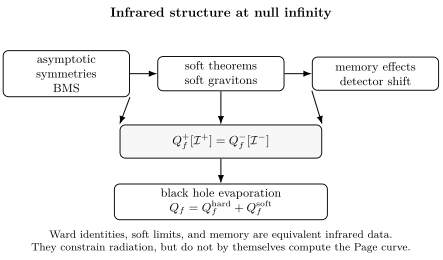
At null infinity, BMS charges organize the relation between asymptotic symmetries, soft gravitons, and memory effects. These charges constrain black hole evaporation and scattering, but their existence alone is not the same as a microscopic account of the Page curve.
A stronger set of recent arguments goes beyond merely listing conserved charges. In four-dimensional asymptotically flat gravity, the algebra near the past boundary of future null infinity, , can be powerful enough to recover information about suitable massless excitations. Related AdS protocols show that observers confined near the boundary can distinguish low-energy bulk states using simple boundary operations, gravitational backreaction, and the entanglement structure of the vacuum. These results are perturbative and state-class dependent, but they make the slogan “information is asymptotic” more concrete than a statement about total energy alone.
The caveat is just as important as the result. Asymptotic recoverability is not the same as a universal, efficient black-hole decoder. The protocols are controlled in weak-gravity or low-energy regimes; black hole evaporation involves strong-field regions, finite entropy, backreaction, and often exponentially hard reconstruction.
This connects naturally to black holes. Hawking, Perry, and Strominger proposed that black holes can carry soft hair associated with asymptotic symmetries. Such hair records certain conservation-law data and corrects the naive statement that black holes are characterized only by mass, charge, and angular momentum.
However, the conservative lesson is again nuanced. Soft charges impose exact constraints on the radiation and on the infrared structure of the state. But the number and accessibility of these charges do not, by themselves, give a complete microscopic decoding of the enormous black hole entropy
Soft hair is real physics. It is not, by itself, a complete replacement for the Page curve, islands, entanglement wedge reconstruction, or a microscopic AdS/CFT description.
7. Localizing information: gravitational splitting
Section titled “7. Localizing information: gravitational splitting”If gravitational dressing reaches infinity, does all bulk information leak to infinity? Perturbative gravity suggests a more careful answer.
Donnelly and Giddings introduced the idea of gravitational splitting: one can define perturbative subsystems so that exterior measurements are sensitive to the total Poincare charges of a region, but not to all of the detailed quantum information inside. In symbols, consider two states and localized in a region with the same total charges. Then for a class of exterior observables ,
up to the controlled order in and within the chosen split structure.
This is the gravitational analogue of saying that outside observers can measure global fluxes but not arbitrary internal details. It protects the usefulness of bulk effective field theory. Without such approximate localization, ordinary semiclassical reasoning would collapse immediately.
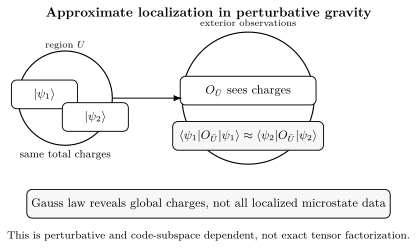
Gravitational dressing makes exact locality impossible, but perturbative gravity can still support approximate localized information. Exterior measurements detect charges and long-range fields; they need not distinguish all internal microstates with the same charges. This is why Gauss-law holography is subtler than “the boundary flux contains the whole diary.”
This idea is crucial for black hole information. If the exterior metric at infinity trivially encoded all details of infalling matter in an easily measurable way, there would be no Hawking paradox. Conversely, if gravity were exactly local like nongravitational QFT, boundary holography would be mysterious. The real theory appears to occupy an intermediate position: exact observables are nonlocal, while approximate locality emerges in low-energy code subspaces.
8. What about soft hair?
Section titled “8. What about soft hair?”Soft hair is often discussed as a possible carrier of black hole information. The precise statement should be separated into several claims.
Claim 1: Black hole evaporation is constrained by asymptotic charges. This is true. The outgoing radiation must obey conservation laws associated with the asymptotic symmetry group.
Claim 2: Soft radiation is correlated with hard radiation. This is also true in the infrared structure of gravitational scattering. Properly defined scattering states are dressed; inclusive and exclusive descriptions differ.
Claim 3: These soft correlations alone reproduce the Page curve. This is not established. The Page curve is a statement about the fine-grained entropy of the Hawking radiation. Soft charges constrain the infrared sector, but the black hole entropy is dominated by hard microscopic degrees of freedom in known controlled descriptions.
Claim 4: Soft hair is irrelevant. This is also too strong. Infrared constraints are part of the exact quantum-gravity bookkeeping and may be essential for a correct -matrix.
A good working attitude is:
This is similar to energy conservation. Energy conservation is indispensable, but knowing the total energy does not determine a many-body quantum state.
9. Asymptotic observables and the black hole information problem
Section titled “9. Asymptotic observables and the black hole information problem”Let us connect the discussion to the main storyline of this course.
Hawking’s calculation treats the near-horizon region using local QFT on a semiclassical geometry. It predicts outgoing modes entangled with interior partners and therefore a radiation entropy that grows monotonically. The island formula changes the fine-grained entropy calculation by allowing the radiation region to have an entanglement wedge containing an island :
Where do asymptotic observables enter?
They enter at a different conceptual layer. The island formula is a controlled semiclassical prescription for fine-grained entropy. Gravitational Gauss laws and boundary observables explain why exact gravitational Hilbert spaces are not naive tensor products of local bulk regions. Both lessons point in the same direction:
The island formula says that after the Page time, certain interior operators are encoded in the radiation algebra. The holography-of-information perspective says that exact gravitational observables are tied to asymptotic structures and constraints. Neither statement says that an infalling observer sees a drama at the Page time. Neither statement allows a low-energy observer to send a message out of the black hole interior by manipulating a boundary charge.
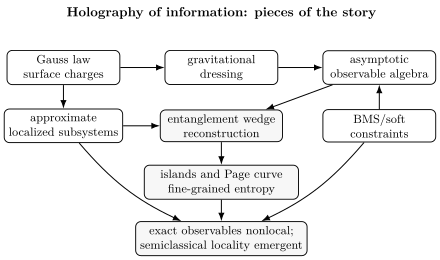
Asymptotic charges, gravitational dressing, entanglement wedges, and islands are different ways in which exact gravitational physics departs from naive local QFT. They should be combined, not conflated: charges constrain the state, dressings make observables gauge invariant, entanglement wedges describe reconstructable algebras, and islands compute fine-grained radiation entropy.
10. Algebra, factorization, and edge modes
Section titled “10. Algebra, factorization, and edge modes”A recurring theme is that gravitational Hilbert spaces do not factorize naively. In an ordinary lattice system one may write
Gauge theories already complicate this because Gauss constraints tie the two sides across the entangling surface. One often introduces edge modes or works with operator algebras with centers. Gravity adds diffeomorphism constraints and the gravitational dressing problem.
A more robust language is algebraic. Instead of asking for a literal tensor factor , ask for an algebra of observables associated with a region or asymptotic domain. In holography, the entanglement wedge reconstruction statement is precisely algebraic:
within an appropriate code subspace. Operator-algebra QEC then explains why the area term behaves like a central operator and why fixed-area sectors simplify the entropy formula.
The same moral appears here. Asymptotic observables do not merely measure a pre-existing tensor-factorized bulk state. They participate in the definition of what the gravitational observable algebra is.
This is why the factorization puzzles of the previous pages, the OAQEC structure of the reconstruction module, and the island formula are not separate curiosities. They are all symptoms of the same deep fact: quantum gravity has a different notion of subsystem.
11. What this page does and does not prove
Section titled “11. What this page does and does not prove”It proves no new theorem. It organizes several lessons that are often conflated.
What is solid:
- gravitational charges are surface integrals;
- the physical Hamiltonian is a boundary term in asymptotic gravity;
- diffeomorphism-invariant bulk observables require nonlocal dressing;
- exact gravitational locality is obstructed;
- asymptotic symmetries impose exact constraints on scattering and evaporation;
- AdS/CFT gives a nonperturbative realization of boundary holography.
What is not automatic:
- that soft hair by itself accounts for black hole microstates;
- that boundary observers can efficiently decode arbitrary interior information;
- that perturbative gravitational Gauss laws alone derive the Page curve;
- that flat-space or de Sitter holography is as sharply defined as AdS/CFT;
- that approximate bulk subsystems are meaningless.
The useful synthesis is this:
Gravity makes exact observables nonlocal and asymptotic, while semiclassical physics emerges from approximate local algebras in restricted code subspaces.
That sentence is one of the safest ways to talk about the holography of information.
12. Exercises
Section titled “12. Exercises”Exercise 1: Maxwell Gauss law versus information
Section titled “Exercise 1: Maxwell Gauss law versus information”In Maxwell theory on a spatial slice , show that the total charge in a compact region is determined by the electric flux through a sphere surrounding it. Then explain why this does not determine the complete quantum state inside the sphere.
Solution
Gauss’s law is
Integrating over a region and applying Stokes’ theorem gives
Thus the total charge is measured by a boundary flux.
But many states can have the same total charge. For example, two different internal wavefunctions of a charged composite object can produce the same total charge and the same exterior Coulomb field at large distances. The flux fixes a conserved charge, not the full density matrix of the region. This is the correct analogy for gravitational charges: surface data impose constraints, but constraints are not automatically a complete microscopic decoder.
Exercise 2: Boundary Hamiltonian on physical states
Section titled “Exercise 2: Boundary Hamiltonian on physical states”Consider a constrained Hamiltonian of the schematic gravitational form
Assume physical states satisfy . Show that acts as a boundary operator on physical states. Why does this statement not imply that a semiclassical observer can instantly read all bulk information?
Solution
Acting on a physical state,
Thus the generator is represented by a boundary charge on the physical Hilbert space.
The second part is conceptual. Knowing that the exact Hamiltonian belongs to the boundary algebra does not mean that all bulk information is available through simple low-energy measurements. Recovery may require exact knowledge of the state, extremely precise measurements, long-time evolution, or operations of enormous computational complexity. It also does not contradict causal propagation inside the semiclassical code subspace. Boundary representation and efficient semiclassical readout are different notions.
Exercise 3: Dressing a scalar operator
Section titled “Exercise 3: Dressing a scalar operator”Let be a scalar field in perturbative gravity. Under an infinitesimal diffeomorphism,
Suppose a functional transforms as . Show to leading order that
is diffeomorphism invariant.
Solution
Expand to first order in :
The variation is
Using at leading order gives
Higher orders require correcting so that the cancellation continues. The important point is that the gauge-invariant operator is not the bare local field; it is the field plus its gravitational dressing.
Exercise 4: Soft hair and the Page curve
Section titled “Exercise 4: Soft hair and the Page curve”Explain why the existence of infinitely many BMS charges or soft modes does not by itself prove that black hole evaporation has a unitary Page curve.
Solution
BMS charges impose conservation laws on gravitational scattering and evaporation. They organize correlations between soft radiation and hard radiation, and they are essential for the correct infrared description of the gravitational -matrix.
However, the Page curve is a quantitative statement about the fine-grained von Neumann entropy of the Hawking radiation:
To derive the Page curve one must show that the fine-grained entropy rises and then decreases in a way consistent with unitary evaporation. Conservation laws, even infinitely many of them, do not automatically determine the full density matrix of a many-body quantum system. They constrain the answer but do not by themselves compute . The island formula and replica-wormhole derivations address precisely this fine-grained entropy calculation.
Exercise 5: Approximate localization in a fixed charge sector
Section titled “Exercise 5: Approximate localization in a fixed charge sector”Suppose two states localized in a region have the same total energy, momentum, angular momentum, and other asymptotic charges. Why might exterior gravitational measurements fail to distinguish them in perturbation theory? What is the limitation of this statement?
Solution
Exterior gravitational measurements are sensitive to the long-range gravitational field. At large distances, the leading data are determined by conserved charges and multipole moments. If the two states are arranged to have the same charges and the same exterior field data to the relevant order, then exterior observables cannot distinguish their internal quantum information. This is the intuition behind gravitational splitting: localized information can exist perturbatively even though exact gravitational observables are dressed.
The limitation is that the statement is perturbative and code-subspace dependent. Exact quantum gravity may not admit a strict tensor-factor localization. Nonperturbative effects, black hole formation, boundary holography, and extremely precise measurements can invalidate a naive local-subsystem picture. Approximate localization is useful, not absolute.
Further reading
Section titled “Further reading”- D. Marolf, “Unitarity and holography in gravitational physics”.
- D. Marolf, “Holographic thought experiments”.
- D. Marolf, “Holography without strings?”.
- W. Donnelly and S. B. Giddings, “Observables, gravitational dressing, and obstructions to locality and subsystems”.
- W. Donnelly and S. B. Giddings, “How is quantum information localized in gravity?”.
- S. B. Giddings and A. Kinsella, “Gauge-invariant observables, gravitational dressings, and holography in AdS”.
- A. Strominger, “Lectures on the infrared structure of gravity and gauge theory”.
- S. W. Hawking, M. J. Perry, and A. Strominger, “Soft hair on black holes”.
- A. Laddha, S. G. Prabhu, S. Raju, and P. Shrivastava, “The holographic nature of null infinity”.
- C. Chowdhury, O. Papadoulaki, and S. Raju, “A physical protocol for observers near the boundary to obtain bulk information in quantum gravity”.
- C. Chowdhury and O. Papadoulaki, “Recovering information in an asymptotically flat spacetime in quantum gravity”.
- S. Raju, “Failure of the split property in gravity and the information paradox”.
- E. Bahiru, A. Belin, K. Papadodimas, G. Sarosi, and N. Vardian, “Holography and localization of information in quantum gravity”.
- E. Witten, “Algebras, regions, and observers”.
- A. Almheiri, T. Hartman, J. Maldacena, E. Shaghoulian, and A. Tajdini, “The entropy of Hawking radiation”.