
Open and Closed Strings
The previous units built two sides of the AdS/CFT story separately. On the boundary side, we found large- gauge theories, single-trace operators, and factorization. On the bulk side, we found Anti-de Sitter geometry, fields in AdS, and black holes. The next task is to explain why these two languages meet in the first place.
The answer in the canonical example is string theory.
This page is not a string theory course. It is a carefully chosen minimum: enough open strings, closed strings, and D-branes to understand why the D3-brane argument produces
The essential slogan is:
and D-branes are the objects that make both statements true at once.
Why this matters
Section titled “Why this matters”AdS/CFT did not arise by guessing that a random gauge theory should equal a random gravitational theory. It arose from a physical system with two complementary low-energy descriptions.
For a stack of D3-branes:
- the open strings ending on the branes give a four-dimensional gauge theory;
- the same branes also source a ten-dimensional closed-string gravitational field;
- in a suitable low-energy limit, the gauge-theory description and the near-horizon gravitational description describe the same degrees of freedom.
This is the historical and structural origin of the canonical correspondence. Later, the dictionary can be formulated abstractly, and many holographic lessons do not require constantly mentioning strings. But the string origin explains several facts that otherwise look mysterious:
- why the boundary theory is a gauge theory;
- why the bulk contains gravity;
- why the number of colors controls bulk quantum effects;
- why the ‘t Hooft coupling controls the bulk curvature in string units;
- why the strongest form of the duality is a string-theoretic statement, not merely an Einstein-gravity statement.
The figure summarizes the logic of this page.
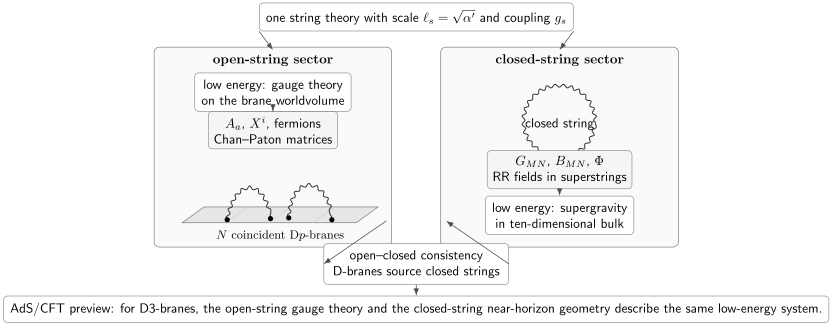
Open strings have endpoints and can end on D-branes. Their massless modes give gauge fields and adjoint matter on the brane worldvolume. Closed strings have no endpoints and propagate through the bulk; their massless modes include the graviton and other supergravity fields. D-branes are the bridge: they support open-string gauge theories and also source closed-string gravitational fields.
The string scale
Section titled “The string scale”A relativistic point particle traces out a worldline. A string traces out a two-dimensional worldsheet. The simplest classical string action is proportional to the area swept out by the string:
where is the induced metric on the worldsheet and is the string tension. The conventional normalization is
Here is the string length. At energies much smaller than , massive string excitations are hard to produce, and the theory can often be approximated by an ordinary field theory of the massless modes. At energies comparable to , the extended nature of the string becomes visible.
This is the first appearance of a distinction that will recur throughout AdS/CFT:
while
In AdS/CFT, the ratio is controlled by the boundary ‘t Hooft coupling. Large means that the bulk curvature is small in string units, so the extended-string corrections are suppressed.
Open strings and closed strings
Section titled “Open strings and closed strings”There are two basic topologies for a single string.
An open string has two endpoints. Its worldsheet has boundaries. A convenient worldsheet coordinate choice is
so the endpoints lie at and .
A closed string has no endpoints. Its spatial worldsheet coordinate is periodic:
This topological difference is not cosmetic. It determines the types of massless particles that appear after quantization.
Very schematically:
In the AdS/CFT construction, both sectors are present in one theory. The open-string sector becomes the gauge theory on D-branes. The closed-string sector becomes the gravitational theory in the bulk.
Closed strings contain gravity
Section titled “Closed strings contain gravity”The quickest way to see why string theory contains gravity is to look at the massless spectrum of a closed string. Closed-string excitations combine a left-moving oscillator and a right-moving oscillator. The first massless tensor excitation has the schematic form
The spacetime tensor product decomposes into symmetric, antisymmetric, and trace parts:
Here:
- is the spacetime metric fluctuation, whose quantum is the graviton;
- is an antisymmetric two-form field;
- is the dilaton, whose expectation value controls the string coupling.
In superstring theory there are also Ramond–Ramond fields, fermions, and supersymmetric partners. For the canonical AdS/CFT example, we need type IIB string theory, whose massless closed-string fields include the metric, dilaton, two-forms, and a self-dual five-form field strength.
At energies low compared with , the closed-string massless modes are described by a supergravity action. The schematic ten-dimensional scaling is
with
The exact numerical convention often used in type II string theory is
The important lesson is the scaling:
Thus the string coupling controls closed-string quantum loops. Weak string coupling means weak quantum gravity in the bulk.
The dilaton and the string coupling
Section titled “The dilaton and the string coupling”The string coupling is not just a number inserted by hand. It is determined by the expectation value of the dilaton:
A spacetime-dependent dilaton corresponds to a spacetime-dependent effective string coupling. In the simplest AdS background, the dilaton is constant, so is constant.
This matters for the parameter map. In the canonical D3-brane duality, one finds schematically
The precise factor depends on conventions for normalizing the Yang–Mills action and generators. In the common AdS/CFT convention used later in this course,
That is why the combination , not just , appears in the curvature radius of the D3-brane geometry.
Open strings need endpoint conditions
Section titled “Open strings need endpoint conditions”Open strings have endpoints, so their variation requires boundary conditions. Split the ten-dimensional spacetime coordinates as
where are directions along a D-brane and are directions transverse to it.
For an open string ending on the D-brane, the endpoint is free to move along the brane but fixed in the transverse directions. The corresponding boundary conditions are
The first condition is a Neumann boundary condition. The second is a Dirichlet boundary condition. This is the origin of the name D-brane: a D-brane is a hypersurface defined by Dirichlet boundary conditions for open strings.
The brane has spatial dimensions and one time dimension, so its worldvolume has dimension . A D3-brane has a dimensional worldvolume, which is exactly why D3-branes are the natural branes behind a four-dimensional gauge theory.
Open strings give gauge fields
Section titled “Open strings give gauge fields”Quantizing an open string produces a tower of excitations. The massless open-string modes include a vector field along the brane,
and scalar fields describing transverse fluctuations of the brane,
In a supersymmetric theory there are also fermionic partners. At low energies, these massless modes are described by a gauge theory on the D-brane worldvolume.
For a single D-brane, the gauge group is . For coincident D-branes, the endpoints of an open string can begin on brane and end on brane . These endpoint labels are called Chan–Paton indices:
The massless fields therefore become matrices:
This is the open-string origin of non-Abelian gauge theory. The gauge group for coincident branes is typically , with fields in the adjoint representation.
In AdS/CFT one often focuses on the part. The overall corresponds to the center-of-mass motion of the brane stack and decouples in the usual low-energy limit of the canonical example.
Why coincident branes matter
Section titled “Why coincident branes matter”If the branes are separated in transverse space, an open string stretching from brane to brane has a minimum length. Its energy is roughly
These stretched strings become massive. In the worldvolume gauge theory, this corresponds to moving onto the Coulomb branch, where the gauge group is broken:
for a generic separation.
When the branes coincide, the stretched strings can become massless. The non-Abelian gauge symmetry is restored. This is why coincident branes are the natural string-theoretic origin of matrix-valued gauge fields.
For D3-branes in type IIB string theory, the low-energy theory on coincident branes is four-dimensional super-Yang–Mills theory. The six scalar fields of SYM are precisely the six transverse fluctuations of the D3-branes inside ten-dimensional spacetime.
D-branes are not just places where strings end
Section titled “D-branes are not just places where strings end”It is tempting to picture a D-brane as a fixed surface. That picture is useful, but incomplete.
D-branes are dynamical objects in string theory. They have:
- a worldvolume gauge theory from open strings ending on them;
- transverse scalar fields describing their motion;
- tension, so they carry energy and gravitate;
- Ramond–Ramond charge, so they source RR gauge potentials.
The D-brane tension scales as
With the common type II normalization,
The factor is important. At weak string coupling, D-branes are heavy objects. They can be treated as classical sources for closed-string fields when the total charge or energy is large enough.
For a stack of many branes, the gravitational backreaction depends on a combination like
This is the first sign of the same combination that will become the ‘t Hooft coupling in the boundary gauge theory.
Open–closed consistency
Section titled “Open–closed consistency”Open and closed strings are not two unrelated theories glued together by hand. In a consistent string theory with open strings, closed strings are generally unavoidable.
One way to see this is through the annulus diagram. Viewed in one direction, it is a one-loop open-string diagram. Viewed after a modular transformation of the worldsheet, the same surface is a tree-level closed-string exchange between two boundaries:
Schematically,
Here is a boundary state representing the D-brane as a source for closed strings. The exact constants are not important for us. The conceptual point is essential:
This is the physical seed of the two-description argument behind AdS/CFT.
Worldsheet topology and the coupling expansion
Section titled “Worldsheet topology and the coupling expansion”String perturbation theory is organized by worldsheet topology. For an oriented worldsheet with genus and boundaries, the Euler characteristic is
The corresponding vacuum worldsheet weight scales as
For closed strings without boundaries, . Then a genus- worldsheet contributes with weight
Thus the closed-string loop expansion is controlled by powers of :
After canonical normalization of external fields, the same expansion says that closed-string interactions are controlled by and closed-string loops by powers of .
With D-branes, worldsheets can have boundaries. Each boundary can carry a Chan–Paton trace. For a stack of branes, this produces factors of . This is why the combination
naturally appears in the open-string description. On D3-branes, it becomes the gauge-theory ‘t Hooft coupling up to conventional numerical factors:
So the field-theory large- expansion and the string worldsheet expansion are two faces of the same organizing principle.
Low-energy limits
Section titled “Low-energy limits”String theory contains infinitely many massive excitations. For AdS/CFT foundations, we usually begin by taking a low-energy limit.
The open-string low-energy limit gives a gauge theory on the brane:
leaving the massless worldvolume fields. For D3-branes, this becomes four-dimensional SYM.
The closed-string low-energy limit gives supergravity in the ambient spacetime:
leaving the metric, dilaton, form fields, and their superpartners.
These two limits are not independent when branes are present. Open strings on the brane can emit and absorb closed strings. Closed strings can feel the brane as a gravitational and RR source. The D-brane system contains both sectors.
The AdS/CFT decoupling argument will exploit this structure very carefully. It will take a low-energy limit in which the brane gauge theory decouples from ordinary asymptotically flat bulk gravity, while a near-horizon closed-string region remains. The claim of the duality is that those two surviving descriptions are equivalent.
The two descriptions waiting behind the curtain
Section titled “The two descriptions waiting behind the curtain”For coincident D3-branes in type IIB string theory, there are two useful weak-coupling descriptions before taking the full AdS/CFT limit.
First, if is small, the branes do not strongly curve spacetime. The open-string description is natural. The low-energy theory on the branes is
plus closed strings propagating in the surrounding ten-dimensional nearly flat spacetime.
Second, if is large while itself remains small, the collective backreaction of the branes is strong even though string loops are suppressed. The closed-string gravitational description is natural. The branes are replaced by a classical D3-brane supergravity geometry.
The profound point is that these are two descriptions of the same underlying brane system. The near-horizon limit will turn the second description into
The next few pages unpack this slowly:
and then the decoupling limit identifies the two surviving low-energy descriptions.
A useful hierarchy of approximations
Section titled “A useful hierarchy of approximations”It is helpful to separate four layers.
Full string theory
Section titled “Full string theory”The most complete statement involves all string modes, all loops, and all allowed backgrounds:
This is the layer at which the D-brane construction truly lives.
Low-energy open-string theory
Section titled “Low-energy open-string theory”At energies below the string scale, the open-string sector on D-branes reduces to a worldvolume field theory. For D3-branes, this is SYM.
Low-energy closed-string theory
Section titled “Low-energy closed-string theory”At energies below the string scale, the closed-string sector reduces to supergravity. This approximation is reliable when curvatures are small in string units:
For AdS backgrounds, this means
Classical gravity
Section titled “Classical gravity”Supergravity becomes classical when quantum loops are suppressed. In AdS units this is controlled by , or equivalently by large in the boundary theory.
For the canonical example, the two conditions for classical two-derivative gravity are roughly
Large suppresses quantum loops. Large suppresses stringy corrections.
What survives into the AdS/CFT dictionary
Section titled “What survives into the AdS/CFT dictionary”Even when we stop explicitly talking about strings, three lessons survive.
First, single-trace operators are single-string or single-particle states in the bulk. In the supergravity limit, they are represented by bulk fields.
Second, large is a bulk perturbation parameter. Boundary factorization becomes weak bulk interactions.
Third, large ‘t Hooft coupling is a curvature condition. It makes the AdS radius large compared with the string length, suppressing the tower of massive string modes.
This is why the classical gravity approximation is powerful but limited. It captures the low-energy closed-string sector in a special limit. It does not erase the string-theoretic origin of the duality.
Dictionary checkpoint
Section titled “Dictionary checkpoint”| String-theory concept | AdS/CFT role |
|---|---|
| string length | scale of stringy corrections |
| string coupling | controls closed-string loops |
| closed string | bulk gravitational excitation |
| massless closed-string modes | metric, dilaton, form fields, supergravity multiplet |
| open string endpoint | degree of freedom living on a D-brane |
| Chan–Paton labels | matrix indices of gauge-theory fields |
| coincident D-branes | or gauge theory |
| D3-brane worldvolume | four-dimensional spacetime of SYM |
| D-brane tension and RR charge | source for closed-string supergravity fields |
| precursor of the ‘t Hooft coupling |
The next page turns this checkpoint into a concrete object: the D-brane as seen by a field theorist.
Common confusions
Section titled “Common confusions”“If closed strings give gravity, why do we need D-branes?”
Section titled ““If closed strings give gravity, why do we need D-branes?””Closed strings give the gravitational sector, but AdS/CFT needs a non-gravitational quantum theory with gauge degrees of freedom. D-branes supply that theory through their open-string sector. They also source the closed-string geometry. Without D-branes, the canonical derivation of AdS/CFT would be missing the bridge between gauge theory and gravity.
“Are open and closed strings independent particles?”
Section titled ““Are open and closed strings independent particles?””They are different string sectors, but they interact. Open strings can join and split. Open-string loop diagrams can be reinterpreted as closed-string exchange. In a consistent theory with D-branes, open and closed sectors are tightly linked.
“Is a D-brane just a boundary condition?”
Section titled ““Is a D-brane just a boundary condition?””At weak coupling, it is often useful to define a D-brane by the boundary conditions it imposes on open strings. But a D-brane is also a dynamical object with tension, charge, worldvolume fields, and gravitational backreaction. Both viewpoints are needed for AdS/CFT.
“Does the boundary CFT literally consist of open strings?”
Section titled ““Does the boundary CFT literally consist of open strings?””In the D3-brane derivation, the gauge theory arises as the low-energy limit of open strings on the branes. Once the decoupled CFT is identified, one can study it as an ordinary quantum field theory. The open-string origin explains why it has the right fields and parameters, but the CFT does not require us to draw open strings in every calculation.
“Is classical gravity the same as the closed-string sector?”
Section titled ““Is classical gravity the same as the closed-string sector?””No. Classical gravity is a low-energy, weakly curved, weakly quantum approximation to the closed-string sector. The full closed-string sector includes massive string modes and quantum loops. In AdS/CFT language, these correspond to finite- and finite- corrections.
“Why do D3-branes give a four-dimensional theory?”
Section titled ““Why do D3-branes give a four-dimensional theory?””A D-brane has spatial directions plus time, so its worldvolume dimension is . A D3-brane has a dimensional worldvolume. The gauge fields living on it are therefore four-dimensional fields.
Exercises
Section titled “Exercises”Exercise 1: The dimension of
Section titled “Exercise 1: The dimension of α′\alpha'α′”The string tension is
In units with , tension has dimensions of energy per length. What are the dimensions of and ?
Solution
In natural units, energy has dimension inverse length. Tension is energy per length, so
Since
we have
Therefore
has dimensions of length. This is why is called the string length.
Exercise 2: Boundary conditions for a D3-brane
Section titled “Exercise 2: Boundary conditions for a D3-brane”A D3-brane in ten-dimensional flat spacetime extends along directions
Write the Neumann and Dirichlet boundary conditions for an open string ending on the brane.
Solution
The endpoint is free to move along the brane directions, so
The endpoint is fixed in the transverse directions, so
The six transverse directions later become the six scalar fields of SYM, interpreted as fluctuations of the D3-brane stack.
Exercise 3: Chan–Paton factors and matrix fields
Section titled “Exercise 3: Chan–Paton factors and matrix fields”For coincident D-branes, an oriented open string can start on brane and end on brane . Explain why the corresponding massless fields are naturally matrices.
Solution
The two endpoint labels are discrete indices:
A massless open-string field therefore carries two such labels:
This is exactly the index structure of an matrix. The massless fields transform in the adjoint representation of the gauge group, usually for coincident branes. This is the string-theoretic origin of matrix-valued gauge fields on a brane stack.
Exercise 4: Why does separating branes make some strings massive?
Section titled “Exercise 4: Why does separating branes make some strings massive?”Suppose two D-branes are separated by distance in a transverse direction. Estimate the energy of the lightest string stretched between them.
Solution
A string stretched between separated branes has minimum length approximately . Its classical energy is tension times length:
Thus strings connecting separated branes become massive. When the branes coincide, , these stretched strings can become massless, enhancing the gauge symmetry.
Exercise 5: Open-string annulus versus closed-string exchange
Section titled “Exercise 5: Open-string annulus versus closed-string exchange”Explain in words why the annulus diagram suggests that D-branes source closed strings.
Solution
The same annulus worldsheet has two interpretations. If time runs around the loop of the annulus, it is a one-loop diagram of open strings. If time runs between the two boundary components, it is a tree-level closed string propagating between two boundary states.
The second interpretation says that each boundary behaves as a source or sink for closed strings. Since those boundaries represent D-branes, D-branes must couple to closed-string fields. In particular, they gravitate and source other supergravity fields.
Exercise 6: The two ingredients of classical gravity
Section titled “Exercise 6: The two ingredients of classical gravity”Use the schematic AdS/CFT relations
Explain why large and large have different physical meanings in the bulk.
Solution
Large means large . For D3-branes this controls the curvature radius in string units:
Thus large makes the curvature small compared with the string scale and suppresses corrections.
Large suppresses bulk quantum effects. Since , taking large at fixed large can make small. More invariantly, large makes the AdS radius large in Planck units, so gravitational loop corrections are suppressed.
Therefore large gives a weakly curved string background, while large gives a weakly quantum bulk. Classical Einstein gravity needs both.
Further reading
Section titled “Further reading”- J. Polchinski, TASI Lectures on D-Branes.
- J. Polchinski, Dirichlet-Branes and Ramond–Ramond Charges.
- J. M. Maldacena, The Large Limit of Superconformal Field Theories and Supergravity.
- O. Aharony, S. S. Gubser, J. Maldacena, H. Ooguri, and Y. Oz, Large Field Theories, String Theory and Gravity.
- C. V. Johnson, D-Brane Primer.