
Flat Space, de Sitter, and Realistic Evaporation
Guiding question. The island formula was developed in AdS black holes coupled to baths and in low-dimensional models. What survives in asymptotically flat evaporation, in de Sitter cosmology, and in the real universe where there is no external nongravitating reservoir?
The previous page emphasized a sharp lesson of gravity: asymptotic observables and gravitational constraints encode information in ways that do not fit the tensor-factor intuition of nongravitational quantum field theory. This page turns that lesson toward the least idealized settings. Real black holes are not sitting in AdS boxes coupled by hand to auxiliary baths. They form from collapse, radiate through greybody potentials, lose mass, angular momentum, and charge, interact with gravitons and Standard Model fields, and eventually enter a regime where semiclassical gravity itself fails.
The central point is not that the modern island story becomes irrelevant outside AdS. Quite the opposite: many of its ingredients appear robust. The generalized entropy,
the quantum extremal surface condition,
and the idea that the fine-grained entropy of radiation can be controlled by a new saddle all have meaningful extensions beyond the cleanest AdS examples. But outside AdS the question becomes more delicate. We must say what the radiation algebra is, what counts as the exterior, how gravitational dressing is fixed, whether there is a nongravitating reference system, and how far a semiclassical QES calculation can be trusted.
A useful slogan is:
AdS plus a bath gives a clean laboratory. Flat space and de Sitter test which parts of the lesson are universal.
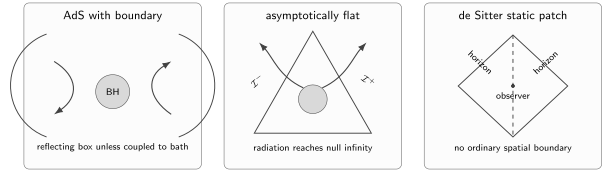
Three boundary-value problems for black-hole information. AdS with reflecting boundary conditions behaves like a box unless it is coupled to a bath. Asymptotically flat evaporation sends radiation to future null infinity . De Sitter has cosmological horizons but no spatial infinity where one can define an ordinary boundary -matrix.
1. Why the AdS+bath model was so useful
Section titled “1. Why the AdS+bath model was so useful”The clean island calculations used a deliberate hybrid setup:
- a gravitating region containing the black hole;
- a nongravitating bath that collects Hawking quanta;
- a radiation region in the bath;
- a fine-grained entropy computed in an ordinary Hilbert space associated with the bath.
This is not a nuisance detail. It is what makes the question sharply defined. A nongravitating bath has local quantum fields with an approximately factorized Hilbert space, so one can trace over its complement and ask for without immediately confronting the full nonfactorization of gravitational subsystems.
In ordinary AdS with reflecting boundary conditions, a large black hole reaches equilibrium with its Hawking radiation. To study evaporation, one must either impose absorbing boundary conditions, couple the AdS system to an auxiliary CFT or bath, or work in a model where the radiation escapes into a nongravitating region. Those choices produce a clean analogue of an evaporating black hole but also introduce artificial structure.
The flat-space and cosmological questions are therefore:
- Can one define the radiation entropy directly at null infinity or in a physical detector system?
- Does the generalized-entropy extremization produce the Page curve without adding a bath by hand?
- How does the answer depend on gravitational constraints, soft modes, and asymptotic charges?
- What replaces the boundary Hilbert space in de Sitter, where there is no AdS-like spatial boundary?
These are not minor technicalities. They are precisely where the modern information problem touches quantum gravity beyond AdS/CFT.
2. Asymptotically flat evaporation: the physical target
Section titled “2. Asymptotically flat evaporation: the physical target”The idealized four-dimensional black hole formed by collapse has past and future null infinities and . Incoming matter falls in from , a trapped region forms, and Hawking radiation escapes to . At late retarded time , an asymptotic observer measures an outgoing flux and a decreasing Bondi mass:
where includes energy carried by all massless fields, including gravitons. For a neutral nonrotating black hole in four dimensions,
in units . The total lifetime scales as
up to species and greybody-factor dependent constants.
The Page-curve expectation is that the fine-grained entropy of the outgoing radiation should rise until the remaining black hole entropy is comparable to the radiation entropy, then decrease to zero if the final state is pure and there is no stable remnant or baby-universe sink. In a coarse semiclassical calculation without islands, the entropy of Hawking radiation instead keeps increasing.
A first conceptual distinction is important. The Page curve is not usually the entropy of the entire future null infinity after evaporation has ended. If asymptotically flat quantum gravity has a unitary -matrix and no hidden remnant sector, then the complete outgoing state on all of should be pure, up to whatever soft-sector dressing is needed to define the state. The Page curve is the entropy of a partial radiation algebra, for example the outgoing modes before a retarded time ,
Thus the flat-space Page curve is a statement about a nested family of algebras , not merely about the final purity of the -matrix. This is exactly where gravitational subtleties enter: the algebra generated by a finite retarded-time segment of is constrained by charges and soft data that are not cleanly localized in the same way as a scalar field in a nongravitating bath.
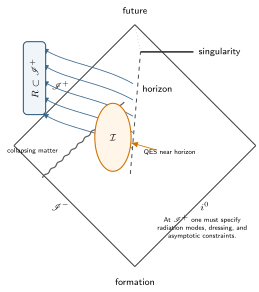
Asymptotically flat evaporation is naturally phrased at . A radiation region is a retarded-time interval or collection of modes at future null infinity. The hard question is to compute the fine-grained entropy of this gravitationally dressed radiation algebra, not merely the thermodynamic entropy flux.
3. Radiation at is not quite a nongravitating bath
Section titled “3. Radiation at I+\mathscr I^+I+ is not quite a nongravitating bath”It is tempting to say: just take the radiation region to be a subset of future null infinity and apply the same island formula. This is close to the truth in some semiclassical models, but in exact gravity the phrase “subset of radiation” hides several choices.
In nongravitational QFT, a region has an algebra of local operators. In gravity, gauge-invariant operators require gravitational dressing. At null infinity, the natural algebra contains radiative data together with constraints and charges. The BMS charges, soft modes, memory effects, and Bondi news are tied together by gravitational constraints. Thus the radiation algebra does not factorize exactly as
At the same time, for many practical semiclassical questions, one can define useful approximate radiation subsystems: wave packets reaching detectors, retarded-time intervals at , angular-momentum modes, or species sectors. The Page-curve question is then asked within an approximation scheme. The more exact one wants the statement to be, the more important gravitational dressing and asymptotic constraints become.
This is why flat-space islands are more conceptually demanding than bath islands. The bath version isolates the entropy problem from the problem of gravitational subsystem factorization. Flat space asks us to solve both at once.
There is also a useful algebraic way to phrase the issue. In ordinary QFT one would write a reduced density matrix and define
In gravity, one should more honestly write something like , the entropy associated with a regulated algebra of observables. If has a center, edge modes, or soft sectors, the entropy decomposes into classical, edge, and bulk-radiative contributions. This is not a semantic refinement. It is exactly analogous to the operator-algebra story in entanglement wedge reconstruction: the right object is often an algebra, not a naive tensor factor.
A conservative flat-space program is therefore:
- define a regulated outgoing algebra at or in a detector system;
- compute its semiclassical no-island entropy;
- include candidate QES/island saddles in the gravitational path integral;
- check that the result is compatible with asymptotic charges, soft memory, and unitarity of the full scattering problem.
The first item is the one that is hidden in bath models.
4. What has been shown in asymptotically flat models
Section titled “4. What has been shown in asymptotically flat models”The most controlled results are not full Standard Model plus four-dimensional quantum gravity. They are controlled toy models and limits. That is exactly how progress should look.
4.1 Two-dimensional dilaton gravity
Section titled “4.1 Two-dimensional dilaton gravity”Several two-dimensional asymptotically flat dilaton-gravity models admit explicit Page-curve computations. In these models, the matter entropy is computable using two-dimensional CFT methods, and the gravitational entropy is expressed through the dilaton:
or an equivalent model-dependent normalization. The island saddle appears after the Page time and cuts off the linear growth of the Hawking entropy. These models are especially useful because they describe formation and evaporation, not only eternal equilibrium black holes.
The lesson is robust but limited: the Page curve can arise in asymptotically flat evaporation using the same generalized-entropy logic, but two-dimensional dilaton gravity does not contain the full angular structure, graviton dynamics, or detector physics of four-dimensional evaporation.
4.2 Adiabatic and “island in the stream” approximations
Section titled “4.2 Adiabatic and “island in the stream” approximations”For slowly evaporating black holes, one can often treat the geometry as a sequence of quasi-stationary black holes with a slowly changing temperature. Radiation emitted at retarded time is related to near-horizon modes at an earlier time, shifted by a scrambling-time-scale delay. This gives an intuitive flat-space picture: the island associated with a portion of the Hawking radiation is paired with a corresponding region near the horizon, mapped along the outgoing radiation stream.
This picture is helpful because it connects the island endpoint to physical outgoing Hawking modes rather than to an artificial bath boundary. It also makes clear why the island is close to the horizon in many semiclassical approximations: the generalized entropy balances an area cost against a matter-entropy decrease.
4.3 Higher-dimensional and four-dimensional results
Section titled “4.3 Higher-dimensional and four-dimensional results”Higher-dimensional islands are harder for two reasons. First, the QES is a genuine codimension-two surface rather than a point. Second, the entropy of quantum fields in a general higher-dimensional curved geometry is rarely exactly computable. Nevertheless, spherical reduction, brane-world/double-holographic models, and large- approximations provide evidence that island-like saddles persist.
Recent four-dimensional analyses have also emphasized a striking subtlety: the relevant island need not always sit precisely at the stretched horizon in a naive way. In some settings, islands associated with particular high-angular-momentum Hawking modes can protrude parametrically outside the horizon. Whether one interprets this as a signal of dramatic nonlocality or as a careful statement about nonperturbative reconstruction depends on the operational setup and the algebra being reconstructed.
In a spherically symmetric four-dimensional approximation, the candidate QES is a two-sphere of radius near the horizon, and the leading area term is
The extremization problem balances the derivative of this area against the derivative of the matter entropy of . Schematically,
This formula is simple to write but hard to evaluate honestly: the matter entropy contains angular modes, greybody scattering, gravitons, and correlations produced by the time-dependent collapse geometry. Spherical reduction packages most of that structure into an effective two-dimensional theory, which is useful but not identical to the full problem.
5. The island formula in flat-space language
Section titled “5. The island formula in flat-space language”A schematic flat-space island formula for a radiation algebra associated with a region is
This expression is deliberately schematic. The phrase stands for a regulated set of modes or detector records. The matter entropy is computed in an effective theory on a semiclassical background, while the area term knows about the gravitational QES. The exact interpretation requires specifying the asymptotic algebra, dressing, and regulator.
A useful way to organize the models is by what supplies the non-gravitating or asymptotic system:
| Setting | Radiation system | Main advantage | Main caveat |
|---|---|---|---|
| AdS plus bath | external nongravitating bath | clean | artificial coupling |
| 2D flat dilaton gravity | or effective bath | explicit evaporation | no transverse gravitons |
| 4D Schwarzschild approximations | modes at | physical target | hard matter entropy and dressing |
| de Sitter toy models | auxiliary universe or observer patch | probes cosmological horizons | no established full dual |
The table is not a ranking of importance. It is a ranking of definition quality. The more physical the setup becomes, the more one must specify the algebra whose entropy is being computed.
Before the Page time, the dominant saddle is usually the no-island saddle:
After the Page time, the island saddle can dominate:
which is of order the remaining black hole entropy plus subleading corrections. In a genuinely evaporating black hole, the remaining area decreases, so the island branch can decrease rather than plateau.
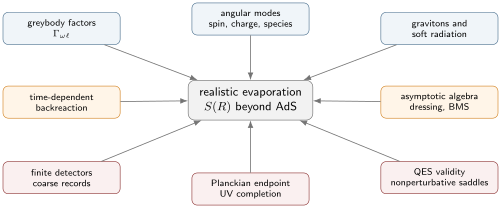
Realistic evaporation combines the island/QES mechanism with ingredients often suppressed in clean models: greybody factors, angular modes, gravitons, backreaction, asymptotic charges, detector algebras, and endpoint physics. None of these invalidates the island idea by itself, but each must be controlled before claiming a complete derivation for real black holes.
6. Greybody factors, angular modes, and detectors
Section titled “6. Greybody factors, angular modes, and detectors”Hawking’s near-horizon calculation gives a thermal occupation number, but the flux seen at infinity is filtered by the spacetime potential outside the horizon. For a massless field mode with frequency and angular momentum ,
where is a greybody factor. In two-dimensional toy models, one often sets such transmission factors to one. In four dimensions, they matter for the detailed entropy flux, species dependence, angular correlations, and the relation between near-horizon modes and asymptotic detector records.
A realistic Page curve should be phrased in terms of information accessible to detectors or asymptotic observables. That introduces at least three layers:
- Microscopic unitarity: the exact final state in quantum gravity is pure.
- Asymptotic algebra: the algebra at captures the outgoing gravitationally dressed radiation.
- Detector records: finite detectors sample a coarse subset of that algebra with finite efficiency and finite time resolution.
The Page curve usually refers to the second layer, not the third. A realistic experiment may not decode the purification even if it is present in principle. Complexity and detector limitations are not small corrections to the practical problem.
7. The endpoint is not described by the island saddle
Section titled “7. The endpoint is not described by the island saddle”For a four-dimensional Schwarzschild black hole, semiclassical gravity is trustworthy while
and curvature near the horizon is small. It fails near the endpoint, where the mass and entropy approach Planckian values. The island formula can explain how the radiation entropy turns over and follows the decreasing black hole entropy at large entropy. It does not by itself give a complete microscopic description of the final Planckian dynamics.
This distinction matters. A Page curve can be derived in a regime where the black hole still has enormous entropy. That is already highly nontrivial: it says the semiclassical entropy calculation was missing nonperturbative saddles long before Planckian curvature appears. But the endpoint still requires a UV-complete theory or an exact nonperturbative definition of the gravitational Hilbert space.
Possible endpoint scenarios include complete evaporation, a Planck-scale remnant, a baby-universe channel, or a transition to some stringy or quantum-gravitational phase. Modern Page-curve calculations strongly constrain the first few options but do not replace a microscopic endpoint theory.
8. de Sitter: horizons without an AdS boundary
Section titled “8. de Sitter: horizons without an AdS boundary”De Sitter space is even more conceptually different. The static patch metric in four dimensions is
with cosmological horizon at . The Gibbons–Hawking temperature and entropy are
in four dimensions.
The analogy with black holes is powerful but incomplete. A black hole in asymptotically flat space has an exterior region and future null infinity. De Sitter has observer-dependent horizons and no spatial boundary like AdS. A static-patch observer can access only a causal diamond. Global de Sitter slices contain regions outside that observer’s horizon, but those regions are not available as an ordinary external reservoir.
The static-patch viewpoint sharpens the issue. One observer’s accessible algebra is associated with a causal diamond, not with a global Cauchy slice of an asymptotic spacetime. If the de Sitter entropy is finite, one might expect a finite-dimensional effective Hilbert space for the patch,
although this equation should be read as a heuristic rather than an established microscopic theorem. The same geometric region can be described differently by observers with different horizons. That observer dependence is not a nuisance; it is part of what makes de Sitter quantum gravity hard.
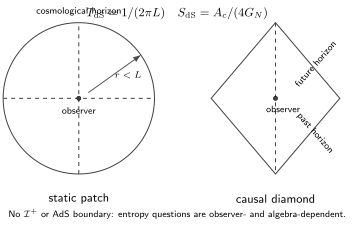
A de Sitter static patch has a cosmological horizon with temperature and entropy . Unlike AdS, de Sitter has no timelike spatial boundary where a dual quantum system is universally accepted. The observer, horizon, and algebraic viewpoint are therefore central.
9. Islands in de Sitter: what they mean and what they do not mean
Section titled “9. Islands in de Sitter: what they mean and what they do not mean”Island-like calculations have been proposed in two-dimensional de Sitter gravity, in black holes inside de Sitter, and in cosmological setups where a gravitating de Sitter region is entangled with an auxiliary nongravitating system. These models show that generalized-entropy extremization can have nontrivial saddles in cosmological spacetimes.
But one must be careful with interpretation. In AdS/CFT, the boundary theory provides a nonperturbative definition. In de Sitter, there is no comparably established microscopic dual for the full spacetime. Therefore a de Sitter island calculation is often a semiclassical statement about a chosen observer patch, auxiliary system, or effective gravitational path integral, not a complete solution of quantum cosmology.
Several questions remain open:
- What is the exact Hilbert space of a de Sitter static patch?
- Is the dimension of a finite Hilbert space, an entropy of an ensemble of states, or something more subtle?
- What is the correct algebra of observables for one observer?
- Can cosmological horizons be treated with the same QES logic as black hole horizons?
- How should one define an -matrix-like observable when there is no ?
The safest statement is that islands provide a powerful semiclassical diagnostic for cosmological entropy puzzles, but de Sitter quantum gravity remains much less settled than AdS/CFT.
10. Celestial holography and flat-space quantum gravity
Section titled “10. Celestial holography and flat-space quantum gravity”Flat-space holography is not a single completed dictionary. One promising direction is celestial holography, which rewrites scattering amplitudes in a conformal basis on the celestial sphere at null infinity. The Lorentz group in four-dimensional flat space acts as the global conformal group on this sphere:
Soft theorems and asymptotic symmetries then look like Ward identities of a putative celestial CFT. This is a natural language for asymptotic charges, memory effects, and massless scattering.
For black hole information, celestial holography is suggestive but not yet a replacement for AdS/CFT. It may help organize the asymptotic algebra of radiation and gravitational constraints, but a full nonperturbative Hilbert-space definition for evaporating black holes in flat space is still missing. The island story and the celestial story are therefore complementary: islands teach us how fine-grained entropy can be computed semiclassically; celestial holography seeks a boundary-like organization of flat-space observables.
11. A conservative picture of realistic evaporation
Section titled “11. A conservative picture of realistic evaporation”A careful modern picture can be summarized as follows.
At early times, ordinary semiclassical gravity gives an accurate description of local Hawking emission. The radiation entropy computed by tracing over interior partners grows approximately as Hawking predicted. This is the no-island saddle.
Near the Page time, the fine-grained entropy calculation becomes sensitive to competing saddles. The island saddle, if applicable, says that the interior partners of late radiation are included in the entanglement wedge or reconstructable algebra of the radiation. This does not require a violent local event at the horizon.
At late semiclassical times, the island branch tracks the decreasing black hole entropy. In an ideal unitary theory with no remnants or baby-universe loss, the final radiation should purify itself. However, actually decoding the information requires extremely complex operations, and the Planckian endpoint is not described by semiclassical QES technology.
In one line:
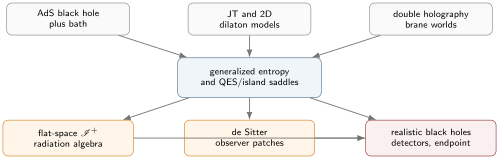
The route from controlled models to realistic evaporation has several bottlenecks. The generalized-entropy/QES mechanism appears robust, but flat space requires asymptotic gravitational algebras, while de Sitter requires a theory of observer patches and cosmological horizons.
12. What would count as a complete beyond-AdS result?
Section titled “12. What would count as a complete beyond-AdS result?”A fully satisfactory derivation for realistic evaporation would have to do more than reproduce the shape of the Page curve. It would specify:
- the exact asymptotic or detector algebra whose entropy is being computed;
- the treatment of soft gravitons, BMS charges, memory, and dressing;
- the gravitational path-integral saddles contributing to ;
- the regime in which the matter entropy and backreaction approximations are valid;
- the relation between information-theoretic reconstruction and efficient decoding;
- the endpoint completion after the semiclassical approximation fails.
The island formula addresses the third and fourth items remarkably well in controlled models. It gives strong evidence that Hawking’s monotonic entropy curve is not the correct fine-grained answer. But the other items are not optional if the goal is a complete statement about black holes in our universe.
This is the right attitude for the frontier: the Page curve is no longer mysterious in the way it was before islands, but the exact observable statement in flat space and de Sitter is still an active research problem.
13. What this page does and does not claim
Section titled “13. What this page does and does not claim”It does claim:
- The Page-curve problem has meaningful analogues in asymptotically flat evaporation and de Sitter horizons.
- Two-dimensional asymptotically flat models show that island saddles can reproduce Page-curve behavior without an AdS box.
- Higher-dimensional and four-dimensional work gives evidence that island-like effects are not an artifact of JT gravity.
- The exact formulation of radiation entropy in gravity requires care with asymptotic observables, dressing, and factorization.
It does not claim:
- A complete derivation of the Page curve for a fully realistic Standard Model black hole exists in the same sense that AdS/CFT defines certain AdS questions.
- de Sitter quantum gravity is understood as well as AdS/CFT.
- The island is a local signal channel from the interior to infinity.
- The semiclassical island formula solves the Planckian endpoint.
- Celestial holography currently supplies a complete black-hole evaporation Hilbert space.
The black-hole information problem has moved from “how could unitarity possibly survive Hawking’s calculation?” to a more refined set of questions: which algebra, which observer, which nonperturbative definition, and which operational decoding problem? That is progress, not a downgrade.
14. Exercises
Section titled “14. Exercises”Exercise 1: Page-time scaling in four-dimensional flat space
Section titled “Exercise 1: Page-time scaling in four-dimensional flat space”Assume a four-dimensional Schwarzschild black hole radiates with
where is a positive dimensionless constant encoding greybody factors and species. Show that the lifetime scales as . Estimate the time at which the Bekenstein–Hawking entropy has fallen to half its initial value.
Solution
Integrating the mass-loss equation gives
so
The evaporation time is therefore
Since
half the initial entropy corresponds to
Thus
This is only a scaling estimate. The actual Page time depends on the entropy flux, greybody factors, species, and the precise definition of the radiation entropy, not just on when the area has halved.
Exercise 2: de Sitter temperature from Euclidean regularity
Section titled “Exercise 2: de Sitter temperature from Euclidean regularity”For the static-patch metric
show that the horizon has temperature .
Solution
Near the horizon set with . Then
After Wick rotation , the Euclidean metric near the horizon is
Define a radial coordinate by . Then
The part is
Regularity at requires to have period , so has period . Therefore
Exercise 3: Why a bath simplifies the entropy problem
Section titled “Exercise 3: Why a bath simplifies the entropy problem”Explain why a nongravitating bath makes easier to define than a radiation interval at in asymptotically flat quantum gravity.
Solution
A nongravitating bath is an ordinary quantum field theory on a fixed background, so a spatial or spacetime region has an approximately local operator algebra and, after regulating UV divergences, a standard reduced density matrix. Thus is a familiar von Neumann entropy.
At in gravity, the outgoing radiation is gravitationally dressed and constrained by asymptotic charges. Soft modes, memory effects, and BMS charges relate data in different angular and retarded-time regions. The Hilbert space therefore does not factorize exactly into and its complement. One can define useful approximate radiation algebras, but the exact statement requires more care than in a nongravitating bath.
Exercise 4: Codimension of a higher-dimensional QES
Section titled “Exercise 4: Codimension of a higher-dimensional QES”In bulk spacetime dimensions, what is the dimension of a quantum extremal surface? What is it in four-dimensional Schwarzschild evaporation?
Solution
A QES is codimension two in spacetime, so its dimension is . In , the QES is two-dimensional. In a spherically symmetric approximation it is often represented by a sphere, with area approximately at some radius close to the horizon. This is very different from two-dimensional dilaton gravity, where the QES is a point and the area term is replaced by a dilaton value.
Exercise 5: A toy island branch for a decreasing black hole
Section titled “Exercise 5: A toy island branch for a decreasing black hole”Suppose the no-island entropy grows as
while the island branch is approximately
where . What equation determines the Page time? Why does the island branch decrease?
Solution
The Page time in this toy model is determined by equality of the two candidate generalized entropies:
The physical entropy is the lower branch after extremizing and minimizing:
The island branch decreases because it is controlled mainly by the remaining black hole entropy, which decreases as the black hole loses mass. In four-dimensional Schwarzschild evaporation, , while decreases roughly linearly with time, giving a behavior like in the simplest scaling model.
Further reading
Section titled “Further reading”- G. W. Gibbons and S. W. Hawking, “Cosmological event horizons, thermodynamics, and particle creation”.
- F. F. Gautason, L. Schneiderbauer, W. Sybesma, and L. Thorlacius, “Page Curve for an Evaporating Black Hole”.
- T. Hartman, E. Shaghoulian, and A. Strominger, “Islands in Asymptotically Flat 2D Gravity”.
- T. Anegawa and N. Iizuka, “Notes on islands in asymptotically flat 2d dilaton black holes”.
- T. J. Hollowood, S. P. Kumar, A. Legramandi, and N. Talwar, “Islands in the Stream of Hawking Radiation”.
- W.-C. Gan, D.-H. Du, and F.-L. Lin, “Island and Page curve for one-sided asymptotically flat black hole”.
- R. Bousso and G. Penington, “Islands Far Outside the Horizon”.
- V. Balasubramanian, A. Kar, and T. Ugajin, “Islands in de Sitter space”.
- D. Teresi, “Islands and the de Sitter entropy bound”.
- S. Pasterski, M. Pate, and A.-M. Raclariu, “Celestial Holography”.
- A.-M. Raclariu, “Lectures on Celestial Holography”.
- D. Marolf, “Unitarity and holography in gravitational physics”.
- A. Laddha, S. G. Prabhu, S. Raju, and P. Shrivastava, “The holographic nature of null infinity”.
- A. Almheiri, T. Hartman, J. Maldacena, E. Shaghoulian, and A. Tajdini, “The entropy of Hawking radiation”.