
Thermofield Double and Two-Sided Black Holes
Guiding question. How can a black-hole exterior look thermal while the complete state is pure, and why does the answer naturally lead to a two-sided geometry with an Einstein–Rosen bridge?
The thermofield double is the cleanest equilibrium example where the slogans of black-hole information become precise. One observer sees a thermal density matrix. The full system is nevertheless in a pure state. In holography, this purification is not merely an auxiliary trick: for a holographic CFT at sufficiently high temperature, the thermofield double is dual to the maximally extended eternal AdS black hole.
This page begins the interior-and-complexity part of the course. It is not yet the evaporating black-hole problem. There is no bath, no Page curve, and no outgoing radiation region . Instead, the thermofield double gives a controlled setting in which thermal horizons, entanglement, behind-the-horizon geometry, two-sided correlators, and wormhole growth can all be discussed with sharp boundary variables.
The central dictionary is:
The left and right CFTs are two independent quantum systems. They do not interact. Their entanglement prepares a connected bulk spacetime.
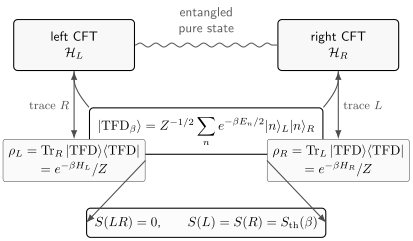
The thermofield double is a pure entangled state of two identical CFTs. Tracing out either side gives a thermal density matrix on the other side: and .
1. The thermofield double state
Section titled “1. The thermofield double state”Let and be two copies of the Hilbert space of the same CFT, with Hamiltonians and . In an energy eigenbasis,
the thermofield double state is
More invariantly, the left factor is often the CPT-conjugate copy of the right Hilbert space. The notation is a convenient shorthand; it hides an antiunitary identification between the two copies. This subtlety matters for precise formulae involving spin, charge, or orientation, but not for the basic entropy calculation.
Tracing out the left system gives
Similarly,
Thus each side is exactly thermal, while the two-sided state is pure:
The mutual information between the complete left and right systems is therefore
For a large- holographic CFT in the deconfined phase, the leading thermal entropy is the Bekenstein–Hawking entropy of the dual black hole,
This equation is already a miniature version of the black-hole information problem. A thermal exterior state is not necessarily the full story. It can be one marginal of a pure entangled state.
2. The eternal AdS black hole
Section titled “2. The eternal AdS black hole”A static AdS-Schwarzschild black hole in bulk dimensions has metric
where, for an uncharged Einstein-gravity black hole,
Here corresponds to spherical, planar, or hyperbolic horizon topology. The horizon radius is determined by
and the Hawking temperature is
The exterior region with is only part of the maximally extended solution. The Kruskal extension has two asymptotically AdS boundaries, a future singularity, a past singularity, and two exterior regions separated by horizons. The two boundaries are dual to the two CFTs in the TFD state.
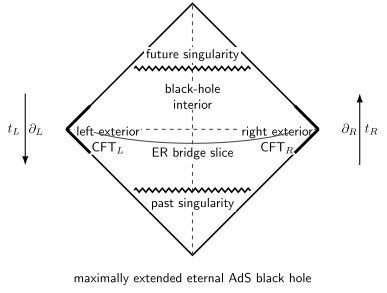
The maximally extended AdS black hole has two asymptotic boundaries. The right exterior is dual to the right CFT, and the left exterior is dual to the left CFT. The two exteriors are connected through the interior by a nontraversable Einstein–Rosen bridge.
The original Maldacena proposal is that this two-sided geometry is the bulk dual of the TFD state. The proposal is not that one CFT somehow secretly contains two boundaries. The boundary theory is doubled:
The Hamiltonian is also doubled. In the simplest decoupled setup,
Because there is no interaction term coupling and , a signal inserted into the right boundary cannot be received at the left boundary. The wormhole is geometrically connected but causally nontraversable.
3. Why the exterior looks thermal
Section titled “3. Why the exterior looks thermal”Consider an observer restricted to the right exterior. Boundary observables available to that observer act only on . For any right operator ,
Therefore the right observer sees a thermal ensemble. This is not because the complete state is mixed. It is because the right observer has traced out the left degrees of freedom.
The bulk interpretation is direct. A single exterior region of the eternal black hole is like the Rindler wedge of a larger spacetime. Restricting to one exterior gives a thermal density matrix, much as restricting the Minkowski vacuum to one Rindler wedge gives the Unruh state.
This point should be kept separate from the evaporating black-hole paradox. In the eternal black hole, the thermal density matrix on one side has an obvious purifier: the other CFT. In a one-sided evaporating black hole, the question is whether the Hawking radiation itself purifies the state at late times, and how semiclassical gravity computes that fine-grained entropy.
4. Time evolution and the two natural clocks
Section titled “4. Time evolution and the two natural clocks”The TFD state has two related but distinct time evolutions.
First, because the Boltzmann weights pair equal energies, the state is invariant under opposite time translations:
This is the boundary version of the stationary Killing symmetry of the eternal black hole. In the Penrose diagram, the future-directed Killing time runs upward on the right boundary and downward on the left boundary.
Second, one can evolve both CFTs forward with the same sign:
Many two-sided observables depend on the sum . In particular, the symmetric evolution produces a state that is locally still thermal on each side but whose interior geometry has a longer Einstein–Rosen bridge.
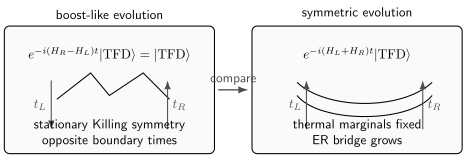
The TFD state is invariant under the boost-like evolution generated by . Evolving both sides forward with does not change either thermal marginal, but it changes two-sided observables and corresponds semiclassically to a growing Einstein–Rosen bridge.
The important lesson is that entanglement entropy alone does not measure the size of the interior. The entropy is time-independent, but the bridge can grow for a long time in the classical bulk description.
5. The Einstein–Rosen bridge
Section titled “5. The Einstein–Rosen bridge”A spatial slice connecting the two boundaries passes through the wormhole. At , the bridge has a reflection-symmetric slice through the bifurcation surface. At later symmetric times, a maximal-volume slice passes deeper through the black-hole interior and its volume grows.
This growth is easiest to visualize in large AdS black holes, where the interior contains an extended region with approximately constant transverse area. A maximal slice can spend longer and longer proper length in that region. Schematically,
at intermediate classical times, where is an AdS or horizon length scale and is an order-one coefficient depending on dimension and convention. The precise coefficient is not the point here. The point is the qualitative separation:
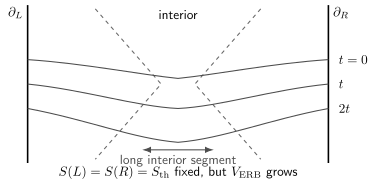
Equal-time slices through the two-sided black hole stretch through the interior. The thermal entropy of each side is fixed, but the Einstein–Rosen bridge can grow under symmetric time evolution. This is the geometric motivation for holographic complexity proposals.
This fact is one of the motivations for holographic complexity. If entanglement entropy is already saturated, but the wormhole continues to grow, then the boundary quantity dual to the growing interior cannot simply be or . Later pages discuss the complexity=volume and complexity=action proposals.
6. Two-sided correlators
Section titled “6. Two-sided correlators”One-sided correlators in the TFD state are ordinary thermal correlators. Two-sided correlators probe the entanglement between the two copies and, in the bulk, can probe the wormhole geometry.
For simple operators related by the left-right identification, one obtains a useful thermal expression of the form
up to conventions for the antiunitary map defining . Thus a left insertion is related to an imaginary-time-shifted right insertion. This is why the TFD is sometimes described as gluing the two exteriors by half a Euclidean thermal circle.
For a heavy bulk field, the large-dimension approximation gives
where is a regulated geodesic length connecting the two boundaries through the wormhole. As grows, the relevant geodesic length grows, and the two-sided correlator decays.
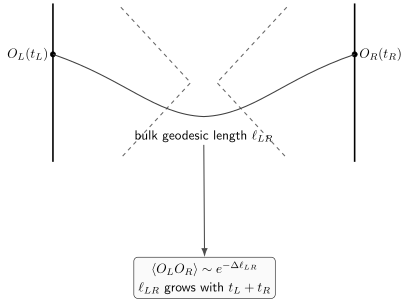
Two-sided correlators are sensitive to the bridge. In a geodesic approximation, a heavy-operator correlator behaves as , so the correlator decays as the regulated two-sided geodesic length grows with .
This decay does not mean that information is lost. It means that simple two-sided probes become insensitive to the detailed purification as the bridge becomes long. The exact finite- quantum system has recurrences and discreteness effects, but the semiclassical geometry captures the large-, intermediate-time behavior.
7. The two-sided black hole is not two interacting black holes
Section titled “7. The two-sided black hole is not two interacting black holes”A common misconception is that the connected geometry implies a direct interaction between the two boundary CFTs. It does not. The TFD state is entangled, but the Hamiltonian is decoupled:
For operators on different sides,
as boundary operators in the decoupled theory. Entanglement can produce correlations, but it cannot transmit a controllable signal. This is the boundary expression of bulk nontraversability.
The distinction is basic but crucial:
Turning the wormhole into a traversable one requires changing the dynamics, for example by adding a left-right coupling that injects negative averaged null energy in the bulk. That is the subject of the next page on ER=EPR and traversable wormholes.
8. Entanglement is necessary but not sufficient
Section titled “8. Entanglement is necessary but not sufficient”The TFD teaches that entanglement can be geometrized. But it does not imply that every highly entangled pair of CFTs has a smooth short wormhole dual.
There are many purifications of the same right thermal density matrix:
All of these states have the same right density matrix,
but their two-sided correlators and putative interiors can be very different. The TFD is special because it is a simple, low-complexity, thermal purification. Acting with a very complicated unitary on the left side can preserve the right thermal state while making the two-sided geometry, if any simple geometry exists, much more complicated.
This is a theme that recurs throughout black-hole information:
The interior is encoded in fine-grained two-sided data, not only in the thermal density matrix seen by one exterior observer.
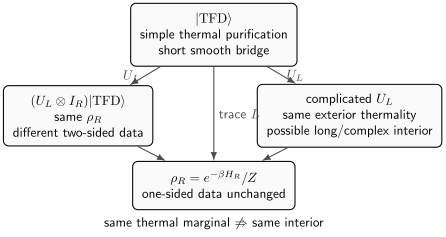
A unitary acting only on the left CFT leaves the right thermal density matrix unchanged, but it changes two-sided correlators and the fine-grained data that encode the interior. The TFD is a special low-complexity purification, not a generic entangled state.
9. Relation to ER=EPR
Section titled “9. Relation to ER=EPR”The eternal black hole is the canonical example behind the ER=EPR slogan. The two CFTs are entangled in the TFD state, and the bulk contains an Einstein–Rosen bridge connecting the two exteriors.
However, the safest formulation is narrower than the slogan:
The broader conjecture that entanglement and wormholes are generally related is more subtle. Generic entanglement need not produce a classical, semiclassical, easily drawable bridge. Smooth geometry requires special structure: large , strong coupling, appropriate energy, low complexity relative to a random state, and a suitable code subspace.
The eternal black hole therefore gives a precise model, not a universal theorem about all entangled states.
10. Relation to black-hole information
Section titled “10. Relation to black-hole information”The TFD is useful for black-hole information for four reasons.
First, it separates thermality from mixedness. One side is thermal because it is entangled with another system, not because the full state is mixed.
Second, it gives a sharp meaning to behind-the-horizon geometry in AdS/CFT. The interior is encoded in nonlocal, two-sided data.
Third, it shows why entanglement entropy cannot be the whole story of the interior. The entropy between the two CFTs is constant, while the bridge can grow.
Fourth, it provides the cleanest playground for questions about interior operators, state dependence, ER=EPR, traversability, and complexity.
But it is not the Page-curve problem. The eternal black hole is in equilibrium. It does not evaporate into an external bath. There is no late radiation system whose entropy must turn over. The TFD is the laboratory in which we understand thermal horizons and two-sided interiors before returning to one-sided evaporation.
11. Common pitfalls
Section titled “11. Common pitfalls”Pitfall 1: “The right CFT is mixed, so the full theory is nonunitary.”
Section titled “Pitfall 1: “The right CFT is mixed, so the full theory is nonunitary.””No. The right CFT density matrix is mixed because we traced out the left CFT. The full state on is pure.
Pitfall 2: “The wormhole lets the two CFTs communicate.”
Section titled “Pitfall 2: “The wormhole lets the two CFTs communicate.””No. The two CFTs are decoupled. The bridge is nontraversable. Correlation is not communication.
Pitfall 3: “The entropy between the two CFTs is the length of the wormhole.”
Section titled “Pitfall 3: “The entropy between the two CFTs is the length of the wormhole.””No. The left-right entanglement entropy is fixed by the thermal entropy. The wormhole length or volume can grow while this entropy remains constant.
Pitfall 4: “Any entangled state has a smooth Einstein–Rosen bridge.”
Section titled “Pitfall 4: “Any entangled state has a smooth Einstein–Rosen bridge.””No. The TFD is a very special entangled state. Generic purifications of a thermal density matrix do not necessarily have a simple semiclassical bridge.
Pitfall 5: “The TFD solves the evaporating black-hole problem.”
Section titled “Pitfall 5: “The TFD solves the evaporating black-hole problem.””No. It gives a precise example of purification and a two-sided black-hole interior, but the evaporating problem requires understanding the fine-grained entropy of Hawking radiation. That is where islands and replica wormholes enter.
12. Exercises
Section titled “12. Exercises”Exercise 1. Thermal marginal of the TFD
Section titled “Exercise 1. Thermal marginal of the TFD”Starting from
show explicitly that tracing out gives .
Solution
The density matrix of the full state is
Tracing over uses , so
Thus the right side is thermal even though the full state is pure.
Exercise 2. Invariance under opposite time translations
Section titled “Exercise 2. Invariance under opposite time translations”Show that
Why is this the boundary expression of the stationary Killing symmetry of the eternal black hole?
Solution
Each term in the TFD state has equal left and right energies:
Therefore
The exponential generated by acts trivially on every term in the sum, so the whole TFD state is invariant. In the bulk, the eternal black hole is invariant under a Killing flow that advances right exterior time and reverses left exterior time. This opposite orientation is why the stationary symmetry corresponds to , not .
Exercise 3. Entropy and mutual information
Section titled “Exercise 3. Entropy and mutual information”For the TFD state, compute , , , and .
Solution
The total state is pure, so
The reduced states are thermal:
Thus
The mutual information is
In the holographic high-temperature phase, .
Exercise 4. Two-sided correlator as a thermal correlator
Section titled “Exercise 4. Two-sided correlator as a thermal correlator”Ignoring antiunitary subtleties, derive schematically why a two-sided correlator can be written as a thermal correlator with an imaginary time shift .
Solution
For simplicity take a Hermitian operator with the same matrix elements on both sides. Expanding the TFD gives
Using the energy phases inside , one can reorganize the Boltzmann factors as a thermal trace with one operator shifted by half the Euclidean thermal circle. Schematically,
up to the precise transpose or CPT map used to define the left operator. The half-period shift is the key structural fact.
Exercise 5. Why nontraversability follows from decoupling
Section titled “Exercise 5. Why nontraversability follows from decoupling”Explain why the existence of nonzero two-sided correlators does not allow an observer on the right boundary to send a message to the left boundary.
Solution
The two-sided state can be entangled, so correlation functions such as can be nonzero. But communication requires that an operation on the right changes measurable expectation values on the left.
In the decoupled theory,
and right operations commute with left observables. If an observer acts on the right by a unitary , the left density matrix becomes
Therefore no left measurement statistics change. Entanglement gives correlations but no signal. In the bulk, this is the boundary explanation of why the Einstein–Rosen bridge is nontraversable.
13. Further reading
Section titled “13. Further reading”- J. Maldacena, “Eternal Black Holes in Anti-de-Sitter”. The original two-sided AdS black hole / TFD dictionary.
- T. Hartman and J. Maldacena, “Time Evolution of Entanglement Entropy from Black Hole Interiors”. The classic analysis relating time-dependent probes to black-hole interiors.
- M. Van Raamsdonk, “Building up spacetime with quantum entanglement”. A conceptual essay on entanglement and connectivity.
- J. Maldacena and L. Susskind, “Cool horizons for entangled black holes”. The ER=EPR proposal.
- A. R. Brown, D. A. Roberts, L. Susskind, B. Swingle, and Y. Zhao, “Complexity, action, and black holes”. A key reference for the later complexity pages.