
The Page Curve in JT Gravity
Guiding question. In a controlled two-dimensional model, how does the island formula turn Hawking’s monotonically growing radiation entropy into a Page curve?
The previous pages introduced the island formula and the JT toolkit. We now combine them. The goal is not merely to draw a Page curve, but to see the mechanics of the calculation: the entropy of a radiation region is computed by comparing semiclassical generalized-entropy saddles.
The empty-island saddle gives Hawking’s answer,
which grows with the amount of emitted radiation. The nonempty-island saddle gives
which is controlled by the remaining black-hole entropy plus matter corrections. The physical entropy is
At early times is smaller. At the Page time the two branches cross. After that, the island branch dominates. In a strictly fixed-temperature eternal setup the island branch is approximately a plateau; in a genuinely evaporating setup it decreases with the Bekenstein–Hawking entropy of the remaining black hole. This distinction is cosmetic for the saddle mechanism but important for the shape of the late-time curve.
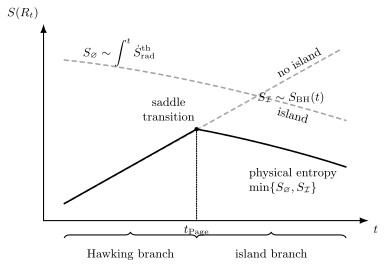
The Page curve in JT gravity is a saddle competition. The no-island saddle reproduces the semiclassical Hawking growth. The island saddle is controlled by the generalized entropy of a near-horizon QES and tracks the remaining black-hole entropy. The physical answer is the lower branch.
We will work in units and AdS radius . The letter denotes the central charge of the two-dimensional matter CFT, not the speed of light.
1. The JT+bath model
Section titled “1. The JT+bath model”A minimal island computation has three ingredients:
- a gravitating JT region containing a black hole;
- a nongravitating bath that collects Hawking radiation;
- a conformal matter sector that propagates through the interface.
The bath is essential because the entropy region must be an ordinary nongravitating subsystem. In a gravitational region, Hilbert-space factorization is subtle because of constraints and edge modes. In the bath, is an ordinary von Neumann entropy.
A useful black-hole metric is
with temperature
The entropy of one JT horizon is
The topological term is often very large. In the semiclassical JT path integral it contributes to the area term at every QES endpoint. In a fixed-microstate discussion, or in a fixed sector of the near-extremal degeneracy, its interpretation requires care. For the semiclassical saddle competition, however, it is part of the generalized entropy that determines which saddle dominates.
The standard solvable calculations often use a symmetric two-sided geometry coupled to left and right baths. This avoids some time-dependent backreaction while keeping the physics of the Page transition. The radiation region is then a union of bath intervals collecting outgoing radiation up to a boundary time . A one-sided evaporating black hole gives the same conceptual story, with factors of two changed and with the black-hole entropy slowly decreasing in time.
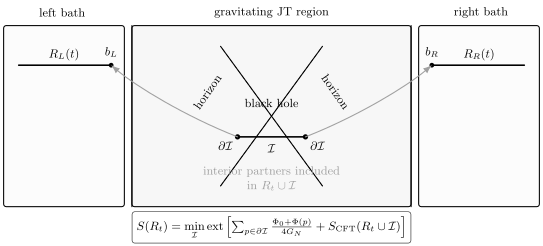
A common JT setup couples a gravitating AdS black-hole region to nongravitating baths. The radiation region lies in the bath. A candidate island lies in the gravitating region, with QES endpoints close to the horizon.
The semiclassical hierarchy is schematically
The first inequality lets the black hole have a large entropy compared with a single matter field. The second makes the QES close to the classical horizon. The matter entropy can nevertheless change by over a long evaporation time, which is precisely why the island saddle can become important.
2. The no-island saddle: Hawking’s answer
Section titled “2. The no-island saddle: Hawking’s answer”The empty-island saddle sets
Then the island formula reduces to the matter entropy of the bath radiation,
In a two-dimensional CFT, entropy of intervals can be computed from endpoint data. In flat null coordinates , the vacuum entropy of a single interval with endpoints and is
where is the Weyl factor relating the physical metric to flat coordinates and are UV cutoffs. For a thermal state at inverse temperature , the entropy of an interval of length on an infinite line is
This formula is the technical reason the no-island entropy grows linearly at late times. Hawking radiation emitted for a long time behaves, for entropy purposes, like a growing thermal interval. In the symmetric two-sided JT+bath model one finds a typical no-island behavior of the form
so that for ,
The coefficient
is an entanglement-production rate in this simplified two-sided setup. Different conventions and one-sided setups shift factors of two, but the important statement is invariant: the no-island saddle gives a monotonically increasing entropy proportional to the duration of emission.
This is Hawking’s answer in fine-grained-entropy language. It treats the outgoing radiation as entangled with interior partners that are not included in the bath region . As more Hawking pairs are produced, more correlations cross the entropy boundary, and grows.
3. The island saddle: include the partners
Section titled “3. The island saddle: include the partners”Now allow a nonempty island. In a symmetric two-sided JT setup, the candidate island has two endpoints, one near each horizon region. Denote the endpoints collectively by . The generalized entropy is
The factor of two is for two QES endpoints. For a one-sided island there is one endpoint and this factor is absent. In higher dimensions the dilaton term is replaced by an area term.
The QES equation is
If the endpoint has both spatial and time coordinates, this means
The important physical balance is
The first term pushes the QES toward smaller area or smaller dilaton. The second term knows about correlations between the outgoing bath radiation and interior modes. The QES sits where the geometric cost of adding an island is balanced by the matter-entropy benefit.
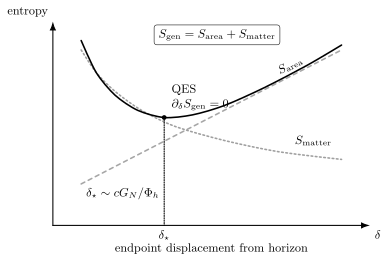
The JT QES endpoint is determined by extremizing the generalized entropy. Moving the endpoint changes the dilaton term and the matter entropy in opposite directions. The QES is not chosen by hand; it is the stationary point of their sum, and the physical saddle is selected only after minimizing over all extrema.
Near the horizon the matter entropy is extremely sensitive to endpoint position because of the exponential redshift. A rough local model captures the scale. Let be a small dimensionless distance from the horizon. The dilaton contribution varies approximately linearly,
while the matter entropy contains a logarithmic term,
Then
and the stationary point obeys
Thus the QES is parametrically close to the horizon in a large-entropy black hole. This estimate is not meant to fix numerical constants; it explains why the island endpoint is near the horizon and why the island saddle is invisible in a naive perturbative expansion around the no-island answer.
At the extremum, the island entropy is approximately
in a fixed-temperature two-sided setup. For a slowly evaporating one-sided black hole, the same statement becomes schematically
or twice this value in a two-sided version. The late-time entropy is controlled by the remaining black-hole entropy, not by the ever-growing number of emitted Hawking quanta.
4. The Page transition
Section titled “4. The Page transition”The physical entropy is the lower generalized-entropy saddle,
At early times,
because the island saddle pays a large area cost. The no-island saddle dominates and the Hawking answer is correct.
At the Page time,
For the fixed-temperature symmetric setup, using
one obtains
If , then
up to constants and cutoff-dependent terms. In a one-sided or adiabatically evaporating setup the coefficient changes, but the parametric statement is robust:
This is much longer than the scrambling time,
for a large black hole. The Page transition is therefore not the same as scrambling. Scrambling controls how quickly newly inserted information is mixed into the black hole degrees of freedom; the Page time controls when the radiation Hilbert space has become large enough for the island saddle to dominate its entropy.
5. Why the matter entropy decreases with an island
Section titled “5. Why the matter entropy decreases with an island”The most unintuitive part of the calculation is the term
Why should adding an interior region lower the entropy?
The answer is that entropy of a union is not additive. If the outgoing bath modes are highly correlated with interior partners, then putting those partners into the same entropy region removes their contribution to the boundary between the region and its complement. In schematic notation,
The island saddle has large mutual information between and . The no-island saddle counts many outgoing-partner correlations as entanglement across the entropy boundary. The island saddle makes many of those correlations internal to .
In two-dimensional CFT calculations this is implemented by the choice of dominant interval pairing. For two intervals, the entropy has multiple candidate contractions. In a holographic or large- approximation, the answer often takes the form
where the disconnected and connected channels exchange dominance as the cross ratio changes. The island Page transition is the gravitational version of the same idea, with the additional area/dilaton cost of the QES endpoints.
Thus the island formula does not require each Hawking pair to be locally modified by an order-one amount. Instead, the fine-grained entropy is computed by a different nonperturbative saddle.
6. The scrambling-time offset
Section titled “6. The scrambling-time offset”In a more realistic evaporating geometry, the island endpoint associated with radiation collected at a late bath time is not simply located at the same exterior time. Because of the near-horizon redshift, the relevant QES is displaced by roughly a scrambling time.
Parametrically,
where is a large entropy scale set by the near-horizon area or dilaton in units of the matter central charge. More detailed formulas contain constants and depend on the evaporation protocol.
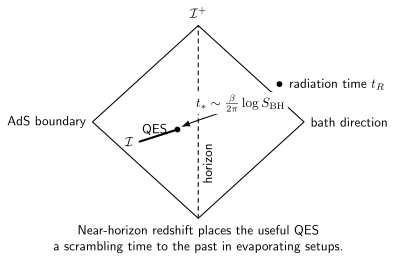
In evaporating geometries, the QES associated with late radiation is typically displaced from the bath time by a scrambling-time scale. This is the geometric origin of the close connection between islands, Hayden–Preskill recovery, and near-horizon exponential redshift.
This offset has a useful interpretation. A Hawking quantum detected at the bath at time emerged from near the horizon after an exponentially large redshift. Its interior partner is naturally associated with an earlier infalling time. The logarithm in is the same logarithm that appeared in fast scrambling and in the Hayden–Preskill protocol.
The Page time and the scrambling time therefore play different roles:
7. Slowly evaporating black holes
Section titled “7. Slowly evaporating black holes”The fixed-temperature JT+bath model is pedagogically clean, but an evaporating black hole has a time-dependent horizon entropy. In an adiabatic approximation one may write
while the island branch is approximately
for a one-sided black hole. The physical entropy is then
This formula captures the qualitative Page curve:
- before the Page time, the radiation entropy rises because more Hawking radiation is emitted;
- after the Page time, the radiation entropy falls because it is bounded by, and tracks, the entropy of the remaining black hole.
The true curve is smooth in a finite microscopic theory. The sharp kink is a leading semiclassical saddle approximation. Near the transition, both saddles contribute and finite- or finite- effects round the cusp.
8. What has actually been shown?
Section titled “8. What has actually been shown?”The JT calculation is powerful because it gives a controlled semiclassical derivation of the Page-curve saddle structure. But it is important to state precisely what the calculation means.
First, the island saddle computes a fine-grained entropy, not a local signal. The formula says that the entanglement wedge of the radiation includes after the Page transition. It does not say that an observer in the bath can send a causal signal from behind the horizon.
Second, the large change in entropy is nonperturbative from the viewpoint of the no-island semiclassical expansion. The near-horizon quantum state can remain locally close to the Unruh vacuum even though the entropy saddle changes globally.
Third, JT gravity is a controlled laboratory, not the full solution of every black-hole information problem. Its topological term, matrix-integral completion, and ensemble interpretation raise factorization questions that will return later. Nevertheless, the Page-curve mechanism it exhibits is not an artifact of drawing a curve by hand. It follows from ordinary extremization and minimization of generalized entropy.
Finally, the calculation anticipates replica wormholes. The no-island and island branches are not arbitrary options added by fiat. In the replica derivation, they arise from different gravitational replica saddles. The next major conceptual step is to understand why the island saddle appears in the gravitational path integral.
9. Common pitfalls
Section titled “9. Common pitfalls”Pitfall 1: “The island is where the radiation went.”
Section titled “Pitfall 1: “The island is where the radiation went.””No. The island is not a local storage location that Hawking quanta physically travel to. It is a region included in the entropy calculation because it belongs to the entanglement wedge of the radiation.
Pitfall 2: “The Page transition is a phase transition in the local geometry.”
Section titled “Pitfall 2: “The Page transition is a phase transition in the local geometry.””Usually no. The background geometry can remain smooth and semiclassical. The transition is in the dominant entropy saddle. It is analogous to an RT surface phase transition.
Pitfall 3: “The island saddle means Hawking’s calculation was locally wrong from the beginning.”
Section titled “Pitfall 3: “The island saddle means Hawking’s calculation was locally wrong from the beginning.””Not in the usual interpretation. Hawking’s local calculation gives the correct leading short-distance state and flux. What it misses is the nonperturbative fine-grained entropy saddle relevant after the Page time.
Pitfall 4: “The Page curve is exactly kinked.”
Section titled “Pitfall 4: “The Page curve is exactly kinked.””The kink is a semiclassical large-entropy approximation. A finite-dimensional unitary system has a smooth entropy curve. The saddle approximation makes the crossover sharp.
Pitfall 5: “JT proves everything about realistic four-dimensional evaporation.”
Section titled “Pitfall 5: “JT proves everything about realistic four-dimensional evaporation.””JT proves a precise mechanism in a highly controlled model. Extending the story to higher-dimensional and asymptotically flat black holes requires additional assumptions and technical work.
Exercises
Section titled “Exercises”Exercise 1. Page time from two branches
Section titled “Exercise 1. Page time from two branches”Suppose the no-island entropy is
and the island entropy is approximately constant,
Find the Page time and the leading semiclassical entropy curve.
Solution
The Page time is where the two branches are equal:
Thus
The semiclassical answer is the lower branch,
This rises linearly until and then saturates. For a truly evaporating black hole the island branch is not exactly constant; it decreases with the remaining black-hole entropy.
Exercise 2. A toy QES extremization
Section titled “Exercise 2. A toy QES extremization”Consider the toy generalized entropy
Find the stationary point and determine whether it is a minimum.
Solution
Differentiate:
The stationary point satisfies
so
The second derivative is
so the stationary point is a local minimum. If , then
which is parametrically close to the horizon for .
Exercise 3. Entropy growth from a thermal interval
Section titled “Exercise 3. Entropy growth from a thermal interval”Use
to show that the entropy grows linearly for .
Solution
For ,
Therefore
The leading large- term is
If the effective interval length grows like in a two-sided bath setup, this gives
Exercise 4. Why adding a region can lower entropy
Section titled “Exercise 4. Why adding a region can lower entropy”Let be the radiation and a candidate island. Express in terms of , , and the mutual information . Explain why large mutual information helps the island saddle.
Solution
The mutual information is
Therefore
If and have large mutual information, the entropy of their union can be much smaller than the sum of their separate entropies. In the island saddle, correlations between Hawking radiation and interior partners become internal correlations of , so they no longer contribute to the entropy across the boundary of the entropy region.
Exercise 5. Page time versus scrambling time
Section titled “Exercise 5. Page time versus scrambling time”Assume
Show that for .
Solution
The ratio is
If
then
Thus the Page time is parametrically later than the scrambling time for a large semiclassical black hole with fixed matter central charge.
Exercise 6. A slowly evaporating model
Section titled “Exercise 6. A slowly evaporating model”Suppose a one-sided black hole has
with . Estimate the Page time from the island formula.
Solution
The Page time is determined by equality of the no-island and island branches:
Thus
and
The entropy curve is approximately
It rises until and then decreases. This is a cartoon; real evaporation has time-dependent and , and the transition is smoothed at finite entropy.
Further reading
Section titled “Further reading”- Ahmed Almheiri, Netta Engelhardt, Donald Marolf, and Henry Maxfield, The Entropy of Bulk Quantum Fields and the Entanglement Wedge of an Evaporating Black Hole.
- Geoffrey Penington, Entanglement Wedge Reconstruction and the Information Paradox.
- Ahmed Almheiri, Raghu Mahajan, Juan Maldacena, and Ying Zhao, The Page Curve of Hawking Radiation from Semiclassical Geometry.
- Ahmed Almheiri, Thomas Hartman, Juan Maldacena, Edgar Shaghoulian, and Amirhossein Tajdini, The Entropy of Hawking Radiation.
- Juan Maldacena, Douglas Stanford, and Zhenbin Yang, Conformal Symmetry and Its Breaking in Two Dimensional Nearly Anti-de-Sitter Space.
- Geoff Penington, Stephen H. Shenker, Douglas Stanford, and Zhenbin Yang, Replica Wormholes and the Black Hole Interior.