
Near-Boundary Expansion
Holographic renormalization works because the near-boundary behavior of asymptotically AdS fields is highly constrained. Once the sources are specified, the equations of motion determine a tower of local terms near . The undetermined terms are the normalizable data, and these are precisely where one-point functions and state dependence enter.
This page is the technical bridge between the statement
and actual holographic computations. We will learn how to expand scalars, gauge fields, and metrics near the boundary, which coefficients are sources, which coefficients are fixed locally, and which coefficients encode vevs.
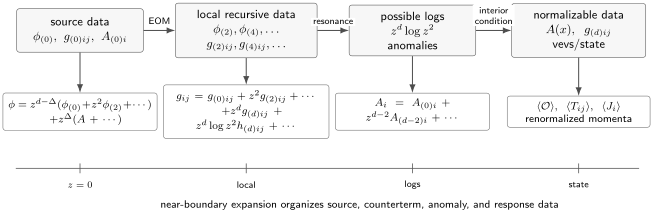
Near-boundary data split into three kinds of information: sources such as and , local coefficients fixed recursively by the equations of motion, and normalizable data such as or that encode expectation values. Logarithmic terms appear in special dimensions and are tied to anomalies.
Why this matters
Section titled “Why this matters”Near-boundary expansions answer three questions that recur throughout AdS/CFT:
- What is the source? The source is the leading asymptotic coefficient after the correct rescaling, not the raw cutoff value of the bulk field.
- What counterterms are needed? Divergences are determined by local terms in the asymptotic expansion.
- What is the vev? The one-point function is associated with the normalizable response, corrected by local terms required by renormalization.
The expansion is also the place where the radial-coordinate/RG-scale intuition becomes concrete. Solving the bulk equations from small inward resembles evolving from UV data toward the IR. The UV data are the sources. The IR condition selects the state.
Fefferman–Graham gauge
Section titled “Fefferman–Graham gauge”For asymptotically locally AdS geometries, a standard near-boundary coordinate choice is Fefferman–Graham gauge:
The boundary is at . The cutoff surface is . The induced metric on the cutoff surface is
The finite boundary metric source is
up to the choice of conformal frame. A different defining function can Weyl-rescale .
Fefferman–Graham gauge is not always the best coordinate system globally. It often breaks down at horizons or caustics. But near the conformal boundary it is the cleanest coordinate system for holographic renormalization.
Scalar fields: indicial exponents
Section titled “Scalar fields: indicial exponents”Consider a scalar field in fixed Euclidean Poincaré AdS:
The scalar wave equation is
Near , the radial derivative terms dominate over boundary derivatives. If
then the leading equation gives
Thus
where
In standard quantization,
The near-boundary expansion begins as
The coefficient is the source for the dual operator . The coefficient is the first state-dependent response coefficient. The renormalized one-point function has the schematic form
with the overall normalization depending on the normalization of the scalar action.
The first local scalar coefficient
Section titled “The first local scalar coefficient”For a scalar in flat-boundary Poincaré AdS, the full equation is
Let
and insert
The term gives the indicial equation. The term gives
Using , this becomes
for , with the sign convention for inherited from the metric signature. This coefficient is local in the source. Higher coefficients are similarly local until one reaches the normalizable order or a logarithmic resonance.
This recursive structure is the reason counterterms are local.
Normalizable data and interior boundary conditions
Section titled “Normalizable data and interior boundary conditions”The asymptotic expansion alone does not determine . To determine it, one must solve the bulk equation with an interior condition. Examples include:
- regularity in Euclidean AdS;
- normalizability in global AdS;
- incoming-wave conditions at a Lorentzian black-hole horizon;
- smoothness at the end of a soliton geometry.
Thus the source specifies the external deformation of the CFT, while depends on the state or saddle selected by the interior.
In momentum space for Euclidean Poincaré AdS, regularity at selects the Bessel solution. Expanding that solution near relates nonlocally to , producing the two-point function. In a black-hole background, the corresponding relation gives thermal Green’s functions.
Logarithmic scalar terms
Section titled “Logarithmic scalar terms”If the two roots differ by an integer in a way that creates a resonance in the recursion, logarithmic terms can appear. A common case is
Then the expansion can contain terms such as
The logarithmic coefficient is local in the source and is tied to scale dependence in the renormalized generating functional. In even boundary dimensions, similar logarithms in the metric expansion encode the Weyl anomaly.
Logs are not a sign that the expansion has failed. They are the expansion’s way of remembering anomalies and renormalization-scale dependence.
Metric expansion
Section titled “Metric expansion”In Fefferman–Graham gauge, the metric has an expansion of the form
The logarithmic term appears for even in pure gravity and is related to the conformal anomaly. For odd , there is no gravitational Weyl anomaly of this type.
The leading coefficient is the boundary metric source:
The coefficients below order are locally determined by through Einstein’s equations. For example, for pure gravity and ,
The coefficient contains the state-dependent information. Its trace and divergence are constrained by the equations of motion and by anomalies, while its transverse-traceless part is related to the expectation value of the stress tensor:
The symbol hides convention-dependent signs and local anomaly terms. The exact formula depends on the action normalization, dimension, and counterterm scheme.
Gauge-field expansion
Section titled “Gauge-field expansion”A bulk gauge field is dual to a conserved current. In radial gauge,
its near-boundary expansion typically has the form
with logarithmic or derivative terms in special dimensions.
The leading coefficient is the source for the conserved current . The normalizable coefficient is related to the current expectation value:
The radial Maxwell constraint gives the Ward identity. In the absence of charged operator sources,
This is the vector-field version of the same pattern: leading coefficient is source, subleading normalizable coefficient is response, and radial constraints become Ward identities.
Spinors and other fields
Section titled “Spinors and other fields”Spinors have first-order radial equations, so their expansion is slightly different. Roughly, one half of the boundary spinor components are fixed as sources, while the conjugate half is determined as a response. A spinor of mass in AdS is dual to a fermionic operator with dimension
in the standard quantization, with alternate choices possible in an allowed mass window.
For -forms and higher-spin fields, the same organizing principle remains: specify the allowed asymptotic behavior, identify the source, solve the radial constraints, renormalize the canonical momentum, and read off the vev.
Sources, local terms, vevs: the three-way split
Section titled “Sources, local terms, vevs: the three-way split”For every field, the near-boundary expansion separates data into three classes.
| Coefficient type | Boundary meaning | Determination |
|---|---|---|
| leading non-normalizable data | source | chosen externally |
| local subleading data | counterterms, contact terms, anomalies | fixed recursively by equations of motion and sources |
| normalizable data | state-dependent vev | fixed by interior condition or full solution |
This split is one of the conceptual pillars of AdS/CFT. It explains why the UV divergences are local while expectation values are sensitive to the full bulk geometry.
Radial canonical momenta
Section titled “Radial canonical momenta”A useful way to package the response is through radial canonical momenta. For a scalar,
The bare momentum diverges as . The renormalized momentum is obtained by adding the counterterm variation:
Then
up to the sign convention relating to . For the metric, the analogous canonical momentum is the extrinsic curvature combination that becomes the Brown–York tensor. For gauge fields, it is the radial electric field.
This viewpoint is especially powerful because the radial Hamiltonian constraints become CFT Ward identities.
A practical near-boundary recipe
Section titled “A practical near-boundary recipe”When solving a new holographic problem, proceed as follows:
- Choose Fefferman–Graham gauge near the boundary if possible.
- Write the most general expansion consistent with the expected weights.
- Insert into the equations of motion. Solve recursively order by order in .
- Separate local and normalizable data. Do not confuse coefficients determined by sources with the independent response.
- Evaluate the divergent action. Express divergences in terms of cutoff fields.
- Add local counterterms. Use covariance with respect to the cutoff metric .
- Compute renormalized canonical momenta. These give one-point functions.
- Apply the interior condition. This fixes the normalizable data as a functional of the sources and the state.
In many practical calculations, especially for two-point functions, one solves the full linearized equation rather than performing only the asymptotic recursion. But the near-boundary expansion is still required to identify sources, counterterms, and vevs.
Example: flat-boundary massless scalar in AdS
Section titled “Example: flat-boundary massless scalar in AdSd+1_{d+1}d+1”For a massless scalar,
the two roots are
Thus the expansion begins as
For , the first local coefficient is
If the source is constant, then , so the derivative corrections vanish near the boundary. The normalizable coefficient is still not determined by near-boundary analysis alone. In pure Euclidean AdS, regularity may set it as a nonlocal functional of ; in a black-brane background, the horizon condition gives a different functional relation.
Example: pure AdS metric
Section titled “Example: pure AdS metric”For pure Poincaré AdS with flat boundary,
all curvature tensors of vanish. Hence
and in fact
in exact Poincaré AdS. The stress tensor in the flat-space vacuum vanishes in this conformal frame:
By contrast, global AdS has boundary . In even-dimensional CFTs on the cylinder, the vacuum stress tensor may have a Casimir contribution. This is not a contradiction; it reflects the choice of boundary conformal frame and anomaly structure.
Dictionary checkpoint
Section titled “Dictionary checkpoint”The near-boundary expansion gives the following entries:
| Bulk coefficient | Boundary meaning |
|---|---|
| in | source for scalar operator |
| in | normalizable response, related to |
| source for , the boundary metric | |
| state-dependent metric coefficient, related to | |
| for a gauge field | source for current |
| response, related to | |
| logarithmic coefficients | anomalies and RG-scale dependence |
| radial constraints | Ward identities |
The recurring pattern is
after counterterms have been added.
Common confusions
Section titled “Common confusions”“Every subleading coefficient is a vev.”
Section titled ““Every subleading coefficient is a vev.””No. Many subleading coefficients are local functions of the source. The vev is associated with the independent normalizable data, plus local terms required by renormalization.
“The near-boundary expansion determines the full bulk solution.”
Section titled ““The near-boundary expansion determines the full bulk solution.””No. It determines the asymptotic solution order by order. The normalizable data generally require an interior condition or a full solution.
“Log terms are optional.”
Section titled ““Log terms are optional.””No. When the recursion demands them, they are forced. They encode anomalies or scale dependence and are essential for correct Ward identities.
“The boundary metric is the induced metric at .”
Section titled ““The boundary metric is the induced metric at z=ϵz=\epsilonz=ϵ.””The induced metric diverges as . The finite boundary metric source is the rescaled leading coefficient .
“Fefferman–Graham gauge is globally harmless.”
Section titled ““Fefferman–Graham gauge is globally harmless.””It is a near-boundary gauge. It can fail in the interior, especially near horizons. Real-time black-hole calculations often use ingoing Eddington–Finkelstein coordinates in the interior and translate to near-boundary data asymptotically.
Exercises
Section titled “Exercises”Exercise 1: Derive the scalar exponents
Section titled “Exercise 1: Derive the scalar exponents”Starting from the near-boundary scalar equation
insert and derive the two exponents.
Solution
With ,
The equation becomes
Thus
The roots are
Exercise 2: Compute
Section titled “Exercise 2: Compute ϕ(2)\phi_{(2)}ϕ(2)”For
show that
in standard quantization, where .
Solution
The coefficient in
gives
Using ,
Since ,
Therefore
Exercise 3: The first metric coefficient for flat boundary
Section titled “Exercise 3: The first metric coefficient for flat boundary”Use
to find when or .
Solution
For a flat boundary metric,
Therefore
This is consistent with exact Poincaré AdS, for which in Fefferman–Graham gauge.
Exercise 4: Source versus response
Section titled “Exercise 4: Source versus response”For a scalar with in standard quantization, explain why is interpreted as the source while is interpreted as response data.
Solution
Near the boundary,
For , the term is the slower falloff. Fixing this coefficient specifies the asymptotic boundary condition for the bulk field. In the CFT, fixing a boundary condition is equivalent to turning on an external source for the dual operator.
The faster falloff is normalizable in the standard range and is not fixed by the source alone. It depends on the interior condition or state. Therefore it is response data and is related to , after including local renormalization terms.
Further reading
Section titled “Further reading”- Sebastian de Haro, Kostas Skenderis, and Sergey N. Solodukhin, Holographic Reconstruction of Spacetime and Renormalization in the AdS/CFT Correspondence.
- Massimo Bianchi, Daniel Z. Freedman, and Kostas Skenderis, Holographic Renormalization.
- Kostas Skenderis, Lecture Notes on Holographic Renormalization.
- Ioannis Papadimitriou and Kostas Skenderis, AdS/CFT Correspondence and Geometry.
- Edward Witten, Anti de Sitter Space and Holography.