
Scalar Two-Point Functions
The previous page gave the GKP/Witten prescription:
Now we use it for the first time.
The goal is to compute the two-point function of a scalar primary operator in a -dimensional CFT from a free massive scalar field in Euclidean AdS. The result must have the conformal form
where is the scaling dimension of . The holographic calculation will explain both pieces: the power comes from the near-boundary behavior of the bulk field, and the normalization comes from the normalization of the bulk action.
This page is deliberately detailed. It is the first calculation in the course where the phrase “compute a CFT correlator from gravity” becomes literal.
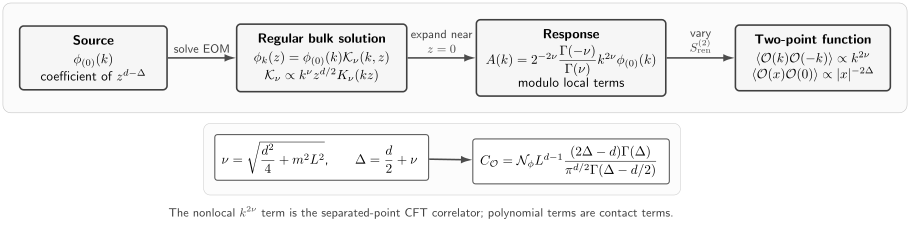
The scalar two-point function calculation. A boundary source fixes the leading falloff of a regular Euclidean bulk solution. The subleading coefficient is proportional to , where . The renormalized on-shell action is quadratic in , and two functional derivatives give .
Use Euclidean Poincaré AdS,
where , and the conformal boundary is at .
Consider a real scalar field with action
The constant is an overall normalization. In a full supergravity compactification it is determined by the ten-dimensional action and by the normalization of the Kaluza–Klein mode. In this page we keep it explicit.
The equation of motion is
In Poincaré coordinates,
The scalar equation becomes
Near-boundary behavior and the dimension
Section titled “Near-boundary behavior and the dimension”Near , derivatives along the boundary are subleading compared with radial powers. Try
The leading radial equation gives
Thus
where
It is useful to define
Then the two asymptotic powers are
In standard quantization,
The source is , and the response coefficient is related to the expectation value. The two-point function is the linear response of to .
Fourier transform
Section titled “Fourier transform”Because Euclidean Poincaré AdS is translation invariant along the boundary, Fourier transform along the directions:
The equation of motion becomes
Equivalently,
Write
Then obeys the modified Bessel equation
The two independent solutions are
In Euclidean AdS, regularity in the interior selects , because grows exponentially while decays exponentially.
The normalized bulk solution
Section titled “The normalized bulk solution”For noninteger , the small-argument expansion is
The regular solution whose leading boundary coefficient is is
with
Indeed, as ,
Since
we identify
The phrase “local terms” matters. The expansion also contains powers such as , , and so on. These are determined locally by the source. After holographic renormalization, they contribute contact terms to the CFT correlator.
The nonlocal part is the term. It is the part that becomes the separated-point power law .
On-shell action
Section titled “On-shell action”On shell, the scalar action reduces to a boundary term. With a cutoff surface and outward normal pointing toward smaller , one finds
or, equivalently,
up to the sign convention for the outward normal. What matters for the CFT correlator is the renormalized finite part after counterterms are added.
Holographic renormalization gives the standard result
Using , the nonlocal momentum-space two-point function is
This expression is best understood modulo local terms. If is an integer, the formula is obtained by analytic continuation and contains a logarithm after subtracting poles:
again up to polynomial contact terms. The scale is the renormalization scale.
Position-space answer
Section titled “Position-space answer”For noninteger , the Fourier transform identity is
understood by analytic continuation as a distribution.
Since
the separated-point two-point function is
up to the normalization convention for and up to contact terms.
This is exactly the form required by conformal invariance. The holographic calculation does more than recover the form: it relates the coefficient to the normalization of the bulk kinetic term.
Position-space bulk-to-boundary propagator
Section titled “Position-space bulk-to-boundary propagator”The same result can be obtained directly in position space. The Euclidean bulk-to-boundary propagator is
with
It is normalized so that
The classical solution is
The renormalized quadratic on-shell action can be written as
again up to contact terms. Differentiating twice and using gives the two-point function above.
This position-space expression is often the cleanest way to see conformal invariance. The momentum-space expression is often the cleanest way to do the calculation.
Where the power law comes from
Section titled “Where the power law comes from”The result
has two complementary explanations.
From the CFT point of view, conformal symmetry fixes the two-point function of scalar primaries:
From the bulk point of view, the exponent comes from the indicial equation near the AdS boundary:
The normalizable response is separated from the source by radial powers. In momentum space that separation appears as . Fourier transforming gives .
This is the first concrete example of the rule:
Normalization and operator conventions
Section titled “Normalization and operator conventions”The coefficient is not universal by itself. If we rescale the boundary operator,
then the source must rescale as
to keep fixed. The two-point coefficient then changes as
In a top-down string compactification, the normalization of is fixed by matching the bulk field normalization to the microscopic CFT convention. In a bottom-up model, is often a phenomenological input.
This is why the power law is usually more robust than the absolute coefficient unless one has carefully normalized both sides.
What happens when is an integer?
Section titled “What happens when ν\nuν is an integer?”Many important examples have integer . For instance, a massless scalar in AdS has , , and hence , .
The formula with has a pole at integer . This does not mean the correlator is infinite. It means that the naive noninteger formula must be renormalized. After subtracting local divergences, the momentum-space correlator contains
The logarithm is precisely what one expects when Fourier transforming a separated-point correlator of the form in cases where the transform is singular as an ordinary function. The logarithm also encodes scale dependence of contact terms.
The lesson is:
Separated-point correlators remain conformal.
Standard versus alternate quantization
Section titled “Standard versus alternate quantization”For
both radial falloffs are normalizable. In this window, there are two possible CFT quantizations:
The standard quantization treats the coefficient of as the source and gives an operator of dimension . The alternate quantization treats the other falloff as the source and gives an operator of dimension .
This page uses standard quantization. The alternate case requires a Legendre transform of the generating functional and will be discussed later with the Breitenlohner–Freedman bound.
A clean example: ,
Section titled “A clean example: d=3d=3d=3, m2L2=−2m^2L^2=-2m2L2=−2”Take AdS with a scalar mass
Then
The standard dimension is
The separated-point correlator is
Since and ,
Thus
This is a useful check because no logarithmic subtlety appears: is noninteger.
What has been computed?
Section titled “What has been computed?”We computed the vacuum Euclidean two-point function of a scalar primary in a CFT on flat Euclidean space. More precisely, we computed the leading large-, strong-coupling, classical-bulk answer for the operator dual to a free bulk scalar field.
We did not compute:
- a Lorentzian retarded correlator;
- a finite-temperature correlator;
- a correlator in an excited state;
- loop corrections in the bulk;
- stringy corrections;
- contact terms fixed by a specific renormalization scheme;
- the normalization of a specific SYM operator.
Each of those requires additional data. But the structure of the calculation will recur throughout the course.
Dictionary checkpoint
Section titled “Dictionary checkpoint”The scalar two-point calculation extracts the following dictionary entries:
| Bulk statement | Boundary statement |
|---|---|
| scalar mass | operator dimension |
| leading falloff | source for |
| regular Euclidean interior solution | vacuum Euclidean correlator |
| response coefficient | linear response of |
| renormalized quadratic on-shell action | connected two-point function |
| local counterterms | contact terms and scheme dependence |
| radial scaling gap | momentum-space scaling |
The key conceptual bridge is
Common confusions
Section titled “Common confusions”“The divergent terms are mistakes.”
Section titled ““The divergent terms are mistakes.””They are not mistakes. The divergent terms are the bulk version of UV divergences in the boundary theory. Holographic renormalization removes them by local counterterms. The nonlocal part of the answer is the physical separated-point correlator.
“The coefficient of is automatically the vev.”
Section titled ““The coefficient of zΔz^\DeltazΔ is automatically the vev.””It is proportional to the vev in simple standard cases, but the precise one-point function is the variation of the renormalized action. Local terms, logarithms, curvature couplings, and alternate quantization can modify the naive identification.
“The solution is chosen because it is normalizable near the boundary.”
Section titled ““The KνK_\nuKν solution is chosen because it is normalizable near the boundary.””No. Near the boundary, contains both source and response falloffs. It is chosen in Euclidean AdS because it is regular in the interior. Boundary normalizability and interior regularity are different conditions.
“The two-point coefficient is a universal prediction.”
Section titled ““The two-point coefficient is a universal prediction.””The power law is fixed by conformal symmetry and the mass-dimension relation. The coefficient depends on the normalization of the bulk field and the boundary operator. In top-down examples it can be fixed precisely; in bottom-up models it is a convention or phenomenological parameter.
“Momentum-space polynomials can be ignored everywhere.”
Section titled ““Momentum-space polynomials can be ignored everywhere.””Polynomial terms in are contact terms. They do not affect separated points, but they matter for Ward identities, anomalies, scheme dependence, and finite counterterms. Ignore them only when the observable really is insensitive to contact terms.
Exercises
Section titled “Exercises”Exercise 1: Derive the mass-dimension relation
Section titled “Exercise 1: Derive the mass-dimension relation”Starting from the near-boundary ansatz
derive
Solution
Near the boundary, ignore boundary derivatives. The scalar equation reduces to
Compute
so
Then
Multiplying by gives
Therefore
The two roots are and , so
Exercise 2: Check the regular solution
Section titled “Exercise 2: Check the regular solution”Show that
has leading behavior as .
Solution
For small and noninteger ,
Thus
The constants and powers of cancel, leaving
Since ,
Therefore the leading behavior is .
Exercise 3: Compute the response coefficient
Section titled “Exercise 3: Compute the response coefficient”Using the second term in the small- expansion
show that
for noninteger , up to local terms.
Solution
Insert the second term into the normalized solution:
The second term gives
The numerical factor is
The powers are
Thus the coefficient of is
up to local terms from the analytic part of the expansion.
Exercise 4: The AdS example
Section titled “Exercise 4: The AdS4_44 example”For and , compute and the separated-point two-point function coefficient in terms of and .
Solution
First,
Therefore
The coefficient formula gives
Substitute and :
Therefore
So
Further reading
Section titled “Further reading”- S. S. Gubser, I. R. Klebanov, and A. M. Polyakov, Gauge Theory Correlators from Non-Critical String Theory.
- E. Witten, Anti de Sitter Space and Holography.
- D. Z. Freedman, S. D. Mathur, A. Matusis, and L. Rastelli, Correlation Functions in the CFT(d)/AdS(d+1) Correspondence.
- E. D’Hoker and D. Z. Freedman, Supersymmetric Gauge Theories and the AdS/CFT Correspondence.
- S. de Haro, K. Skenderis, and S. N. Solodukhin, Holographic Reconstruction of Spacetime and Renormalization in the AdS/CFT Correspondence.
- K. Skenderis, Lecture Notes on Holographic Renormalization.