
Holographic Complexity: Volume and Action
Guiding question. Entanglement explains why a two-sided AdS black hole is connected, but what boundary quantity keeps growing when the Einstein–Rosen bridge keeps growing long after ordinary thermalization?
The thermofield double is already maximally useful as a lesson in holography. Its left and right density matrices are thermal, and the dual spacetime is the eternal two-sided AdS black hole. But the TFD also exposes a puzzle. Many simple boundary diagnostics equilibrate quickly. Local one-point functions settle down. Thermal entropy is time independent. Two-sided correlators decay. Yet the wormhole interior, measured by a long spacelike slice through the Einstein–Rosen bridge, grows for a very long time.
That mismatch motivates the idea that the growing black-hole interior is not dual to ordinary thermodynamic entropy. It is instead dual to computational complexity: roughly, the minimum number of simple gates required to prepare the boundary state from a reference state.
The two standard geometric proposals are
and
The first says complexity is proportional to the maximal spatial volume of a bulk slice. The second says complexity is proportional to the gravitational action of the Wheeler–DeWitt patch. Both were designed to capture a simple but striking fact:
This page explains the logic of the two proposals, their strengths, their ambiguities, and the role they play in black-hole information. The important attitude is neither to dismiss them as metaphors nor to treat them as established dictionary entries on the same footing as RT/HRT. Holographic complexity is a powerful probe of black-hole interiors, but the precise boundary definition of complexity in continuum QFT remains subtle.
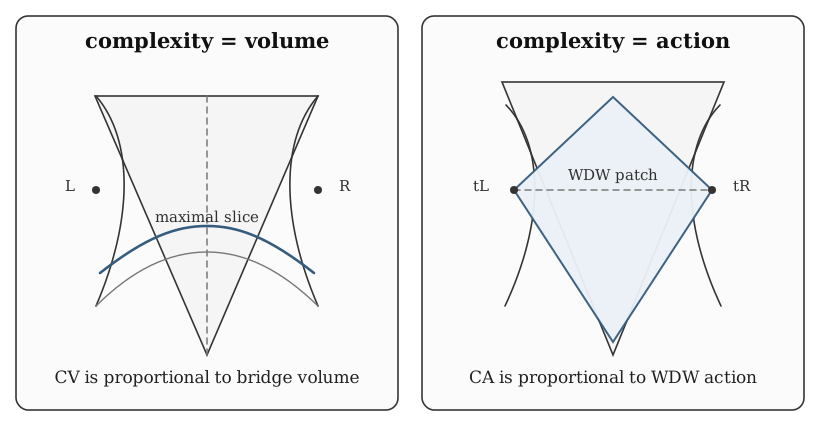
Two standard probes of black-hole interior growth. In the CV proposal, is proportional to the volume of a maximal codimension-one slice connecting the boundary times. In the CA proposal, is proportional to the on-shell gravitational action of the Wheeler–DeWitt patch.
1. Why entanglement is not enough
Section titled “1. Why entanglement is not enough”The eternal two-sided black hole is dual to
The reduced density matrix on the right is thermal:
Therefore the left-right entanglement entropy is just the thermal entropy,
Under the symmetric time evolution
the one-sided density matrices remain thermal. Hence the left-right entanglement entropy does not grow. But the bulk Einstein–Rosen bridge does grow: a maximal spatial slice connecting the two asymptotic boundaries becomes longer and has larger volume at late times.
This is the slogan behind complexity:
The slogan is useful but imprecise. The amount of entanglement between the two CFTs tells us that the two-sided geometry is connected in the special TFD-like state. It does not specify the detailed interior geometry. A generic highly entangled state of two CFTs need not have a smooth semiclassical wormhole. To get the eternal black hole, one needs a special pattern of correlations: approximately thermal, low-complexity, and compatible with semiclassical locality.
This point is important for black-hole information. The Page curve teaches us about fine-grained entropy, while entanglement wedge reconstruction teaches us where bulk information is encoded. Complexity asks a different question: how hard is it to produce, decode, or destroy the semiclassical interior? That question becomes essential in discussions of firewalls, Harlow–Hayden decoding, Python’s Lunch, and late-time interior reconstruction.
2. Complexity in quantum mechanics
Section titled “2. Complexity in quantum mechanics”For a finite-dimensional quantum system, the circuit complexity of a target state is usually defined relative to:
- a reference state ,
- a set of elementary gates ,
- an allowed tolerance ,
- a cost function.
The state complexity is then schematically
For an operator , one similarly defines
For a system with entropy , the effective Hilbert-space dimension is roughly
A useful random-circuit intuition is:
until it reaches a maximum of order
The recurrence time is vastly longer,
for a typical finite quantum system. This hierarchy is the reason complexity is attractive as a dual of black-hole interiors. A black hole thermalizes on a time scale of order the inverse temperature and scrambles on
but its interior volume appears to grow for a time exponentially long in . That is exactly the kind of behavior expected from circuit complexity rather than entropy.
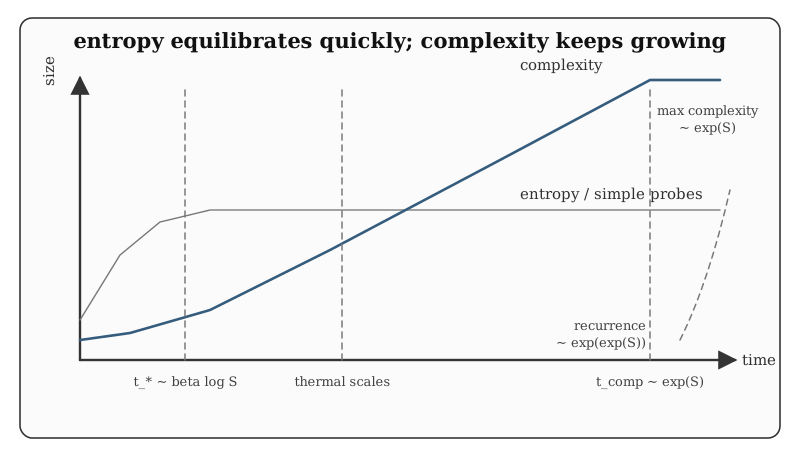
Entropy and simple correlators equilibrate quickly compared with the enormous time scales associated with complexity. Complexity is expected to grow roughly linearly until , while quantum recurrence occurs only around .
For continuum QFT, this definition is much less settled. One must specify the reference state, ultraviolet regulator, gate set, locality structure, and treatment of gauge constraints. This is one reason holographic complexity remains less sharply defined than entanglement entropy. Entanglement entropy also has regulator dependence, but RT/HRT gives a precise gravitational prescription for its universal and renormalized structure. Complexity has several plausible gravitational prescriptions, but a universally accepted boundary definition is still missing.
This does not make the subject empty. It means the proposals should be used as diagnostics of interior physics, not as final axioms.
3. Complexity = Volume
Section titled “3. Complexity = Volume”The original geometric intuition is that the complexity of a two-sided state is proportional to the size of the Einstein–Rosen bridge. The most common version is the complexity=volume proposal:
where is the maximal-volume codimension-one bulk slice anchored at the two boundary Cauchy slices labelled by and . The length scale is often taken to be the AdS radius or another characteristic scale. The overall numerical normalization is not fixed by the proposal.
For the eternal black hole, the volume grows linearly at late times:
where is the horizon radius and is a dimension-dependent constant. Hence
Up to dimension-dependent factors, this is of the order of
for large AdS black holes. This order-of-magnitude agreement is part of the evidence that complexity, not entropy, controls the late-time interior.
The CV proposal has several attractive features:
- it directly measures the spatial bridge seen in the TFD geometry;
- it explains why interior growth continues after thermal equilibrium;
- it responds to shock waves in a way that resembles circuit complexity;
- it is technically simpler than action calculations.
But it also has weaknesses:
- the choice of length scale is somewhat ad hoc;
- the overall normalization is not fixed;
- the maximal slice is not as covariantly natural as a spacetime region;
- the dual boundary definition of the complexity is not uniquely specified.
These weaknesses motivated the CA proposal.
4. Complexity = Action
Section titled “4. Complexity = Action”The complexity=action proposal replaces the maximal spatial volume by the on-shell action of a spacetime region. The relevant region is the Wheeler–DeWitt patch: the domain of dependence of any bulk Cauchy slice anchored at the chosen boundary times.
The proposal is
where is the gravitational action evaluated on the WDW patch, including the necessary boundary, joint, and counterterm contributions.
For Einstein gravity with negative cosmological constant,
The boundary structure is not cosmetic. WDW patches have null boundaries, and null boundaries require special care: normalization choices for null normals can appear unless appropriate counterterms are included. Corners where null boundaries intersect contribute joint terms. Near the AdS boundary, both CV and CA require regularization.
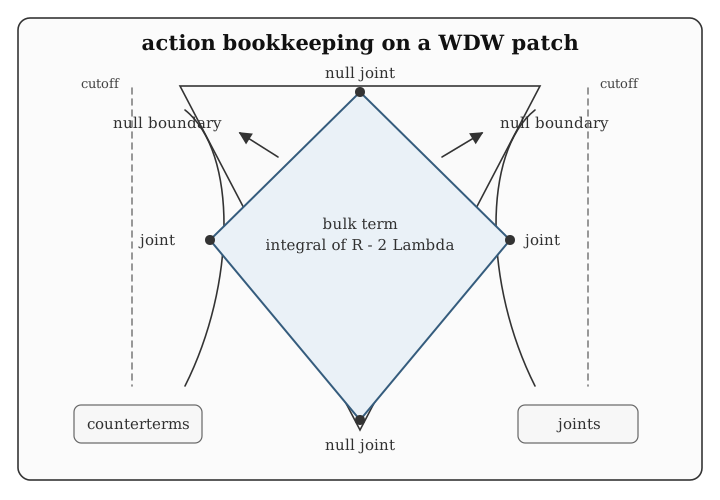
The Wheeler–DeWitt patch is bounded by null sheets shot inward from the boundary time slices. The CA proposal requires the bulk action plus boundary, joint, and counterterm contributions. These terms are essential for a well-defined variational problem and for reparametrization-invariant null boundaries.
The CA proposal is appealing because it is more covariant and does not introduce a separate arbitrary length scale. For neutral two-sided AdS black holes, the late-time action growth often takes the form
so that
This resembles Lloyd’s proposed bound on the rate of computation,
although the interpretation of this bound in holographic complexity is subtle. Charged, rotating, higher-derivative, and multi-horizon black holes show that the story is more delicate than the slogan “black holes saturate Lloyd’s bound.” It is safer to say that CA was partly motivated by the idea that black holes are exceptionally fast computers, and that neutral AdS black holes display a striking late-time growth rate of order .
5. Complexity of formation
Section titled “5. Complexity of formation”A useful finite quantity is the complexity of formation. For the two-sided black hole, it measures the extra complexity of preparing the thermofield double relative to preparing two independent vacuum states or two disconnected thermal reference states. Schematically,
In the bulk, one computes the analogous difference between the black-hole geometry and an appropriate vacuum reference. The point of this subtraction is similar to the subtraction of vacuum divergences in entanglement calculations: the absolute complexity is UV divergent, while differences can be more meaningful.
For large AdS black holes, the complexity of formation scales like the entropy,
This agrees with the intuition that preparing the TFD requires an order- amount of initial work, while subsequent time evolution increases complexity for an exponentially long time. In this way the TFD geometry has two pieces of complexity information:
and
The distinction is useful. Entanglement entropy tells us the bridge is present. Complexity of formation tells us how costly it is to make the special correlated state. Late-time complexity growth tells us how the interior evolves after the state has already become thermally entangled.
6. The switchback effect
Section titled “6. The switchback effect”One of the strongest pieces of evidence for holographic complexity is the switchback effect.
Consider a circuit of the form
where is a simple perturbation inserted at an early time . If were absent, the forward and backward evolutions would cancel exactly:
With present, cancellation is spoiled only after the perturbation has grown under chaotic time evolution. The complexity increase is delayed by roughly the scrambling time:
This is the switchback effect: most of the forward/backward evolution cancels until the perturbation has spread over the system.
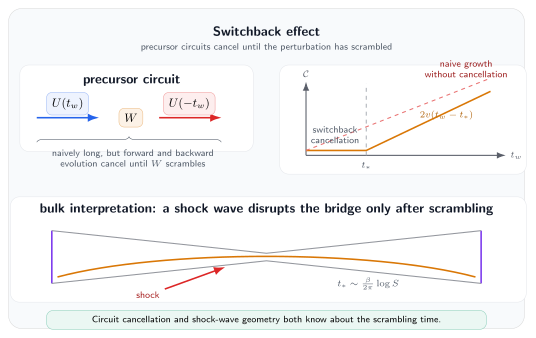
A simple perturbation inserted at time interrupts the cancellation between and . In a chaotic system the interruption becomes extensive only after the scrambling time . In the bulk, the same delay appears in shock-wave geometries probing the Einstein–Rosen bridge.
The bulk dual is a shock wave sent into the black hole from one boundary. For sufficiently early injection, the shock is exponentially blueshifted near the horizon and changes the interior geometry. CV and CA calculations reproduce a delayed growth matching the circuit intuition. This is not a proof of the proposals, but it is a highly nontrivial consistency check: the geometry knows about the cancellation structure of chaotic quantum circuits.
The switchback effect is also conceptually tied to the Harlow–Hayden obstruction. It separates information-theoretic existence from computational accessibility. Even if some operator exists that decodes a black-hole interior degree of freedom, implementing that operator may require a circuit so complex that no semiclassical observer can perform it in time.
7. Relation to the black-hole interior
Section titled “7. Relation to the black-hole interior”The interior of a two-sided AdS black hole contains a spacelike direction along which the Einstein–Rosen bridge grows. This is not ordinary expansion in the exterior. It is a feature of the behind-horizon geometry.
In Schwarzschild-AdS coordinates, a maximal volume slice enters the region behind the horizon and asymptotically runs along a preferred radius inside the black hole. The linear growth of volume comes from the fact that the slice accumulates more and more interior length as the boundary time increases. In the TFD, the relevant time is usually
for the symmetric evolution.
Complexity proposals therefore offer a boundary diagnostic of a region that is difficult to access by causal reconstruction. This is why complexity appears in discussions of:
- the growth of the Einstein–Rosen bridge;
- the difficulty of making firewalls;
- precursor operators;
- shock waves and chaos;
- late-time interior reconstruction;
- Python’s Lunch and decoding complexity.
However, one should not identify complexity with the entire interior. The interior has local effective fields, causal structure, and geometric observables. Complexity is one coarse global measure of how hard the boundary state or operator is to prepare. It is sensitive to interior growth but does not by itself reconstruct local behind-horizon operators.
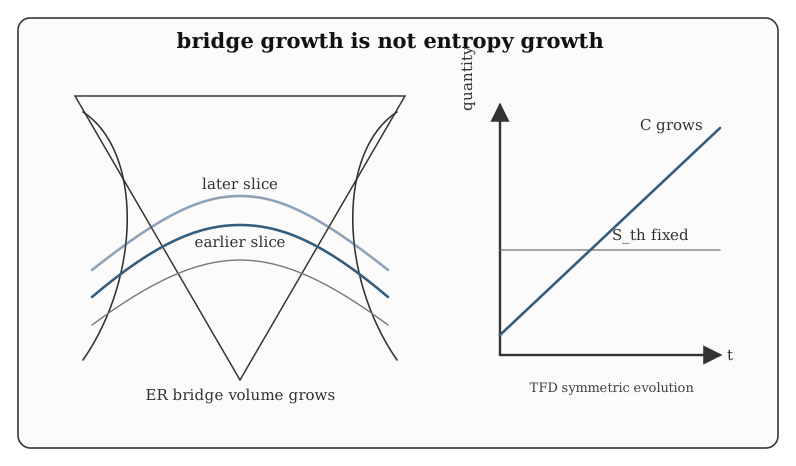
For the eternal two-sided black hole, the thermal entropy of one side is time independent, while the Einstein–Rosen bridge grows under the symmetric TFD evolution. Complexity is designed to track this continued growth; entropy alone cannot.
8. CV, CA, and CV 2.0
Section titled “8. CV, CA, and CV 2.0”Besides CV and CA, another proposal is sometimes called CV 2.0 or spacetime-volume complexity:
where is often taken to be the WDW patch or a related spacetime region. This proposal is motivated by the observation that spacetime volume can reproduce some qualitative features of complexity growth with simpler computations.
A useful comparison is:
These proposals often agree qualitatively for neutral eternal black holes: they grow linearly at late times, show switchback behavior under shocks, and are sensitive to the black-hole interior. But they can differ quantitatively and sometimes qualitatively in charged, rotating, higher-derivative, or multi-horizon cases. That disagreement should be taken seriously. It probably means that the precise dual notion of complexity has not yet been isolated.
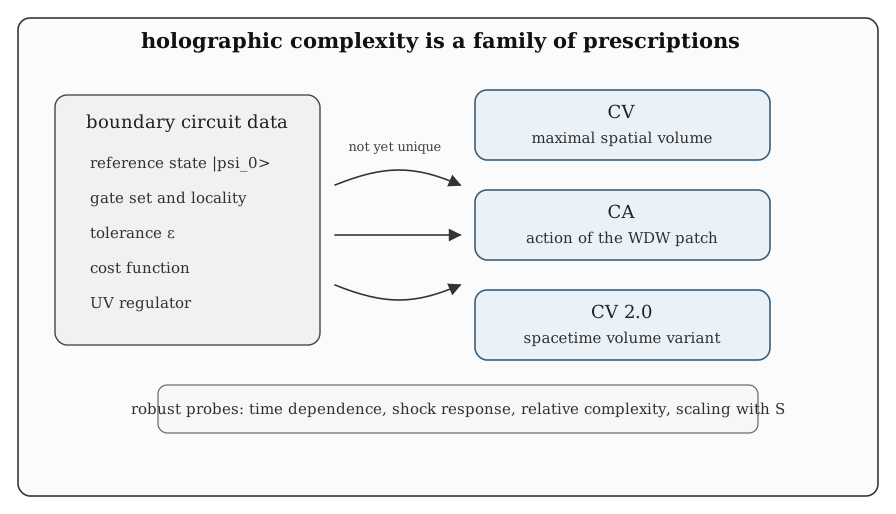
Holographic complexity is a family of related proposals rather than a single universally established dictionary entry. CV, CA, and spacetime-volume variants share the idea that complexity probes black-hole interiors, but they differ in normalization, regulator dependence, and sensitivity to boundary terms.
9. UV divergences and renormalization
Section titled “9. UV divergences and renormalization”Both entanglement entropy and complexity are UV divergent in continuum quantum field theory, but the divergences have different meanings.
For entanglement entropy, the leading divergence is local near the entangling surface:
For complexity, the divergence is usually interpreted as the cost of preparing short-distance modes relative to a reference state. In holography, the divergences arise from the near-boundary region. In CV, the maximal volume extends toward the asymptotic boundary and must be cutoff at . In CA, the WDW patch reaches the boundary and includes divergent bulk, boundary, and joint contributions.
A schematic structure is
The coefficients depend on the proposal and on choices analogous to the gate set and reference state. This is not necessarily a flaw. Quantum circuit complexity is not an intrinsic property of a state alone; it is a property relative to allowed operations and a reference. But it does mean that universal statements should focus on robust features: time dependence, shock response, relative complexity, and scaling with .
10. Lloyd bound and its caveats
Section titled “10. Lloyd bound and its caveats”Lloyd proposed an upper bound on the rate at which a system of energy can perform computation:
The CA proposal famously gives
for simple neutral eternal AdS black holes at late times. This numerical match was one of the early motivations for CA.
But the bound must be handled with care.
First, the definition of the energy matters. Should one subtract the ground-state energy? For charged or rotating black holes, should the relevant thermodynamic potential be ? Different answers lead to different comparisons.
Second, the gravitational calculation is sensitive to boundary and joint terms. A statement about the absolute action growth may change under modifications of the prescription.
Third, quantum complexity in field theory depends on gate choices. The relation between Lloyd’s bound for idealized computation and holographic complexity in a strongly coupled continuum system is not automatic.
Fourth, examples with charge, rotation, higher-derivative interactions, and multiple horizons show that naive saturation is not universal.
The safest formulation is:
That is already a deep statement, but it is not a theorem that every black hole saturates a unique computational speed limit.
11. Complexity and black-hole information
Section titled “11. Complexity and black-hole information”How does holographic complexity fit into the black-hole information story?
It does not replace the Page curve. The Page curve is a statement about fine-grained entropy:
It does not replace entanglement wedge reconstruction. Reconstruction is a statement about where logical bulk operators can be represented.
Complexity instead refines the distinction between existence and accessibility.
After the Page time, the island formula says that certain interior regions are in the entanglement wedge of the radiation:
Therefore, in principle, interior operators can have radiation representatives. But the representative can be extremely complicated. Complexity asks whether the reconstruction is feasible for any observer with finite resources.
This is where the Harlow–Hayden lesson reappears. A decoding operation may exist mathematically but require time exponential in the black-hole entropy. Holographic complexity provides a geometric language for such obstructions. The next page, on Python’s Lunch, makes this sharper: certain nonminimal quantum extremal surfaces create a geometric obstruction whose decoding cost behaves roughly like
Thus the role of complexity in black-hole information is not to say “the information is absent” or “the information is present.” It is to ask:
12. What the proposals do and do not prove
Section titled “12. What the proposals do and do not prove”They do explain why entropy is insufficient
Section titled “They do explain why entropy is insufficient”The bridge keeps growing while entropy has saturated. Complexity has the correct qualitative time scales to track this growth.
They do not give a complete boundary definition
Section titled “They do not give a complete boundary definition”A precise continuum QFT definition of holographic complexity remains an active subject. Any statement about absolute complexity depends on reference state, gate set, tolerance, regulator, and cost function.
They do not by themselves solve the information paradox
Section titled “They do not by themselves solve the information paradox”The Page curve and island formula are entropy statements. Complexity explains why decoding and interior manipulation can be difficult, not why the fine-grained entropy takes the unitary value.
They do connect interiors to computation
Section titled “They do connect interiors to computation”Shock waves, switchback behavior, precursor operators, and late-time bridge growth all point to a deep relation between interior geometry and computational complexity.
They are most reliable as comparative diagnostics
Section titled “They are most reliable as comparative diagnostics”Time dependence, differences between states, response to perturbations, and scaling with are more robust than an absolute numerical value of .
13. Exercises
Section titled “13. Exercises”Exercise 1. Entanglement entropy versus TFD time evolution
Section titled “Exercise 1. Entanglement entropy versus TFD time evolution”Show that the symmetric time evolution
does not change the reduced density matrix .
Solution
The TFD is
Under ,
The reduced density matrix is
Using , all phases cancel:
Therefore the one-sided entropy is constant, even though the two-sided bulk interior grows.
Exercise 2. Dimensional analysis of CV
Section titled “Exercise 2. Dimensional analysis of CV”In -dimensional Einstein gravity, has dimensions of length, while the maximal slice volume has dimensions of length. Explain why
is dimensionless.
Solution
The dimensions are
Thus
The formula is dimensionless, as a gate count should be. The analysis does not fix the numerical coefficient or the precise choice of the length scale ; that is one of the ambiguities of the CV proposal.
Exercise 3. The switchback delay
Section titled “Exercise 3. The switchback delay”Suppose a chaotic system has complexity growth rate and scrambling time . A precursor operator is modeled by
Assume that forward/backward cancellations remove all extensive complexity growth until the perturbation has scrambled. Write a simple estimate for the extra complexity .
Solution
The switchback estimate is
The term is the cost of inserting the simple perturbation . The extensive part of the complexity grows only after the perturbation has spread across the system. In the bulk, this same delay is represented by the shock wave becoming strong enough to appreciably lengthen the Einstein–Rosen bridge.
Exercise 4. Why CA is more covariant but not automatically less ambiguous
Section titled “Exercise 4. Why CA is more covariant but not automatically less ambiguous”Explain why the CA proposal is more covariant than CV, and then list two ambiguities that remain in CA.
Solution
CA is more covariant because it uses a spacetime region, the Wheeler–DeWitt patch, and the gravitational action evaluated on that region. CV, by contrast, asks for a maximal spatial slice and introduces an additional length scale .
However, CA still has ambiguities. First, WDW patches have null boundaries, and the action depends on boundary, joint, and counterterm prescriptions. Null normalizations and reparametrization choices must be handled carefully. Second, the result is UV divergent near the AdS boundary and requires a cutoff, whose boundary interpretation depends on the definition of complexity in the dual QFT. More broadly, the boundary gate set and reference state are not fixed by the bulk formula alone.
Exercise 5. Complexity and island reconstruction
Section titled “Exercise 5. Complexity and island reconstruction”After the Page time, an island lies in the entanglement wedge of the radiation. Does this imply that an exterior observer can efficiently read off an interior diary from the radiation? Explain.
Solution
No. Entanglement wedge reconstruction is an existence statement: within an appropriate code subspace, there exists a radiation operator that represents the island operator. It does not imply that the operator is simple or efficiently implementable.
The decoding operation may have enormous circuit complexity. In Harlow–Hayden-type arguments, decoding Hawking radiation can require time exponential in the black-hole entropy. In Python’s Lunch geometries, decoding cost is related to barriers in generalized entropy. Thus the island formula can say that information is present in the radiation while complexity explains why it may be practically inaccessible.
14. Further reading
Section titled “14. Further reading”- L. Susskind, Computational Complexity and Black Hole Horizons, arXiv:1402.5674.
- D. Stanford and L. Susskind, Complexity and Shock Wave Geometries, arXiv:1406.2678.
- A. R. Brown, D. A. Roberts, L. Susskind, B. Swingle, and Y. Zhao, Complexity Equals Action, arXiv:1509.07876.
- A. R. Brown, D. A. Roberts, L. Susskind, B. Swingle, and Y. Zhao, Complexity, Action, and Black Holes, arXiv:1512.04993.
- T. Hartman and J. Maldacena, Time Evolution of Entanglement Entropy from Black Hole Interiors, arXiv:1303.1080.
- D. Carmi, S. Chapman, H. Marrochio, R. C. Myers, and S. Sugishita, On the Time Dependence of Holographic Complexity, arXiv:1709.10184.
- S. Chapman, H. Marrochio, and R. C. Myers, Complexity of Formation in Holography, arXiv:1610.08063.
- A. R. Brown and L. Susskind, Second Law of Quantum Complexity, arXiv:1701.01107.
15. Summary
Section titled “15. Summary”The lesson of holographic complexity is not that every detail of the black-hole interior has been reduced to a gate count. The lesson is sharper and more modest:
The CV proposal captures this through maximal spatial volume. The CA proposal captures it through the action of the WDW patch. Both explain why the Einstein–Rosen bridge can continue to grow after entanglement entropy has saturated. Both reproduce switchback-type delays under perturbations. Both suggest that computational complexity is a missing ingredient in the information problem.
For the Page curve, the central question is whether the radiation entropy is computed by the no-island or island saddle. For reconstruction, the central question is which boundary region represents a bulk operator. For complexity, the central question is how hard the relevant operation is. That distinction is the bridge to the next topic: Python’s Lunch and decoding complexity.