
FLM, Generalized Entropy, and Bulk Entanglement
RT and HRT are classical gravitational formulas. They compute a boundary entropy by an area:
in the static case, or by the area of an HRT surface in the covariant case. This leading term is of order , which is order in the standard large- normalization of holographic CFTs.
But a bulk quantum theory has more than classical geometry. Bulk fields fluctuate. Gravitons fluctuate. Matter fields can be entangled across the RT/HRT surface. If two boundary states have the same classical geometry but differ by a few bulk quanta, their entanglement entropies should differ by an amount of order . The classical area term cannot see this.
The first universal correction is the Faulkner–Lewkowycz–Maldacena formula, usually called the FLM formula:
Here is the classical RT surface, or the classical HRT surface in a covariant setting, and is the bulk homology region bounded by and . The correction is the ordinary bulk effective-field-theory entropy of the quantum fields in , including gravitons once the appropriate gauge-invariant algebra is specified.
In one sentence: RT/HRT counts the classical area of the cut; FLM adds the quantum entanglement of bulk degrees of freedom across that cut.
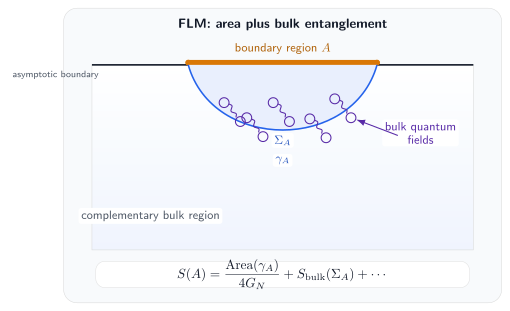
The FLM correction adds the entropy of bulk quantum fields in the homology region . At leading classical order, the RT/HRT surface supplies the area term. At one-loop order, bulk correlations crossing contribute .
This page explains the formula, its replica derivation, its renormalization, and why it is the conceptual bridge from classical RT/HRT to quantum extremal surfaces and islands.
Guiding question
Section titled “Guiding question”What is the first sign, in holographic entropy, that the bulk is a quantum system rather than a classical geometry?
The answer is that the entropy of a boundary region is not only the area of the surface separating the entanglement wedge from its complement. It also contains the entropy of the bulk quantum state restricted to the wedge. The entanglement wedge is not empty geometry; it carries a quantum state.
This sounds almost inevitable in hindsight. If a bulk Bell pair has one particle inside the entanglement wedge of and the other particle outside, the boundary density matrix on should notice. The geometry may remain unchanged at order , but the entropy changes by order one. FLM is precisely the statement that this order-one change is computed by bulk entanglement entropy.
The formula and its domain of validity
Section titled “The formula and its domain of validity”For a static classical bulk dual and a boundary region , let be the classical RT surface. Let be a bulk Cauchy region satisfying
The FLM formula is
In a time-dependent setting, replace by the classical HRT surface and interpret as a Cauchy slice of the corresponding classical entanglement wedge. The bulk entropy is independent of the choice of Cauchy slice inside the wedge, provided the state and algebra are evolved unitarily and no flux escapes through singular boundaries not included in the setup.
There are several important qualifications.
First, is an entropy in the bulk effective theory, not an entropy of a separate microscopic system added by hand. It is the entropy of the bulk fields in the region dual to .
Second, the formula is an expansion. In ordinary large- holography,
so the area term is while the one-loop bulk entropy of a fixed number of light fields is . Higher bulk loops, graviton loops, and the shift of the extremal surface appear at lower orders in the expansion.
Third, if the bulk action contains higher-derivative terms, the word “area” should be replaced by the appropriate gravitational entropy functional. For two-derivative Einstein gravity this is simply . More generally, it includes Wald-like and anomaly-like local terms. The invariant object is the full generalized entropy, not a regulator-dependent split into “area” and “bulk entropy.”
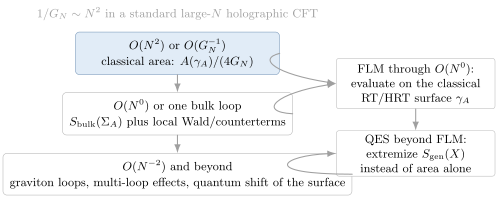
In a standard large- holographic CFT, the classical RT/HRT area is order . The FLM correction is order , corresponding to one bulk loop. Beyond FLM, the correct surface is not fixed by extremizing area alone but by extremizing the generalized entropy.
In a nongravitational quantum field theory, one often writes the Hilbert space as a tensor product
and defines
This notation is useful, but in gauge theory and gravity it is slightly too naive. Local constraints prevent an exact factorization of the Hilbert space across a spatial cut. In electromagnetism, Gauss’s law ties the electric flux through the cut to charged matter. In gravity, diffeomorphism constraints and gravitational dressing make the issue deeper.
A more precise statement is algebraic: is the entropy associated with the bulk operator algebra in the entanglement wedge of , including the correct treatment of edge modes, centers, and local geometric terms. In simple perturbative calculations, one often uses an extended Hilbert space or a regulator and then adds the necessary counterterms. Later, operator-algebra quantum error correction will give the clean conceptual framework.
For the present page, the operational meaning is enough:
measures the amount of quantum information in the bulk state that is entangled across the RT/HRT cut.
A helpful toy example is a bulk Bell pair. Suppose the bulk contains two qubits in the state
If both qubits lie in , or both lie in , this pair contributes nothing to . If one qubit lies in and the other in , then the reduced state on either side is maximally mixed and the pair contributes
Thus the FLM correction captures order-one entanglement that the classical geometry cannot resolve.
Why the classical surface is enough at FLM order
Section titled “Why the classical surface is enough at FLM order”A natural worry is that once we add , perhaps the surface itself should move. The answer is yes, but not at the order computed by FLM.
Let be a surface near the classical RT/HRT surface . Define the generalized entropy functional schematically by
The classical surface obeys
Now write . The extremality condition for the generalized entropy is approximately
Since is order , the displacement is
The corresponding change in the entropy at FLM order vanishes because the first variation of the area is zero at . The area cost from moving the surface is quadratic:
Therefore, through order , one evaluates the bulk entropy on the classical RT/HRT surface. At the next conceptual step, however, the surface should be chosen by extremizing itself. That is the quantum extremal surface prescription.
This is one of the cleanest ways to remember the hierarchy:
Replica derivation in one page
Section titled “Replica derivation in one page”The most economical derivation uses the replica trick. For a boundary region , the entropy is obtained from
In holography, is computed by a bulk gravitational path integral whose asymptotic boundary is the -fold branched cover of the boundary geometry. In the classical saddle approximation,
where is a bulk replica geometry. The Lewkowycz–Maldacena argument shows that, near , the fixed locus of the replica symmetry becomes a codimension-two surface whose area gives the RT term.
At one loop, the bulk path integral also contains the determinant of quantum fluctuations around the replicated saddle:
The first term gives the area contribution. The second term is the replica computation of the entanglement entropy of the bulk quantum fields across the RT surface. Thus
This derivation is powerful because it explains why the bulk entropy appears with exactly the same region selected by the homology constraint. The replica geometry does not add an arbitrary correction; it cuts the bulk along the same entangling surface that defines the classical entanglement wedge.
Generalized entropy and renormalization
Section titled “Generalized entropy and renormalization”The formula
looks simple, but each term separately is ultraviolet divergent in a continuum effective theory.
The bulk entropy has the usual short-distance entanglement divergence near the cut . In a bulk spacetime of dimension , the leading divergence has the schematic form
Here is a bulk UV cutoff, is the induced metric on the entangling surface, and the terms shown are representative local geometric terms. Their exact form depends on the theory, dimension, regulator, and field content.
The gravitational couplings are also cutoff-dependent. The bare area term is not separately physical:
must be combined with the renormalization of and of higher-curvature couplings. Schematically,
After this renormalization, the generalized entropy is finite and physical:
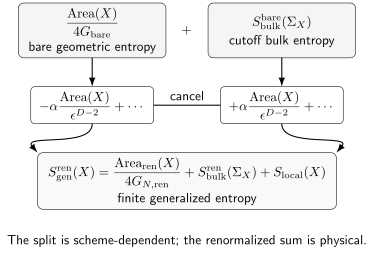
The area term and the bulk entanglement entropy are not separately regulator-independent. The UV divergences of are local on the cut and are absorbed into the renormalization of Newton’s constant and higher-curvature gravitational couplings. The invariant quantity is the full generalized entropy .
This point is not a technical nuisance; it is conceptually central. In quantum gravity the surface term and the bulk entropy term are parts of one object. If a statement depends on the separate value of “the area contribution” or “the matter entropy contribution,” it may be regulator-dependent. If it depends on , it has a chance to be physical.
Relation to black hole generalized entropy
Section titled “Relation to black hole generalized entropy”The same structure appeared earlier in black hole thermodynamics. For a black hole horizon, the generalized entropy is
The generalized second law says that this quantity should not decrease in physical processes:
FLM imports this logic into subregion duality. The RT surface is not necessarily an event horizon, but the entropy associated with cutting the bulk into two regions has the same structure: a gravitational surface entropy plus the entropy of quantum fields on one side.
This is why the modern island formula looks so natural in hindsight. The entropy of a radiation region is computed by a generalized entropy, not by matter entropy alone:
The island formula is not an unrelated trick. It is the same generalized-entropy principle applied to a situation where the relevant quantum extremal surface may surround an island inside a gravitating region.
Entanglement wedge meaning
Section titled “Entanglement wedge meaning”Classically, the RT/HRT surface defines an entanglement wedge . FLM says the entropy of depends on the quantum state of fields in that wedge:
This already suggests that the wedge is not merely a geometric region. It is a quantum subsystem, or more precisely a quantum operator algebra, encoded in the boundary region .
The next major step is JLMS, which relates boundary and bulk relative entropy:
FLM is one of the ingredients behind this equality. The area operator supplies the difference between boundary and bulk modular Hamiltonians, while the bulk entropy term makes the boundary entropy sensitive to the state inside the wedge. Later pages will explain how this becomes entanglement wedge reconstruction and holographic quantum error correction.
A precise but useful slogan
Section titled “A precise but useful slogan”A common slogan is:
Boundary entanglement entropy equals area plus bulk entanglement.
This is good, but incomplete. The more precise statement is:
In a large- holographic theory, the entropy of a boundary region is the generalized entropy of the corresponding bulk entangling surface, evaluated perturbatively; at FLM order this is the classical RT/HRT area plus the bulk entanglement entropy across that surface.
The difference matters. The first slogan can make it sound as if the area and bulk entropy are two separately physical pieces. The second statement emphasizes the perturbative expansion and the generalized entropy.
What FLM does and does not say
Section titled “What FLM does and does not say”FLM does say that order-one differences in the bulk quantum state affect boundary entanglement entropy. It turns RT/HRT from a purely classical area formula into the first term of a quantum gravitational entropy expansion.
FLM does say that the entanglement wedge carries the relevant bulk quantum degrees of freedom for the boundary region .
FLM does not by itself compute the Page curve of an evaporating black hole. For that, one needs quantum extremal surfaces and, in the gravitational replica derivation, replica wormholes.
FLM does not say that the bulk Hilbert space factorizes exactly across . Gauge constraints and gravitational dressing require an algebraic treatment.
FLM does not make a small correction in every possible theory. Its order depends on the number of light bulk species and on the large- scaling. The standard formula assumes the usual holographic hierarchy in which the number of light fields is not of order .
FLM does not mean that the RT surface is literally a membrane carrying all microscopic degrees of freedom. The area term is a gravitational entropy term. Its microscopic interpretation depends on the UV completion.
Common pitfalls
Section titled “Common pitfalls”Pitfall 1: “The bulk entropy term is optional.”
Section titled “Pitfall 1: “The bulk entropy term is optional.””It is not optional. Without , two states with the same classical geometry but different bulk entanglement would have the same boundary entropy through order , which is false.
Pitfall 2: “The area term and bulk entropy are separately well-defined.”
Section titled “Pitfall 2: “The area term and bulk entropy are separately well-defined.””In continuum effective field theory they are not. Their sum, with the correct local gravitational entropy terms, is the meaningful generalized entropy.
Pitfall 3: “FLM already extremizes generalized entropy.”
Section titled “Pitfall 3: “FLM already extremizes generalized entropy.””At FLM order, one evaluates on the classical RT/HRT surface. The shift of the surface is suppressed by . The all-orders conceptual upgrade is the QES prescription.
Pitfall 4: “Bulk entropy means entropy of particles visibly crossing the surface.”
Section titled “Pitfall 4: “Bulk entropy means entropy of particles visibly crossing the surface.””No. It is the von Neumann entropy of the bulk quantum state restricted to one side of the surface. It counts all correlations, including vacuum entanglement, not just identifiable particles.
Exercises
Section titled “Exercises”Exercise 1: Large- scaling
Section titled “Exercise 1: Large-NNN scaling”Assume and that the RT surface has area of order . Estimate the scaling of the RT term and the FLM bulk entropy term for a fixed number of light bulk fields.
Solution
The area term scales as
For a fixed number of light bulk fields, the bulk entanglement entropy is a one-loop effect in the bulk effective theory and scales as . Therefore FLM gives the first subleading correction to the classical RT/HRT entropy:
If the number of light species scaled like , this bookkeeping would break down and the backreaction of the quantum fields would have to be included differently.
Exercise 2: A Bell pair across the RT surface
Section titled “Exercise 2: A Bell pair across the RT surface”Consider a bulk Bell pair
Compute its contribution to if one qubit lies in and the other lies in . What if both qubits lie in ?
Solution
If one qubit lies on each side, tracing out leaves a maximally mixed state on the qubit in :
Therefore
If both qubits lie in , the Bell pair is entirely inside the subsystem. It is a pure state within and contributes no entropy across the cut:
The same is true if both qubits lie in .
Exercise 3: Why the surface shift is beyond FLM order
Section titled “Exercise 3: Why the surface shift is beyond FLM order”Let
Suppose extremizes and . Show parametrically that the surface displacement caused by extremizing is , and that its effect on the entropy is .
Solution
Expand around the classical extremal surface :
Since extremizes the area,
The generalized extremality equation is schematically
Since and is order one in classical units, this gives
The entropy shift from the area term is quadratic because the first variation vanishes:
The change in from moving the surface is also
Thus the displacement affects the entropy only at order , beyond the FLM correction.
Exercise 4: Renormalizing the leading divergence
Section titled “Exercise 4: Renormalizing the leading divergence”Suppose the regulated bulk entropy has the leading divergence
Show how this divergence can be absorbed into the renormalization of Newton’s constant.
Solution
The bare generalized entropy is
Combine the two area-proportional terms:
Define the renormalized Newton constant by
Then
In a complete treatment, subleading divergences similarly renormalize higher-curvature gravitational couplings and possible edge-mode/contact terms.
Exercise 5: Replica origin of the bulk entropy term
Section titled “Exercise 5: Replica origin of the bulk entropy term”In a saddle approximation, suppose
Explain why the entropy contains both an area term and a bulk entanglement term.
Solution
The replica formula computes
up to a conventional sign depending on whether one writes or . The classical gravitational action has a contribution from the conical defect or replica fixed point. Taking the derivative at gives the gravitational entropy term, which is for Einstein gravity.
The one-loop determinant is precisely the partition function of bulk quantum fields on the replicated geometry. Applying the same replica derivative to this determinant computes the entanglement entropy of those bulk fields across the fixed surface. Therefore the entropy takes the form
The ellipsis denotes higher-loop and higher-derivative contributions.
Further reading
Section titled “Further reading”- Thomas Faulkner, Aitor Lewkowycz, and Juan Maldacena, “Quantum corrections to holographic entanglement entropy,” arXiv:1307.2892.
- Aitor Lewkowycz and Juan Maldacena, “Generalized gravitational entropy,” arXiv:1304.4926.
- Leonard Susskind and John Uglum, “Black hole entropy in canonical quantum gravity and superstring theory,” arXiv:hep-th/9401070.
- Finn Larsen and Frank Wilczek, “Renormalization of black hole entropy and of the gravitational coupling constant,” arXiv:hep-th/9506066.
- Sergey N. Solodukhin, “Entanglement Entropy of Black Holes,” arXiv:1104.3712.
- Netta Engelhardt and Aron C. Wall, “Quantum Extremal Surfaces: Holographic Entanglement Entropy beyond the Classical Regime,” arXiv:1408.3203.
- Daniel Harlow, “The Ryu–Takayanagi Formula from Quantum Error Correction,” arXiv:1607.03901.
The next page upgrades FLM from a perturbative correction evaluated on the classical surface to the full quantum extremal surface prescription.