
Fermions and Spectral Functions
Bosonic fields already taught us how holography computes sources, expectation values, and retarded correlators. Fermions add a new layer. They let us ask whether a strongly coupled finite-density state has sharp fermionic excitations, Fermi surfaces, gaps, particle-hole asymmetry, or non-Fermi-liquid scaling.
The basic computation is conceptually familiar:
For fermions, the bulk equation is first order, the source/response split uses radial gamma-matrix projectors, and the answer is a matrix-valued retarded Green function.
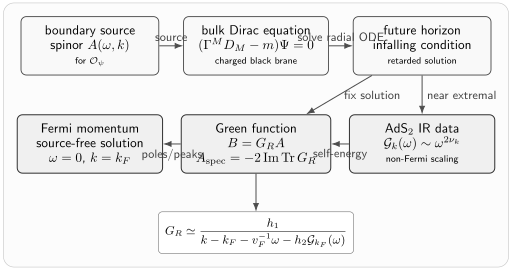
The holographic fermion workflow. A charged bulk spinor obeys a radial Dirac equation in the finite-density black-brane background. Infalling regularity fixes the solution in the IR, while the near-boundary source-response relation gives and the spectral function .
Why this matters
Section titled “Why this matters”Many finite-density systems are diagnosed by their fermionic spectral function. In weakly interacting condensed matter, poles of the electron Green function identify quasiparticles and Fermi surfaces. Strongly coupled systems can have much stranger behavior: broad continua, critical scaling, incoherent metals, pseudogaps, or sharp momenta without ordinary quasiparticles.
Holography provides a controlled large- way to compute fermionic response in such states. One studies a gauge-invariant fermionic operator in the boundary theory by introducing a charged spinor in the bulk.
The key object is the retarded Green function
The spectral function is the absorptive part:
up to convention-dependent factors. Peaks of reveal the energies and lifetimes of fermionic excitations.
The bulk Dirac action
Section titled “The bulk Dirac action”A standard probe fermion action is
where
Here is the bulk spinor mass, is its charge under the bulk gauge field, and is the same gauge field dual to the boundary current .
A useful extension adds a Pauli or dipole coupling,
which can strongly reshape spectral functions. We will first focus on the minimal Dirac problem.
Spinor dimensions and near-boundary data
Section titled “Spinor dimensions and near-boundary data”Near the AdS boundary, decompose the spinor using the radial gamma matrix:
For a spinor in AdS, the two independent asymptotic components behave schematically as
for standard quantization and . The dual operator dimension is
The coefficient is the source spinor and is the response spinor. The retarded Green function is a matrix relating them:
More carefully, there are gamma-matrix and boundary-term conventions. But the principle is exactly the same as for scalars: solve in the interior, expand near the boundary, and read off response over source.
For spinors with
an alternate quantization is possible in which the source and response roles are exchanged. This mirrors the scalar story, but the allowed mass window differs because the spinor equation is first order.
Dirac equation in a finite-density background
Section titled “Dirac equation in a finite-density background”Consider a translationally invariant charged black brane:
Use a Fourier ansatz
with momentum chosen along one spatial direction. The Dirac equation becomes a radial first-order system. Its local frequency is shifted by the electrostatic potential:
up to sign conventions. This shift is the bulk origin of finite-density fermionic response.
Near a non-extremal horizon, infalling behavior is
in Schwarzschild-like coordinates. Imposing this condition selects the retarded Green function.
Because the Dirac equation is first order, it is often convenient to evolve ratios of spinor components rather than the components themselves. In an appropriate gamma-matrix basis, the equation can be reduced to a flow equation for a matrix , where
The boundary Green function is then obtained as
up to a basis-dependent matrix factor and possible contact terms.
Spectral functions
Section titled “Spectral functions”The spectral function is
A sharp quasiparticle pole in a weakly coupled Fermi liquid has the schematic form
with near the Fermi surface.
Holographic finite-density states can instead produce sharp Fermi momenta with non-Fermi-liquid scaling. A Fermi momentum is identified by a pole or strong peak at
Equivalently, at and there is a nontrivial infalling bulk solution with vanishing boundary source. This is the fermionic analogue of a quasinormal-mode condition.
Emergent AdS and the IR Green function
Section titled “Emergent AdS2_22 and the IR Green function”In extremal RN-AdS backgrounds, the near-horizon region is
From the AdS point of view, the boundary spatial momentum is a parameter. It contributes to the effective mass of the AdS spinor. The IR scaling exponent is schematically
The corresponding IR Green function scales as
with a retarded phase fixed by the AdS infalling condition. Matching the AdS solution to the UV region gives a low-energy Green function near a Fermi momentum:
The constants , , , and depend on the UV region and must be computed from the full radial problem. The nonanalytic power of is controlled by the IR AdS throat.
Fermi-liquid-like and non-Fermi-liquid regimes
Section titled “Fermi-liquid-like and non-Fermi-liquid regimes”The exponent controls the low-frequency self-energy.
If
then the linear term dominates over at low frequency. The excitation can look relatively Fermi-liquid-like, although the full large- finite-density state is not necessarily an ordinary Landau Fermi liquid.
If
then the nonanalytic IR self-energy dominates. The excitation is a non-Fermi liquid: the width is not parametrically smaller than the energy in the ordinary quasiparticle sense.
If
one obtains marginal-Fermi-liquid-like behavior, with logarithmic structure in the low-energy Green function.
If becomes imaginary, the AdS region exhibits log-periodic behavior. This is often called an oscillatory region and usually indicates that the naive normal phase is trying to reorganize.
What is the boundary fermion?
Section titled “What is the boundary fermion?”The operator is a gauge-invariant fermionic operator of the boundary CFT. It need not be an elementary electron. In top-down examples, it may be a complicated single-trace fermionic operator. In bottom-up models, it is often treated as a phenomenological probe of fermionic spectral weight.
This is why holographic fermion spectral functions are powerful but must be interpreted carefully. A peak in shows that the strongly coupled theory has a fermionic excitation with momentum . It does not automatically mean one has derived a microscopic electron Green function of a real material.
Probe approximation and charge fractionalization
Section titled “Probe approximation and charge fractionalization”Most introductory calculations treat the Dirac field as a probe. This means the fermion diagnoses the state but does not source the background geometry.
At finite density, the background charge may be carried by the horizon, by charged bosonic hair, by explicit charged matter, or by a fermion fluid. Probe fermions can reveal sharp Fermi momenta even when the charge sourcing the geometry is not carried by those probe fermions. This is one reason holographic finite-density phases are often described as fractionalized: part of the charge is hidden behind the horizon from the point of view of gauge-invariant low-energy quasiparticles.
Backreacted fermion systems, such as electron stars or Dirac-hair black holes, are richer and more difficult. The probe calculation is the right first step because it isolates the Green-function dictionary.
Pauli couplings and zeros
Section titled “Pauli couplings and zeros”The minimal Dirac action is not the most general effective action. A commonly studied correction is a dipole or Pauli coupling:
Such terms can shift spectral weight, move Fermi momenta, and produce zeros of the Green function. Poles and zeros are both meaningful: poles indicate strong response to a source, while zeros indicate suppressed response.
The lesson is that holographic spectral functions are sensitive to bulk effective couplings. A bottom-up fermion model is not uniquely defined until the effective action, boundary conditions, and quantization are specified.
Fermions in a superconducting background
Section titled “Fermions in a superconducting background”One can also study probe fermions in the condensed background of the previous page. If the bulk action contains a gauge-invariant Yukawa or Majorana-like coupling between the scalar and the fermion, the condensate can open a gap in the fermionic spectral function.
A schematic interaction is
where is the charged scalar. Gauge invariance requires the charges to match. This setup gives a holographic analogue of pairing: the condensate mixes particle and hole sectors and can gap the Fermi surface.
The analogy is structural. It does not mean the minimal model has derived a BCS pairing mechanism.
Numerical workflow
Section titled “Numerical workflow”A practical spectral-function computation usually follows this route:
-
choose a charged black-brane background;
-
choose bulk spinor parameters , , and possible Pauli couplings;
-
fix gamma matrices and projectors;
-
solve the radial Dirac equation with infalling horizon behavior;
-
extract the response/source matrix at the boundary;
-
compute
-
scan over to find peaks, poles, gaps, or zeros.
Because the Dirac equation is first order, this is often numerically simpler than solving coupled gravitational perturbation equations. The interpretation, however, is subtle.
Dictionary checkpoint
Section titled “Dictionary checkpoint”| Boundary object | Bulk object |
|---|---|
| fermionic operator | bulk Dirac field |
| source spinor | leading radial spinor component |
| response spinor | subleading radial spinor component |
| retarded fermion Green function | response/source matrix with infalling horizon condition |
| spectral function | imaginary part of boundary Green function |
| Fermi momentum | source-free infalling solution at |
| non-Fermi self-energy | AdS IR Green function |
| gap from condensate | fermion mixing in a hairy background |
Common confusions
Section titled “Common confusions”“The bulk fermion is an electron.”
Section titled ““The bulk fermion is an electron.””Not generally. It is dual to a gauge-invariant fermionic operator. In a phenomenological model, one may interpret this operator as electron-like, but that is an additional modeling assumption.
“Every sharp peak is a stable quasiparticle.”
Section titled ““Every sharp peak is a stable quasiparticle.””No. A peak can indicate strong spectral weight, but the width and scaling determine whether the excitation is long-lived. Holographic non-Fermi liquids often have sharp Fermi momenta without ordinary Landau quasiparticles.
“The horizon itself is the Fermi surface.”
Section titled ““The horizon itself is the Fermi surface.””No. A charged horizon represents deconfined or fractionalized charge in the large- state. Probe-fermion Fermi surfaces are diagnosed by poles of fermionic Green functions.
“The exponent is a UV scaling dimension.”
Section titled ““The exponent νk\nu_kνk is a UV scaling dimension.””No. It is an infrared scaling exponent associated with the emergent AdS region. The UV operator dimension is controlled by the asymptotic AdS mass .
“The spectral function alone identifies the full phase.”
Section titled ““The spectral function alone identifies the full phase.””No. Spectral functions are diagnostic probes. To identify a phase, one also needs thermodynamics, symmetry realization, charge distribution, transport, and stability.
Exercises
Section titled “Exercises”Exercise 1: Spinor dimension
Section titled “Exercise 1: Spinor dimension”For a Dirac field in AdS with , what is the standard-quantization dimension of the dual fermionic operator?
Solution
In standard quantization,
Therefore
For example, in a boundary theory,
Exercise 2: Why infalling boundary conditions?
Section titled “Exercise 2: Why infalling boundary conditions?”Why do infalling horizon boundary conditions compute the retarded Green function?
Solution
A retarded response describes a disturbance sourced at the boundary whose effect propagates into the system with causal boundary conditions. In the bulk, the black-hole horizon absorbs perturbations. The infalling condition says that near the future horizon the wave travels into the horizon rather than emerging from it. The outgoing condition would correspond to advanced or non-causal response. Thus the infalling solution is the Lorentzian bulk implementation of retarded boundary conditions.
Exercise 3: Fermi momentum as a normal mode
Section titled “Exercise 3: Fermi momentum as a normal mode”Explain why a Fermi momentum can be identified by a source-free infalling solution at .
Solution
The retarded Green function is a response/source ratio. A pole occurs when the response remains nonzero while the source coefficient vanishes. This is the same logic as a normal mode or quasinormal mode: one has a nontrivial solution satisfying the interior condition and no external source at the boundary. If such a pole occurs at and , the spectral function has low-energy fermionic weight at a definite momentum. This is interpreted as a holographic Fermi surface.
Exercise 4: AdS scaling
Section titled “Exercise 4: AdS2_22 scaling”Suppose
and
Why does lead to non-Fermi-liquid behavior?
Solution
If , then . As , the term decays more slowly than the linear term . Thus the nonanalytic IR self-energy dominates the denominator. The excitation width is not parametrically smaller than its energy in the ordinary Landau-quasiparticle way, giving non-Fermi-liquid behavior.
Further reading
Section titled “Further reading”- N. Iqbal and H. Liu, Real-time response in AdS/CFT with application to spinors.
- H. Liu, J. McGreevy, and D. Vegh, Non-Fermi liquids from holography.
- T. Faulkner, H. Liu, J. McGreevy, and D. Vegh, Emergent quantum criticality, Fermi surfaces, and AdS.
- T. Faulkner, N. Iqbal, H. Liu, J. McGreevy, and D. Vegh, From black holes to strange metals.
- M. Cubrovic, J. Zaanen, and K. Schalm, String Theory, Quantum Phase Transitions and the Emergent Fermi Liquid.
- H. Liu, Lectures on holographic non-Fermi liquids and quantum phase transitions.