
Black Hole Interior and State Dependence
Guiding question. What does it mean to reconstruct an operator behind a black-hole horizon, and when is “state dependence” a harmless feature of effective reconstruction rather than a failure of quantum mechanics?
The exterior of an AdS black hole is already subtle, but it is a relatively familiar kind of subtlety. Outside the horizon, local bulk fields can be reconstructed by HKLL-type methods, by entanglement wedge reconstruction, or by ordinary boundary time evolution. The black-hole interior is worse. A point behind the horizon is not in the causal wedge of a single exterior boundary time band, and in a one-sided black hole there is no manifest second CFT whose operators obviously represent the other side of the horizon.
The question is not whether the exact boundary theory evolves unitarily. In AdS/CFT it does. The question is how a semiclassical observer falling through the horizon is represented in exact boundary variables. In effective field theory, a smooth horizon requires interior partner modes entangled with exterior Hawking modes. In the exact theory, those partners cannot be assigned in a naive state-independent way across the entire Hilbert space without running into the same monogamy, counting, and typical-state tensions that motivated the firewall paradox.
The modern answer is not one slogan. It is a hierarchy of statements:
Sometimes this dependence is completely benign: different boundary representatives of the same logical bulk operator are normal in quantum error correction. Sometimes it is sharper and more controversial: Papadodimas–Raju mirror operators are defined relative to a reference black-hole state and a small algebra of simple probes. In the island era, post-Page interior operators can have radiation representatives because the island lies in the entanglement wedge of the radiation. And in more recent discussions, late-time interiors may be described by non-isometric or complexity-protected codes rather than ordinary exact subspace codes.
The purpose of this page is to sort these ideas carefully. The dangerous mistake is to treat “state dependence” as one thing. It is not. A code-subspace-dependent reconstruction map is not the same as nonlinear time evolution. A mirror operator defined only on simple excitations around is not the same as a universal observable acting on all black-hole microstates. And the claim that the radiation can reconstruct an island is not the claim that an infalling observer sees duplicate local copies of the same degree of freedom.
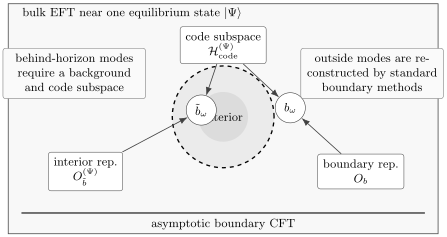
Exterior modes can often be reconstructed using standard boundary methods. Interior partner modes require a representative tied to a background, a gravitational dressing, and a code subspace. The same exact CFT Hilbert space can support many semiclassical charts.
1. The interior operator problem
Section titled “1. The interior operator problem”Near a nonextremal horizon, semiclassical effective field theory is locally Rindler-like. For a single frequency mode, one can distinguish an exterior mode and an interior partner mode . A smooth infalling vacuum is not the state annihilated by and separately. Rather, it is approximately a two-mode squeezed state.
A convenient way to encode smoothness is through the infalling annihilation operator
with the smoothness condition
Equivalently,
This relation says that the interior partner is not independent of the exterior mode when acting on the equilibrium state. It is exactly the kind of relation one expects from the Unruh vacuum or the thermofield double: the smooth horizon is built from entanglement between the two Rindler wedges.
For the eternal two-sided black hole, this is relatively transparent. A right exterior mode can have its partner represented by a left CFT operator. In the thermofield double,
left and right operators are related by KMS-like identities. Schematically,
up to the antiunitary identification between the two Hilbert spaces. The second exterior supplies operators that look like the partner modes of the first exterior.
For a one-sided black hole, especially a typical high-energy pure microstate, there is no literal second boundary. Nevertheless, an infalling observer expects to see a smooth horizon. The problem is therefore:
The word “representing” is crucial. We are not looking for a new fundamental Hilbert space behind the horizon. We are looking for an exact-boundary representation of a semiclassical effective operator. As in ordinary bulk reconstruction, equality only needs to hold within a code subspace and to some order in the and semiclassical expansions.
2. Why a universal interior dictionary is too much to ask
Section titled “2. Why a universal interior dictionary is too much to ask”Suppose one asks for an exact, state-independent CFT operator representing the interior partner for every black-hole microstate in a large energy band. This is an attractive wish, but it asks for more than semiclassical gravity itself promises.
There are several obstructions.
First, the interior is not an ordinary subregion of a fixed global Hilbert-space tensor factor. In gauge theory and gravity, local subregions do not factorize naively because of constraints and edge modes. In gravity, the situation is sharper because asymptotic charges are measured at infinity. Any exactly diffeomorphism-invariant local operator must be gravitationally dressed, and the dressing is part of the observable.
Second, the horizon smoothness condition is state-sensitive. The relation
is a statement about a particular state, or about a small ensemble of states with the same semiclassical geometry. It is not an operator identity on the entire Hilbert space. If it were an exact global identity, one could apply it to arbitrary superpositions and highly excited states where the original semiclassical horizon chart is not valid.
Third, the number of apparent semiclassical interior states can exceed what a finite-entropy black hole can encode as independent exact states. A black hole with entropy has roughly independent microstates in a fixed energy band. Semiclassical effective field theory behind the horizon, if extrapolated too freely and for too long, appears to contain many more configurations. That cannot be a globally isometric embedding into the exact black-hole Hilbert space.
Fourth, the AMPS and typical-state arguments show that interior partners cannot be assigned independently of the degrees of freedom that purify the exterior Hawking modes. Before the Page time, the purifier is naturally inside the black hole. After the Page time, the purifier of a late outgoing mode is partly in the early radiation. A state-independent interior operator that ignores this change would be trying to keep two incompatible entanglement patterns at once.
The lesson is not that the interior is fake. The lesson is that a semiclassical interior is an emergent description with a domain of validity. Its operators need only be defined on the states and measurements for which that description is valid.
3. Code subspaces: the safe form of dependence
Section titled “3. Code subspaces: the safe form of dependence”The cleanest way to say this is through code subspaces. Let be the exact boundary Hilbert space and a small subspace of states that admit one semiclassical bulk description. The bulk-to-boundary map is an encoding
A logical bulk operator is represented by a boundary operator if
This equation does not define uniquely outside the image of the code subspace. It is also not required to work for states that differ by large backreaction, different topology, or exponentially complicated excitations. This is normal. In QEC, a logical Pauli operator can have many physical representatives. Those representatives agree on the code subspace but differ outside it.
Thus the mild statement
is not a violation of quantum mechanics. It is the usual statement that the effective dictionary depends on which effective theory one is using.
The same phenomenon already appeared in earlier pages. An operator in an entanglement wedge of can be reconstructed on . If the same bulk operator also lies in the entanglement wedge of a different boundary region , it can have another representation on . The two boundary operators need not be the same microscopic operator. They need only have the same action on the code subspace.
For interiors, the code subspace must be chosen more carefully. A small algebra of simple exterior operators may preserve the black-hole background, while arbitrary products of exponentially many operators do not. The correct interior reconstruction map may be valid for simple infalling experiments but not for arbitrary microscopic protocols.
4. Papadodimas–Raju mirror operators
Section titled “4. Papadodimas–Raju mirror operators”One influential proposal by Papadodimas and Raju constructs interior operators for a one-sided black hole using a reference state and a small algebra of simple exterior operators. The small algebra is generated by low-dimension single-trace operators and their products, with a cutoff chosen so that acting with does not drastically change the black-hole background.
The associated code subspace is
For an exterior mode , the mirror operator is defined by its action on this subspace. Schematically,
It also satisfies, on the code subspace,
and
The minus sign in the energy commutator is one of the signatures that behaves like the interior partner of a positive-frequency exterior mode. Together with the thermal factor , these equations reproduce the local smooth-horizon correlations expected from effective field theory.
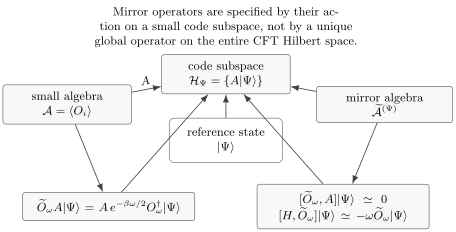
In the Papadodimas–Raju construction, the mirror operator is specified by its action on the code subspace generated by a small algebra acting on a reference state . It is not a unique microscopic operator on the entire CFT Hilbert space.
The idea is closely related to Tomita–Takesaki theory. Given a state and an algebra, modular conjugation naturally produces a commutant-like algebra. In finite-dimensional terms, if is cyclic and separating for , there is an anti-linear map that relates to . The mirror construction uses this kind of state-and-algebra pair to produce operators that commute with the simple exterior algebra inside correlators.
This proposal is powerful because it directly targets the one-sided black-hole interior. It is also controversial because the map depends on . A critic worries that state-dependent operators might conflict with linearity: if and have different interiors, what should the operator be on ? The PR answer is that the semiclassical interior operator is not a globally defined observable; it is an effective operator in the code subspace associated with the relevant state. Whether this is fully satisfactory depends on the class of states and experiments under discussion.
The clean way to use mirror operators is therefore modest:
They should not be treated as a universal exact dictionary for all black-hole microstates.
5. Three meanings of state dependence
Section titled “5. Three meanings of state dependence”The literature uses the phrase state dependence in several inequivalent ways. Keeping them separate prevents many fake paradoxes.
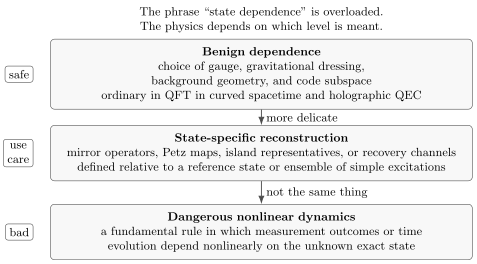
Not all state dependence is equally problematic. Dependence on gauge, dressing, background, or code subspace is part of effective reconstruction. A fundamental nonlinear rule for time evolution or measurement would be a different and much more dangerous claim.
5.1 Background and dressing dependence
Section titled “5.1 Background and dressing dependence”Even in perturbative quantum gravity, a local bulk operator must be gravitationally dressed. The choice of dressing can run to the boundary, to a nearby massive object, or to some relational feature of the state. Changing the dressing changes the boundary representation. This is not a pathology; it is how diffeomorphism-invariant observables work.
Similarly, a field called depends on a coordinate chart, a background metric, and a perturbative expansion. If the state changes enough to alter the geometry, the symbol no longer labels the same physical point. That kind of dependence is ordinary.
5.2 Code-subspace dependence
Section titled “5.2 Code-subspace dependence”A stronger but still healthy form is code-subspace dependence. A bulk operator can have one boundary representative in one code subspace and another representative in another code subspace. This is common in holographic QEC.
A simple analogy is a quantum error-correcting code. The logical operator may be represented by or by depending on which erasure is being corrected. These are different physical operators, but they agree on the code subspace. No one would call this nonlinear quantum mechanics.
5.3 State-specific interior maps
Section titled “5.3 State-specific interior maps”Mirror operators and some island reconstruction maps are more state-specific. The recovery channel or mirror algebra may be built using a reference density matrix, a modular operator, or a chosen equilibrium state. This is more delicate because it is not merely a choice of boundary region; it is tied to the state whose interior is being described.
The safe interpretation is operational: simple observers who remain within the code subspace cannot distinguish the state-specific reconstruction from ordinary interior effective field theory. Exponentially precise or exponentially complex probes may lie outside the domain of the reconstruction.
5.4 Dangerous nonlinear dynamics
Section titled “5.4 Dangerous nonlinear dynamics”The dangerous version would be a fundamental rule saying that the outcome of a measurement or the time evolution of a system depends nonlinearly on the unknown exact quantum state. That would generically violate the Born rule and produce inconsistencies with ordinary quantum mechanics.
The modern QEC/island interpretation does not require such a rule. The exact boundary or radiation system evolves linearly. What depends on the state is the effective map from semiclassical interior variables to exact operators, just as a coordinate chart or recovery map can depend on the background.
6. The two-sided case: state dependence can hide in plain sight
Section titled “6. The two-sided case: state dependence can hide in plain sight”In the eternal black hole, one might think there is no state-dependence problem because the left CFT supplies the interior partner of the right exterior. But even here, the smooth interior depends on the special entangled state.
For the thermofield double, the two-sided geometry is smooth. But if we act on one side with a sufficiently complicated unitary,
the reduced density matrix on the right remains thermal if acts only on the left. The entropy is unchanged. But two-sided correlators and the geometric interpretation of the bridge can change dramatically. The right exterior alone cannot tell us whether the other side is arranged into a smooth semiclassical partner.
This is a useful warning: the exterior density matrix does not uniquely determine the interior geometry. Interior reconstruction depends on the purification, the correlations, and the allowed code subspace. Entanglement entropy is not enough.
This observation is also relevant to ER=EPR. A special entangled state such as the TFD has a smooth two-sided geometry. A generic entangled state with the same entropy need not have a nice wormhole. Smoothness is a refined property of the state, not just a count of Bell pairs.
7. Post-Page interiors and islands
Section titled “7. Post-Page interiors and islands”The island formula changes the discussion after the Page time. For an evaporating black hole coupled to a bath, the radiation entropy is computed by
After the Page time, the dominant saddle often has a nonempty island. The interpretation is entanglement wedge reconstruction:
Therefore some operators in the island, including operators that look like part of the black-hole interior in semiclassical gravity, can be reconstructed from the radiation system .
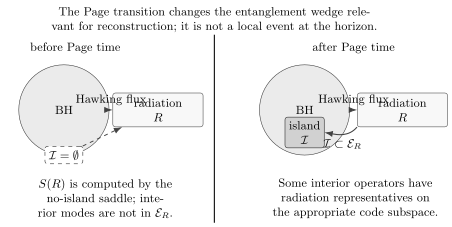
Before the Page time, the radiation region usually has no island. After the Page time, the island saddle can dominate, and some interior operators lie in the entanglement wedge of the radiation. This is a reconstruction statement, not a local signal from the island to the bath.
This sounds state-dependent because the reconstruction changes at the Page transition. But the correct statement is again code-subspace-dependent. Around a semiclassical background with a particular QES saddle, the entanglement wedge determines which algebra can be reconstructed from which exact degrees of freedom. If the dominant QES changes, the effective reconstruction map changes.
Does this mean the interior is duplicated, once in the black hole and once in the radiation? No. In QEC, the same logical operator can have multiple physical representatives. The representatives agree on the code subspace and are not independent degrees of freedom. The island is not a second local copy; it is part of the logical algebra encoded in the radiation.
This also clarifies why the island formula is related to, but not identical with, the Papadodimas–Raju construction. Both involve interior operators represented in surprising exact variables. But island reconstruction is tied to the entanglement wedge of an explicitly chosen region , while PR mirror operators are built from a state and a small algebra in a one-sided CFT. The conceptual overlap is real, but the technical frameworks differ.
8. What does an infalling observer actually measure?
Section titled “8. What does an infalling observer actually measure?”A semiclassical infalling observer performs simple, low-energy measurements over a proper time that is small compared with the enormous timescales associated with decoding Hawking radiation. Such an observer is not implementing an arbitrary unitary on black-hole microstates.
This operational restriction matters. The interior effective theory only needs to reproduce correlators of simple observables such as
for modest , modest energies, and states in the code subspace. It need not define a consistent local quantum field theory for arbitrary exponentially complicated observables.
A useful way to say this is:
It is not the claim that there exists an exact tensor factor independent of the exterior, the radiation, the state, and the gravitational constraints.
This is also why complexity enters black-hole interior physics. Harlow–Hayden-type arguments suggest that decoding the early radiation to perform an AMPS experiment can require time exponential in . More recent non-isometric-code models sharpen the idea: the semiclassical interior may be protected from contradictions by the computational difficulty of accessing the operations that would reveal the overcounting of effective interior states.
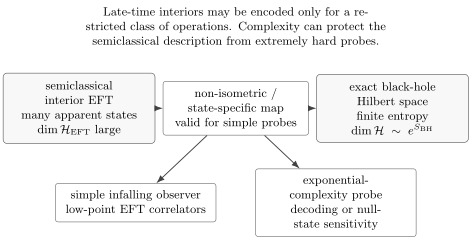
Late-time semiclassical interior EFT can have more apparent states than the exact finite-entropy black hole can encode isometrically. A non-isometric or state-specific map can still reproduce simple infalling observations, while exponentially complex probes may expose the limitations of the effective description.
9. A finite-dimensional analogy
Section titled “9. A finite-dimensional analogy”Consider a code subspace embedded into a larger physical Hilbert space. Let be a logical operator. There may exist two different physical operators and such that
but
This is not a contradiction. It only means the physical representatives are equivalent modulo operators that annihilate the code subspace.
For black-hole interiors, the code subspace itself may be centered on a reference state:
A mirror operator and another mirror operator may both be valid, but on different subspaces. Trouble arises only if we demand that one exact operator act as the correct interior partner for all possible black-hole states, including states outside any common semiclassical chart.
This is the same moral as coordinate patches in differential geometry. A manifold can be perfectly well-defined even though no single coordinate chart covers it without singularities. The interior dictionary may require multiple overlapping reconstruction charts.
10. The Marolf–Polchinski typical-state challenge
Section titled “10. The Marolf–Polchinski typical-state challenge”Marolf and Polchinski sharpened the concern that typical black-hole microstates in AdS/CFT may not have smooth horizons. Roughly, if one uses the boundary Hamiltonian and exterior mode operators to define number operators for infalling modes, typical energy eigenstates appear highly excited rather than vacuum-like. This gives a version of the firewall worry that does not rely directly on a distant radiation system.
The lesson one draws depends on how one treats the interior operator. If the interior number operator is assumed to be a fixed state-independent CFT operator on a huge Hilbert space of microstates, the typical-state argument is powerful. If the interior operator is instead defined only within a state-dependent or code-subspace-dependent reconstruction, the argument no longer applies in the same way, because the operator whose expectation value is measured is not fixed across all those microstates.
This is not a free pass. A successful interior proposal must explain which states have smooth interiors, which do not, how the code subspaces overlap, and why no operational contradiction with linear quantum mechanics appears. But it changes the target: the relevant question is not whether one global interior operator exists; it is whether a consistent collection of effective interior reconstructions exists for the states and experiments semiclassical gravity claims to describe.
11. How to talk about state dependence without confusion
Section titled “11. How to talk about state dependence without confusion”Here is a reliable vocabulary.
Good phrasing
Section titled “Good phrasing”Interior operators are effective logical operators defined on a code subspace. Their boundary representatives may depend on the background state, the chosen algebra of simple probes, the gravitational dressing, and the entanglement wedge.
A post-Page island means that some interior logical operators have radiation representatives. This is a QEC statement about encoded algebras, not a local duplication of degrees of freedom.
Smoothness is an operational claim. It says that simple infalling measurements see the Unruh-like vacuum correlations expected from effective field theory.
Risky phrasing
Section titled “Risky phrasing”The interior operator is state-dependent. This is too vague. It could mean benign code-subspace dependence or a dangerous nonlinear rule.
The radiation contains a copy of the interior. This sounds like cloning. Better: the radiation can reconstruct the island algebra on an appropriate code subspace.
The horizon becomes special at the Page time. The Page transition is a change in the dominant entropy saddle and reconstruction wedge, not a local shock experienced by an infaller.
Bad phrasing
Section titled “Bad phrasing”Quantum mechanics becomes nonlinear behind the horizon. That is not what QEC, islands, or mirror operators require.
Every black-hole microstate has the same smooth interior operator. This is stronger than semiclassical gravity and is not supported by the modern reconstruction picture.
12. Summary
Section titled “12. Summary”The black-hole interior is where holography is least like an ordinary local field theory. The exact theory is unitary and lives at the boundary, but the smooth interior is an emergent, state-sensitive, code-subspace-dependent description.
The main points are:
- A smooth horizon requires interior partner modes with thermal two-mode correlations.
- In a one-sided black hole, those partner modes are not obviously represented by a second boundary system.
- A universal state-independent interior operator on the entire black-hole Hilbert space is too strong and conflicts with several information-theoretic and typical-state arguments.
- Code-subspace dependence is normal in holographic QEC.
- Papadodimas–Raju mirror operators define interior representatives using a reference state and a small algebra.
- After the Page time, islands imply that some interior operators can be reconstructed from radiation.
- None of this requires nonlinear fundamental dynamics, but it does require humility about the domain of validity of semiclassical interior EFT.
The next pages will connect these ideas to holographic complexity. One reason complexity matters is that information is encoded'' and information is efficiently accessible” are very different statements. The interior may be present in the exact state while being protected from simple observers by entanglement-wedge structure, code-subspace restrictions, and computational complexity.
Exercises
Section titled “Exercises”Exercise 1: Thermal partner relation in the TFD
Section titled “Exercise 1: Thermal partner relation in the TFD”Let
Assume an operator has matrix elements . Show that acting with a left operator on the TFD can be rewritten as acting with a right operator with a thermal imaginary-time shift. Explain why this is the two-sided ancestor of mirror-operator relations.
Solution
Acting on the left gives
Relabeling the pair of indices shows that this can be represented by an operator acting on the right with transposed matrix elements and a relative thermal factor. More explicitly, the right operator whose matrix elements are weighted by
reproduces the same vector. This is often written schematically as
up to the antiunitary identification between the two CFT copies. The important point is that the partner operator is defined through its action on a particular entangled state. This is the clean two-sided version of the mirror-operator idea.
Exercise 2: Mirror operators on a code subspace
Section titled “Exercise 2: Mirror operators on a code subspace”Let , where is a small algebra. Suppose a mirror operator is defined by
for all , where is some operator. Show that for all . Why does this not imply that as an exact operator identity on the full Hilbert space?
Solution
Taking and using the definition with the identity operator gives
Using the definition with gives
Therefore
The equality was only proven on vectors of the form inside the code subspace. Operators that agree on can differ on states orthogonal to . Thus this is a code-subspace relation, not a global operator identity.
Exercise 3: Code-subspace dependence is not nonlinear dynamics
Section titled “Exercise 3: Code-subspace dependence is not nonlinear dynamics”In a quantum error-correcting code, the same logical operator may have two physical representatives and satisfying
for all . Explain why the existence of multiple representatives does not violate linearity.
Solution
Linearity concerns the action of a fixed physical operator on superpositions. If represents on the code subspace, then for any superposition
inside the code subspace,
The same is true for . The operators may differ outside the code subspace, but the code does not claim they represent there. Multiple representatives are therefore compatible with ordinary linear quantum mechanics.
Exercise 4: Islands and no cloning
Section titled “Exercise 4: Islands and no cloning”After the Page time, suppose an island lies in the entanglement wedge of the radiation . Explain why saying that an interior operator can be reconstructed on does not mean that there are two independent copies of that operator.
Solution
Entanglement wedge reconstruction says that the logical algebra associated with the island has a representative acting on within an appropriate code subspace. Another representative may exist using different degrees of freedom in another reconstruction frame. These representatives are not independent operators acting on independent tensor factors; they are different physical realizations of the same logical operator. They agree on the code subspace. This is the same mechanism by which ordinary QEC avoids no-cloning: redundant representations do not create independent copies of the logical information.
Exercise 5: Smoothness as a limited statement
Section titled “Exercise 5: Smoothness as a limited statement”Why is the statement
not enough to define a global interior effective field theory for all black-hole microstates?
Solution
The condition is a relation involving a particular state and a particular choice of exterior and interior mode operators. It characterizes the local vacuum correlations near the horizon for that semiclassical background. It does not specify how the same should act on arbitrary states far outside the code subspace, on superpositions of macroscopically different geometries, or on states produced by exponentially complex operations. A global interior EFT would require a consistent assignment of all interior operators on a much larger Hilbert space. The smoothness condition supplies the local code-subspace data, not the global dictionary.
Further reading
Section titled “Further reading”- Kyriakos Papadodimas and Suvrat Raju, The Black Hole Interior in AdS/CFT and the Information Paradox.
- Kyriakos Papadodimas and Suvrat Raju, State-Dependent Bulk-Boundary Maps and Black Hole Complementarity.
- Daniel Harlow, Aspects of the Papadodimas–Raju Proposal for the Black Hole Interior.
- Donald Marolf and Joseph Polchinski, Gauge/Gravity Duality and the Black Hole Interior.
- Ahmed Almheiri, Xi Dong, and Daniel Harlow, Bulk Locality and Quantum Error Correction in AdS/CFT.
- Geoff Penington, Stephen H. Shenker, Douglas Stanford, and Zhenbin Yang, Replica Wormholes and the Black Hole Interior.
- Chris Akers, Netta Engelhardt, Daniel Harlow, Geoff Penington, and Shreya Vardhan, The Black Hole Interior from Non-Isometric Codes and Complexity.