
Ryu–Takayanagi formula
The Ryu–Takayanagi formula is one of the most important entries in the AdS/CFT dictionary. It says that, in a classical static holographic bulk, the entanglement entropy of a boundary region is computed by the area of a minimal surface in the bulk.
For a boundary spatial region , the formula is
where is a codimension-two bulk surface satisfying
and a homology condition explained below.
This formula is astonishing because the left-hand side is a quantum-information quantity in a non-gravitational QFT, while the right-hand side is a geometric area in a higher-dimensional gravitational spacetime.
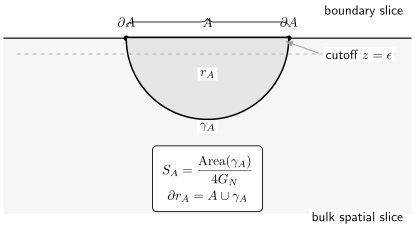
The RT surface is anchored on and homologous to . In a static classical bulk, .
The statement
Section titled “The statement”Assume the bulk geometry is static and asymptotically AdS. Choose a constant-time slice of the boundary and a spatial region on that slice. The RT surface is the minimal-area bulk codimension-two surface such that
More precisely, must also be homologous to : there must exist a bulk spatial region such that
with orientations understood. Then the leading large- entanglement entropy is
The formula is valid at the leading classical-gravity order. Quantum corrections will modify it to include bulk entanglement across the surface; time-dependent states require the covariant HRT generalization.
A compact summary is:
for holographic theories in the correct large-, large-gap regime.
Why the surface has codimension two
Section titled “Why the surface has codimension two”In a -dimensional boundary QFT, the region is spatial, so it has dimension . Its boundary has dimension .
The bulk spacetime has dimension . A constant-time bulk slice has dimension . The RT surface lies inside that bulk spatial slice and is anchored on , so it has dimension ? Careful: the RT surface is codimension two in spacetime, hence dimension
On a constant-time slice, it is codimension one. This is why in AdS/CFT the RT surface is a geodesic: the bulk spacetime is three-dimensional, and a codimension-two surface is one-dimensional.
The dimension matches the Bekenstein–Hawking area law. A black-hole horizon is also a codimension-two surface, and its entropy is
The RT formula generalizes this area-entropy relation from horizons to entangling surfaces.
Why the homology condition matters
Section titled “Why the homology condition matters”The condition is not enough. The RT surface must be homologous to . That is, and should together bound a bulk region .
This condition has several important consequences.
First, for a pure state on the whole boundary, it ensures
The same bulk surface can be viewed as homologous to or to .
Second, in black-hole geometries, the homology condition can force the RT surface for a large region to include or avoid horizon pieces in a precise way. This is how ordinary thermal entropy enters entanglement entropy.
Third, the homology region is the first appearance of what later becomes the entanglement wedge. In classical static situations, the entanglement wedge is the domain of dependence of .
The simplest example: an interval in AdS/CFT
Section titled “The simplest example: an interval in AdS3_33/CFT2_22”Consider the vacuum of a two-dimensional holographic CFT on the line. The dual bulk is Poincaré AdS:
Take a boundary interval
at . The RT surface is a spacelike geodesic in the hyperbolic plane,
By symmetry, the geodesic is a semicircle:
Regulate the boundary by cutting off the geometry at . Parametrize the semicircle by
Then
The cutoff corresponds to . The geodesic length is
Therefore
Using the Brown–Henneaux central charge
we obtain
which is exactly the CFT vacuum interval result.
This example is the canonical first check of the RT formula.
UV divergences from near-boundary area
Section titled “UV divergences from near-boundary area”The RT surface approaches the AdS boundary near . This automatically produces a divergent area.
Near the boundary, the bulk metric locally looks like
For a smooth entangling surface, the RT surface is approximately a vertical extension of close to . Its area therefore contains
For ,
Thus
This is exactly the QFT area law. The coefficient is cutoff dependent, just as on the boundary.
The near-boundary divergence is not an embarrassment. It is the holographic image of short-distance entanglement.
Strip regions in higher dimensions
Section titled “Strip regions in higher dimensions”A useful higher-dimensional example is an infinite strip in the vacuum of a -dimensional CFT:
Work in Euclidean-signature or constant-time Poincaré AdS:
Let the RT surface be described by and extend along the transverse directions. If is the regulated transverse volume, the area functional is
Since the integrand does not depend explicitly on , there is a conserved quantity. At the turning point where , one obtains
This gives
The area has the structure
where is a positive dimension-dependent constant. The first term is the area-law divergence. The second term is finite and controlled by conformal invariance.
Ball-shaped regions
Section titled “Ball-shaped regions”For a ball of radius in the vacuum of a CFT, the RT surface in Poincaré AdS is a hemisphere:
This example is special because the boundary reduced density matrix is conformally related to a thermal state on hyperbolic space. In the bulk, the same geometry can be described as a hyperbolic black hole whose horizon area computes the entropy.
This relation is the cleanest geometric bridge between three ideas:
It also plays a central role in derivations of the RT formula and in later arguments connecting entanglement to Einstein’s equations.
The replica argument in one page
Section titled “The replica argument in one page”The RT formula was originally proposed as a conjecture and later understood through the gravitational replica method.
On the boundary, the Rényi entropies are computed from
where is the path integral on an -fold branched cover. In holography, at large ,
where is the Euclidean action of a bulk saddle whose boundary is the replicated geometry.
The entanglement entropy is
up to the conventional sign inherited from . In the limit, the replicated geometry has a codimension-two fixed locus. Regularity of the bulk saddle enforces extremality of this locus, and differentiating the action with respect to the replica opening angle produces
This is the same mechanism that gives black-hole entropy from a conical defect. The RT surface is a generalized entropy surface, not an arbitrary geometric ornament.
Minimal versus extremal
Section titled “Minimal versus extremal”In a static spacetime with a time-reflection-symmetric slice, the RT surface is a minimal-area surface within that slice.
In time-dependent Lorentzian spacetimes, there may be no preferred static slice. The correct generalization is the Hubeny–Rangamani–Takayanagi prescription: use a codimension-two extremal surface in the full Lorentzian spacetime, again anchored on and satisfying a homology condition.
This course treats RT first because it is easier to visualize and compute. The covariant HRT formula appears later.
RT and black holes
Section titled “RT and black holes”In a thermal state dual to a black brane, the RT surface for a small boundary region stays near the boundary. It mostly measures vacuum-like UV entanglement.
For a large region, the surface dips deep into the bulk and can run close to the horizon. In that limit, part of the area becomes approximately
so
This reproduces the expected extensive thermal entropy.
For global AdS black holes, competing surfaces can lead to entanglement plateaus and phase transitions. These are geometric versions of large- changes in the dominant saddle for entanglement entropy.
Strong subadditivity from geometry
Section titled “Strong subadditivity from geometry”The RT formula gives a beautiful geometric proof of strong subadditivity. The idea is that minimal surfaces for unions of regions can be cut and re-glued into candidate surfaces for other unions. Since the actual RT surface is minimal among candidates, one obtains inequalities such as
This is not merely a consistency check. It shows that the area prescription knows about a fundamental theorem of quantum information.
Holographic entropy actually satisfies additional inequalities beyond those obeyed by arbitrary quantum states. These extra constraints reflect the special large- geometric structure of holographic states.
What RT does not say
Section titled “What RT does not say”The RT formula is powerful, but it is not the whole story.
It does not by itself compute the full finite- entanglement entropy. The leading correction is bulk entanglement across the RT surface. Schematically,
where becomes a quantum extremal surface in the quantum-corrected formula.
It does not apply directly to arbitrary time-dependent situations; one must use HRT.
It does not say that all QFT entanglement entropy is geometric. The geometric prescription is a feature of holographic theories in a regime with a classical bulk dual.
It does not remove the need for renormalization. The RT area is divergent and must be regulated in a way matched to the boundary cutoff.
Dictionary checkpoint
Section titled “Dictionary checkpoint”The RT formula adds a new kind of entry to the dictionary:
| Boundary quantity | Bulk quantity |
|---|---|
| region on a spatial slice | boundary anchor for a bulk surface |
| entangling surface | boundary of the RT surface |
| entanglement entropy | |
| short-distance area-law divergence | near-boundary area divergence |
| pure-state equality | homology and complementary regions |
| thermal entropy contribution | horizon area contribution |
| strong subadditivity | minimal-surface cut-and-paste inequality |
| reduced density matrix of | later: entanglement wedge of |
This is the first place in the course where geometry computes an intrinsically nonlocal QFT quantity.
Common confusions
Section titled “Common confusions”“The RT surface is any surface ending on .”
Section titled ““The RT surface is any surface ending on ∂A\partial A∂A.””No. It must be the minimal-area surface among surfaces anchored on and homologous to , in the static classical case.
“The RT formula is the same as the black-hole entropy formula.”
Section titled ““The RT formula is the same as the black-hole entropy formula.””It uses the same area-over- structure, but the surface need not be a horizon. Black-hole entropy is a special case or close cousin. RT applies to boundary subregion entanglement.
“The homology condition is a technical detail.”
Section titled ““The homology condition is a technical detail.””It is essential. Without it, the formula gives wrong answers in spacetimes with horizons or nontrivial topology and can fail basic entropy properties.
“RT is finite because minimal surfaces avoid the boundary.”
Section titled ““RT is finite because minimal surfaces avoid the boundary.””They do not avoid the boundary. They are anchored at , so their area diverges near . This divergence matches the UV divergence of QFT entanglement entropy.
“The surface should always be connected.”
Section titled ““The surface should always be connected.””Not necessarily. For multiple boundary regions, the minimal homologous surface can be connected or disconnected. Transitions between these choices produce sharp large- changes in mutual information.
“RT proves that spacetime is literally made of entanglement entropy.”
Section titled ““RT proves that spacetime is literally made of entanglement entropy.””RT shows that entanglement and geometry are deeply linked in holographic theories. Turning that into a precise statement about the emergence of all spacetime data requires additional ideas: entanglement wedges, relative entropy, modular flow, bulk reconstruction, and quantum corrections.
Exercises
Section titled “Exercises”Exercise 1: The AdS geodesic length
Section titled “Exercise 1: The AdS3_33 geodesic length”For the semicircle
in the metric
show that the regularized length is
Solution
Compute
Therefore
Since ,
The cutoff gives . Thus
For small ,
Hence
Exercise 2: Recover the CFT coefficient
Section titled “Exercise 2: Recover the CFT2_22 coefficient”Use
to show that the interval entropy is
Solution
Using the previous result,
The Brown–Henneaux relation gives
Therefore
Exercise 3: Width of the strip
Section titled “Exercise 3: Width of the strip”Starting from the strip area functional
show that
Solution
The Lagrangian is
Since it has no explicit dependence, the Hamiltonian-like quantity
is conserved. Compute
so
At the turning point , , so the conserved value is . Hence
Solving for gives
Then
With , this becomes
Exercise 4: Why large regions see horizons
Section titled “Exercise 4: Why large regions see horizons”Explain qualitatively why the RT surface for a large region in a black-brane geometry gives an extensive thermal entropy term.
Solution
For a large boundary region, the minimal surface can lower its area by dipping deep into the bulk. In a black-brane geometry, the deepest accessible region is near the horizon. The surface then contains a long segment running close to the horizon, with area approximately proportional to the boundary volume of times the horizon area density. Dividing by gives
which is the ordinary thermal entropy contained in the region. The remaining parts of the surface connect this near-horizon segment to the boundary and produce boundary-law contributions.
Further reading
Section titled “Further reading”- S. Ryu and T. Takayanagi, Holographic Derivation of Entanglement Entropy from AdS/CFT.
- S. Ryu and T. Takayanagi, Aspects of Holographic Entanglement Entropy.
- V. E. Hubeny, M. Rangamani, and T. Takayanagi, A Covariant Holographic Entanglement Entropy Proposal.
- A. Lewkowycz and J. Maldacena, Generalized Gravitational Entropy.
- H. Casini, M. Huerta, and R. C. Myers, Towards a Derivation of Holographic Entanglement Entropy.
- M. Headrick and T. Takayanagi, A Holographic Proof of the Strong Subadditivity of Entanglement Entropy.