
The Mass-Dimension Relation
The previous page computed a scalar two-point function from a bulk on-shell action. In that calculation, one fact was used everywhere: the power with which a scalar field approaches the AdS boundary is fixed by its mass. That power becomes the scaling dimension of the dual CFT operator.
For a scalar field in dual to a scalar primary operator in a -dimensional CFT, the relation is
Equivalently,
In standard quantization, the operator dimension is usually
The other root, , is not an error. It controls the source falloff in standard quantization and, in a special mass window, can itself become the operator dimension in alternate quantization. The next page is devoted to that subtlety.
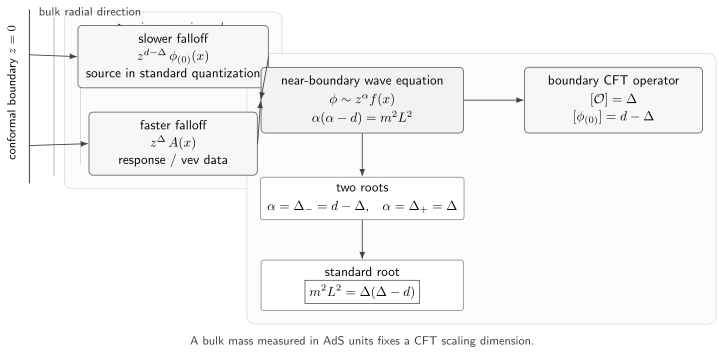
A scalar field near the AdS boundary has two independent falloffs. The near-boundary wave equation gives . In standard quantization, the slower falloff is the source and the faster falloff is the response, with .
Why this relation matters
Section titled “Why this relation matters”A CFT has no particle masses. Its local operators are labeled by quantum numbers under the conformal group: spin, global charges, and scaling dimension. A gravitational theory in AdS, by contrast, has fields propagating on a curved spacetime. These fields have masses, spins, and interactions.
The mass-dimension relation is the bridge:
The phrase “in AdS units” matters. The mass is dimensionful, but is dimensionless. Since is dimensionless, the scalar dictionary must involve .
This relation appears whenever we:
- identify supergravity modes with single-trace operators;
- decide whether a boundary deformation is relevant, marginal, or irrelevant;
- compute scalar two-point functions;
- diagnose possible instabilities of an AdS solution;
- impose boundary conditions in analytic or numerical holography;
- build bottom-up holographic models.
A negative does not automatically mean that the AdS background is unstable. The correct lower bound is the Breitenlohner–Freedman bound,
which follows already from requiring the square root in to be real. We will return to this bound carefully on the next page.
Use Poincare AdS in bulk dimensions:
The conformal boundary is at . In Euclidean signature, replace by .
Consider a free scalar field with action
The equation of motion is
For the Poincare metric,
Using
we find
The near-boundary behavior is encoded in this equation.
The indicial equation
Section titled “The indicial equation”Near , the term is subleading for smooth boundary dependence and finite boundary momentum. The leading radial equation is
Try a power-law solution
Then
Substituting gives
Therefore
The two roots are
Thus a scalar field behaves near the boundary as
where and are the two independent asymptotic coefficients.
Since
we can write the standard-quantization expansion as
This gives the central result:
Why the exponent is a CFT dimension
Section titled “Why the exponent is a CFT dimension”The derivation above gives two radial powers. Why should one of them be a CFT scaling dimension?
The reason is that AdS isometries act as conformal transformations at the boundary. In Poincare coordinates, the bulk transformation
leaves the metric invariant. This is the boundary dilatation.
In standard quantization,
Because scales as , the coefficient transforms as a source of dimension
The CFT source coupling is
For this term to be dimensionless, must have dimension
Thus the radial falloff has become the CFT scaling law.
The lesson is
Source and response in standard quantization
Section titled “Source and response in standard quantization”For most scalar calculations in this course, we use standard quantization:
Then
The dictionary is
More precisely, after holographic renormalization,
The local terms depend on counterterm choices and are responsible for contact terms in correlators. The nonlocal part of the response is fixed by the bulk solution.
Momentum-space solution
Section titled “Momentum-space solution”The same exponents appear in the exact Euclidean momentum-space solution. Fourier transform along the boundary:
The radial equation becomes
The solution regular in the Euclidean interior is
up to normalization. Near ,
Thus the full regular solution contains the same two powers,
When the regular solution is inserted into the renormalized on-shell action, the nonlocal momentum-space two-point function scales as
Fourier transformation gives
This is exactly the conformal two-point function for a scalar primary of dimension .
Global AdS interpretation
Section titled “Global AdS interpretation”There is another useful way to see the formula. In global AdS, the boundary is the cylinder
The CFT Hamiltonian on this cylinder is the dilatation operator. A primary operator of dimension creates a cylinder state of energy
A scalar field in global AdS has normal-mode frequencies
The lowest normal mode has
So the mass-dimension relation can also be read as
Boundary derivatives acting on the primary create descendants. In the bulk, these correspond to higher global normal modes with extra energy .
Examples
Section titled “Examples”Massless scalar
Section titled “Massless scalar”If , then
The roots are
In standard quantization, a massless scalar is dual to a marginal scalar operator of dimension . In the canonical example, the dilaton couples to the Yang–Mills Lagrangian density, an operator of dimension .
For ,
If
then
This saturates the BF bound in .
If
then
The root sits at the scalar unitarity bound in four dimensions, so it is an endpoint case requiring care.
For ,
If
then
Both choices are allowed in the alternate-quantization window. This example appears frequently in and in holographic condensed-matter models.
Relevant, marginal, and irrelevant operators
Section titled “Relevant, marginal, and irrelevant operators”In a -dimensional CFT, a scalar deformation by is
The classification is
Using standard quantization,
Therefore:
- marginal scalar operators with correspond to ;
- relevant scalar operators with correspond to negative above the BF bound;
- irrelevant scalar operators with correspond to positive .
This is an excellent sanity check when building holographic models. Choosing a scalar mass is choosing the UV dimension of the dual operator.
The BF bound preview
Section titled “The BF bound preview”The square root
is real only if
This is the Breitenlohner–Freedman bound. At the bound,
Below the bound,
so the CFT dimensions would be complex. On the bulk side, the AdS background is unstable to this scalar mode. The next page explains the BF bound and alternate quantization more carefully.
What about spin?
Section titled “What about spin?”The scalar relation is the simplest because the Klein–Gordon equation is second order and has two visible radial falloffs. Other fields obey analogous but different relations.
A massless bulk gauge field is dual to a conserved current,
The bulk metric is dual to the stress tensor,
A spinor in AdS obeys a first-order equation and has a relation of the rough form
with its own boundary-condition subtleties. The scalar case is the correct first laboratory because it displays sources, responses, the BF bound, and alternate quantization in their cleanest form.
Dictionary checkpoint
Section titled “Dictionary checkpoint”For a scalar field in ,
implies
where
In standard quantization,
The exact vev is obtained by varying the renormalized on-shell action, not by reading off blindly.
Common confusions
Section titled “Common confusions”“Negative means the bulk is unstable.”
Section titled ““Negative m2m^2m2 means the bulk is unstable.””Not in AdS. A scalar is stable if it obeys
Negative mass squared often corresponds to a relevant scalar operator.
“The two roots are two different particles.”
Section titled ““The two roots are two different particles.””No. They are two asymptotic behaviors of the same bulk field. In standard quantization, one is the source falloff and the other is the response falloff. In a special window, one may choose alternate quantization.
“The faster-falling coefficient is automatically the vev.”
Section titled ““The faster-falling coefficient is automatically the vev.””It is related to the vev, but holographic renormalization is needed. Local counterterms can contribute contact terms and scheme-dependent pieces.
“The relation depends on Poincare coordinates.”
Section titled ““The relation depends on Poincare coordinates.””No. Poincare coordinates make the derivation short. Global AdS gives the same as the lowest normal-mode energy.
“A massless scalar is dual to the identity operator.”
Section titled ““A massless scalar is dual to the identity operator.””No. In standard quantization, a massless scalar has . The root is the source falloff, not the identity operator.
Exercises
Section titled “Exercises”Exercise 1: Derive the indicial equation
Section titled “Exercise 1: Derive the indicial equation”Starting from
insert and derive the indicial equation.
Solution
For ,
Thus
The coefficient must vanish, so
Exercise 2: A scalar in
Section titled “Exercise 2: A scalar in AdS5\mathrm{AdS}_5AdS5”For a scalar in with , find the two possible exponents.
Solution
For , the boundary dimension is . The equation is
Thus
so
The roots are
Exercise 3: Relevant operators and negative mass squared
Section titled “Exercise 3: Relevant operators and negative mass squared”Show that for , standard quantization gives a negative bulk that still obeys the BF bound.
Solution
The mass is
If , then and , so .
Rewrite the relation as
The square is nonnegative, so
Exercise 4: Source dimension
Section titled “Exercise 4: Source dimension”Show that the source coupled to an operator of dimension through
has dimension .
Solution
The action is dimensionless. The measure has mass dimension , and has dimension . Therefore
so
This matches the standard bulk expansion, where the source multiplies .
Further reading
Section titled “Further reading”- S. S. Gubser, I. R. Klebanov, and A. M. Polyakov, Gauge Theory Correlators from Non-Critical String Theory.
- E. Witten, Anti de Sitter Space and Holography.
- D. Z. Freedman, S. D. Mathur, A. Matusis, and L. Rastelli, Correlation Functions in the CFT/AdS Correspondence.
- I. R. Klebanov and E. Witten, AdS/CFT Correspondence and Symmetry Breaking.
- K. Skenderis, Lecture Notes on Holographic Renormalization.