
Strange Metals and Planckian Transport
The previous two pages separated two facts that are easy to confuse.
First, a finite-density holographic state can be violently dissipative at the horizon. Local perturbations fall in, quasinormal modes decay, and thermalization can occur on a time of order .
Second, none of that automatically gives a finite DC resistivity. If translations are exact and the charge current overlaps with total momentum, a uniform electric field accelerates the whole fluid. The DC conductivity is infinite until momentum can relax.
Strange metals force us to combine both statements. They are metallic states whose transport looks too fast, too featureless, or too incoherent to be explained by ordinary long-lived quasiparticles. The most famous signature is
often over a wide temperature range. This page explains what holography has taught us about this observation, and just as importantly what it has not taught us.
The slogan is:
A holographic horizon naturally gives rapid, order- decay of many excitations. But a resistivity is a property of an electric current in a specific material environment. To get , one must still specify how current decays: through weak momentum relaxation, strong momentum relaxation, incoherent currents, entropy-controlled viscosity, a critical bath coupled to electronic bands, or some other mechanism.
Throughout this page, is the number of boundary spatial dimensions. We keep and in a few formulas where they clarify the meaning of “Planckian”, but otherwise use units with .
What is strange about a strange metal?
Section titled “What is strange about a strange metal?”A metal is “ordinary” when its low-energy dynamics can be organized in terms of quasiparticles. For a Fermi liquid, the quasiparticles live near a Fermi surface, carry the same charge as electrons, and have a lifetime that grows parametrically long as :
up to phase-space and logarithmic details. Transport then has a Boltzmann or memory-matrix description in which the current is carried by these long-lived excitations.
A strange metal is a compressible conducting state where this picture fails. The phrase is phenomenological rather than a sharply defined universality class. Common diagnostics include:
- a linear-in- DC resistivity, often with little sign of saturation;
- broad spectral functions rather than sharp quasiparticle peaks;
- optical conductivity that is not well described by a single Drude peak over the relevant frequency range;
- violations or strong modifications of Fermi-liquid expectations for the Hall angle, magnetoresistance, thermal transport, or the Wiedemann—Franz ratio;
- proximity to superconductivity, magnetism, nematicity, charge order, pseudogap physics, or other competing phases.
The danger is obvious: one can match a single scaling law while missing the physics. A serious theory should explain not only , but also the optical response, thermodynamics, Hall response, thermal diffusion, spectral functions, and the way these quantities change across nearby phases.
The Planckian time
Section titled “The Planckian time”The “Planckian” time in this context is not the gravitational Planck time . It is the thermal quantum time
At temperature , the only available microscopic energy scale in a scale-invariant quantum system is . The shortest natural time that can be made from and is therefore .
Different conventions insert factors of . For example, the chaos bound is often written
so the fastest allowed Lyapunov time is
This is related in spirit to Planckian dissipation, but it is not the same observable as an electrical transport lifetime. A metal can have an order- chaos rate, an order- local equilibration rate, and a much slower momentum relaxation rate. Conversely, a Drude fit may produce a scattering time of order without revealing which microscopic channel is responsible.
It is useful to keep four rates separate:
In a simple Drude metal these rates may be tied to one quasiparticle lifetime. In a strongly coupled metal they need not be the same thing.
A Drude estimate and why it is not enough
Section titled “A Drude estimate and why it is not enough”Suppose one writes a Drude conductivity
If the inferred scattering rate is Planckian,
then
This formula is useful because it converts a measured slope into a dimensionless number once and are estimated. But it is not a derivation of strange metallicity. It assumes a Drude form, a carrier density, and an effective mass. In many strange metals those quantities are themselves ambiguous because the state does not contain long-lived quasiparticles.
The holographic lesson is sharper: a Planckian-looking rate is natural in a thermal quantum-critical bath, but DC resistivity also depends on how the electric current overlaps with conserved or almost-conserved quantities.
Why horizons are naturally Planckian
Section titled “Why horizons are naturally Planckian”For a neutral or charged black brane at nonzero temperature, the near-horizon region looks locally like Rindler space. Infalling boundary conditions select retarded response. Perturbations decay into the horizon with quasinormal frequencies of the form
where is an order-one number depending on the channel and the model. This is the gravitational origin of the common statement that holographic matter has no long-lived quasiparticles: the poles of retarded correlators are generically far from the real axis, at distances set by .
The same fact also explains why holographic fluids often look “perfect”. In two-derivative Einstein gravity,
so momentum diffuses with a small viscosity set by quantum units. This is a robust statement about a large class of strongly coupled large- plasmas. It is not, by itself, a statement about electrical resistivity in a lattice metal.
At finite density the clean-limit conductivity has the structure discussed earlier:
Here is the incoherent conductivity and is the momentum relaxation rate. In the clean theory , so the Drude-like term becomes a delta function at . The horizon can absorb local perturbations, but it cannot destroy an exactly conserved boundary momentum.
Five holographic routes to -linear resistivity
Section titled “Five holographic routes to TTT-linear resistivity”There is no unique holographic mechanism for . That is not a bug. It is a warning that linear resistivity is a coarse observable. The following map is a useful organizing device.
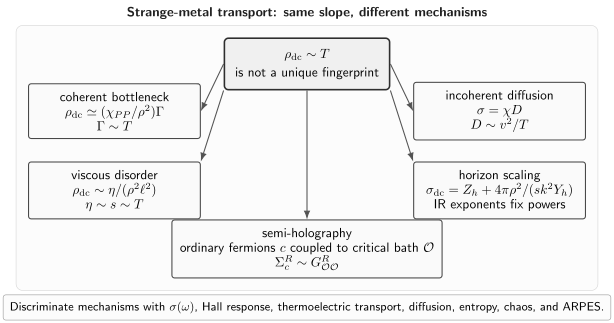
Several mechanisms can lead to -linear DC resistivity. Holography is especially useful because it separates local Planckian equilibration from momentum relaxation, incoherent current relaxation, entropy-controlled hydrodynamics, and semi-holographic coupling to a critical bath.
We now unpack the five routes in the figure.
Route 1: Planckian Drude phenomenology
Section titled “Route 1: Planckian Drude phenomenology”The simplest phenomenological story is
This is often how experimental data are summarized. If a metal has a reasonably identifiable plasma frequency , the optical conductivity can be fitted to an extended Drude form,
or in SI-like conventions with corresponding prefactors. A -linear DC resistivity then translates into an apparent transport scattering rate
This observation is powerful but incomplete. It does not explain why the rate is Planckian, why the current relaxes through that rate, why optical conductivity may be non-Drude, or why different transport channels can show different powers of .
In holography this route is best viewed as a diagnostic language, not a fundamental model. A black hole gives order- relaxation rates easily. The hard part is identifying which rate controls a measured conductivity.
Route 2: weak momentum relaxation and memory matrices
Section titled “Route 2: weak momentum relaxation and memory matrices”When translation breaking is weak, hydrodynamics plus memory matrices give a controlled answer. Suppose the clean Hamiltonian is perturbed by a weak lattice or disorder potential,
For a single periodic lattice mode , the momentum relaxation rate is schematically
Then the coherent DC resistivity is
when the Drude contribution dominates over .
This formula is conceptually beautiful because it says: the resistivity is determined by the spectral weight of the clean strange metal at the lattice wavevector. Holography can compute that spectral weight in strongly coupled finite-density phases where conventional field theory struggles.
For an -like IR, operators at different momenta can have different IR dimensions. If the finite-temperature spectral function scales as
then
up to thermodynamic prefactors. Linear resistivity requires a particular IR exponent. It is possible, but not automatic.
This route also makes clear why is not a universal prediction of RN-AdS. The lattice chooses a wavevector. The operator coupled to that lattice has an IR dimension. The exponent of the resistivity depends on that IR data.
Route 3: entropy, viscosity, and disorder
Section titled “Route 3: entropy, viscosity, and disorder”There is a different hydrodynamic route in which the resistivity is controlled by entropy rather than by a finely selected lattice exponent.
Imagine a strongly interacting charged fluid moving through a slowly varying random background with correlation length . Momentum can relax by viscous diffusion into the disorder landscape. Parametrically,
Then
If the holographic fluid has
and the entropy density obeys a Sommerfeld-like law
then
This mechanism is attractive because it ties linear resistivity to thermodynamics. It also explains a subtle feature: if as , then the disorder contribution can vanish with temperature rather than leaving a large residual resistivity. That is very unlike an ordinary quasiparticle metal, where static impurities typically produce elastic residual scattering.
The cleanest holographic realization uses charged dilatonic black branes whose IR is conformal to and whose entropy density is linear in temperature. The Gubser—Rocha model is the best-known example. With homogeneous momentum relaxation, massive gravity, or axion-like translation breaking, the low-temperature resistivity can scale as
This is a mechanism, not a magic spell. It relies on a temperature-independent effective disorder scale and on an IR geometry with . Change either ingredient and the exponent may change.
Route 4: incoherent metallic transport
Section titled “Route 4: incoherent metallic transport”The previous two routes assume that momentum is long-lived enough to remain the transport bottleneck. But holographic metals can also be incoherent: momentum relaxes so rapidly, or current overlaps so weakly with momentum, that the Drude contribution is not the main actor.
The useful object is the current orthogonal to momentum. Schematically,
This current can relax even when total momentum is conserved. Its conductivity is the term in hydrodynamics. In many holographic theories, is controlled by horizon data: gauge couplings, scalar profiles, and metric components evaluated at the black-brane horizon.
In a strongly momentum-relaxed metal, the DC conductivity often has a structure like
where the second term is suppressed when momentum is no longer a useful slow mode. A linear resistivity can arise if the horizon couplings scale so that
This route is powerful because it avoids quasiparticles and avoids relying on a narrow Drude peak. It is also dangerous if overinterpreted: a bottom-up horizon formula can fit a scaling law without uniquely identifying the microscopic degrees of freedom in a material.
Route 5: semi-holography and a critical bath
Section titled “Route 5: semi-holography and a critical bath”Holography often describes a large- critical sector rather than the literal electrons of a crystal. Semi-holography tries to combine both ingredients. One couples ordinary band fermions to fermionic operators in a strongly coupled large- sector:
At leading order in large , the band fermion Green’s function becomes
with
For a locally critical bath,
When , this resembles marginal-Fermi-liquid phenomenology: the imaginary part of the self-energy is of order at . For , quasiparticles are destroyed even more strongly. The intuitive picture is simple: the band electron can decay into a strongly interacting critical bath whose intrinsic timescale is Planckian.
This approach has become increasingly important because it gives a language closer to photoemission and band-structure phenomenology. Recent refined semi-holographic effective theories show how quasi-universal spectral functions can lead to linear-in- resistivity and Planckian dissipation over broad temperature ranges. That is promising, but it is still an effective framework. The microscopic origin of the tuning, and its relation to the full cuprate or heavy-fermion phase diagrams, remains an open research problem.
The Gubser—Rocha metal as a useful benchmark
Section titled “The Gubser—Rocha metal as a useful benchmark”The simplest RN-AdS metal has an extremal entropy density at . This is useful but unphysical if taken literally. The Gubser—Rocha construction modifies Einstein—Maxwell theory with a dilaton so that the low-temperature entropy scales linearly:
A schematic Einstein—Maxwell—dilaton action is
where introduces translation breaking, for example through axions, a lattice, or a massive-gravity-like sector.
The IR geometry is conformal to . It is locally quantum critical in the sense that time scales while space scales weakly or not at all, but the conformal factor changes the thermodynamics enough to remove the RN-AdS ground-state entropy. In the translation-broken versions used for transport, one commonly finds a low-temperature structure of the form
in suitable normalizations and regimes, hence
This is one of the cleanest holographic demonstrations that -linear resistivity can arise without quasiparticles.
But it is not the final theory of strange metals. A model that captures may still fail to capture the Hall angle, magnetoresistance, optical conductivity, or thermal transport. For example, a homogeneous axion or massive-gravity model often has too few independent relaxation channels. Real strange metals may require several slow modes, critical sectors, disorder, phonons, or intertwined order.
Optical conductivity: where mechanisms reveal themselves
Section titled “Optical conductivity: where mechanisms reveal themselves”DC transport collapses a lot of physics into one number. Optical conductivity is harder to fake.
A coherent metal has a narrow Drude peak:
If , the system has a well-defined momentum relaxation time even if it has no quasiparticles. This is a hydrodynamic Drude peak, not a quasiparticle Drude peak.
A more incoherent strange metal may have no narrow Drude peak. Spectral weight can spread into a broad mid-infrared structure, or obey approximate scaling over an intermediate frequency range,
in appropriate windows. Holographic lattices and Gubser—Rocha-like models show that the same DC linearity can coexist with changing optical regimes: coherent at low temperature or weak lattice strength, bad-metal-like at higher temperature, and incoherent at stronger translation breaking.
This is why one should not judge a model only by . A good strange-metal model should survive simultaneous comparison of
The more constrained the comparison, the more meaningful the match.
Hall response and the problem of one lifetime
Section titled “Hall response and the problem of one lifetime”Many strange metals exhibit more than one apparent transport rate. In cuprate phenomenology, for example, the longitudinal resistivity and the Hall angle have often been summarized as if
over certain regimes. This “two-lifetime” structure is difficult for the simplest Drude model and also difficult for many homogeneous holographic models with a single momentum relaxation time.
Hydrodynamics can generate richer magnetotransport because charge, heat, momentum, imbalance, phase relaxation, and disorder can all participate. Holography can compute such coupled response functions, but matching the full experimental pattern is more demanding than matching .
This is one of the healthiest lessons of the field: holography is not a vending machine for exponents. It is a framework for computing constrained response functions in strongly coupled states. The constraints are where the real tests live.
Relation to the Mott—Ioffe—Regel limit
Section titled “Relation to the Mott—Ioffe—Regel limit”In a quasiparticle metal, the mean free path should be large compared with the lattice spacing , or at least . When the inferred resistivity violates this expectation, one says the metal is “bad” or beyond the Mott—Ioffe—Regel limit.
Holographic strange metals are not bothered by this. There is no quasiparticle mean free path to protect. The current is not carried by long-lived particles bouncing between scattering events. It is a collective response of a strongly coupled quantum fluid.
This does not mean every bad metal is holographic. It means that holography gives controlled examples where the Boltzmann logic behind the Mott—Ioffe—Regel bound is simply inapplicable.
Diffusion bounds and thermal transport
Section titled “Diffusion bounds and thermal transport”Another way to express Planckian intuition is through diffusion:
What should the velocity be? In relativistic CFTs, is often the speed of light of the emergent theory. In nonrelativistic or finite-density systems, proposed velocities include the butterfly velocity , sound velocities, Fermi velocities, or phonon velocities.
Holography suggests relations of the form
in selected models and channels. These relations are useful but not universal theorems. Charge diffusion, energy diffusion, and momentum diffusion can behave differently. In strong momentum relaxation, thermal diffusivity is often the cleanest place to look for chaos-controlled Planckian behavior, while charge diffusivity may depend on additional IR data such as gauge couplings.
This distinction matters experimentally. Thermal diffusivity can probe energy relaxation even when electrical transport is complicated by disorder, density, and momentum overlap.
What holography explains cleanly
Section titled “What holography explains cleanly”Holography gives a controlled theoretical laboratory for several features that are hard to obtain simultaneously in conventional methods:
-
No quasiparticles. Retarded functions are governed by quasinormal modes and branch cuts rather than long-lived particle poles.
-
Fast local equilibration. Thermal horizons naturally produce decay rates of order .
-
Finite-density critical matter. Charged black branes solve strongly coupled finite-density problems without a sign problem.
-
Hydrodynamic transport with known coefficients. The same gravitational solution determines thermodynamics, conductivities, viscosities, diffusion constants, and pole motion.
-
Controlled translation breaking. Lattices, axions, massive gravity, and disorder-inspired models allow one to study how momentum relaxation changes transport.
-
A useful distinction between coherent and incoherent metals. A metal can have a Drude peak without quasiparticles, or be incoherent without a Drude peak.
These are genuine achievements. They explain why holography has become a serious language for strange-metal theory.
What holography does not yet explain
Section titled “What holography does not yet explain”The limitations are equally important.
A bottom-up holographic metal is usually not derived from the microscopic Hamiltonian of a cuprate, pnictide, heavy-fermion compound, or nickelate. The large- limit is not the electron spin degeneracy. The bulk gauge field is dual to a global current, not to the dynamical electromagnetic field inside a crystal. The lattice may be modeled by axions or a smooth periodic source rather than by real ions. Phonons are often absent. Disorder may be idealized. The density may be fractionalized behind a horizon rather than carried by visible Fermi surfaces.
Therefore:
The most trustworthy use of holography is not “this material is dual to this black hole.” It is: “this black hole teaches us a consistent mechanism by which strongly coupled matter can produce a pattern of observables without quasiparticles.”
Common pitfalls
Section titled “Common pitfalls”Pitfall 1: Planckian means Planck scale. No. Here Planckian means the thermal quantum time , not the gravitational Planck time.
Pitfall 2: -linear resistivity proves quantum criticality. No. Quantum criticality is one natural route, but disorder, semi-holography, incoherent transport, and other mechanisms can also produce linear resistivity.
Pitfall 3: RN-AdS alone gives a finite strange-metal resistivity. No. Clean finite-density RN-AdS has infinite DC conductivity because momentum is conserved. Translation breaking or an incoherent current channel is needed.
Pitfall 4: A Drude peak means quasiparticles. No. A hydrodynamic Drude peak can arise from a slowly relaxing conserved momentum even when microscopic quasiparticles are absent.
Pitfall 5: The chaos bound determines the electrical resistivity. Not generally. Chaos, local equilibration, diffusion, momentum relaxation, and current relaxation are related in some models but distinct in general.
Pitfall 6: One exponent is a theory. No. A theory of strange metals must explain a network of observables.
Exercises
Section titled “Exercises”Exercise 1: Planckian Drude slope
Section titled “Exercise 1: Planckian Drude slope”Assume a single-band Drude formula
and a Planckian transport rate
Derive the slope in . What information is hidden inside ?
Solution
The resistivity is
Using the Planckian rate,
Therefore
The slope hides the carrier density , the effective mass , and the dimensionless coefficient . In a strange metal these quantities may not be sharply defined quasiparticle parameters. This is why a Planckian Drude estimate is useful but not a microscopic theory.
Exercise 2: Infinite DC conductivity despite fast equilibration
Section titled “Exercise 2: Infinite DC conductivity despite fast equilibration”Consider a finite-density system with exact translations and
Explain why the DC conductivity is infinite even if the local equilibration time is .
Solution
Fast local equilibration means that generic perturbations rapidly relax to local thermal equilibrium. It does not mean that conserved quantities disappear. If translations are exact, total momentum is conserved.
At finite density, the electric current overlaps with momentum:
A uniform electric field injects momentum into the charged fluid. Since cannot decay, part of the current cannot decay either. Hydrodynamically,
when . The second term gives a delta function in and an infinite DC conductivity.
Exercise 3: Entropy-controlled linear resistivity
Section titled “Exercise 3: Entropy-controlled linear resistivity”Suppose a strongly coupled fluid has
where is a temperature-independent disorder length. If is constant and , show that .
Solution
Substitute the momentum relaxation rate into the resistivity:
If is constant, then
If and and are temperature-independent to leading order, then
The mechanism works because transport is controlled by the viscosity of a nearly perfect quantum fluid. The linearity is thermodynamic in origin.
Exercise 4: Memory matrix exponent
Section titled “Exercise 4: Memory matrix exponent”A weak lattice couples to an operator whose finite-temperature IR spectral function gives
Assuming thermodynamic prefactors are slowly varying, what value of gives linear resistivity?
Solution
The memory-matrix formula gives
In the coherent regime,
Therefore
For linear resistivity, we need
so
This illustrates why a weak-lattice RN-AdS mechanism does not automatically give -linear resistivity. The lattice wavevector and the IR operator dimension matter.
Exercise 5: Semi-holographic quasiparticle destruction
Section titled “Exercise 5: Semi-holographic quasiparticle destruction”Consider a semi-holographic fermion Green’s function
Assume has a nonzero imaginary part. For , estimate the decay rate. When is the decay rate comparable to the excitation energy?
Solution
At ,
The excitation energy is of order . The ratio is
If , the ratio is order one as . This is the marginal case: the decay rate is comparable to the excitation energy, and quasiparticles are barely ill-defined.
If , the ratio grows as , so quasiparticles are destroyed more strongly. If , the ratio vanishes and quasiparticles become sharper at low temperature.
Exercise 6: Why one observable is not enough
Section titled “Exercise 6: Why one observable is not enough”A holographic model gives . List three additional observables you would ask it to reproduce before taking it seriously as a model of a specific strange metal.
Solution
Good answers include:
- optical conductivity , including whether there is a Drude peak or mid-infrared continuum;
- Hall angle and magnetoresistance;
- thermal conductivity or diffusivity;
- entropy or specific heat, such as or ;
- spectral function as measured by ARPES-like probes;
- scaling of superconducting or density-wave susceptibilities;
- charge and energy diffusion constants.
The point is that -linear resistivity is a single exponent. A credible model should reproduce a constrained pattern of response functions.
Further reading
Section titled “Further reading”- S. A. Hartnoll, A. Lucas, and S. Sachdev, Holographic Quantum Matter, especially sections 1.2, 4, 5, and 8, for non-quasiparticle matter, compressible phases, metallic transport, Planckian timescales, and experimental connections.
- J. Zaanen, Y. Liu, Y.-W. Sun, and K. Schalm, Holographic Duality in Condensed Matter Physics, chapters 8, 12, and 14, for RN strange metals, translation breaking, Gubser—Rocha-like linear resistivity, and the epistemic status of holographic matter.
- S. A. Hartnoll, “Theory of universal incoherent metallic transport,” for the incoherent-metal viewpoint.
- R. A. Davison, K. Schalm, and J. Zaanen, “Holographic duality and the resistivity of strange metals,” for the entropy/viscosity mechanism.
- F. Balm et al., “-linear resistivity, optical conductivity and Planckian transport for a holographic local quantum critical metal in a periodic potential,” for a detailed Gubser—Rocha lattice study.
- B. Doucot, A. Mukhopadhyay, G. Policastro, S. Samanta, and H. Swain, “An effective framework for strange metallic transport,” for a recent refined semi-holographic effective framework.