
Islands in Higher Dimensions
Guiding question. Which parts of the island story are genuinely dimension-independent, and which parts rely on the special solvability of two-dimensional gravity and CFT?
The island formula is not intrinsically two-dimensional. In a -dimensional semiclassical gravitational region coupled to a nongravitating bath, the expected fine-grained entropy of a radiation region is still computed by
with the usual replacements by Wald–Dong entropy in higher-derivative theories and by generalized-entropy counterterms in the renormalized theory. What changes in higher dimensions is not the principle but the difficulty of evaluating it. The island boundary is now a genuine codimension-two surface rather than a pair of points, the matter entropy is strongly shape dependent, and the gravitational backreaction can rarely be ignored.
The moral of this page is deliberately conservative:
Two-dimensional JT examples teach the mechanism. Higher-dimensional examples test whether the mechanism is an artifact of D solvability. So far the evidence is strong that it is not. But many calculations still rely on symmetry, double holography, dimensional reduction, equilibrium setups, or large- matter.
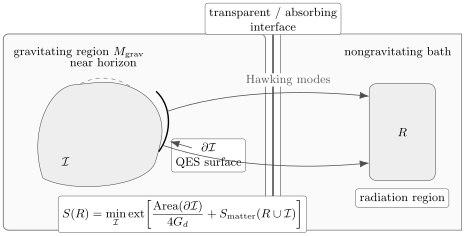
A higher-dimensional island problem has the same logical ingredients as the JT examples: a gravitating black-hole region, a nongravitating radiation bath, a radiation region , and a candidate island . The difference is geometric. The QES is a codimension-two surface, so finding it is a real shape problem.
1. The dimension-independent statement
Section titled “1. The dimension-independent statement”Let the full effective description contain a semiclassical gravitational spacetime and a nongravitating bath . A radiation region has an ordinary Hilbert-space entropy because the bath does not gravitate. The island formula says that this entropy is not computed by alone, but by allowing additional gravitating regions :
where
The counterterm contribution is often suppressed in notation. It is not optional. The matter entropy has UV divergences near , and these divergences are absorbed into the renormalization of and higher-curvature couplings. The finite answer is the renormalized generalized entropy.
The quantum extremal surface condition is the stationarity condition
where describes the embedding of . In Einstein gravity this has the schematic local form
Here is the mean-curvature vector of the surface in the two normal directions and is the induced metric on . In the classical limit the matter variation is negligible, so one recovers an ordinary extremal area surface. In the island problem, however, the matter variation is precisely what can balance the area cost and place the QES near, outside, or inside the horizon depending on the setup.
The final prescription is not “find any extremum.” It is
At early times the dominant saddle is usually the no-island saddle, . At late times an island saddle can dominate. The Page transition is then a transition between generalized-entropy saddles.
2. Codimension: from endpoints to surfaces
Section titled “2. Codimension: from endpoints to surfaces”In two-dimensional gravity, a spatial island is an interval and its boundary consists of points. This is why many JT computations reduce to extremizing a function of one or two endpoint coordinates.
In spacetime dimensions, a spatial island is a codimension-zero spatial region, and its boundary is a codimension-two surface in spacetime. For example, in a four-dimensional spherically symmetric black hole, a symmetric QES is a two-sphere. Without symmetry, the QES is an arbitrary spacelike two-surface satisfying a nonlinear integro-differential equation because is nonlocal.
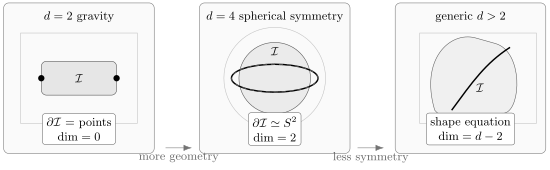
In D gravity, is a set of endpoints. In higher-dimensional gravity, it is a codimension-two surface, such as a sphere in a spherically symmetric four-dimensional black hole. Symmetry can reduce the problem to a radial extremization, but the underlying object is still a surface.
This codimension count is more than bookkeeping. It changes the technical character of the calculation.
First, the area term is large and shape-dependent:
Second, the matter entropy is no longer determined by a universal two-dimensional conformal map. Even in flat space, entanglement entropy in depends on the detailed geometry of the entangling surface. There are universal logarithmic terms in special dimensions and special shapes, but there is no general closed formula comparable to
Third, the QES can have multiple competing topologies. For eternal black holes, one may compare Hartman–Maldacena-like surfaces that pass through the wormhole with island surfaces that remain close to horizons or branes. For one-sided evaporation, one may compare the no-island radiation saddle with surfaces whose island boundary is near the shrinking horizon.
3. Why higher-dimensional calculations are hard
Section titled “3. Why higher-dimensional calculations are hard”The formula
looks deceptively simple. In practice, each term hides a major issue.
| Ingredient | In JT / D CFT | In higher dimensions |
|---|---|---|
| Island boundary | Points | Codimension-two surfaces |
| Matter entropy | Often analytic from conformal symmetry | Shape-dependent and usually nonlocal |
| Geometry | Dilaton gravity, no propagating gravitons | Dynamical metric perturbations and backreaction |
| Bath coupling | Often idealized by transparent boundary conditions | Can affect graviton localization and boundary conditions |
| Evaporation | Simple energy-flux models | Greybody factors, angular modes, superradiance, backreaction |
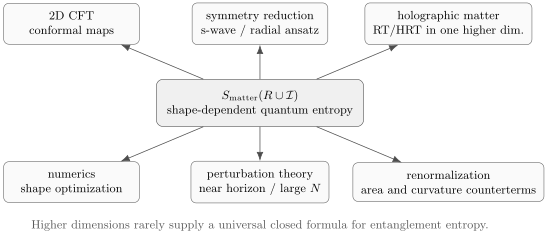
The hard term in higher-dimensional island calculations is usually . Two-dimensional conformal symmetry often turns it into endpoint data. In higher dimensions one usually needs extra structure: spherical symmetry, a near-horizon dimensional reduction, perturbation theory, numerical methods, or a holographic matter sector.
This is the main reason double holography has been so valuable. If the matter sector has a classical holographic dual, then becomes the area of an RT/HRT surface in one higher dimension. The higher-dimensional island problem becomes an ordinary extremal-surface problem in the ambient bulk, possibly with brane endpoint conditions.
But one should keep the layers straight. Double holography does not make all higher-dimensional island problems easy. It makes a special class of strongly coupled large- matter theories geometrically tractable.
4. Controlled higher-dimensional examples
Section titled “4. Controlled higher-dimensional examples”There are several kinds of higher-dimensional evidence for islands.
Eternal AdS black holes in equilibrium with baths
Section titled “Eternal AdS black holes in equilibrium with baths”One controlled class consists of eternal asymptotically AdS black holes in equilibrium with an auxiliary bath. These are not evaporating to zero mass. Instead, the information-paradox-like question is whether the entropy associated with bath regions grows forever as the two-sided wormhole grows. A no-island Hartman–Maldacena surface gives growth. An island surface gives saturation.
In such models, the late-time answer is schematically
where grows with time and is of order the black hole entropy. The Page transition is a surface phase transition, not a local dynamical event at the horizon.
Brane-world and double-holographic models
Section titled “Brane-world and double-holographic models”In brane-world models, a -dimensional gravitating brane is embedded in a -dimensional ambient AdS spacetime. Black holes on the brane can be coupled to bath degrees of freedom. The brane island formula is mapped to an RT/HRT problem in the ambient bulk:
The QES on the brane is the point or surface where the higher-dimensional extremal surface meets the brane. In this representation, the island is not mysterious: it is the intersection of the radiation entanglement wedge with the brane.
Top-down string theory constructions
Section titled “Top-down string theory constructions”A further check is to embed the brane-world story into string theory. In such examples, the lower-dimensional gravitational setup and the bath arise from brane configurations in a UV-complete theory. The calculation is still usually done by classical extremal surfaces in a higher-dimensional geometry, but the construction gives better control over which quantum system is being described.
These models are not yet “the Page curve of an astrophysical black hole.” They are evidence that the island mechanism can be realized in higher-dimensional, UV-motivated holographic settings.
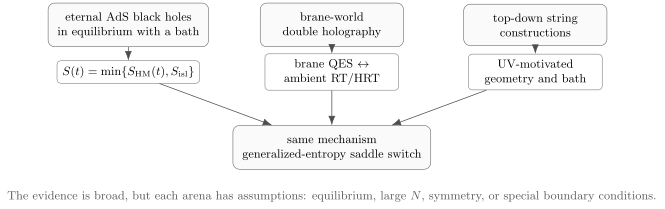
Three useful higher-dimensional arenas. Eternal AdS black holes test island saturation in equilibrium. Brane-world double holography converts brane QESs into ambient RT/HRT surfaces. Top-down string constructions provide UV-motivated realizations of the same mechanism.
5. Schwarzschild, asymptotic flatness, and dimensional reduction
Section titled “5. Schwarzschild, asymptotic flatness, and dimensional reduction”For asymptotically flat Schwarzschild black holes, there is no timelike AdS boundary and no canonical nongravitating bath attached by hand. Radiation is naturally measured near future null infinity . This makes the conceptual target closer to the original Hawking problem but technically harder.
One common strategy is to use a near-horizon or s-wave dimensional reduction. A massless field in a spherically symmetric background can be decomposed into angular momentum modes. Near the horizon, the radial dynamics of low angular momentum modes often resembles a two-dimensional problem. This gives an effective entropy estimate and can locate an island surface near the horizon.
The danger is to confuse the reduced problem with the full problem. A four-dimensional black hole has greybody factors, angular momentum barriers, many partial waves, and gravitational perturbations. Higher angular momentum modes can behave differently from the s-wave sector. Thus a D reduction can capture an important near-horizon mechanism without being a complete calculation of the full four-dimensional fine-grained radiation entropy.
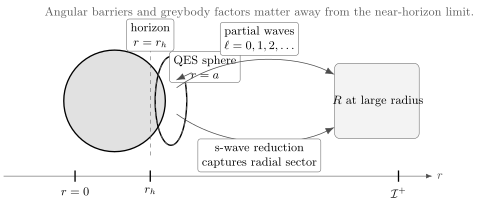
For a four-dimensional Schwarzschild black hole, spherical symmetry can reduce a symmetric QES to a radius, but the radiation field still contains angular modes and greybody factors. The s-wave approximation is a useful near-horizon tool, not a complete substitute for the full higher-dimensional entropy problem.
A useful way to phrase the asymptotically flat challenge is this:
whereas in quantum gravity one must also understand how the asymptotic radiation algebra, gravitational dressing, BMS charges, and infrared effects define the fine-grained entropy at .
This does not invalidate the island rule. It means that the cleanest derivations remain in settings where the radiation region is an ordinary nongravitating subsystem.
6. Graviton localization and massive-gravity subtleties
Section titled “6. Graviton localization and massive-gravity subtleties”Higher-dimensional bath couplings can change the gravitational sector in ways absent from simple JT models. A recurring issue is whether gravity is localized on the brane and whether the effective graviton is exactly massless.
In ordinary nongravitational QFT, it is harmless to split a system into a region and a bath. In gravity, constraints and long-range fields make factorization subtle. When a gravitating region is coupled transparently to a bath, the boundary conditions that allow energy to leak out can also affect the graviton spectrum. In some brane-world constructions, the effective lower-dimensional graviton is massive or quasi-localized rather than exactly massless.
This matters for interpretation. A massive graviton changes the long-distance gravitational constraints and can make entanglement wedges behave more like ordinary QFT regions. A strictly massless graviton is tied to asymptotic gravitational constraints and boundary charges. The island formula can still be meaningful, but the microscopic meaning of “the radiation subsystem” and “the gravitational region” becomes more delicate.
A clean page-curve cartoon often writes
In gravity this factorization is not fundamental. It is an effective description whose accuracy depends on boundary conditions, dressing choices, and the code subspace.
7. Charged, rotating, and higher-derivative black holes
Section titled “7. Charged, rotating, and higher-derivative black holes”Real black holes can carry angular momentum, charge, and higher-curvature corrections. The island prescription adapts, but each feature adds structure.
For charged black holes, the near-horizon region may contain an AdS throat, especially near extremality. This makes JT-like methods useful, but one must also track gauge constraints, charged matter, and chemical potentials. The generalized entropy may include gauge-field edge terms and higher-derivative corrections.
For rotating black holes, several new issues appear:
- the horizon generator is ;
- superradiant modes can affect the radiation spectrum;
- a global Hartle–Hawking state may fail to exist in the same simple way as for static black holes;
- QESs need not lie on a simple time-reflection-symmetric slice.
For higher-derivative gravity, the area term is replaced by the appropriate gravitational entropy functional. Schematically,
so the island formula becomes
The conceptual lesson is unchanged: the dominant entropy saddle may include an island. The technical implementation changes because the surface equations and entropy functional are modified.
8. Backreaction and real evaporation
Section titled “8. Backreaction and real evaporation”Many higher-dimensional island calculations are performed in equilibrium or in a fixed-background approximation. For a genuinely evaporating -dimensional black hole, the mass, temperature, horizon area, greybody factors, and stress tensor change with time.
For a four-dimensional asymptotically flat Schwarzschild black hole,
The coarse-grained black hole entropy decreases as evaporation proceeds. A unitary fine-grained Page curve should eventually follow the shrinking black hole entropy scale:
up to order-one details, greybody factors, and the number of species. In a fixed-temperature eternal setup, by contrast, the late-time island branch often saturates rather than decreases. This is not a contradiction; these are different physical setups.
A fully realistic calculation would require at least:
- a controlled semiclassical evaporating geometry,
- a definition of the radiation algebra at infinity,
- matter entropies beyond the s-wave approximation,
- backreaction of Hawking flux and the QES,
- gravitational dressing and constraints,
- a treatment of very late-time quantum gravity.
This is why higher-dimensional island physics is better viewed as a growing program than as a finished computation of astrophysical evaporation.
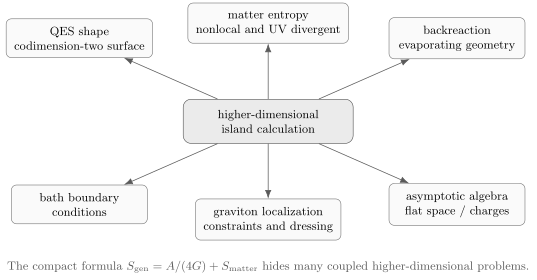
The island prescription is compact, but higher-dimensional applications require control over several coupled problems: surface geometry, matter entropy, gravitational backreaction, bath boundary conditions, graviton localization, and the asymptotic radiation algebra.
9. What higher dimensions teach us
Section titled “9. What higher dimensions teach us”Higher-dimensional examples teach three lessons.
First, islands are not merely a peculiarity of JT gravity. The QES mechanism extends naturally once one has a clean definition of radiation entropy and enough control over the generalized entropy functional.
Second, the strongest results are model-dependent in a useful way. Double-holographic and brane-world models are not generic black holes, but they are laboratories where the same mathematical prescription can be tested beyond two-dimensional dilaton gravity.
Third, higher dimensions sharpen the interpretation of islands. The island is not a new local channel through which Hawking quanta escape. It is a statement about the entanglement wedge and the fine-grained entropy functional. In higher dimensions, this statement becomes more geometric because the island boundary is an actual surface whose location depends on area, matter entropy, and boundary conditions.
The next conceptual page will ask what the island “is.” The answer will be deliberately nonlocal: an island is a region included in the entanglement wedge of the radiation, not a locally visible message in the outgoing Hawking flux.
Common pitfalls
Section titled “Common pitfalls”Pitfall 1: “The island formula was proved in JT, so higher dimensions are automatic.”
The formula is expected to be general within semiclassical gravity, but calculations in higher dimensions require additional control. Matter entropies, backreaction, graviton localization, and asymptotic definitions can be hard.
Pitfall 2: “A s-wave reduction solves the four-dimensional problem.”
It solves a reduced problem. It may capture the near-horizon mechanism, but the full four-dimensional radiation entropy includes angular modes, greybody factors, and gravitational constraints.
Pitfall 3: “Eternal equilibrium Page curves and evaporating Page curves are the same.”
They are related but not identical. Eternal black holes in baths often show saturation. One-sided evaporating black holes should show a rise and fall, tracking the shrinking coarse-grained black hole entropy at late times.
Pitfall 4: “Higher-dimensional islands are always behind the horizon.”
Not necessarily. Depending on the setup, islands or their QES boundaries can lie outside, near, or inside horizons. The location is determined by extremizing generalized entropy, not by a slogan about interiors.
Pitfall 5: “Double holography is just a picture.”
In controlled large- models it is a calculational duality: the matter entropy term is replaced by an RT/HRT area in an ambient bulk. But it is still a special class of theories, not a universal solution method.
Exercises
Section titled “Exercises”Exercise 1. Codimension of a QES
Section titled “Exercise 1. Codimension of a QES”In a -dimensional spacetime, what is the dimension of ? Check the cases .
Solution
A QES is codimension two in spacetime. Therefore
Thus:
In D gravity, the island boundary consists of points. In D spherical symmetry, a QES can be a two-sphere.
Exercise 2. Spherical reduction of the area term
Section titled “Exercise 2. Spherical reduction of the area term”Consider a four-dimensional spherically symmetric island boundary at radius . Show that the area term is
Solution
A sphere of radius in four dimensions has area
Therefore
If the QES lies close to the Schwarzschild horizon, , then
This is why late-time island entropies in simple symmetric models are of order the Bekenstein–Hawking entropy.
Exercise 3. A toy higher-dimensional QES equation
Section titled “Exercise 3. A toy higher-dimensional QES equation”Suppose a symmetric candidate island in four dimensions is labeled by a radius , and the generalized entropy is modeled as
with and . Find the extremum.
Solution
Differentiate:
The QES condition is
Thus
Solving the quadratic equation,
For ,
The precise logarithm in this toy model should not be taken literally. The exercise illustrates the general structure: an area force can be balanced by a matter-entropy variation.
Exercise 4. Eternal versus evaporating setups
Section titled “Exercise 4. Eternal versus evaporating setups”Explain why a late-time entropy plateau in an eternal black hole coupled to a bath is not the same as the decreasing branch of the Page curve for a one-sided evaporating black hole.
Solution
An eternal black hole in equilibrium has a fixed temperature and a fixed coarse-grained black hole entropy. The no-island Hartman–Maldacena-like entropy can grow with time, while the island saddle gives an entropy of order the fixed black hole entropy. The physical entropy therefore saturates.
A one-sided evaporating black hole loses mass, so its horizon area and Bekenstein–Hawking entropy decrease. After the Page time, unitarity suggests that the fine-grained radiation entropy should roughly track the remaining black hole entropy and eventually return to zero. Thus the late-time behavior is decreasing, not merely saturating.
The two settings share the same saddle-switch mechanism, but the background physics differs.
Exercise 5. Why double holography helps
Section titled “Exercise 5. Why double holography helps”Explain in one paragraph why double holography is especially useful for higher-dimensional island calculations but does not by itself solve all realistic black-hole evaporation problems.
Solution
Double holography is useful because it replaces the hard matter entropy by a geometric RT/HRT area in one higher dimension. This turns a quantum entropy problem into a classical extremal-surface problem, often making higher-dimensional islands calculable. But the method applies to special large- matter sectors with holographic duals and often to brane-world or equilibrium geometries. Realistic evaporation also involves asymptotic flatness, greybody factors, gravitational dressing, backreaction, and finite- effects. Thus double holography is a powerful laboratory, not a universal shortcut.
Further reading
Section titled “Further reading”- A. Almheiri, R. Mahajan, and J. E. Santos, “Entanglement islands in higher dimensions”.
- H. Z. Chen, R. C. Myers, D. Neuenfeld, I. A. Reyes, and J. Sandor, “Quantum Extremal Islands Made Easy, Part II: Black Holes on the Brane”.
- A. Almheiri, R. Mahajan, J. Maldacena, and Y. Zhao, “The Page curve of Hawking radiation from semiclassical geometry”.
- K. Hashimoto, N. Iizuka, and Y. Matsuo, “Islands in Schwarzschild black holes”.
- T. Hartman, E. Shaghoulian, and A. Strominger, “Islands in Asymptotically Flat 2D Gravity”.
- C. F. Uhlemann, “Islands and Page curves in 4d from Type IIB”.
- R. Bousso and G. Penington, “Islands Far Outside the Horizon”.
- A. Almheiri, T. Hartman, J. Maldacena, E. Shaghoulian, and A. Tajdini, “The entropy of Hawking radiation”.