
Holography as Quantum Error Correction
Guiding question. Why can the same bulk operator have many different boundary representations without violating locality or the no-cloning theorem?
Main lesson. The low-energy bulk theory is not embedded into the boundary CFT as an ordinary tensor factor. It is embedded as a quantum error-correcting code. The bulk semiclassical Hilbert space is a code subspace,
and bulk observables are logical operators. A logical operator can have different boundary representatives on different boundary regions, provided those representatives agree on the encoded subspace:
This is the quantum-information-theoretic form of bulk locality. It explains why subregion duality is redundant, why radial position is tied to error-correction strength, and why entanglement wedge reconstruction is possible.
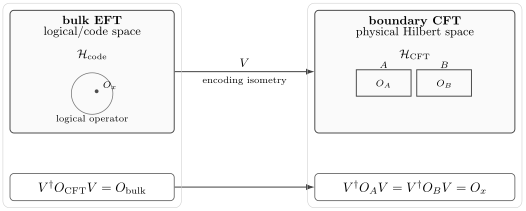
The holographic QEC dictionary. The semiclassical bulk Hilbert space is a code subspace embedded into the exact CFT Hilbert space by an isometry . Bulk fields are logical operators. Boundary operators acting on different physical regions can represent the same logical bulk observable, but only inside the code subspace.
1. The puzzle: too many ways to describe one bulk point
Section titled “1. The puzzle: too many ways to describe one bulk point”Suppose a scalar field excitation sits at a bulk point . In global HKLL reconstruction, one represents it by an operator smeared over the entire boundary:
In AdS-Rindler reconstruction, the same excitation can sometimes be represented using only a boundary subregion . Entanglement wedge reconstruction goes further: if
then there exists an operator supported on that represents the bulk operator at . If also lies in the entanglement wedge of another region , there is another representative .
Naively this sounds impossible. How can the same bulk degree of freedom live in many different boundary places? If and are both versions of , did the CFT clone a quantum degree of freedom?
The resolution is that the equalities are logical equalities, not microscopic equalities. The operators and need not be equal on the full CFT Hilbert space. They agree only after projecting to the image of the code subspace:
where
Equivalently,
Thus and are not two independent copies of an unknown quantum system. They are two physical implementations of the same logical observable, exactly as in a quantum error-correcting code.
This is the conceptual leap introduced by the quantum-error-correcting interpretation of AdS/CFT: bulk locality is not microscopic boundary locality. Bulk locality is a property of the encoded low-energy sector.
2. Code subspaces in AdS/CFT
Section titled “2. Code subspaces in AdS/CFT”The full CFT Hilbert space contains black holes of many masses, highly stringy states, multi-particle states with large backreaction, and states with no simple semiclassical description. A local bulk effective field theory on a chosen background describes only a tiny sector. This sector is the code subspace.
A simple code subspace might be generated by acting on a semiclassical state with a controlled number of low-energy bulk operators:
The cutoff is not just a technical nuisance. It is physical. If the code subspace includes too much energy or entropy, the geometry changes, the relevant HRT/QES surfaces move, and the reconstruction problem becomes a different problem.
There are several levels of code subspace:
- Small code subspace: a fixed classical geometry plus perturbative bulk fields.
- Medium code subspace: nearby geometries whose extremal surface remains stable.
- Large code subspace: states with enough entropy or backreaction to compete with area terms, where a fixed reconstruction can fail.
The encoding map
identifies a bulk effective state with the exact CFT state . When we write an operator equality such as
the precise version is usually
This single equation already contains much of the subtlety of bulk emergence. It says that the CFT operator reproduces the matrix elements of the bulk operator among the states where semiclassical bulk effective theory is valid.
3. Ordinary quantum error correction
Section titled “3. Ordinary quantum error correction”In ordinary quantum error correction one has:
- a logical Hilbert space ;
- a larger physical Hilbert space ;
- an encoding isometry ;
- a noise channel ;
- a recovery channel .
The code corrects the noise if
where
For an erasure error, the noise is especially simple. If the physical system factorizes as
and the region is lost, then
The erasure of is correctable if there exists a recovery map such that
for every logical state .
In the Heisenberg picture, this means every logical operator can be represented on the surviving physical region :
Thus erasure correction and operator reconstruction are two sides of the same statement.
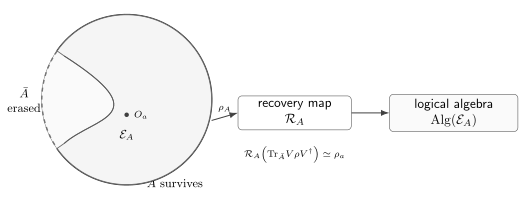
Erasure correction in holography. Losing the boundary region is correctable for bulk observables in . The surviving boundary region contains enough physical degrees of freedom to reconstruct the logical algebra of the corresponding entanglement wedge.
3.1 Knill–Laflamme condition
Section titled “3.1 Knill–Laflamme condition”For a finite-dimensional subspace code with projector and error operators , exact correctability is characterized by the Knill–Laflamme condition
This means that the errors can change the syndrome but cannot reveal information about the encoded state. If the environment learned which logical state was encoded, no recovery operation could restore an unknown quantum state.
For erasure of , a useful equivalent statement is the decoupling condition:
is independent of the logical state . In words, the erased region must contain no information about the logical state. If the erased region knows nothing, the complement can know everything.
This logic will reappear in the Page curve and island story. After the Page time, the radiation region can contain logical information about an interior island because the complementary black hole degrees of freedom no longer contain an independent copy of the relevant logical algebra.
4. The holographic dictionary as a code dictionary
Section titled “4. The holographic dictionary as a code dictionary”The quantum-error-correcting dictionary is:
| Quantum error correction | Holography |
|---|---|
| logical Hilbert space | bulk effective Hilbert space |
| physical Hilbert space | CFT Hilbert space |
| encoding isometry | AdS/CFT map |
| logical operator | bulk operator in the code subspace |
| physical operator | boundary CFT operator |
| erased physical qubits | missing boundary region |
| recoverable logical subsystem | bulk region in the entanglement wedge |
| code distance | size of boundary erasure that can be tolerated |
| syndrome | UV/boundary data not interpreted as bulk low-energy physics |
This dictionary is not merely an analogy. It is a structural statement about subregion duality. The boundary representation of a bulk operator is redundant because the code is designed to tolerate erasures.
For a boundary region , define the restriction channel
If the logical bulk subsystem lies in the entanglement wedge , then preserves the information in . There exists a recovery map whose adjoint gives boundary representatives:
The statement is local in the emergent bulk but nonlocal in the microscopic boundary degrees of freedom. This is why a bulk field can look local in the interior while being encoded redundantly in boundary CFT variables.
5. Secret sharing as the simplest model
Section titled “5. Secret sharing as the simplest model”A useful toy model is quantum secret sharing. Imagine a logical qutrit encoded into three physical qutrits so that any two parties can recover the secret, but any one party alone has no information.
One standard three-qutrit code is
For an arbitrary logical state
any single physical qutrit is maximally mixed:
Therefore one share contains no information about . But any two shares determine the third by linear constraints, so any two shares can recover the logical qutrit.
This captures the slogan:
Holographic subregion duality is a vastly more sophisticated, approximate, continuum version of this structure. A bulk logical operator can be reconstructed from different sufficiently large boundary regions, while too small a boundary region has no access to that operator.
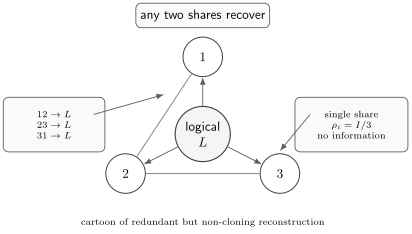
Quantum secret sharing gives the simplest cartoon of holographic redundancy. Any two boundary shares can reconstruct the central logical degree of freedom, but one share alone contains no information about it. Holographic codes replace this discrete toy model by a geometrical pattern governed by entanglement wedges.
6. Redundant representations and no-cloning
Section titled “6. Redundant representations and no-cloning”Suppose a bulk operator lies in the entanglement wedge of both and . Then there are boundary operators and satisfying
This redundancy is not cloning. The no-cloning theorem forbids a unitary operation that maps
for every unknown state . Holographic reconstruction does not do this. It gives multiple representations of one logical operator on one encoded state, not multiple independent physical copies of the state.
A precise way to say this is:
Thus and have the same matrix elements between encoded states, but they can differ wildly outside the code subspace. The difference operator
is a null operator on the code subspace. It is invisible to low-energy bulk effective theory.
This is exactly how ordinary quantum error-correcting codes work. A logical Pauli operator may be represented by many different physical Pauli strings, related by stabilizers. The physical strings are different operators, but they induce the same logical transformation.
The bulk version is subtler because the equivalence is approximate, state-dependent through the code subspace, and constrained by gravity. But the logical structure is the same.
7. Radial locality and code distance
Section titled “7. Radial locality and code distance”One of the original motivations for the QEC interpretation is radial locality. A bulk point close to the boundary is usually reconstructible from a relatively small boundary region. A bulk point deep in the interior requires a larger boundary region. A point near the center of global AdS may require more than half of the boundary.
This is what one expects from error correction. The deeper a logical degree of freedom sits in the bulk, the more protected it is against erasure of boundary regions. In code language, deeper bulk degrees of freedom have larger effective code distance.
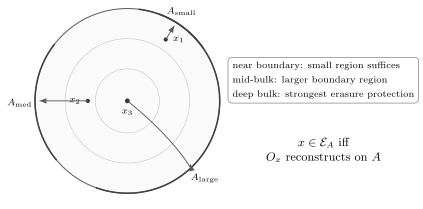
Radial locality as error correction. A near-boundary excitation can be reconstructed from a relatively small boundary interval, while a deeper excitation requires a larger boundary region. The radial direction is tied to the amount of boundary erasure the logical degree of freedom can tolerate.
This is only a heuristic unless the entanglement wedge is specified. The precise condition is:
For nested boundary regions,
entanglement wedge nesting gives
Thus if is reconstructible from , it is also reconstructible from the larger region . In error-correction language, adding physical qubits cannot make the logical information harder to recover.
8. Complementary recovery
Section titled “8. Complementary recovery”A particularly important QEC structure is complementary recovery. Suppose a bulk Cauchy slice is divided by an RT/HRT/QES surface into two wedge regions and , dual to boundary regions and :
Then operators in should be reconstructible on , while operators in should be reconstructible on :
This is stronger than merely saying that can recover . It says that the two complementary boundary regions recover complementary bulk algebras. Complementary recovery is one of the key inputs behind the quantum-error-correcting derivation of the RT formula.
At leading order, the boundary entropy of takes the schematic form
From the QEC viewpoint, the first term behaves like a universal entropy associated with the encoding itself, while is the logical entropy of the bulk degrees of freedom in the wedge. In the more precise operator-algebra formulation, the area term is related to a central element of the logical algebra. That refinement is important enough to deserve its own later page.
9. QEC and the RT formula
Section titled “9. QEC and the RT formula”The RT formula originally looked like a purely geometric statement:
But from the code perspective, this formula has an information-theoretic meaning. The entropy of a physical boundary region has two contributions:
- an encoding entropy, associated with the number of microscopic boundary states compatible with the same low-energy bulk data;
- a logical entropy, associated with the bulk degrees of freedom reconstructed in the wedge.
The quantum-corrected version is therefore natural:
In ordinary subspace QEC with a fixed area term, one can model this as
where is independent of the logical state. In holography the area term is generally an operator, and the correct treatment requires operator-algebra QEC:
Here is the abstract area operator and is the entropy of the bulk algebra in the entanglement wedge. This is not an optional mathematical decoration. It is forced by gauge constraints and by the fact that gravitational Hilbert spaces do not factorize cleanly across surfaces.
The basic moral remains simple:
10. Approximate codes and finite- corrections
Section titled “10. Approximate codes and finite-NNN corrections”Textbook QEC often studies exact finite-dimensional codes. Holographic QEC is not exact in that sense. Several approximations are layered together:
10.1 Large- approximation
Section titled “10.1 Large-NNN approximation”Classical bulk locality is sharp only in the large- limit. At finite , bulk locality is approximate, and the code has finite accuracy.
10.2 Semiclassical expansion
Section titled “10.2 Semiclassical expansion”The code subspace is defined around a semiclassical background. If states have enough energy or entropy to move the extremal surface, the original reconstruction can fail.
10.3 Gauge constraints
Section titled “10.3 Gauge constraints”Gauge-invariant bulk operators must be dressed. In gravity the dressing often reaches the boundary, so the naive tensor-factor language must be replaced by algebraic language.
10.4 Nonperturbative effects
Section titled “10.4 Nonperturbative effects”Exact quantum gravity may not contain an exact operator corresponding to a sharply localized bulk point. The low-energy local operator is an effective observable, valid within a controlled code subspace.
10.5 Complexity
Section titled “10.5 Complexity”The existence of a recovery map does not imply an efficient recovery map. This distinction becomes crucial for black hole interiors, Hayden–Preskill recovery, Python’s lunch, and the practical decoding of Hawking radiation.
A useful hierarchy is therefore:
Much confusion about black hole information comes from collapsing these three notions into one.
11. Relation to black hole information
Section titled “11. Relation to black hole information”The QEC viewpoint changes the way one reads the black hole information paradox.
In Hawking’s semiclassical description, an outgoing mode is paired with an interior partner . In a naive tensor-factor picture, if is also entangled with early radiation , monogamy appears to produce the firewall paradox.
The QEC lesson is that the interior partner need not be an independent microscopic tensor factor. It may be a logical degree of freedom with different reconstructions in different boundary or radiation regions.
This does not make the paradox disappear by a slogan. It reframes the question:
After the Page time, the island formula says that the entanglement wedge of the radiation contains an island :
Entanglement wedge reconstruction then says that operators in have representatives on the radiation region . This is a QEC statement:
It does not mean the interior information is visible as a simple local pattern in the Hawking quanta. It means the radiation subsystem contains the logical algebra of the island, possibly in a highly scrambled and computationally difficult form.
12. What the QEC picture does not say
Section titled “12. What the QEC picture does not say”The QEC interpretation is powerful, but it should not be oversold.
It does not say that the bulk is an ordinary stabilizer code. Stabilizer codes are useful toy models. The actual CFT encoding is dynamical, approximate, continuum, gauge constrained, and strongly interacting.
It does not by itself derive the CFT. QEC explains how bulk locality can be compatible with a boundary description once the duality exists. It is not a complete microscopic construction of every holographic CFT.
It does not make reconstruction unique. Redundancy is the point. Many physical operators can represent the same logical observable.
It does not eliminate gravitational dressing. Bulk operators must be gauge invariant, and gravitational dressing is part of the reconstruction problem.
It does not guarantee efficient decoding. A recovery channel can exist while being exponentially complex to implement.
It does not allow superluminal signaling. Entanglement wedge inclusion is not causal accessibility. The causal wedge and entanglement wedge answer different questions.
13. Common pitfalls
Section titled “13. Common pitfalls”Pitfall 1: “A bulk point is stored at a boundary point.”
No. A bulk point is encoded nonlocally in boundary degrees of freedom. In a good code, local boundary regions may contain no direct information about deep bulk degrees of freedom.
Pitfall 2: “Multiple reconstructions mean multiple copies.”
No. Multiple boundary representatives agree only inside the code subspace. They are not independent clones.
Pitfall 3: “The code subspace is the whole CFT Hilbert space.”
No. The code subspace is tiny compared with the full CFT Hilbert space. It is the regime where semiclassical bulk effective theory is valid.
Pitfall 4: “QEC is just a metaphor.”
No. The reconstruction conditions, relative-entropy equalities, and entropy formulas have precise QEC formulations. The toy models are metaphors; the code-subspace structure is mathematical.
Pitfall 5: “A recovery map gives a practical decoding algorithm.”
No. Existence and efficiency are different. Black hole decoding can be information-theoretically possible but computationally prohibitive.
14. Summary
Section titled “14. Summary”Holography realizes bulk effective field theory as a quantum error-correcting code:
The central reconstruction statement is
The QEC interpretation explains:
- why bulk operators can have many boundary representatives;
- why no-cloning is not violated;
- why radial locality is related to erasure protection;
- why entanglement wedge reconstruction is the natural form of subregion duality;
- why the RT/QES formula resembles an entropy formula for a code;
- why island reconstruction is a statement about logical algebras, not local signals.
The next pages sharpen this picture. The HaPPY code provides an exactly solvable tensor-network model of holographic QEC, while operator-algebra QEC explains why area terms, centers, and gauge constraints are not optional details but part of the exact grammar of gravitational subregion duality.
Exercises
Section titled “Exercises”Exercise 1. Matrix elements of a logical representative
Section titled “Exercise 1. Matrix elements of a logical representative”Let be an isometric encoding. Suppose is a physical operator satisfying
Show that for all logical states ,
Why does this not imply that is unique?
Solution
Using ,
The equality only fixes matrix elements inside the image of the code subspace. If is any physical operator satisfying
then represents the same logical operator. Thus logical representatives are equivalence classes of physical operators modulo operators that vanish on the code subspace.
Exercise 2. Decoupling criterion for erasure
Section titled “Exercise 2. Decoupling criterion for erasure”Consider an exact erasure-correcting code with physical Hilbert space . Show that if the erased region has reduced density matrix independent of the logical input state,
for all logical states , then contains no information about the logical state. Explain why this is necessary for recovery from .
Solution
The reduced state on is exactly the same state for every logical input . Therefore no measurement on can distinguish two logical states. In information-theoretic language, the channel to is constant.
If recovery from is possible, then losing cannot destroy the logical state. If nevertheless contained information about the logical state, the encoded state would distribute information into both and in a way that would conflict with the no-cloning/no-broadcasting constraints for unknown quantum states. Exact QEC makes this precise: correctability of erasure on is equivalent to decoupling of from the logical reference system.
Exercise 3. One share of the three-qutrit secret-sharing code
Section titled “Exercise 3. One share of the three-qutrit secret-sharing code”For the three-qutrit code
show that for any logical basis state , the reduced density matrix of the first qutrit is . Why does the same conclusion hold for an arbitrary logical superposition?
Solution
For each logical basis state, the first qutrit takes the values exactly once with equal amplitude. For example,
Tracing out qutrits 2 and 3 kills cross terms because the corresponding states of qutrits 2 and 3 are orthogonal. Hence
\rho_1= rac{1}{3}\left(|0\rangle\langle0|+|1\rangle\langle1|+|2\rangle\langle2|\right)=\frac{I_3}{3}.For an arbitrary superposition , cross terms between different logical basis states also vanish after tracing out qutrits 2 and 3. This follows because, for fixed first-qutrit value, the remaining two-qutrit states associated with different logical labels are orthogonal. Therefore the first share is always maximally mixed and contains no information about the logical state.
Exercise 4. Redundant representatives and no-cloning
Section titled “Exercise 4. Redundant representatives and no-cloning”Suppose and are two physical representatives of a logical operator :
Show that has vanishing matrix elements between encoded states. Explain in one paragraph why this avoids the no-cloning paradox.
Solution
Subtracting the two equations gives
Therefore, for any logical states ,
The two operators are not two independent copies of the logical degree of freedom. They are two representatives with identical action on the encoded subspace. Outside the code subspace they may differ. The no-cloning theorem forbids copying an unknown quantum state into two independent systems; it does not forbid multiple physical representatives of one logical observable in a redundant encoding.
Exercise 5. Radial position and minimal boundary size
Section titled “Exercise 5. Radial position and minimal boundary size”Consider a family of boundary regions in a static holographic geometry, where measures the angular size of the region. Suppose a bulk point lies in only for . Interpret as an error-correction diagnostic. What should happen to as moves deeper into the bulk?
Solution
The condition means operators near can be reconstructed on . Thus is the minimal boundary region size needed to recover the logical information at .
If moves deeper into the bulk, it should generally require a larger boundary region for reconstruction. Therefore increases. In QEC language, deep bulk degrees of freedom are more protected against erasure of boundary regions: small boundary regions do not contain enough information to reconstruct them, while sufficiently large regions do.
Exercise 6. Code subspace size and area budget
Section titled “Exercise 6. Code subspace size and area budget”Suppose a wedge reconstruction is valid for a code subspace whose bulk entropy in is much smaller than the area term:
Explain why enlarging the code subspace until is comparable to the area term can invalidate the original reconstruction.
Solution
The entanglement wedge is determined by a generalized entropy competition. If the bulk entropy contribution is small compared with the area term, the extremal surface and wedge are stable under changes of the code state. A single reconstruction map can then work throughout the code subspace.
If the code subspace is enlarged so much that
then the generalized entropy of competing surfaces can change by an amount comparable to the classical area difference. The dominant QES may move or jump. The bulk region dual to is then not fixed across the enlarged code subspace, so the original reconstruction map need not remain valid.
Further reading
Section titled “Further reading”- A. Almheiri, X. Dong, and D. Harlow, “Bulk Locality and Quantum Error Correction in AdS/CFT,” arXiv:1411.7041.
- F. Pastawski, B. Yoshida, D. Harlow, and J. Preskill, “Holographic quantum error-correcting codes: Toy models for the bulk/boundary correspondence,” arXiv:1503.06237.
- X. Dong, D. Harlow, and A. C. Wall, “Reconstruction of Bulk Operators within the Entanglement Wedge in Gauge-Gravity Duality,” arXiv:1601.05416.
- D. Harlow, “The Ryu–Takayanagi Formula from Quantum Error Correction,” arXiv:1607.03901.
- D. Harlow, “TASI Lectures on the Emergence of the Bulk in AdS/CFT,” arXiv:1802.01040.
- J. Cotler, P. Hayden, G. Penington, G. Salton, B. Swingle, and M. Walter, “Entanglement Wedge Reconstruction via Universal Recovery Channels,” arXiv:1704.05839.