
Why AdS3 Is Special
AdS/CFT is the low-dimensional laboratory where holography becomes unusually sharp. The bulk gravity theory is only three-dimensional, so Einstein gravity has no local propagating gravitons. The boundary theory is two-dimensional, so conformal symmetry is infinite-dimensional. Put these together and something remarkable happens: a theory that looks locally almost empty in the bulk has a huge algebra of boundary excitations.
That is the first lesson of AdS/CFT:
The physics migrates to global geometry, black holes, boundary conditions, asymptotic symmetries, and the Virasoro algebra. This is why AdS/CFT is a beautiful place to learn the difference between a gauge redundancy and a physical boundary degree of freedom.
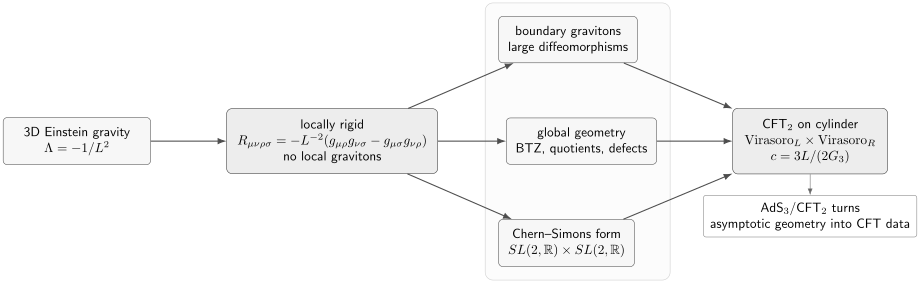
AdS gravity is locally rigid but globally and asymptotically rich. The absence of local gravitons does not remove black holes, boundary gravitons, or the Virasoro symmetry of the dual CFT.
The setup
Section titled “The setup”The simplest bulk theory is three-dimensional Einstein gravity with negative cosmological constant:
Here is the AdS radius and is Newton’s constant in three bulk dimensions. The equations of motion are
or equivalently
Global AdS may be written as
At large ,
so after conformal compactification the boundary is the Lorentzian cylinder
This is exactly the natural spacetime for a two-dimensional CFT in radial quantization.
Why three-dimensional gravity has no local gravitons
Section titled “Why three-dimensional gravity has no local gravitons”In four or more dimensions, the Riemann tensor has components not fixed by the Ricci tensor. These components are packaged in the Weyl tensor, and they contain local gravitational-wave degrees of freedom.
In three dimensions, the Weyl tensor vanishes identically. The full Riemann tensor is determined algebraically by the Ricci tensor:
For the AdS Einstein equation this gives
Thus every solution of the vacuum equations is locally AdS. There are no local gravitational waves. A small fluctuation of the metric is locally pure gauge, once the constraints and equations of motion are imposed.
This does not mean that the theory is trivial. It means that the interesting data are not local curvature waves. They are:
- global identifications of AdS;
- boundary conditions at infinity;
- asymptotic symmetries and their charges;
- black holes obtained as quotients of AdS;
- boundary gravitons generated by large diffeomorphisms.
The phrase “large diffeomorphism” is important. A small diffeomorphism is a gauge redundancy. A large diffeomorphism that changes the boundary data or carries a nonzero canonical charge is a physical transformation.
The boundary is a two-dimensional CFT
Section titled “The boundary is a two-dimensional CFT”Two-dimensional conformal field theory is also exceptional. In , the global conformal group is finite-dimensional. In Lorentzian two dimensions, using light-cone coordinates
local conformal transformations act independently on the two null coordinates:
Quantum mechanically, the corresponding symmetry algebra is two copies of the Virasoro algebra:
The constants and are the left- and right-moving central charges. They measure the number of degrees of freedom, control the Weyl anomaly, and determine the high-energy density of states through the Cardy formula.
The miracle of AdS/CFT is that these Virasoro algebras appear directly from the asymptotic symmetries of AdS gravity.
The Brown–Henneaux surprise
Section titled “The Brown–Henneaux surprise”Brown and Henneaux studied the canonical charges of three-dimensional gravity with asymptotically AdS boundary conditions. The result is
with
for parity-invariant Einstein gravity.
This is not merely the statement that the boundary metric has two-dimensional conformal symmetry. It is stronger. The asymptotic diffeomorphisms of the bulk have finite canonical charges, and their charge algebra has a classical central extension. The central term is already present before quantization.
This central charge is one of the cleanest formulas in holography:
It says that the semiclassical gravity limit is the large-central-charge limit of the boundary CFT.
Boundary gravitons
Section titled “Boundary gravitons”Since pure AdS gravity has no local gravitons, one might guess that there are no graviton states at all. Brown–Henneaux teaches the opposite.
Start with global AdS. Act with an asymptotic diffeomorphism that preserves the allowed falloff conditions but is not pure gauge. The resulting geometry is still locally AdS, but it carries different boundary stress-tensor data. In the CFT language, these states are Virasoro descendants of the vacuum.
Schematically,
This is a central conceptual point. In AdS, “gravitons” are not local propagating particles in the interior. They are boundary gravitons associated with nontrivial asymptotic symmetry charges.
Global geometry still matters
Section titled “Global geometry still matters”Local triviality does not prevent nontrivial global solutions. Important examples include:
Global AdS
Section titled “Global AdS3_33”Global AdS is the vacuum geometry. In the dual CFT on the cylinder, it corresponds to the vacuum state. Because the cylinder has Casimir energy, the vacuum has shifted Virasoro zero modes relative to the plane.
Conical defects
Section titled “Conical defects”Point-particle-like sources and quotient geometries can create conical defects. These are locally AdS away from the defect but globally distinct.
BTZ black holes
Section titled “BTZ black holes”The BTZ black hole is locally AdS outside singular identifications, yet it has horizons, temperature, entropy, and angular momentum. This is astonishing from a higher-dimensional perspective: black-hole thermodynamics appears in a spacetime with no local curvature waves.
The rotating BTZ black hole is characterized by left- and right-moving temperatures and . Its entropy is reproduced by the Cardy formula of a CFT with Brown–Henneaux central charge. This will be one of the main payoffs of the AdS/CFT unit.
Chern–Simons formulation
Section titled “Chern–Simons formulation”Three-dimensional gravity is also special because it can be rewritten as a gauge theory. For negative cosmological constant, define
where is the dreibein and is the spin connection. Then the Einstein-Hilbert action can be written, up to boundary terms, as
with gauge group
The Chern–Simons level is
The Brown–Henneaux central charge may then be written as
This form is useful because Chern–Simons theory is topological in the bulk but can induce dynamical degrees of freedom at the boundary. That is exactly the AdS story in another language.
Why this is a holographic laboratory
Section titled “Why this is a holographic laboratory”AdS/CFT is useful for several reasons.
First, many calculations are exact or nearly exact. Two-dimensional CFT gives powerful tools: Virasoro symmetry, modular invariance, operator product expansions, conformal blocks, and the Cardy formula.
Second, the bulk is simple enough that global questions become visible. Black holes, quotient geometries, boundary gravitons, and modular sums can often be studied explicitly.
Third, the setup teaches lessons that reappear in higher dimensions:
But AdS/CFT is also dangerous if overgeneralized. Many of its strongest results depend on features special to three bulk dimensions and two boundary dimensions. In higher-dimensional AdS/CFT, the boundary conformal group is finite-dimensional, the bulk has local gravitons, and there is usually no full Virasoro algebra organizing the entire theory.
Pure gravity versus stringy AdS
Section titled “Pure gravity versus stringy AdS3_33”A final warning: “AdS/CFT” is not a single theory.
There are string-theoretic AdS backgrounds, such as those involving D1/D5 systems or NS5/F1 systems. These have rich spectra, supersymmetry in many examples, and well-defined microscopic constructions.
There is also the idea of pure three-dimensional Einstein gravity with negative cosmological constant. This theory is extremely attractive because it appears simple, but its exact quantum definition is subtle. Not every modular-invariant-looking partition function is a healthy CFT. Not every semiclassical saddle sum defines a unitary theory.
For this foundations course, the safe attitude is:
while
Dictionary checkpoint
Section titled “Dictionary checkpoint”The first AdS/CFT dictionary is:
| Bulk AdS concept | Boundary CFT concept |
|---|---|
| global AdS | CFT vacuum on the cylinder |
| central charge | |
| Brown–Henneaux asymptotic symmetry | VirasoroVirasoro |
| boundary gravitons | Virasoro descendants |
| BTZ black holes | high-energy thermal CFT states |
| quotient geometry | state or ensemble with nontrivial global data |
| Chern–Simons level |
This table is the entry point. The next pages derive the central charge, then use it to understand BTZ black holes and the Cardy entropy formula.
Common confusions
Section titled “Common confusions”“No local gravitons means no quantum gravity.”
Section titled ““No local gravitons means no quantum gravity.””No. It means there are no local propagating graviton wave packets in pure three-dimensional Einstein gravity. The theory can still have boundary gravitons, black holes, topological sectors, and nontrivial quantum states.
“Every diffeomorphism is gauge.”
Section titled ““Every diffeomorphism is gauge.””Small diffeomorphisms with vanishing charges are gauge redundancies. Large diffeomorphisms that act nontrivially at the boundary and carry finite charges are physical symmetries. Brown–Henneaux boundary gravitons come from precisely such transformations.
“The Virasoro algebra is just the global AdS isometry algebra.”
Section titled ““The Virasoro algebra is just the global AdS3_33 isometry algebra.””The exact isometry algebra of global AdS is finite-dimensional:
The Brown–Henneaux algebra is larger. It is the asymptotic symmetry algebra, not the exact isometry algebra of one fixed metric.
“AdS/CFT is representative of all AdS/CFT.”
Section titled ““AdS3_33/CFT2_22 is representative of all AdS/CFT.””It is representative of some deep ideas: boundary conditions, stress tensors, black-hole entropy, and holographic entanglement. It is not representative of everything. Higher-dimensional bulk gravity has local gravitons, and higher-dimensional CFTs do not have the infinite-dimensional Virasoro symmetry of CFT.
Exercises
Section titled “Exercises”Exercise 1: Why are all vacuum solutions locally AdS?
Section titled “Exercise 1: Why are all vacuum solutions locally AdS3_33?”Use the three-dimensional identity expressing in terms of and . Show that the vacuum Einstein equation with implies constant negative curvature.
Solution
The vacuum equation is
Taking the trace in three dimensions gives
so
Substituting back gives
In three dimensions,
Plugging in and gives
This is the Riemann tensor of constant negative curvature. Therefore every vacuum solution is locally AdS.
Exercise 2: What is the large- limit?
Section titled “Exercise 2: What is the large-ccc limit?”The Brown–Henneaux central charge is
What is the boundary interpretation of the semiclassical gravity limit ?
Solution
If , then
Thus semiclassical AdS gravity corresponds to a large-central-charge CFT. This is the AdS/CFT analogue of the large- limit in higher-dimensional gauge/gravity duality. The central charge counts the effective number of degrees of freedom and controls the size of stress-tensor fluctuations.
Exercise 3: Exact isometries versus asymptotic symmetries
Section titled “Exercise 3: Exact isometries versus asymptotic symmetries”Explain why the exact isometry group is not the same thing as the Brown–Henneaux asymptotic symmetry group.
Solution
The exact isometry group preserves a specific metric, such as global AdS, exactly. For global AdS this group is
The Brown–Henneaux asymptotic symmetry group is defined more broadly. It consists of diffeomorphisms that preserve a class of asymptotically AdS boundary conditions, not necessarily one exact metric. These transformations can change subleading data in the metric and carry finite canonical charges. Their algebra is two copies of the Virasoro algebra, whose global subgroup is generated by the modes and .
Further reading
Section titled “Further reading”- J. D. Brown and M. Henneaux, Central Charges in the Canonical Realization of Asymptotic Symmetries: An Example from Three-Dimensional Gravity.
- E. Witten, -Dimensional Gravity as an Exactly Soluble System.
- E. Witten, Three-Dimensional Gravity Revisited.
- M. Bañados, C. Teitelboim, and J. Zanelli, The Black Hole in Three Dimensional Space-Time.
- S. Carlip, Conformal Field Theory, -Dimensional Gravity, and the BTZ Black Hole.
- O. Aharony, S. S. Gubser, J. Maldacena, H. Ooguri, and Y. Oz, Large Field Theories, String Theory and Gravity.