
Page Curve and Fine-Grained Entropy
The previous page made the information-loss problem sharp: in Hawking’s leading semiclassical description, each outgoing mode is purified by a partner behind the horizon, so the entropy of the collected radiation grows monotonically. But if black hole formation and evaporation are described by ordinary unitary quantum mechanics, the final radiation produced from a pure initial state must itself be pure.
The Page curve is the simplest quantitative way to see the conflict. It is the expected time-dependence of the fine-grained von Neumann entropy of the Hawking radiation,
The Page curve rises at early times, reaches a maximum near the Page time, and then decreases to zero when the black hole has fully evaporated. It is not a curve of luminosity, temperature, or coarse-grained thermodynamic entropy. It is a diagnostic of purification.
Guiding question
Section titled “Guiding question”If the Hawking radiation looks locally thermal, why should its fine-grained entropy ever decrease?
The short answer is that a subsystem of a closed quantum system cannot remain almost maximally mixed after the complementary subsystem has become too small to purify it. In a unitary evaporation process, the remaining black hole Hilbert space eventually has fewer available states than the radiation Hilbert space. After that time, the radiation must begin to purify itself through correlations among early and late quanta.
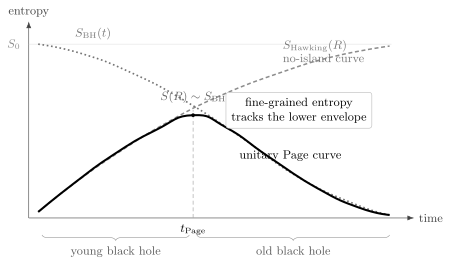
The Hawking calculation gives a monotonically increasing fine-grained entropy for the radiation because each outgoing mode is purified by an interior partner. A unitary evaporation process instead predicts a Page curve: after the Page time, late radiation must be correlated with early radiation, and decreases as the remaining black hole entropy decreases.
Which entropy?
Section titled “Which entropy?”The word “entropy” does too much work in black hole physics. This page uses three related but distinct notions.
The fine-grained entropy of a density matrix is
For a closed system evolving unitarily,
all eigenvalues of are unchanged. Therefore the fine-grained entropy of the entire closed system is constant. In particular, a pure state stays pure and has
A subsystem can have nonzero fine-grained entropy because it is entangled with its complement. If the total system factorizes as
then the radiation density matrix is
The entropy measures entanglement between the radiation and the remaining black hole degrees of freedom , assuming the total state is pure.
The coarse-grained entropy counts macroscopic ignorance. For radiation it is the entropy one would assign after keeping only thermodynamic data such as energy, particle number, angular distribution, or a small number of low-point correlators. It can increase even if the exact microscopic state is pure. Ordinary burning is like this: the emitted photons are approximately thermal in simple observables, but the complete radiation state is pure if the process is treated as a closed quantum system.
The Bekenstein-Hawking entropy
is thermodynamic and also counts, in a holographic theory, the logarithm of the number of black hole microstates available at fixed macroscopic charges. In Page’s argument it is used as an estimate
The Page curve concerns the first notion: the fine-grained von Neumann entropy of the collected Hawking radiation.
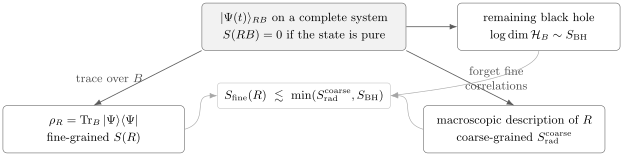
Fine-grained entropy, coarse-grained entropy, and black hole thermodynamic entropy answer different questions. The Page curve tracks , the entropy of the reduced density matrix of the collected radiation. It can decrease even while coarse-grained thermodynamic entropy continues to behave irreversibly.
Bipartite pure states and the Schmidt decomposition
Section titled “Bipartite pure states and the Schmidt decomposition”The elementary linear algebra behind the Page curve is the Schmidt decomposition. For a pure state in
one can write
where
and
The reduced density matrices are
They have the same nonzero eigenvalues, so
This simple equality has a huge consequence. If the total state is pure, the radiation entropy cannot exceed the logarithm of the dimension of the remaining black hole Hilbert space:
It also cannot exceed the logarithm of the effective dimension of the radiation Hilbert space:
Therefore
At early times is small and the radiation can be nearly maximally mixed. At late times is small and the radiation cannot remain nearly maximally mixed. The curve must turn over if the process is unitary and the black hole has finite entropy.
Page theorem
Section titled “Page theorem”Page’s theorem makes this typicality statement precise. Consider a random pure state in
with
Averaging over the Haar measure on pure states, the mean entropy of subsystem is
Equivalently, using harmonic numbers
one may write
For
this becomes
Thus the smaller subsystem is almost maximally mixed. Its entropy is only
below the maximum.
In bits rather than natural logarithms, divide all entropies by .
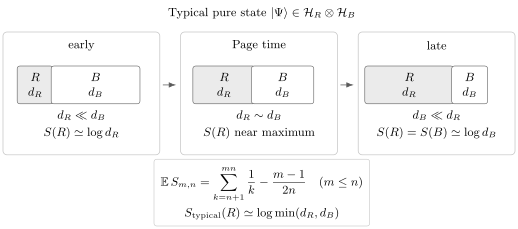
For a typical pure state in , the smaller subsystem is almost maximally mixed. The entropy is approximately when , approximately when , and of order the common entropy near the Page time.
Page’s theorem is not a dynamical theorem about black holes. It does not say that black holes literally sample the Haar measure on their full Hilbert space at every moment. Its role is more modest and more powerful: it tells us what a generic unitary evaporation process should look like if the black hole behaves like a finite quantum system that scrambles information efficiently.
The black hole as a shrinking purifier
Section titled “The black hole as a shrinking purifier”Let denote the Hawking radiation collected up to time , and let denote the remaining black hole. In a unitary description of evaporation from a pure initial state, the combined state is approximately pure:
The black hole Hilbert space dimension is estimated by
The radiation has a coarse-grained entropy that grows as more quanta are emitted. This quantity is close to what Hawking’s semiclassical calculation computes when it treats each emitted quantum as thermally entangled with an interior partner.
The Page estimate is then
up to order-one and smoothing corrections near the transition.
This formula is not yet the island formula. It is a Hilbert-space estimate. But it already contains the target that islands must reproduce. The later island formula will compute this same minimum from a generalized entropy extremization:
The no-island saddle gives the Hawking curve. The island saddle gives the late-time descending branch.
Early times: why Hawking’s answer is plausible
Section titled “Early times: why Hawking’s answer is plausible”At early times the radiation Hilbert space is the smaller subsystem:
A typical pure state on then has
Physically, the radiation is nearly maximally entangled with the still-large black hole. It is therefore unsurprising that the radiation looks thermal and carries little accessible information about the initial state. This is the regime where Hawking’s calculation and Page’s unitary estimate agree.
This point is worth emphasizing. The Page curve does not require early Hawking radiation to be obviously nonthermal. On the contrary, typicality predicts that early radiation from a young black hole should look almost exactly thermal in fine-grained entropy as well as in simple observables.
The Page time
Section titled “The Page time”The Page time is the time when the two competing entropies are comparable:
Equivalently, it is the time when the radiation Hilbert space and the remaining black hole Hilbert space have comparable effective dimensions:
A simple four-dimensional Schwarzschild estimate illustrates the scale. In units ,
and the evaporation law has the parametric form
If we use the reversible toy estimate
then the Page time satisfies
so
Since the remaining lifetime scales as , this gives
This number is not universal. Real Hawking radiation is not a perfectly reversible blackbody process; greybody factors and species content affect the relation between radiated coarse entropy and the decrease of . The robust statement is parametric: the Page time is of order the evaporation time,
in four spacetime dimensions, but it occurs while the black hole is still macroscopic for .
That last point is crucial. The Page-time conflict is not confined to the final Planckian burst.
Late times: purification by the radiation
Section titled “Late times: purification by the radiation”After the Page time, the remaining black hole is the smaller subsystem:
For a typical pure state,
As the black hole loses area, decreases, so must decrease. The late outgoing modes must be correlated with the early radiation in such a way that adding more radiation can reduce the entropy of the total collected radiation.
This is counterintuitive only if one thinks of entropy as the entropy of each emitted quantum separately. The entropy of a union can decrease when a new subsystem is added. For example, if is entangled with an external system and the next emitted subsystem contains purification information, then
is perfectly possible.
In black hole language, late radiation must be entangled more with early radiation than with a new independent interior partner. This is exactly what the leading Hawking pair picture fails to produce.
A reference-system diagnostic
Section titled “A reference-system diagnostic”A clean way to talk about information is to introduce an external reference system . Suppose the collapsing matter is initially entangled with . The reference never interacts with the black hole; it is just a bookkeeping device that remembers the initial quantum information.
If evaporation is unitary, then after complete evaporation the radiation must purify the reference:
assuming the initial state of the entire universe was pure after identifying with the final radiation. Equivalently, the mutual information
must eventually become large enough to encode the initial state.
For a young black hole, Page typicality says that the early radiation is almost decoupled from :
For an old black hole, new radiation can reveal information rapidly because the black hole is already highly entangled with the earlier radiation. This observation is the starting point for the Hayden-Preskill protocol, which is the topic of the next page.
Hawking curve versus Page curve
Section titled “Hawking curve versus Page curve”The Hawking curve is obtained by repeating the local pair-entanglement step. If is the th outgoing mode and its interior partner, the leading state has the schematic form
Tracing over the interior partners gives
The entropy grows monotonically. This is the Hawking curve.
The Page curve instead requires that, after the Page time, the new outgoing mode is not primarily purified by a new independent interior degree of freedom. It must be correlated with the previously emitted radiation . In entropy language one needs
for sufficiently late emissions.
This is why small independent corrections to each Hawking pair cannot solve the problem. The Page curve demands an order-one change in the fine-grained purification structure after the Page time. That order-one change can be invisible in simple local observables, but it cannot be invisible to the entropy of the entire collected radiation.
Coarse thermality is compatible with microscopic purity
Section titled “Coarse thermality is compatible with microscopic purity”One of the most common confusions is the statement “the radiation is thermal, therefore information is lost.” That statement is false without qualification.
A density matrix can look thermal after coarse-graining while the exact global state is pure. For a box of gas, a star, or a piece of coal, low-point observables relax toward thermal values because the system has many degrees of freedom. The exact final radiation still contains subtle correlations.
Black holes are different not because the spectrum is approximately Planckian. They are different because the semiclassical geometry gives a specific purifier for each outgoing quantum: the partner behind the horizon. If that remains true until complete evaporation, the radiation is mixed in a fine-grained sense.
Thus the Page curve asks a sharper question:
When computing for the entire collected radiation, what purifies the late Hawking quanta?
In Hawking’s leading calculation: the interior partners.
In a unitary evaporation process: the earlier radiation, after the Page time.
In the island formula: the radiation’s entanglement wedge includes an island inside the gravitating region, so the entropy calculation reorganizes which degrees of freedom are counted as part of the radiation system.
The Page curve as a constraint, not a mechanism
Section titled “The Page curve as a constraint, not a mechanism”The Page curve is sometimes described as “the resolution” of the information paradox. More precisely, it is a unitarity constraint. A proposed resolution must explain how the fine-grained radiation entropy follows the Page curve while preserving the successes of semiclassical gravity.
The Page theorem alone does not tell us:
- which microscopic degrees of freedom encode the information;
- how a semiclassical observer reconstructs the interior;
- why the gravitational path integral knows about the unitary answer;
- whether the relevant correlations are efficiently decodable;
- how factorization works in gravitational path integrals;
- what happens in realistic asymptotically flat quantum gravity.
It tells us what the answer must look like if evaporation is unitary and the black hole has finite entropy.
This distinction is historically important. Page’s argument predicted the shape of the entropy curve long before the modern island formula. The island and replica-wormhole developments are powerful because they reproduce the Page curve from a gravitational entropy calculation rather than merely postulating it from Hilbert-space typicality.
Relation to the generalized second law
Section titled “Relation to the generalized second law”The generalized second law says that
should not decrease in ordinary semiclassical processes. During evaporation, the area term decreases while entropy appears outside the black hole.
The Page curve is not a violation of this principle. It tracks a different entropy. The decreasing late-time branch is the fine-grained entropy of the entire collected radiation, not the coarse-grained thermodynamic entropy of a gas of photons or gravitons.
A useful slogan is:
while
Both statements can be true in a unitary theory of gravity.
Common pitfalls
Section titled “Common pitfalls”Pitfall 1: “The Page curve is the entropy of each Hawking quantum.”
No. It is the entropy of the entire collected radiation region . Individual late quanta can still look locally thermal.
Pitfall 2: “A thermal spectrum contradicts the Page curve.”
No. A state can have nearly thermal low-point observables while containing fine-grained correlations. The Page curve concerns the exact density matrix of all the radiation.
Pitfall 3: “The Page theorem proves black holes are random matrices.”
No. The theorem is a typicality result. It gives a robust expectation for generic unitary evaporation, not a microscopic model of black hole dynamics.
Pitfall 4: “The Page time is when the black hole is Planckian.”
No. For a large initial black hole, the Page time is of order the evaporation time but occurs while the remaining black hole is still large.
Pitfall 5: “The Page curve says information comes out smoothly from the beginning.”
Not in the usual typicality estimate. Early radiation is almost maximally mixed and carries very little recoverable information about the initial state. Information becomes accessible only after the Page time, and decoding it can be computationally hard.
Pitfall 6: “The Page curve by itself explains the interior.”
No. The Page curve constrains entropy. Interior reconstruction requires additional ideas: entanglement wedges, quantum error correction, modular flow, islands, and possibly state-dependent or algebraic structures.
Exercises
Section titled “Exercises”Exercise 1. Schmidt decomposition and equal entropies
Section titled “Exercise 1. Schmidt decomposition and equal entropies”Let
be a Schmidt decomposition. Show that
Solution
Tracing over gives
Tracing over gives
The two reduced density matrices have the same nonzero eigenvalues . Therefore
Exercise 2. The Page-theorem approximation
Section titled “Exercise 2. The Page-theorem approximation”For , Page’s formula is
Using
show that for ,
Solution
Use the asymptotic expansion
and
Then
Subtracting the Page correction gives
The two terms proportional to combine as
Thus
For the regime , this is usually written as
with the precise subleading bookkeeping depending on how and are taken large.
Exercise 3. Deriving the min rule from typicality
Section titled “Exercise 3. Deriving the min rule from typicality”Assume the radiation and remaining black hole are described by a typical pure state in
with effective dimensions
Use Page’s theorem to justify
Solution
If , Page’s theorem says that the smaller subsystem is almost maximally mixed:
If , then the smaller subsystem is . Since the total state is pure,
Page’s theorem applied to gives
Combining the two regimes gives
Exercise 4. Page time in a reversible Schwarzschild toy model
Section titled “Exercise 4. Page time in a reversible Schwarzschild toy model”Suppose a four-dimensional Schwarzschild black hole has
and evaporation law
where is a positive constant. In the toy model
find and .
Solution
The Page time is defined by
Using the toy model,
so
Since ,
Now integrate the evaporation law:
The time to evaporate from to is
The total evaporation time is
Therefore
Numerically this is approximately .
Exercise 5. Entropy can decrease when a subsystem is added
Section titled “Exercise 5. Entropy can decrease when a subsystem is added”Give a simple example in which adding a subsystem decreases the entropy:
Explain why this is relevant to the late Page curve.
Solution
Let be one qubit of a Bell pair and be the other. Before adding , the reduced state of is maximally mixed:
so
The joint state is pure:
so
Thus
For an old black hole, the newly emitted late radiation can play the role of : it can purify part of the previously emitted radiation. This is how the entropy of the collected radiation can decrease after the Page time.
Exercise 6. Reference-system information
Section titled “Exercise 6. Reference-system information”Let be a reference system entangled with the matter that formed the black hole. Why does unitarity imply that must eventually be purified by the Hawking radiation?
Solution
The reference system does not interact with the black hole. It is introduced so that the initial black hole-forming matter can be regarded as part of a larger pure state. If the black hole evaporates completely and the dynamics is unitary, the final degrees of freedom, apart from , are the Hawking radiation .
Since unitary evolution preserves purity of the total state, the final state on
must be pure. Therefore
and
The information initially correlated with must be encoded in correlations within the final radiation. If the radiation remained in the mixed state predicted by the naive Hawking curve, this purification would fail.
Further reading
Section titled “Further reading”- D. N. Page, “Average Entropy of a Subsystem,” Physical Review Letters 71 (1993), 1291–1294. arXiv:gr-qc/9305007.
- D. N. Page, “Information in Black Hole Radiation,” Physical Review Letters 71 (1993), 3743–3746. arXiv:hep-th/9306083.
- S. K. Foong and S. Kanno, “Proof of Page’s Conjecture on the Average Entropy of a Subsystem,” Physical Review Letters 72 (1994), 1148–1151. DOI: 10.1103/PhysRevLett.72.1148.
- S. Sen, “Average Entropy of a Quantum Subsystem,” Physical Review Letters 77 (1996), 1–3. arXiv:hep-th/9601132.
- J. Preskill, “Do Black Holes Destroy Information?” arXiv:hep-th/9209058.
- S. D. Mathur, “The Information Paradox: A Pedagogical Introduction,” arXiv:0909.1038.
- A. Almheiri, R. Mahajan, J. Maldacena, and Y. Zhao, “The Page Curve of Hawking Radiation from Semiclassical Geometry,” JHEP 03 (2020), 149. arXiv:1908.10996.
- A. Almheiri, T. Hartman, J. Maldacena, E. Shaghoulian, and A. Tajdini, “The Entropy of Hawking Radiation,” Reviews of Modern Physics 93 (2021), 035002. arXiv:2006.06872.
The next page studies fast scrambling and Hayden-Preskill recovery. Page’s theorem tells us when information should begin to emerge. Hayden and Preskill explain why, for an old black hole, newly thrown-in information can return after only a scrambling time, provided one already has access to the early radiation.