
Rényi Entropy, Replicas, and Cosmic Branes
The von Neumann entropy is the number that appears in RT, HRT, FLM, QES, and the island formula. But the most powerful derivations rarely compute it directly. They compute a family of quantities first,
and then take the limit . These are the Rényi entropies. They are more than a technical detour: they probe the spectrum of the reduced density matrix, reveal phase transitions invisible in a single entropy, and give the gravitational path integral a natural replica geometry.
For holography, the replica trick has a special importance. The Lewkowycz–Maldacena argument derives the RT formula by studying gravitational saddles whose boundaries are -fold branched covers. Dong’s cosmic-brane prescription then generalizes this logic away from : a backreacting codimension-two brane computes a refined Rényi entropy,
Here is a cosmic brane in the replica quotient geometry, and is its tension in Einstein gravity. As , the brane becomes tensionless, its backreaction disappears, and reduces to the RT/HRT surface.
This page explains the replica construction, the geometric origin of the area term, the difference between ordinary and refined Rényi entropies, and why this technology is the direct ancestor of replica wormholes.
Guiding question
Section titled “Guiding question”How can a boundary quantity like know about a bulk codimension-two surface?
The answer comes in three steps.
First, in ordinary QFT, is represented by a path integral on an -fold branched cover. The sheets are glued cyclically along the entangling region .
Second, in AdS/CFT, the same boundary branched cover is used as the asymptotic boundary condition for a gravitational path integral. At large , the answer is dominated by a classical bulk saddle.
Third, if the bulk saddle has a replica symmetry, the quotient by contains a codimension-two fixed locus. Near , regularity of the covering geometry forces this fixed locus to be an extremal surface, and differentiating the gravitational action produces its area divided by .
The slogan is short:
But the details matter. Most confusions about islands and replica wormholes begin with a too-casual use of this slogan.
Rényi entropies as spectral data
Section titled “Rényi entropies as spectral data”Let be a spatial region of the boundary theory and let
be the reduced density matrix. The Rényi entropy of order is
For a density matrix with eigenvalues ,
so varying probes different parts of the spectrum. Large emphasizes the largest eigenvalues; small positive is more sensitive to the number of nonzero eigenvalues. The von Neumann entropy is recovered by analytic continuation:
It is often useful to write , the modular Hamiltonian. Then
This makes look like an inverse temperature for the modular Hamiltonian. In this language, is a free-energy-like quantity, while the refined Rényi entropy introduced below is an entropy-like quantity. This distinction is precisely why the cosmic-brane formula is naturally written for , not directly for .
Near , Rényi entropies know not only the von Neumann entropy but also fluctuations of the modular Hamiltonian. Expanding around gives
where
is sometimes called the capacity of entanglement. Thus the replica family contains more information than a single entropy.
The QFT replica construction
Section titled “The QFT replica construction”For integer , has a direct path-integral representation. One prepares by cutting the Euclidean spacetime open along , leaving an upper and a lower edge of the cut. Multiplication of density matrices glues the lower edge of one copy to the upper edge of the next. Taking the trace closes the cycle.
The result is an -fold branched cover, which we denote by . Schematically,
where is the partition function on the original Euclidean manifold. The normalization is important: it ensures at .
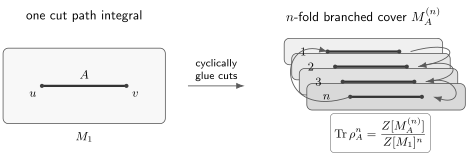
The replica construction computes by cyclically gluing copies of the Euclidean path integral along the cut defining . For a single interval in two dimensions, the endpoints of become branch points; in higher dimensions, the branch locus is the entangling surface .
The entanglement entropy then follows from
Equivalently, using the unnormalized partition functions,
where .
The catch is that QFT gives the replica construction only at positive integers . To obtain the von Neumann entropy, one assumes that the integer sequence admits a suitable analytic continuation to real or complex near . In ordinary QFT this is already a subtle step. In gravity it becomes more subtle, because the dominant saddle can change as varies.
Example: a single interval in a two-dimensional CFT
Section titled “Example: a single interval in a two-dimensional CFT”For a two-dimensional CFT in the vacuum, take with length . The replica geometry can be described by twist operators at the endpoints of the interval:
The twist operators have conformal dimension
so their two-point function gives
Therefore
and the limit gives
This example is useful because it displays the two core features of the replica method: geometry replaces a power of a density matrix, and analytic continuation in is necessary to reach the von Neumann entropy.
The gravitational replica path integral
Section titled “The gravitational replica path integral”In a holographic CFT, the replicated boundary geometry is used as the conformal boundary of a bulk gravitational path integral:
At leading order in large , one chooses the dominant classical saddle satisfying the prescribed boundary conditions. If is invariant under the replica cyclic group , one can form the quotient
The quotient has a single copy of the original boundary , but it contains a codimension-two fixed locus in the bulk. For integer , the full cover is smooth; the quotient has a conical opening angle
around the fixed locus. Equivalently, the quotient has a deficit angle
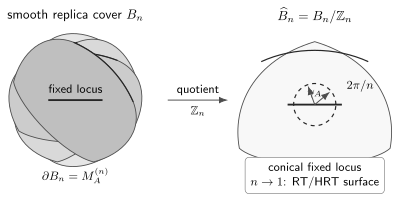
If the bulk replica saddle has a symmetry, the quotient has one asymptotic boundary but contains a codimension-two fixed locus. Near , this locus becomes the RT surface. The area term in holographic entropy comes from differentiating the gravitational action with respect to the conical opening angle.
The entanglement entropy is
Since in the replica-symmetric quotient description, this can also be written as
This is the generalized gravitational entropy formula. In Einstein gravity, the derivative is localized at the conical fixed locus and gives
The surface is not inserted by hand. It is the limit of the fixed locus of the replica quotient.
Why extremality appears
Section titled “Why extremality appears”The RT surface is not merely a place where a cone was placed. It must also be extremal.
Near the candidate fixed locus, choose local coordinates transverse to the surface and coordinates along the surface. The local metric has the schematic expansion
Here are the two extrinsic curvature tensors of the codimension-two surface. The replicated geometry has a small conical deformation near the fixed locus. Requiring the full covering geometry to be smooth as removes potentially singular terms in the Einstein equations. The result is
This is precisely the extremal-surface condition.
In a static Euclidean setup with a time-reflection symmetry, the extremal surface lies on the time-reflection slice and becomes a minimal surface there. This is why the same derivation gives RT in static cases and HRT after the appropriate covariant extension.
There is a conceptual lesson here. The RT/HRT surface is selected dynamically by the replica saddle. It is not an arbitrary cut through the bulk.
Refined Rényi entropy
Section titled “Refined Rényi entropy”The ordinary Rényi entropy is free-energy-like. Define
Then compares with its value at . The entropy-like quantity is the refined Rényi entropy
Using
we can write
This is the analog of thermal entropy,
with the replica index playing the role of an inverse modular temperature.
The ordinary Rényi entropy can be recovered by integrating the refined one:
At ,
This distinction is crucial: the clean cosmic-brane area formula computes , and is obtained from it by integration over .
Cosmic branes
Section titled “Cosmic branes”Dong’s prescription says that, in Einstein gravity, the refined Rényi entropy is computed by the area of a backreacting codimension-two cosmic brane:
The brane is homologous to and lives in a bulk geometry whose boundary is the original, unreplicated boundary geometry. Its tension is
A codimension-two object with tension produces a conical deficit
Therefore gives
exactly the deficit angle of the replica quotient.
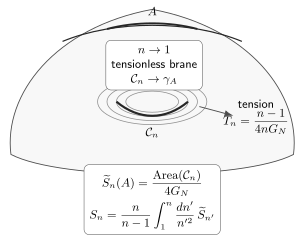
The refined Rényi entropy is computed by a cosmic brane with tension . For the brane creates a positive conical deficit and backreacts on the bulk geometry. The limit is tensionless and returns the RT/HRT surface.
Several points are worth emphasizing.
First, is generally not the same surface as the RT surface. Its tension backreacts on the geometry, so its position and area can depend nontrivially on .
Second, the cosmic brane computes , not directly . Confusing these two quantities is a common source of wrong factors.
Third, the prescription is geometric but not purely kinematic. One must solve the gravitational equations with a brane source, then evaluate the brane area in the backreacted geometry.
Fourth, in higher-derivative theories of gravity, the area term is replaced by the appropriate gravitational entropy functional, including possible extrinsic-curvature corrections. For the black-hole-information pages, we usually stay with two-derivative Einstein gravity unless stated otherwise.
The limit and RT
Section titled “The n→1n\to1n→1 limit and RT”The cosmic-brane picture recovers RT in a very direct way. As ,
so the brane becomes a probe. Its backreaction disappears, and the brane position is determined by extremizing its area in the original geometry:
Thus
and
This is a useful way to remember the logic:
With FLM and QES included, the same replica logic receives bulk one-loop corrections and then promotes area to generalized entropy. This is why the island formula has the same schematic structure as holographic entropy: it is the saddle-point rule for a gravitational replica computation.
Hyperbolic black holes and spherical regions
Section titled “Hyperbolic black holes and spherical regions”There is one especially clean example of holographic Rényi entropy. For a spherical region in the vacuum of a CFT, a conformal transformation maps the reduced density matrix to a thermal density matrix on hyperbolic space. The Rényi entropy becomes a thermal free-energy computation on
where the circumference of is proportional to .
In the bulk, this is described by a hyperbolic black hole. The refined Rényi entropy is the thermal entropy of that black hole at the corresponding temperature. The cosmic brane is another way of packaging the same physics: changing changes the conical opening angle, and the entropy is the area of the corresponding horizon or brane.
This example is valuable because it connects three viewpoints:
It also makes clear why is entropy-like: it is literally a thermal entropy in the conformally transformed problem.
Saddle transitions and analytic continuation
Section titled “Saddle transitions and analytic continuation”At large , the gravitational path integral is evaluated by a saddle approximation. The replica partition function can have several candidate saddles,
At leading order, the dominant saddle is the one with the smallest on-shell action. As changes, the dominant saddle can switch:
at some critical value of . This produces a phase transition in the large- Rényi entropy.
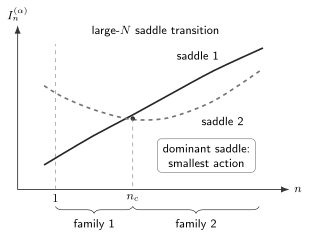
Large- Rényi entropies can have saddle transitions. The dominant gravitational saddle is the one with smallest action. At finite the full sum is smooth, but the strict classical limit can produce nonanalytic behavior as a function of or of the size of the region .
This is not a pathology. It is the gravitational analog of a thermodynamic phase transition. But it is a warning: analytic continuation from integer is not always a harmless technicality. If multiple saddles exist, the correct continuation must specify which saddle family is being followed and which saddle dominates in the desired limit.
This warning becomes central in black hole information. Replica wormholes are additional saddles in the gravitational replica path integral. They are not visible if one assumes from the beginning that the only relevant saddle is the disconnected Hawking saddle.
Replica symmetry: assumption and limitation
Section titled “Replica symmetry: assumption and limitation”Much of the elegant RT/cosmic-brane story assumes that the dominant -replica saddle has a symmetry. This symmetry allows one to take the quotient and describe the answer using a single-copy geometry with a conical defect or cosmic brane.
But replica symmetry is an assumption about a saddle, not a theorem about all gravitational path integrals. In some problems, replica symmetry can be spontaneously broken, or different saddle families can dominate for different . When replica symmetry is absent, the quotient description becomes inadequate, even though the original replicated path integral still makes sense.
For many standard holographic entanglement problems, the replica-symmetric saddle gives the correct classical RT/HRT answer. For island calculations, the important new saddles are often replica symmetric before analytic continuation, but their topology can connect different replicas. The quotient still contains a fixed locus, but the global topology is different from the naive disconnected geometry.
This is why replica wormholes should not be described as an exotic afterthought. They are a natural possibility once the gravitational path integral is allowed to sum over replica topologies.
Fixed-area states and area fluctuations
Section titled “Fixed-area states and area fluctuations”Rényi entropies are sensitive to fluctuations of the area operator. In ordinary semiclassical states, the RT area is not exactly fixed. Different components of the state can have slightly different areas, and the Rényi entropy weights those components differently for different .
A useful theoretical laboratory is a fixed-area state, in which the area of the relevant RT surface is held fixed. In such a state, the leading area contribution behaves more like a constant superselection label, and the entropy takes the schematic form
This is much closer to ordinary quantum error correction: the area term is a fixed central contribution, while the bulk Rényi entropy describes the encoded bulk degrees of freedom.
In generic states, however, area fluctuations matter. They are one reason why holographic Rényi entropies are more subtle than simply replacing by in the FLM formula.
Fixed-area states will reappear when we discuss operator-algebra quantum error correction and the meaning of the area operator as a central element.
Relation to quantum extremal surfaces
Section titled “Relation to quantum extremal surfaces”QESs are usually presented through the von Neumann entropy, but their origin is replica-theoretic. The relevant object in a gravitational entropy calculation is not merely an area; it is a generalized entropy associated with a replica fixed locus:
At leading classical order, differentiating the gravitational action around a cone gives the area term. At one loop, the bulk fields on the replicated geometry give the bulk entanglement contribution. Combining these contributions and extremizing the result gives the QES prescription:
Thus the replica trick provides the microscopic computational reason why generalized entropy, rather than bare area, is the object to extremize.
Why this page matters for islands
Section titled “Why this page matters for islands”The island formula is a replica statement. For a nongravitating radiation region coupled to a gravitating system, one computes
by a path integral with replicas. The naive Hawking saddle keeps the replicas disconnected in the gravitating region. Replica wormhole saddles connect them. In the limit, the fixed locus of the quotient becomes the boundary of an island, and the entropy becomes
The conceptual continuity is tight:
So the replica method is not just a derivation technique. It is the language in which the modern Page curve calculation is formulated.
What this page does and does not prove
Section titled “What this page does and does not prove”The replica trick explains how a geometric area term can emerge from a gravitational calculation of . It also explains why cosmic branes compute refined Rényi entropies and why the limit selects extremal surfaces.
It does not, by itself, prove that every desired analytic continuation is unique. It does not guarantee that the replica-symmetric saddle dominates. It does not remove the need to understand the gravitational path integral nonperturbatively. And it does not mean that the conical defect is a physical object present in Lorentzian spacetime.
The safe interpretation is this: replicas and cosmic branes are a controlled semiclassical method for computing entropy-like quantities in holographic states, provided the relevant saddle family and analytic continuation are understood.
That cautious sentence is less flashy than “the entropy is the area of a cosmic brane,” but it is much closer to how the calculation actually works.
Common pitfalls
Section titled “Common pitfalls”Pitfall 1: “The Rényi entropy is just the von Neumann entropy with replaced by .”
Section titled “Pitfall 1: “The Rényi entropy is just the von Neumann entropy with SSS replaced by SnS_nSn.””No. Rényi entropies probe the full spectrum of . They are nonlinear in a way that makes them sensitive to saddle transitions, area fluctuations, and high or low eigenvalues depending on .
Pitfall 2: “The cosmic brane computes directly.”
Section titled “Pitfall 2: “The cosmic brane computes SnS_nSn directly.””The clean area formula computes the refined Rényi entropy . The ordinary Rényi entropy is obtained by integrating over the replica index.
Pitfall 3: “The brane is the same as the RT surface for all .”
Section titled “Pitfall 3: “The brane is the same as the RT surface for all nnn.””Only at does the cosmic brane become tensionless and reduce to the RT/HRT surface. For , it backreacts.
Pitfall 4: “The replica trick avoids analytic continuation.”
Section titled “Pitfall 4: “The replica trick avoids analytic continuation.””The path integral is directly defined at positive integers . The von Neumann entropy requires a continuation to .
Pitfall 5: “Replica wormholes are unrelated to RT.”
Section titled “Pitfall 5: “Replica wormholes are unrelated to RT.””They are a new class of gravitational replica saddles, but the mechanism by which an area term appears is the same family of ideas: quotient, fixed locus, generalized entropy, and analytic continuation.
Exercises
Section titled “Exercises”Exercise 1: The limit
Section titled “Exercise 1: The n→1n\to1n→1 limit”Let
Show that
Solution
Define
Since , we have . Then
Both numerator and denominator vanish at , so use l’Hôpital’s rule:
But
so
Therefore
Exercise 2: Refined Rényi entropy and the integral formula
Section titled “Exercise 2: Refined Rényi entropy and the integral formula”The refined Rényi entropy is defined by
Derive
Solution
Let
Then the definition says
or
Since remains finite as ,
Therefore
Substituting back gives
and hence
Exercise 3: Cosmic-brane tension and deficit angle
Section titled “Exercise 3: Cosmic-brane tension and deficit angle”In Einstein gravity, a codimension-two brane of tension produces a conical deficit
Show that
corresponds to the replica quotient opening angle .
Solution
Substitute into the deficit-angle formula:
Thus
A cone with total angular period has deficit
which agrees with the brane result.
Exercise 4: The CFT interval entropy
Section titled “Exercise 4: The CFT2_22 interval entropy”Using
take the limit and recover the vacuum entanglement entropy of a single interval.
Solution
Taking gives
Therefore
Hence
This is the standard CFT vacuum result for a single interval.
Exercise 5: A large- saddle transition
Section titled “Exercise 5: A large-NNN saddle transition”Suppose a replicated gravitational path integral has two candidate saddles with actions
where . Assume the dominant saddle minimizes . Find the approximate crossing value of near when is small, and explain why the resulting Rényi entropy can be nonanalytic at large .
Solution
The crossing occurs when
Let . Then
For small , one solution near is approximately
with corrections of order from the term. Thus
At finite , the partition function is a sum,
so it is smooth. But at strict large , the smaller action dominates exponentially. Replacing the sum by a minimum gives a piecewise-defined classical answer. The derivative can jump at , producing a nonanalyticity in the leading large- Rényi entropy.
Exercise 6: Modular-temperature interpretation
Section titled “Exercise 6: Modular-temperature interpretation”Let and define
Show that the refined Rényi entropy can be written as
and interpret the result as a thermal entropy with respect to .
Solution
Since
the ordinary Rényi entropy is
Here , because is normalized. Therefore
Apply the definition:
This gives
so
This has the same form as thermal entropy,
with playing the role of inverse temperature and playing the role of Hamiltonian.
Further reading
Section titled “Further reading”- Aitor Lewkowycz and Juan Maldacena, “Generalized gravitational entropy,” arXiv:1304.4926.
- Xi Dong, “The Gravity Dual of Rényi Entropy,” arXiv:1601.06788.
- Horacio Casini, Marina Huerta, and Robert C. Myers, “Towards a derivation of holographic entanglement entropy,” arXiv:1102.0440.
- Janet Hung, Robert C. Myers, Michael Smolkin, and Alexandre Yale, “Holographic Calculations of Rényi Entropy,” arXiv:1110.1084.
- Xi Dong, Jonah Kudler-Flam, and Pratik Rath, “A Modified Cosmic Brane Proposal for Holographic Renyi Entropy,” arXiv:2312.04625.
- Shinsei Ryu and Tadashi Takayanagi, “Aspects of Holographic Entanglement Entropy,” arXiv:hep-th/0605073.
- Veronika E. Hubeny, Mukund Rangamani, and Tadashi Takayanagi, “A Covariant holographic entanglement entropy proposal,” arXiv:0705.0016.
- Thomas Faulkner, Aitor Lewkowycz, and Juan Maldacena, “Quantum corrections to holographic entanglement entropy,” arXiv:1307.2892.
- Thomas Hartman, “Entanglement Entropy at Large Central Charge,” arXiv:1303.6955.
- Matthew Headrick, “Lectures on entanglement entropy in field theory and holography,” arXiv:1907.08126.
- Mukund Rangamani and Tadashi Takayanagi, “Holographic Entanglement Entropy,” arXiv:1609.01287.
The next page uses this technology to explain bit threads and holographic entropy inequalities from a complementary, more geometric viewpoint. Later, the same replica technology will return in a more dramatic form as replica wormholes.