
Hawking–Page transition
Why this matters
Section titled “Why this matters”The planar black brane describes a thermal CFT on flat space. But a CFT can also be placed on a sphere:
In that case, the bulk has two natural Euclidean saddles with the same boundary:
The dominant saddle changes as the temperature is raised. This is the Hawking–Page transition. In holography, Witten’s interpretation is that this gravitational transition is the large- confinement/deconfinement transition of the boundary gauge theory on .
The transition teaches a lesson that appears everywhere in holography:
The same boundary geometry can be filled in by more than one bulk spacetime. The leading large- thermodynamics is controlled by the saddle with the smallest Euclidean action.
The boundary problem
Section titled “The boundary problem”The boundary thermal partition function is
Equivalently, the Euclidean CFT lives on
The bulk path integral must sum over asymptotically AdS Euclidean geometries whose conformal boundary is this space:
At large , this sum is dominated by the saddle with minimal renormalized Euclidean action.
The two basic saddles are:
- thermal AdS: Euclidean global AdS with the time direction periodically identified;
- Euclidean AdS black hole: a geometry where the thermal circle smoothly caps off at the horizon.
The two saddles have the same boundary but different topology.
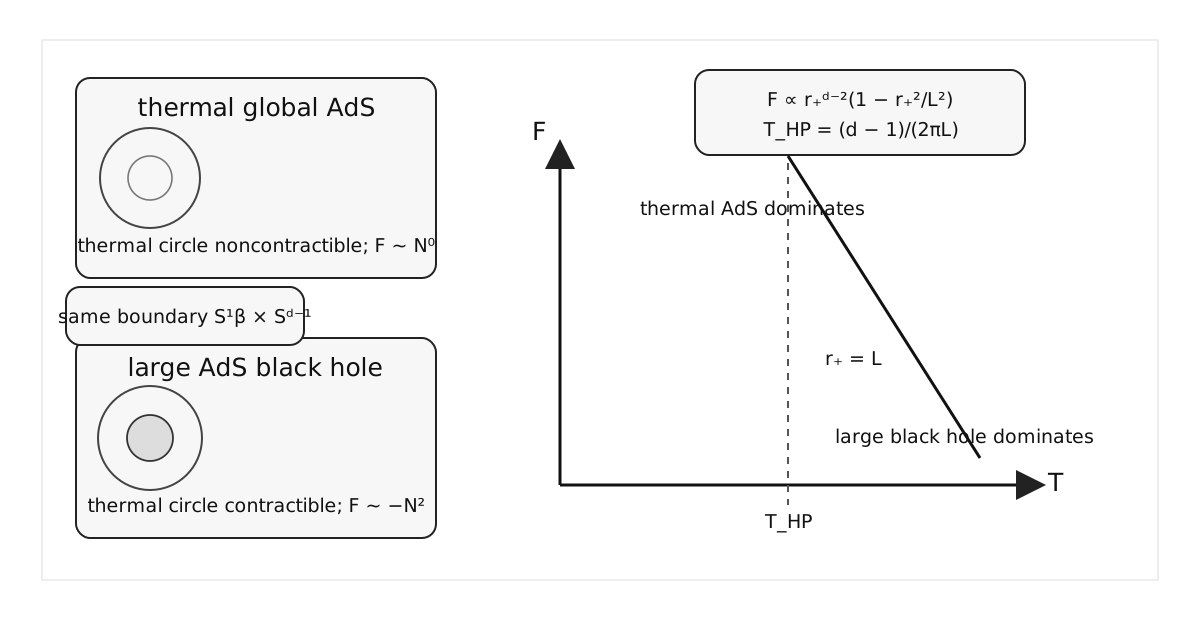
The Hawking–Page transition compares two bulk fillings of the same boundary . Thermal AdS dominates at low temperature; the large AdS black hole dominates above . The thermal circle is noncontractible in thermal AdS but contractible in the black-hole saddle.
Thermal AdS
Section titled “Thermal AdS”Global Lorentzian AdS has metric
The Euclidean thermal AdS saddle is obtained by and by identifying
There is no horizon, so smoothness does not fix . Any boundary temperature is allowed. The Euclidean topology is schematically
where is the spatial ball whose boundary is .
The low-temperature CFT interpretation is a gas of color-singlet states on a compact space. At large , the temperature-dependent part of the free energy is order , not .
The global AdS-Schwarzschild black hole
Section titled “The global AdS-Schwarzschild black hole”The spherical AdS black hole is
with
The horizon radius is defined by , so
The Euclidean black-hole geometry has topology
where the disk is formed by the Euclidean time circle and the radial direction. The time circle shrinks smoothly at the horizon.
Temperature of the global black hole
Section titled “Temperature of the global black hole”After Wick rotation, smoothness at fixes the Euclidean period:
Using
we find
Therefore
This function has a minimum for . Setting gives
and hence
For , there is no smooth spherical AdS black hole with boundary circle size . For , there are two branches: a small black hole and a large black hole.
Mass, entropy, and free energy
Section titled “Mass, entropy, and free energy”The mass of the AdS-Schwarzschild black hole is
where is the volume of the unit . The entropy is
The canonical free energy is
Substituting the expressions above gives the remarkably simple result
relative to thermal AdS with the same boundary circle.
Thus:
and
The Hawking–Page transition occurs at
At this point the temperature is
For temperatures above , the large black hole has lower free energy than thermal AdS and dominates the canonical ensemble.
Small and large AdS black holes
Section titled “Small and large AdS black holes”The black-hole temperature curve has two branches above :
- the small black hole, with ;
- the large black hole, with .
The sign of the specific heat follows from the sign of . Since entropy increases with ,
has the same sign as . Therefore:
and
The small branch is thermodynamically unstable in the canonical ensemble. The large branch is stable once it exists, but it only dominates over thermal AdS when .
The sequence is:
Example: AdS/CFT
Section titled “Example: AdS5_55/CFT4_44”For AdS, the boundary dimension is , and the CFT lives on
The temperature of the spherical black hole is
The minimum temperature is
and the Hawking–Page temperature is
The transition temperature is of order the inverse sphere radius. That is natural: on a compact sphere, the theory has a finite-size scale.
Gauge theory interpretation
Section titled “Gauge theory interpretation”The boundary theory is a large- gauge theory on a compact space. The low-temperature phase has only order-one thermal free energy:
The high-temperature phase has order- free energy:
This is the large- distinction between a color-singlet confined phase and a deconfined adjoint plasma.
In the bulk:
while
The free-energy scaling is the simplest evidence. Thermal AdS has no horizon, hence no classical horizon entropy. The large black hole has entropy
This is the gravitational origin of the large number of deconfined degrees of freedom.
The Polyakov loop and contractible thermal circles
Section titled “The Polyakov loop and contractible thermal circles”A sharper diagnostic involves the Polyakov loop, a Wilson loop wrapping the Euclidean thermal circle. Holographically, a fundamental Wilson loop is computed by a string worldsheet ending on the corresponding boundary loop.
In thermal AdS, the Euclidean time circle is noncontractible in the bulk. There is no disk-shaped worldsheet ending on the thermal circle at leading classical order, so the Polyakov loop vanishes in the large- saddle:
In the Euclidean black-hole geometry, the thermal circle caps off at the horizon. A disk-shaped string worldsheet can end on the boundary thermal circle and fill into the bulk. Thus
in the black-hole phase.
This is the geometric version of center-symmetry behavior in the deconfinement transition. The phrase “center symmetry” should be used with some care in theories with matter content or boundary conditions that explicitly break it, but in the canonical large- discussion the thermal-circle topology gives the right intuition.
Relation to the planar black brane
Section titled “Relation to the planar black brane”The previous page studied the planar black brane, dual to a CFT on flat space. The Hawking–Page transition is instead about a CFT on a sphere.
The two are related by a large-volume limit. At high temperature on ,
the dominant black hole has
Near a small patch of its horizon, the sphere looks flat, and the large black hole locally approaches the planar black brane. The free energy becomes extensive in the spatial volume of the sphere, and the thermodynamics approaches the black-brane equation of state.
As with fixed,
Thus on flat space, the deconfined black-brane phase dominates at any nonzero temperature in the classical holographic CFT. There is no finite-temperature Hawking–Page transition for the neutral planar black brane on .
Topology is part of the physics
Section titled “Topology is part of the physics”A useful way to remember the transition is:
Both have boundary
but they fill it in differently. The bulk topology tells the boundary theory whether the thermal circle is contractible, which controls the leading behavior of the Polyakov loop.
This is a recurring theme in holography. Boundary observables are sensitive not only to the local metric but also to global bulk topology.
What is actually first order?
Section titled “What is actually first order?”At infinite , the Hawking–Page transition is sharp. The leading free energy jumps from order thermal behavior to order black-hole behavior, and the entropy jumps by order .
At finite , the exact CFT on a compact space has a finite-dimensional regulated Hilbert space below any energy cutoff and no truly singular thermodynamic transition. The sharp transition is a large- phenomenon.
This is analogous to many large- matrix models: a phase transition appears in the limit even at finite spatial volume.
Beyond the canonical case
Section titled “Beyond the canonical case”The phrase “Hawking–Page transition” is often used more broadly for a transition between a horizonless geometry and a black-hole geometry. But one should keep the details straight.
For example:
- on , thermal AdS competes with spherical AdS black holes;
- with a compact spatial circle, the AdS soliton can compete with a black brane;
- in bottom-up models, different black-hole branches or horizonless geometries can model different phases.
These are related ideas, but not identical calculations. The clean canonical calculation is the comparison between thermal global AdS and the global AdS-Schwarzschild black hole.
Dictionary checkpoint
Section titled “Dictionary checkpoint”| Boundary gauge theory on | Bulk saddle |
|---|---|
| thermal partition function | Euclidean gravity path integral |
| low-temperature singlet phase | thermal AdS |
| high-temperature deconfined phase | large AdS black hole |
| order- thermal free energy | horizonless saddle |
| order- entropy and free energy | black-hole horizon |
| Polyakov loop zero at leading order | noncontractible thermal circle |
| Polyakov loop nonzero | contractible thermal circle |
| deconfinement transition | Hawking–Page transition |
The transition is therefore not merely a black-hole curiosity. It is the gravitational computation of a large- phase transition in the boundary theory.
Common confusions
Section titled “Common confusions”“The Hawking–Page transition happens for every black brane.”
Section titled ““The Hawking–Page transition happens for every black brane.””No. The standard Hawking–Page transition compares thermal global AdS with a spherical AdS black hole for boundary . The neutral planar black brane on flat space does not have a finite-temperature Hawking–Page transition of this type.
“Thermal AdS has zero free energy.”
Section titled ““Thermal AdS has zero free energy.””After a conventional subtraction, its temperature-dependent free energy is order . But the CFT on a sphere can also have a Casimir energy of order . The Hawking–Page comparison concerns the properly renormalized action difference between saddles with the same boundary.
“The small black hole is the confined phase.”
Section titled ““The small black hole is the confined phase.””No. The small black hole is a black-hole saddle with negative specific heat. It is not the dominant low-temperature canonical saddle. The low-temperature phase is thermal AdS.
“The transition means the CFT becomes gravitational.”
Section titled ““The transition means the CFT becomes gravitational.””The CFT is always nongravitational. The transition means that the dominant bulk saddle changes. The same boundary quantum system has different semiclassical bulk descriptions in different thermal regimes.
“The Polyakov-loop argument is just a local horizon argument.”
Section titled ““The Polyakov-loop argument is just a local horizon argument.””It is topological. The key distinction is whether the Euclidean thermal circle is contractible in the bulk. A contractible circle permits a disk worldsheet ending on the boundary loop; a noncontractible circle does not.
Exercises
Section titled “Exercises”Exercise 1: Derive the global black-hole temperature
Section titled “Exercise 1: Derive the global black-hole temperature”For
show that
Solution
The horizon condition gives
The temperature is
Since
we find
Therefore
Exercise 2: Locate the minimum temperature
Section titled “Exercise 2: Locate the minimum temperature”Show that has a minimum at
and find .
Solution
Write
Then
Setting this to zero gives
Substituting back into gives
Exercise 3: Find the Hawking–Page temperature
Section titled “Exercise 3: Find the Hawking–Page temperature”Given
show that the Hawking–Page transition occurs at
Solution
The transition occurs when the black-hole free energy equals the thermal AdS free energy, which in this normalization means
The nonzero solution is
Using
we get
Exercise 4: Explain the planar limit
Section titled “Exercise 4: Explain the planar limit”Use
to explain why there is no finite Hawking–Page temperature for the neutral planar black brane on .
Solution
The planar limit corresponds to making the boundary sphere very large, , while zooming in on a small local patch. Then
Therefore any fixed nonzero temperature lies above the transition temperature in the infinite-volume limit. The dominant saddle becomes the planar black brane. This is why the neutral black brane on flat space does not exhibit a finite-temperature Hawking–Page transition.
Further reading
Section titled “Further reading”- S. W. Hawking and D. N. Page, Thermodynamics of Black Holes in Anti-de Sitter Space.
- E. Witten, Anti de Sitter Space, Thermal Phase Transition, and Confinement in Gauge Theories.
- O. Aharony, S. S. Gubser, J. Maldacena, H. Ooguri, and Y. Oz, Large Field Theories, String Theory and Gravity.
- V. Balasubramanian and P. Kraus, A Stress Tensor for Anti-de Sitter Gravity.