
Operator-Algebra Quantum Error Correction
Guiding question. Ordinary quantum error correction protects a whole logical Hilbert space. Holographic subregion duality usually protects only a bulk algebra of observables. What changes when the thing being reconstructed is not a tensor factor, but a von Neumann algebra with a center?
The previous pages described entanglement wedge reconstruction in operational language: if a bulk operator lies in the entanglement wedge of a boundary region , then it has a boundary representative supported on . That statement is almost right, but it hides a structural subtlety. In gauge theory and gravity, a spatial region does not come with a canonical tensor factor Hilbert space. The right object attached to a region is an algebra of observables. Its center may contain quantities that can be measured from both sides of an entangling surface, such as electric flux in gauge theory or the area of a quantum extremal surface in gravity.
Operator-algebra quantum error correction, abbreviated OAQEC, is the finite-dimensional quantum-information framework that captures this structure. It is the cleanest language for the quantum-corrected RT formula:
Here is the bulk algebra reconstructible on boundary region , is the entropy of the state restricted to that algebra, and is a central operator. In holography,
where is the RT, HRT, or quantum extremal surface associated with . This is the point at which the geometric area term stops looking mysterious: it behaves like a central contribution to an algebraic entropy formula.
1. Why ordinary subspace QEC is not quite enough
Section titled “1. Why ordinary subspace QEC is not quite enough”A standard quantum error-correcting code embeds a logical Hilbert space into a larger physical Hilbert space,
In holography, is the boundary Hilbert space, while is a small semiclassical bulk code subspace around a chosen family of geometries. For a boundary bipartition , ordinary erasure correction asks whether all logical information can be recovered from after erasing .
But subregion duality usually asks a subtler question. Boundary region should reconstruct the bulk inside , while should reconstruct the complementary bulk region. The code should therefore protect different logical algebras against different erasures:
The prime denotes the commutant inside the code subspace: is the set of logical operators that commute with every operator in . This is exactly the right notion for two complementary entanglement wedges.
Ordinary subspace QEC is recovered in the special case
where reconstructs every logical operator. Holographic subregion reconstruction is more general: reconstructs a subalgebra, not necessarily the entire logical algebra.
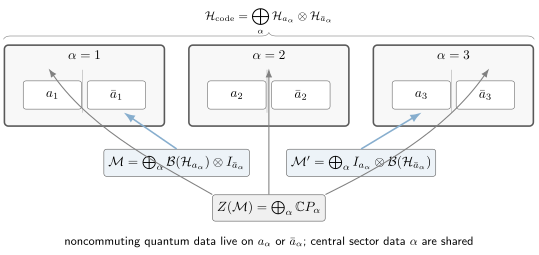
A finite-dimensional von Neumann algebra decomposes the code space into superselection sectors . Operators in act on the factors, operators in the commutant act on the factors, and the center is generated by sector projectors .
2. Reconstruction of an algebra
Section titled “2. Reconstruction of an algebra”Let be the encoding isometry into the boundary Hilbert space. A logical operator is reconstructible on if there exists a physical operator supported only on such that, for every code state ,
and similarly for the adjoint,
For an algebra , we demand this for every . This definition emphasizes observables rather than states. It is therefore naturally suited to gauge theories, gravity, and subregion duality, where the observable algebra is often better defined than a tensor factor Hilbert space.
There is also a useful error-correction criterion. Erasing is correctable for the algebra precisely when operators in commute with the logical imprint of arbitrary noise on . Schematically, for all errors supported on ,
This is the Heisenberg-picture version of error correction: the algebra of observables in is protected against errors on .
The complementary statement is equally important. If is reconstructible on and the code has complementary recovery, then the commutant is reconstructible on . In holography, this is the algebraic version of the statement that complementary boundary regions reconstruct complementary entanglement wedges, up to shared center degrees of freedom on the extremal surface.
3. The structure theorem for finite-dimensional algebras
Section titled “3. The structure theorem for finite-dimensional algebras”In finite dimensions, every von Neumann algebra has a canonical block decomposition. The code Hilbert space can be written as
The algebra and its commutant take the form
The center is
Equivalently, the center is generated by projectors onto the blocks. The sector label is classical data: it can be measured by both and because central elements commute with everything. This does not violate no-cloning. Quantum information in and is not duplicated; only the sector label is shared.
This direct-sum structure is the algebraic origin of several holographic facts:
- an extremal surface can carry central data visible from both sides;
- the area operator can be measured by both the wedge and the wedge;
- entropy has a classical sector contribution in addition to ordinary within-sector entropy;
- fixed-area states simplify the story by restricting to one value of the center.
4. Algebraic entropy
Section titled “4. Algebraic entropy”Given a code state , decompose it according to the central projectors:
The reduced state seen by the algebra is
where
The algebraic entropy is the ordinary entropy of this block-diagonal object:
Here
is the Shannon entropy of the center. In many semiclassical discussions one works in a fixed-area, fixed-center code subspace, so . But for general states the central entropy is real and must be tracked.
A useful warning: is not the same thing as the von Neumann entropy of an arbitrarily chosen tensor factor. It is the entropy of the state restricted to a chosen algebra. Different choices of algebra, especially different choices of center, can give different algebraic entropies. This is not a bug; it is exactly what happens in gauge theory and gravity.
5. The area operator as a central operator
Section titled “5. The area operator as a central operator”For a holographic boundary region , the relevant bulk algebra is the algebra of operators in the entanglement wedge . Let us call it . The commutant is associated with the complementary wedge. The two wedges meet at the extremal surface .
At leading classical order, contributes the RT/HRT area term. At the algebraic level, this contribution is represented by a central operator . In Einstein gravity,
For higher-derivative gravity or renormalized quantum gravity, should be understood more generally as the geometric entropy operator: Wald-like terms, anomaly terms, and counterterms can contribute. The important structural fact is not the precise functional form, but its centrality in the code subspace:
This centrality means that commutes with all operators in the entanglement wedge and with all operators in the complementary wedge. Physically, both sides can agree on the area of their common interface. Neither side thereby obtains a copy of the other side’s local quantum information.
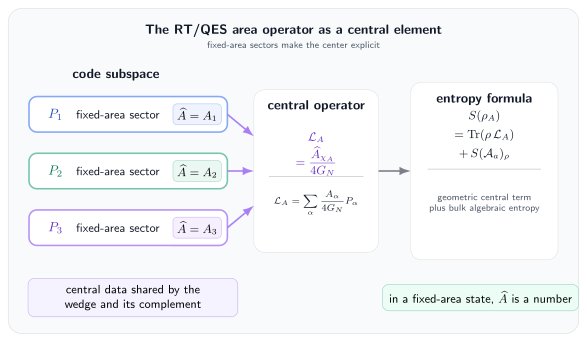
The extremal surface separates the entanglement wedge of from the complementary wedge. The associated area operator is central: it belongs to the shared interface data rather than to only one side’s noncommuting local algebra.
6. The quantum-corrected RT formula from OAQEC
Section titled “6. The quantum-corrected RT formula from OAQEC”The central result of the OAQEC viewpoint is that a code with complementary recovery naturally gives an entropy formula of RT form:
In holographic language, this is the quantum-corrected RT formula:
The ellipsis hides higher-order corrections, counterterms, and the subtleties of defining bulk entropy in a gauge/gravity theory. The OAQEC expression clarifies what the formula means: the boundary entropy is the sum of a central geometric term and the entropy of the bulk algebra reconstructible in the entanglement wedge.
To see the algebraic mechanism in a toy finite-dimensional code, suppose the encoding can be written sector by sector as
The part carries logical bulk information. The fixed state supplies entanglement across the boundary cut. Tracing out gives
The first two terms are the algebraic bulk entropy . The last term is the expectation value of the central operator
In a holographic code, this central operator is interpreted as the area of the extremal surface in Planck units.
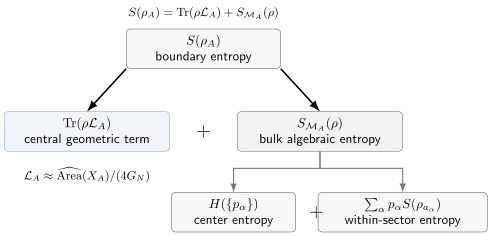
The boundary entropy splits into a central geometric contribution and the entropy of the reconstructible bulk algebra. With several center sectors, contains both the Shannon entropy and the average within-sector entropy .
7. Gauge constraints, edge modes, and why centers are natural
Section titled “7. Gauge constraints, edge modes, and why centers are natural”The appearance of a center is not an exotic holographic trick. It is familiar in gauge theory. Consider electromagnetism on a spatial region. Gauss’s law relates the electric flux through the boundary of the region to the charge inside. The normal electric flux through the entangling surface commutes with all gauge-invariant operators localized strictly inside the region. It is therefore a central observable for the local gauge-invariant algebra.
Gravity has an analogous, deeper issue. Diffeomorphism constraints prevent a naive factorization of the Hilbert space across a spatial surface. To define localized gravitational observables one must specify a gravitational dressing, and boundary or edge data appear at the interface. In semiclassical gravity, the area of the codimension-two surface is part of this interface data.
This gives a useful conceptual ladder:
The algebraic viewpoint is therefore not optional decoration. It is forced on us by gauge invariance and gravitational constraints.
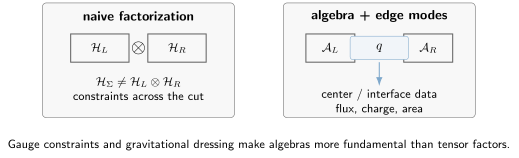
Gauge constraints obstruct naive Hilbert-space factorization. An algebraic or extended-Hilbert-space description keeps track of interface data, such as fluxes in gauge theory or area-like geometric data in gravity.
8. Fixed-area states and why they are useful
Section titled “8. Fixed-area states and why they are useful”A fixed-area state is a state, or more precisely a code subspace, in which the area operator has a sharply fixed eigenvalue:
Then the entropy formula reduces to
If the bulk matter state also has simple factorization properties, fixed-area states can make holographic entropy behave more like entropy in an ordinary tensor-network model. This is why they are so useful in discussions of Rényi entropy, cosmic branes, replica wormholes, and tensor-network interpretations of RT.
But fixed-area states are not generic. A general semiclassical state may be a superposition or mixture of different area sectors. Then the central Shannon entropy and the expectation value of the area operator both matter. This distinction becomes important when discussing replica calculations and ensemble-like decompositions.
9. Relation to entanglement wedge reconstruction
Section titled “9. Relation to entanglement wedge reconstruction”Entanglement wedge reconstruction can now be phrased more sharply:
Boundary region reconstructs the bulk algebra associated with its entanglement wedge, while reconstructs the commutant associated with the complementary wedge. The shared extremal-surface data live in the center.
This formulation resolves a small but persistent confusion. If and both know the area of , did we clone information? No. The area is central classical data in the code subspace. Noncommuting local bulk information is assigned to one side or the other, while central data can be common.
It also clarifies how the quantum-corrected RT formula and reconstruction theorem fit together. The same algebraic structure that allows complementary recovery also gives the entropy decomposition. Reconstruction and entropy are not two unrelated miracles; they are two faces of the same OAQEC structure.
10. Relation to islands
Section titled “10. Relation to islands”The island formula is also algebraic at heart. For a radiation region , the fine-grained entropy is computed by
After the Page transition, the winning QES gives an island inside the black hole. The modern reconstruction interpretation is
In words: the island algebra is reconstructible from the radiation. OAQEC refines this statement. What the radiation reconstructs is not a naive tensor factor called “the island Hilbert space,” but an algebra of island observables, with the QES area term appearing as central geometric data.
This is especially important because black hole interiors involve gauge constraints, gravitational dressing, and possible state/code-subspace dependence. The slogan “the radiation contains the island” is useful, but the algebraic statement is safer:
within an appropriate code subspace and with the relevant QES center included.
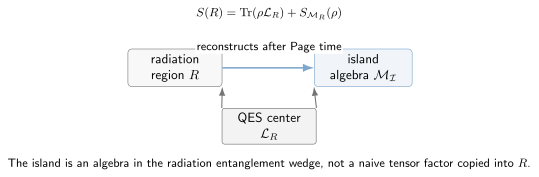
After the Page transition, the radiation reconstructs an island algebra. The QES area term is central data in the algebraic entropy formula, not an ordinary local matter entropy inside the radiation Hilbert space.
11. What this page does and does not claim
Section titled “11. What this page does and does not claim”OAQEC is powerful because it expresses holographic subregion duality in the right language. But it should not be overinterpreted.
First, OAQEC is not a microscopic derivation of AdS/CFT. It is an abstract structure that AdS/CFT appears to realize in semiclassical code subspaces.
Second, the central area operator is code-subspace dependent. A semiclassical code subspace around one family of geometries can have a clean area center, while a much larger Hilbert space may not admit the same simple algebraic decomposition.
Third, algebraic entropy depends on the algebra. In gauge theory and gravity this is a feature, not a failure. The entropy assigned to a region depends on which boundary, edge, or center observables are included.
Fourth, OAQEC does not by itself solve computational questions. It tells us that reconstruction exists as an information-theoretic operation under the appropriate assumptions. It does not say that the reconstruction is efficient. This is why decoding complexity remains important in the black hole information problem.
12. Common pitfalls
Section titled “12. Common pitfalls”Pitfall 1: “The area term is just bulk entanglement entropy.”
No. The quantum-corrected formula has both a geometric central term and a bulk algebraic entropy term. Bulk entanglement contributes to ; the area contribution is represented by .
Pitfall 2: “If both sides know the area, information has been cloned.”
No. Central data can be shared by an algebra and its commutant. This is classical superselection information, not a duplicated noncommuting quantum degree of freedom.
Pitfall 3: “Every bulk region has an ordinary Hilbert-space tensor factor.”
Not in gauge theory or gravity. Local physics is better organized by algebras. Tensor-factor language is often useful in toy models, but it can obscure edge modes and constraints.
Pitfall 4: “OAQEC replaces entanglement wedge reconstruction.”
No. It sharpens it. Entanglement wedge reconstruction says which bulk observables can be reconstructed. OAQEC says what kind of mathematical object those observables form and how their entropy is related to boundary entropy.
Pitfall 5: “The center is unique and absolute.”
The center is the center of a chosen algebra. Changing the algebra can change the center. In holography the relevant algebra is fixed by the entanglement wedge and the code subspace under discussion.
Exercises
Section titled “Exercises”Exercise 1. Center and commutant of a direct-sum algebra
Section titled “Exercise 1. Center and commutant of a direct-sum algebra”Let
and define
Find and .
Solution
An operator commutes with all operators in exactly when, within each block, it acts trivially on and arbitrarily on . Therefore
The center is the intersection of and . Within each block, an operator must be proportional to the identity on both factors. Thus
Equivalently, it is generated by the two block projectors and .
Exercise 2. Algebraic entropy with two center sectors
Section titled “Exercise 2. Algebraic entropy with two center sectors”Suppose a state restricted to has the form
Show that
Solution
The eigenvalues of the block-diagonal density matrix are times the eigenvalues of and times the eigenvalues of . Therefore
Using block diagonality,
Since , this becomes
The first two terms are the Shannon entropy of the center.
Exercise 3. A toy derivation of the area term
Section titled “Exercise 3. A toy derivation of the area term”Consider a code whose encoded states take the sector-decomposed form
Assume the different sectors are orthogonal on . Show that
Explain how to interpret the last term as .
Solution
Tracing out gives a block-diagonal state on :
The entropy of a block-diagonal density matrix is the Shannon entropy of the block weights plus the average entropy within each block. Therefore
Using additivity of entropy on tensor products,
Thus
Define the central operator
Then
In a holographic code, is interpreted as the area operator in Planck units.
Exercise 4. Fixed-area versus variable-area code subspaces
Section titled “Exercise 4. Fixed-area versus variable-area code subspaces”Suppose the center has two area sectors with
A state has probabilities and in the two sectors and has no within-sector bulk entropy. Compute according to the OAQEC formula. What happens in a fixed-area sector?
Solution
With no within-sector bulk entropy, the algebraic entropy is only the Shannon entropy of the center:
The central geometric contribution is
Therefore
In a fixed-area sector, say , the Shannon entropy vanishes and
This is the simplest algebraic version of the RT area term.
Exercise 5. Why central data do not violate no-cloning
Section titled “Exercise 5. Why central data do not violate no-cloning”Explain why both and can contain the sector projectors without violating the no-cloning theorem.
Solution
The no-cloning theorem forbids copying arbitrary unknown quantum states, or equivalently duplicating noncommuting quantum information. The projectors are mutually commuting central observables. They encode classical superselection data: which block the state occupies. Classical commuting data can be redundantly available to both an algebra and its commutant.
Within a fixed sector , the noncommuting operators acting on belong to , while the noncommuting operators acting on belong to . These quantum degrees of freedom are not duplicated. Only the shared sector label is visible on both sides.
Further reading
Section titled “Further reading”- Daniel Harlow, The Ryu–Takayanagi Formula from Quantum Error Correction.
- Cedric Bény, Achim Kempf, and David W. Kribs, Generalization of Quantum Error Correction via the Heisenberg Picture.
- Ahmed Almheiri, Xi Dong, and Daniel Harlow, Bulk Locality and Quantum Error Correction in AdS/CFT.
- Xi Dong, Daniel Harlow, and Aron C. Wall, Reconstruction of Bulk Operators within the Entanglement Wedge in Gauge-Gravity Duality.
- Aitor Lewkowycz and Juan Maldacena, Generalized Gravitational Entropy.
- William Donnelly and Laurent Freidel, Local Subsystems in Gauge Theory and Gravity.
- Daniel Harlow, Jerusalem Lectures on Black Holes and Quantum Information.