
Black Hole Entropy and the Holographic Principle
The black hole information problem begins before Hawking radiation. It begins with the classical fact that the event horizon behaves as if it has thermodynamic laws, and with the quantum fact that the coefficient in this analogy is exactly fixed. A black hole of horizon area has entropy
and a stationary black hole with surface gravity has temperature
In units , which we will usually use,
The conceptual shock is not merely that black holes are hot. It is that the entropy of the most compact object in gravity scales like area, not volume. This is the first hint that quantum gravity is holographic: the number of independent degrees of freedom in a gravitating region is not the number suggested by local quantum fields at every point in the bulk.
Guiding question
Section titled “Guiding question”Why does the entropy of a black hole equal one quarter of its horizon area in Planck units, and why does that fact suggest that quantum gravity should be holographic?
A useful answer has three layers.
First, classical general relativity gives a set of laws for stationary black holes that mirror the laws of thermodynamics. Second, Hawking’s quantum calculation turns the analogy into an identity by assigning a real temperature to the horizon. Third, once entropy is proportional to area, gravitational collapse gives an upper bound on the entropy that can fit inside a region. This bound is the seed of the holographic principle.
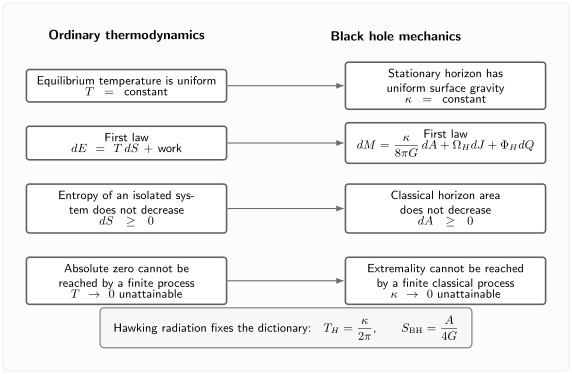
Classical black hole mechanics has the form of thermodynamics. In the units of the figure, Hawking radiation fixes , and the first law then gives . Restoring constants gives and .
Classical black hole mechanics
Section titled “Classical black hole mechanics”Consider a stationary, asymptotically flat black hole in Einstein-Maxwell theory. The horizon is generated by a Killing vector field
where is the asymptotic time-translation Killing field, is the rotational Killing field, and is the angular velocity of the horizon. The surface gravity is defined on the Killing horizon by
Equivalently, measures the failure of the horizon generator to be affinely parametrized. It is also the acceleration, redshifted to infinity, needed to hold a unit mass just outside the horizon.
The four laws of black hole mechanics are then:
| Black hole mechanics | Thermodynamic analogy |
|---|---|
| Zeroth law: is constant over the horizon of a stationary black hole, under suitable energy conditions. | Temperature is constant in thermal equilibrium. |
| First law: . | . |
| Second law: classically, in physical processes, assuming cosmic censorship and an appropriate energy condition. | Entropy does not decrease. |
| Third law: roughly, cannot be reached by a finite sequence of physical operations. | Absolute zero cannot be reached by finite processes. |
Before Hawking radiation, this was an analogy. The horizon area behaved like entropy, and surface gravity behaved like temperature, but the numerical conversion was unknown. A purely classical black hole has no emission, so if it had a temperature in the ordinary sense, that temperature would appear to be zero. This is the tension that Hawking’s calculation resolves.
Hawking temperature fixes the normalization
Section titled “Hawking temperature fixes the normalization”Near any nonextremal Killing horizon, the Euclidean continuation of the metric looks locally like polar coordinates. In Lorentzian signature, a two-dimensional slice near the horizon can be written schematically as
where is proper distance from the horizon. After ,
This is smooth at only if the angular coordinate has period . Thus the Euclidean time period is
and the corresponding temperature is
in units . Restoring constants gives
The Euclidean argument is not the only derivation. Hawking’s original calculation used quantum fields on a collapsing black hole geometry and found a thermal flux at future null infinity. The important point for us is that the horizon temperature is real. Therefore the first law of black hole mechanics becomes the first law of thermodynamics:
Comparing this with
and using gives
Choosing the integration constant so that a vanishing horizon has vanishing entropy gives
This result is universal for two-derivative Einstein gravity. In higher-derivative theories, the entropy is replaced by a more general geometric expression, usually called Wald entropy. In Einstein gravity, Wald entropy reduces to area divided by .
Example: Schwarzschild black hole
Section titled “Example: Schwarzschild black hole”The four-dimensional Schwarzschild metric is
The horizon radius is
so the area is
The surface gravity is
and hence
The entropy follows either from or by integrating the first law:
Thus
The heat capacity is negative:
This is a basic warning that asymptotically flat black holes are not ordinary thermal systems in a box. As a Schwarzschild black hole loses energy, it gets hotter. Large AdS black holes are different because the AdS boundary conditions and the gravitational potential can stabilize the canonical ensemble.
What kind of entropy is ?
Section titled “What kind of entropy is SBHS_{\rm BH}SBH?”The formula is simple; its interpretation is not.
Thermodynamically, is the entropy conjugate to the Hawking temperature in the first law. It is the quantity whose increase compensates for ordinary entropy lost behind the horizon. Microscopically, in a complete quantum theory of gravity, it should count black hole states:
up to the usual qualifications about ensembles, energy windows, and finite- corrections.
In AdS/CFT, this microscopic interpretation becomes concrete. A large AdS black hole is dual to a thermal state of the boundary CFT, and its Bekenstein-Hawking entropy matches the leading large- thermal entropy of the CFT. This is one of the cleanest reasons to take the area law literally as a counting formula, not merely as a formal analogy.
At the same time, should not be identified naively with the entanglement entropy of quantum fields across a fixed horizon. Matter entanglement across a horizon is UV divergent and depends on the number of light species. The area term is also renormalized by the same short-distance physics. The physical object in semiclassical gravity is the generalized entropy
where is the von Neumann entropy of fields outside the horizon and denotes counterterm contributions. The area term and the matter entropy are not separately universal; their renormalized sum is the meaningful quantity.
This point will become crucial later. The island formula and the quantum extremal surface prescription are not obtained by extremizing the area alone. They extremize generalized entropy.
The generalized second law
Section titled “The generalized second law”Classically, Hawking’s area theorem says that the horizon area cannot decrease. Quantum mechanically, black holes radiate, so the area can decrease. The replacement is the generalized second law:
where for a black hole horizon
Here is the ordinary entropy outside the horizon, including radiation and matter fields. If matter falls into the black hole, may decrease, but the horizon area increases. If the black hole evaporates, the area decreases, but entropy appears in the outgoing radiation. The generalized second law says that the sum never decreases.
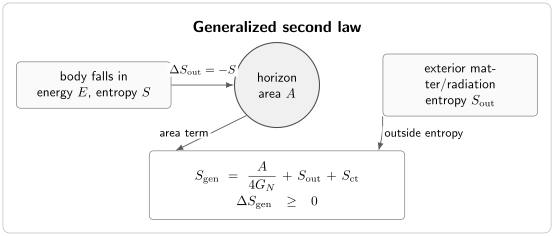
The generalized second law replaces the classical area theorem. In semiclassical gravity, the area term can decrease because of Hawking radiation, but the sum is expected to be nondecreasing in ordinary physical processes.
The generalized second law is one of the most important pieces of evidence that horizon area is a genuine entropy. It also explains why the information problem is subtle. Hawking radiation can carry coarse-grained entropy while the fine-grained entropy of the full state remains constrained by unitarity. The generalized second law is a statement about the appropriate coarse-grained or generalized entropy of a semiclassical horizon, not directly the Page curve of the collected radiation.
Bekenstein bound from a lowering experiment
Section titled “Bekenstein bound from a lowering experiment”A useful thought experiment gives the scale of the Bekenstein bound. Suppose an object of energy , radius , and entropy is slowly lowered toward a large Schwarzschild black hole and then dropped in. Because of gravitational redshift, the energy delivered to the black hole can be much smaller than . The minimum occurs when the object is lowered until its center is roughly a proper distance from the horizon.
Near the horizon, the redshift factor is approximately
The energy added to the black hole as measured at infinity is therefore
Using the first law for a nonrotating, uncharged black hole,
If the generalized second law is to hold after the object disappears behind the horizon, we need
Restoring and gives, for dimensionless entropy ,
This is the Bekenstein bound. Its precise domain of validity requires care: it is most naturally a bound for weakly gravitating isolated systems, not a universal formula for arbitrary regions in arbitrary spacetimes. But the thought experiment captures the essential idea. If too much entropy could be hidden in a small object of given energy and size, one could violate the generalized second law by dropping it into a black hole.
From area law to holography
Section titled “From area law to holography”Now compare two ways of estimating the number of degrees of freedom in a spatial region.
In ordinary local quantum field theory with a UV cutoff , the number of short-distance cells in a three-dimensional region of volume is of order
If each cell carries independent degrees of freedom, the entropy can scale like volume:
Gravity changes the conclusion. If one tries to put too much energy or entropy into a region, the region collapses into a black hole. For a roughly spherical region of boundary area , the largest entropy that can be hidden without making a larger black hole is of order
The maximum entropy scales as boundary area, not bulk volume.
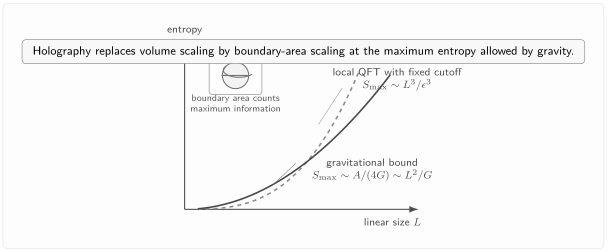
Local quantum field theory suggests independent degrees of freedom in each UV cell, leading to volume scaling. Gravity forbids arbitrarily many independent bulk degrees of freedom in a fixed region: once the entropy is high enough, the region is better described as a black hole whose entropy scales as the area of the boundary.
This is the basic holographic argument. It does not by itself construct the boundary theory. It says that any correct quantum theory of gravity must avoid the naive volume-counting of local quantum field theory. The maximum number of independent states associated with a region should be bounded by something like
The word “holographic” becomes precise in AdS/CFT: a gravitational theory in -dimensional asymptotically AdS spacetime is exactly equivalent to a nongravitational conformal field theory on the -dimensional boundary. The boundary theory has enough degrees of freedom to describe the bulk, including black holes, because the number of states grows with the boundary scaling suggested by the area law.
The covariant entropy bound
Section titled “The covariant entropy bound”The simple area bound just described is too naive in general spacetime. In cosmology or inside black holes, spatial volume and area can behave in counterintuitive ways. The covariant entropy bound gives a more flexible statement.
Let be a codimension-two spacelike surface with area . Shoot null geodesics orthogonally away from . A light-sheet is a null hypersurface generated by those geodesics in a direction for which the expansion is nonpositive:
The covariant entropy bound states schematically that the entropy passing through such a light-sheet obeys
This is a profound refinement of the slogan “entropy in a region is bounded by area.” The bound is not attached to an arbitrary spacelike volume. It is attached to light-sheets, which are causal, geometrical objects. For black hole horizons, this covariant viewpoint naturally connects entropy bounds to focusing, energy conditions, and the generalized second law.
Modern quantum versions replace classical area by generalized entropy. This is one route from the old holographic principle to quantum extremal surfaces and islands.
Why the coefficient is one quarter
Section titled “Why the coefficient is one quarter”The factor is not a convention. It is fixed by the simultaneous validity of the first law and Hawking’s temperature. In Einstein gravity,
for a nonrotating, uncharged black hole, while
Therefore
The cancellation of is important. It means the same entropy-area relation works for all nonextremal stationary black holes in Einstein gravity, independent of mass, spin, and charge.
There is also a Euclidean path-integral way to see the coefficient. The gravitational partition function in a saddle approximation is
so the thermodynamic entropy is
For a black hole saddle, the regularity condition fixes the Euclidean time circle, and the on-shell gravitational action contains a horizon contribution that gives . This derivation is especially useful because it generalizes naturally to gravitational replica methods, where conical defects and cosmic branes compute entropy.
Area as entropy, not as ordinary hair
Section titled “Area as entropy, not as ordinary hair”A black hole in classical general relativity is characterized by a small set of asymptotic charges: mass, angular momentum, and gauge charges. The enormous entropy is therefore not a count of classical hair visible outside the horizon. It is a count of microscopic states compatible with the same macroscopic exterior geometry.
This distinction is central to black hole information. If a black hole of mass has approximately
microstates, then it cannot behave like an object with infinitely many internal states unless one accepts remnants or other exotic possibilities. During evaporation, the Bekenstein-Hawking entropy decreases. If the full process is unitary, the fine-grained entropy of the radiation cannot keep increasing after the remaining black hole has too few states to purify it. This is the Page-curve intuition in its simplest form.
For a four-dimensional Schwarzschild black hole,
Thus the number of black hole microstates decreases as the black hole loses mass. A unitary evaporation process must eventually transfer information to the radiation in a way that the naive Hawking calculation does not capture.
Entanglement, edge modes, and the species problem
Section titled “Entanglement, edge modes, and the species problem”It is tempting to say that black hole entropy is simply entanglement entropy across the horizon. This is partly right and partly misleading.
The right part is that quantum fields near a horizon are highly entangled across it. In fact, the leading divergence of entanglement entropy in local QFT is proportional to the area of the entangling surface:
in spacetime dimensions. This resembles the Bekenstein-Hawking area law.
The misleading part is that the coefficient depends on the UV cutoff and the species of matter fields. By contrast, is expressed in terms of the renormalized Newton constant. The resolution is that the matter entanglement divergence renormalizes the gravitational couplings. The entropy of a gravitating region is not a matter entropy alone, but a generalized entropy.
Gauge theories and gravity add another complication: Hilbert spaces do not factorize naively across spatial subregions because of constraints. Edge modes or algebraic centers may be needed to define subregion entropy carefully. This is not an optional technicality. It is the precursor of the operator-algebra viewpoint that later clarifies quantum-corrected RT and entanglement wedge reconstruction.
What the holographic principle does and does not say
Section titled “What the holographic principle does and does not say”The holographic principle is often summarized as “the physics in a volume is encoded on its boundary.” That slogan is useful, but it can be too loose. For these notes, keep four qualifications in mind.
First, the area law is an entropy bound, not an explicit encoding map. AdS/CFT gives an explicit realization, but the original black hole argument only says that a volume-counting theory has too many states.
Second, the bound is gravitational. A nongravitational quantum field theory in a fixed box can have a Hilbert space that factorizes locally once a cutoff is imposed. The holographic restriction appears when the energy carried by those states is allowed to gravitate.
Third, not every system saturates the bound. Ordinary matter has entropy far below . Black holes are special because they are maximally entropic objects for their size.
Fourth, the boundary need not be a literal material screen. In AdS/CFT the boundary is the conformal boundary of spacetime. In the covariant entropy bound the relevant object is a light-sheet. In black hole thermodynamics the relevant “boundary” is the horizon. These are related ideas, not identical constructions.
Connection to later pages
Section titled “Connection to later pages”This page supplies the entropy scale for the rest of the course.
The next page will explain Hawking radiation and the information-loss paradox. There, the same temperature appears as the temperature of the outgoing radiation. The Page-curve page will use
to argue that a finite black hole cannot purify an ever-growing radiation entropy. The holographic entropy pages will upgrade the area law to RT, HRT, FLM, and quantum extremal surfaces. Finally, the island formula will replace the old horizon entropy by a generalized entropy extremization:
In that formula, the area term is a direct descendant of Bekenstein-Hawking entropy, while the matter entropy term is the quantum correction demanded by semiclassical gravity. The modern island story is therefore not a replacement for black hole thermodynamics. It is black hole thermodynamics used with the correct fine-grained entropy functional.
Common pitfalls
Section titled “Common pitfalls”Pitfall 1: “Area increase is the same as entropy increase.”
Classically this is a good analogy, but quantum mechanically the area can decrease through Hawking evaporation. The more robust statement is the generalized second law for .
Pitfall 2: “Black hole entropy is just the entropy of matter that formed the black hole.”
A black hole of fixed mass has entropy vastly larger than that of a typical star of the same mass. The entropy counts all microstates compatible with the macroscopic black hole, not merely the entropy of a particular collapse history.
Pitfall 3: “Holography means the bulk is fake.”
In AdS/CFT, the bulk is an emergent but physically meaningful description within a regime of validity. The point is not that spacetime is useless; the point is that its fundamental encoding is nonlocal from the bulk viewpoint.
Pitfall 4: “The area law alone solves the information problem.”
The area law tells us the entropy scale and suggests a finite number of black hole states. It does not by itself explain how information gets into Hawking radiation. For that one needs the Page curve, holographic entropy, reconstruction, and islands.
Exercises
Section titled “Exercises”Exercise 1. Schwarzschild entropy from the first law
Section titled “Exercise 1. Schwarzschild entropy from the first law”For a four-dimensional Schwarzschild black hole, use
and to derive .
Solution
The first law gives
Integrating,
Choosing the constant to vanish when gives
The Schwarzschild radius is , so
Therefore
Exercise 2. Negative heat capacity
Section titled “Exercise 2. Negative heat capacity”Show that a four-dimensional Schwarzschild black hole has negative heat capacity. What is the physical consequence for asymptotically flat evaporation?
Solution
The Hawking temperature is
Solving for gives
Hence
The physical consequence is that the black hole heats up as it loses energy. In asymptotically flat space, this makes evaporation runaway rather than stable canonical thermal equilibrium. This is why black hole thermodynamics in a canonical ensemble is cleaner for large AdS black holes or black holes placed in a finite box.
Exercise 3. Euclidean regularity and temperature
Section titled “Exercise 3. Euclidean regularity and temperature”Suppose the near-horizon Euclidean metric of a nonextremal black hole is
Show that smoothness at requires .
Solution
The flat Euclidean plane in polar coordinates is
where has period . Comparing with
we identify
Therefore smoothness at the origin requires
or
The Euclidean time period is , so the temperature is in units .
Exercise 4. Bekenstein bound from the generalized second law
Section titled “Exercise 4. Bekenstein bound from the generalized second law”An object of energy , radius , and entropy is slowly lowered into a large Schwarzschild black hole. Near the horizon, assume the redshift factor is . Derive the bound on implied by the generalized second law.
Solution
The energy delivered to the black hole as measured at infinity is approximately
The black hole entropy increase is
Using gives
When the object crosses the horizon, the outside entropy decreases by . The generalized second law requires
Therefore
Restoring and gives, for dimensionful entropy,
Exercise 5. Why volume counting overcounts in gravity
Section titled “Exercise 5. Why volume counting overcounts in gravity”Consider a ball of radius in four spacetime dimensions. A cutoff quantum field theory might suggest an entropy scaling like . A black hole of the same radius has entropy . Explain why the two scalings are in tension when is taken near the Planck length.
Solution
In four spacetime dimensions, the Planck length satisfies roughly . If the QFT cutoff is taken to be Planckian, , then local QFT volume counting gives
The black hole entropy for a region of radius scales as
For ,
Thus naive local QFT assigns far more independent states to the region than gravity allows before the region collapses into a black hole. The conclusion is not that effective field theory is useless, but that most states in a naive cutoff Hilbert space cannot be independent gravitational states in a fixed region.
Exercise 6. Area term versus generalized entropy
Section titled “Exercise 6. Area term versus generalized entropy”Why is a better semiclassical object than either or alone?
Solution
The area term alone misses the entropy of quantum fields outside the horizon. This is fatal in semiclassical processes such as Hawking evaporation, where radiation entropy outside the black hole is essential. The matter entropy alone is also not physical as a universal gravitational entropy, because it is UV divergent and depends on the cutoff and the matter content.
The divergences in are absorbed into the renormalization of gravitational couplings, including . Thus the meaningful quantity is the renormalized generalized entropy
This is the quantity that appears in the generalized second law, quantum extremal surfaces, and the island formula.
Further reading
Section titled “Further reading”- J. D. Bekenstein, “Black Holes and Entropy,” Physical Review D 7 (1973), 2333–2346. DOI: 10.1103/PhysRevD.7.2333.
- J. M. Bardeen, B. Carter, and S. W. Hawking, “The Four Laws of Black Hole Mechanics,” Communications in Mathematical Physics 31 (1973), 161–170. Project Euclid.
- S. W. Hawking, “Particle Creation by Black Holes,” Communications in Mathematical Physics 43 (1975), 199–220. Project Euclid.
- G. W. Gibbons and S. W. Hawking, “Action Integrals and Partition Functions in Quantum Gravity,” Physical Review D 15 (1977), 2752–2756. DOI: 10.1103/PhysRevD.15.2752.
- G. ’t Hooft, “Dimensional Reduction in Quantum Gravity,” arXiv:gr-qc/9310026.
- L. Susskind, “The World as a Hologram,” arXiv:hep-th/9409089.
- R. M. Wald, “Black Hole Entropy is Noether Charge,” arXiv:gr-qc/9307038.
- R. Bousso, “A Covariant Entropy Conjecture,” arXiv:hep-th/9905177.
- R. Bousso, “The Holographic Principle,” arXiv:hep-th/0203101.
The next page turns the thermodynamic facts into a paradox. Hawking radiation gives black holes a real temperature and produces an outgoing thermal flux. If one combines that local semiclassical calculation with complete evaporation, the result appears to be a pure-to-mixed evolution. That is the original information-loss problem.