
Replica Wormholes
Guiding question. The island formula gives the correct Page curve in many semiclassical models, but why should a region behind the horizon be included when computing the entropy of radiation far away from the black hole? Replica wormholes give the gravitational path-integral answer: when we compute , the dominant saddle need not keep the gravitating replicas disconnected.
The previous pages introduced the island formula as a quantum-extremal-surface prescription:
This page explains how that rule arises from a replica calculation. The slogan is simple but easy to misread:
A replica wormhole is a saddle of the entropy computation, not a new classical channel through which Hawking quanta travel.
It connects different copies of the black-hole spacetime in the auxiliary geometry used to evaluate . After quotienting by replica symmetry and taking , the wormhole leaves behind a quantum extremal surface and an island.
1. What must be computed
Section titled “1. What must be computed”Let be a nongravitating radiation region in the bath. Because lies in an ordinary nongravitating system, its density matrix is a familiar object:
The von Neumann entropy is
The replica trick rewrites it as
With explicit normalization,
where is the path integral with copies glued cyclically along and glued ordinarily along the complement. In nongravitational QFT this prescription is fixed once the state and the region are specified. In gravity there is an extra step: the metric and other gravitational fields in the gravitating region must also be integrated over.
Schematically,
The boundary condition specifies the cyclic gluing in the bath. It does not require the gravitating interiors of the replicas to remain disconnected.
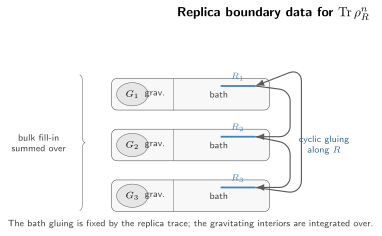
The replica path integral for cyclically glues the nongravitating radiation region between replicas. In the gravitating region one must sum over allowed bulk geometries compatible with this boundary gluing.
This is the crucial opening for replica wormholes.
2. The Hawking saddle: disconnected replicas
Section titled “2. The Hawking saddle: disconnected replicas”The simplest saddle is the one Hawking’s calculation effectively uses. Each replica contains a copy of the evaporating black hole, and the gravitating regions remain disconnected:
The matter fields are still glued cyclically along , because this is part of the replica boundary condition. But the geometry does not connect the replicas through the black-hole interior.
This saddle computes the no-island entropy,
with the matter entropy evaluated on the semiclassical evaporating background. At early times this is the correct answer. At late times it grows like the Hawking radiation entropy and overshoots the Bekenstein-Hawking entropy of the remaining black hole. In a unitary evaporation process that cannot be the fine-grained entropy of the radiation.
The lesson is not that Hawking made an algebra mistake. Rather, Hawking kept only one saddle class in a gravitational computation that, for fine-grained entropy, is sensitive to nonperturbatively different topologies.
3. The replica-wormhole saddle
Section titled “3. The replica-wormhole saddle”A replica wormhole is a saddle in which the gravitating replicas are connected in the interior. For integer , the saddle has the same asymptotic or bath boundary conditions as the disconnected saddle, but its topology is different.
One should picture the radiation region as still living in cyclically glued bath copies, while the black-hole interiors are connected through a Euclidean or complexified wormhole. The wormhole is not traversable, and it is not a Lorentzian shortcut available to an observer. It is part of the auxiliary saddle that computes a trace of powers of a density matrix.
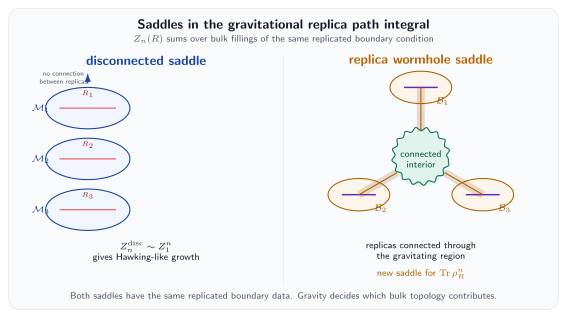
Two saddle classes for . The disconnected Hawking saddle keeps the gravitating replicas independent. The replica-wormhole saddle connects the gravitating interiors while respecting the same cyclic gluing of in the nongravitating bath.
In a saddle approximation,
where labels disconnected and connected saddle classes. The Rényi entropy is then controlled by whichever saddle dominates the ratio after analytic continuation near .
The connected saddle is usually exponentially suppressed at early times. At late times, however, it can dominate the entropy calculation. This dominance exchange is the replica-wormhole origin of the Page transition.
4. Quotient by replica symmetry
Section titled “4. Quotient by replica symmetry”The cleanest derivation assumes that the dominant -replica saddle has a replica symmetry. One may then quotient by that symmetry:
The quotient geometry has a conical defect at the fixed locus of the replica symmetry. In the cosmic-brane language, this defect is described by a brane of tension
As , this brane becomes tensionless, but the derivative with respect to leaves a finite entropy contribution. The fixed locus becomes the quantum extremal surface .
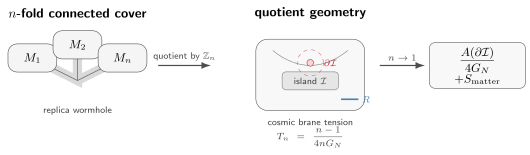
Assuming replica symmetry, the connected -fold saddle can be quotiented to a single geometry with a conical defect. In the limit the defect becomes the QES , and the matter replica gluing computes .
The appearance of is the most important conceptual point. In the quotient description, the matter fields are cyclically glued not only along the radiation region , but also across the region whose boundary is the replica fixed locus. That region is the island. Thus the matter part of the entropy is not , but
The gravitational part gives the area, or in two-dimensional dilaton gravity the dilaton value, at the fixed locus:
Extremizing the saddle with respect to the location of the fixed locus gives
This is precisely the QES condition.
5. Entropy from the replica action
Section titled “5. Entropy from the replica action”Let denote the on-shell action of a candidate -replica saddle. With the normalized partition function,
The von Neumann entropy is
For a replica-symmetric saddle, the derivative has two pieces.
First, the gravitational action near the conical defect gives the area term:
Second, the matter action on the replicated geometry gives the matter entropy of the cyclically glued region:
Putting these together gives the generalized entropy of the island saddle:
If several replica-symmetric saddles exist, the path integral chooses the dominant one. In the entropy formula this becomes the familiar final step:
The order is important:
Extremization is a local saddle equation. Minimization is a dominance statement among competing saddles.
6. The Page transition as a saddle switch
Section titled “6. The Page transition as a saddle switch”The disconnected Hawking saddle typically gives an entropy that grows with time:
The island saddle gives an entropy controlled by the remaining black-hole entropy plus relatively small matter corrections:
For an eternal black hole coupled to a thermal bath, this second branch may be approximately constant. For a genuinely evaporating black hole, it decreases as the black hole loses area. The Page curve is the lower envelope:
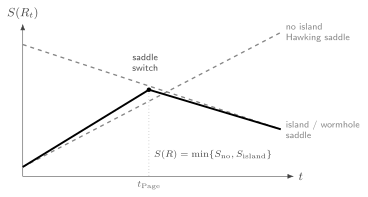
The Page transition is a saddle switch in the replica path integral. At early times the disconnected Hawking saddle dominates. At late times the replica-wormhole saddle dominates and gives the island branch.
At strictly infinite semiclassical control, this switch looks sharp. At finite or finite , the exact entropy of a finite-dimensional system is smooth. The sharp cusp is a large- artifact, just like a Hawking-Page transition is a sharp saddle switch only in the classical gravity limit.
7. A useful JT topological check
Section titled “7. A useful JT topological check”In JT gravity the action contains a topological term
so a topology with Euler character contributes a factor . This makes the area contribution especially transparent.
In a common two-endpoint island geometry, the relevant connected replica wormhole has a topological contribution of the schematic form
After normalizing by ,
Therefore
This is the two-dimensional version of the area term for two QES endpoints:
The exact coefficient and number of endpoints depend on the model and on whether the island has one or two boundaries. The moral is robust: topology in the gravitational replica saddle supplies the Bekenstein-Hawking part of the generalized entropy.
8. Replica wormholes and the island formula
Section titled “8. Replica wormholes and the island formula”The derivation can be compressed into a short chain:
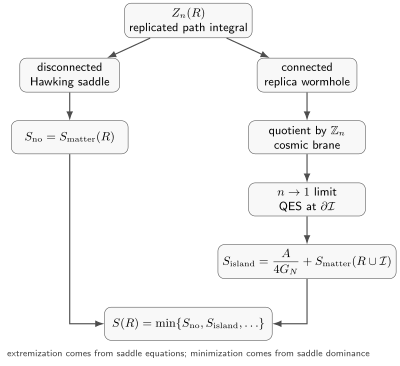
The logical path from the replica trace to the island rule. The delicate steps are the sum over gravitational saddles, the assumption or selection of replica-symmetric saddles, and analytic continuation from integer to .
This chain is why the island formula is not merely a phenomenological patch. In the controlled models where the saddle analysis is reliable, the island appears because the correct gravitational path integral for includes connected saddles.
9. What is connected to what?
Section titled “9. What is connected to what?”The word “wormhole” can be treacherous. Replica wormholes are not the same as the Einstein-Rosen bridge of the eternal two-sided black hole, and they are not a traversable wormhole created by a double-trace deformation. They connect replicas in the auxiliary computation.
A good way to say it is:
- The physical system has one radiation density matrix .
- To compute , we introduce copies of the system.
- The gravitational path integral over those copies can have connected saddles.
- After analytic continuation to , the connected saddle contributes an island to .
Thus the wormhole is real as a saddle of the gravitational entropy calculation, but it is not a local Lorentzian route by which information escapes.
10. Why this can produce an order-one entropy correction
Section titled “10. Why this can produce an order-one entropy correction”A common worry is that replica wormholes look nonperturbative, so they should be tiny. The resolution is the same as in many saddle-point problems: an exponentially small correction to a partition function can produce an order-one correction to the logarithm when it becomes the dominant saddle.
More concretely, suppose two saddle classes contribute
For fixed near , one term may dominate before the Page time and the other after it. Since entropy differentiates near , the dominant saddle controls . There is no need for each individual Hawking quantum to receive a large local correction. The correction is nonlocal and fine-grained: it changes the entropy functional by changing the dominant topology in the replica computation.
This is closely related to why Mathur’s small-corrections argument did not leave room for merely perturbative pair-by-pair corrections. Replica wormholes do not perturb each Hawking pair locally. They change the global fine-grained entropy calculation.
11. Assumptions and caveats
Section titled “11. Assumptions and caveats”The replica-wormhole derivation is powerful, but it rests on assumptions that should be kept visible.
Semiclassical saddle dominance
Section titled “Semiclassical saddle dominance”The calculation assumes that a saddle-point approximation to the gravitational path integral is meaningful. In JT gravity and related low-dimensional models this can be made rather explicit. In higher-dimensional quantum gravity, the same logic is strongly motivated but generally less computationally controlled.
Analytic continuation in
Section titled “Analytic continuation in nnn”The path integral is defined most directly for positive integer . The entropy requires a continuation to real near :
Analytic continuation is often physically natural but rarely unique from integer data alone. The derivation assumes that the relevant saddle family admits the correct continuation.
Replica symmetry
Section titled “Replica symmetry”The quotient derivation assumes a -symmetric saddle or at least that replica-symmetric saddles dominate. Replica-symmetry-breaking saddles can exist in some gravitational path integrals. Understanding their role is part of the broader nonperturbative problem.
Factorization
Section titled “Factorization”Connected Euclidean wormholes often suggest ensemble averages because they can give nonfactorizing contributions to products of partition functions:
In JT gravity, the dual is indeed a matrix ensemble, so this feature is natural. In ordinary AdS/CFT with a single fixed boundary theory, factorization is more subtle. One expects additional nonperturbative ingredients to restore the exact single-theory answer, but the clean general mechanism is still an active research topic.
What the derivation proves
Section titled “What the derivation proves”Replica wormholes give a controlled semiclassical explanation of why the island formula computes the radiation entropy in important models. They do not by themselves provide a complete microscopic Hilbert-space construction for every evaporating black hole in every UV-complete theory. They tell us what the correct fine-grained gravitational entropy calculation does.
12. Relation to entanglement wedge reconstruction
Section titled “12. Relation to entanglement wedge reconstruction”The island formula says that after the Page time the radiation entropy is computed by a generalized entropy in which the island is included:
The reconstruction interpretation is
where is the entanglement wedge of the radiation. Replica wormholes explain why the entropy functional knows about this enlarged entanglement wedge. Entanglement wedge reconstruction explains what it means operationally: operators in the island can be represented, in a highly nonlocal code-subspace sense, on the radiation degrees of freedom.
This is the modern synthesis:
The arrow should not be read as “the interior sends signals to the radiation.” It means that the fine-grained algebra encoded in the radiation includes interior operators after the Page transition.
13. Common pitfalls
Section titled “13. Common pitfalls”Pitfall 1: “The replica wormhole is a physical tunnel for Hawking quanta.”
No. It is a saddle in the replicated entropy calculation. It does not allow causal propagation from the interior to the bath.
Pitfall 2: “The island is inserted by hand.”
No. In the replica derivation, the island is the region exposed by quotienting a connected replica saddle. Its boundary is the fixed locus of the replica symmetry in the limit.
Pitfall 3: “Replica wormholes are ordinary small corrections to Hawking radiation.”
No. They are nonperturbative saddle contributions to a fine-grained entropy calculation. They can change the dominant saddle for after the Page time.
Pitfall 4: “The Page curve is completely solved in every setting.”
No. The Page curve has been derived in controlled semiclassical and holographic models using islands and replica wormholes. Questions remain about factorization, microscopic reconstruction, realistic asymptotically flat evaporation, and cosmological horizons.
Exercises
Section titled “Exercises”Exercise 1. Entropy from the replica action
Section titled “Exercise 1. Entropy from the replica action”Assume that a single saddle dominates and
Show that
Solution
By definition,
Using the saddle approximation,
This expression vanishes at , because . Therefore
Thus
Exercise 2. Topological entropy in a JT replica wormhole
Section titled “Exercise 2. Topological entropy in a JT replica wormhole”Suppose a connected JT replica-wormhole saddle has topological factor
while . Compute the topological contribution to the von Neumann entropy.
Solution
The normalized replica partition function has topological factor
Therefore
This is the topological part of the two-endpoint island area term.
Exercise 3. Why ?
Section titled “Exercise 3. Why Smatter(R∪I)S_{\rm matter}(R\cup\mathcal I)Smatter(R∪I)?”Explain why the matter entropy in the island formula is rather than .
Solution
In the disconnected Hawking saddle, the only region cyclically glued in the matter path integral is the radiation region , so the matter replica computes .
In the replica-wormhole saddle, quotienting by replica symmetry produces a fixed locus. The region bounded by this fixed locus is the island . In the quotient geometry, the matter fields are effectively cyclically glued across and across . Thus the matter replica computes the entropy of the union:
The island is not added by hand; it is the region selected by the connected replica geometry.
Exercise 4. A toy saddle switch
Section titled “Exercise 4. A toy saddle switch”Let
with . Interpret as a no-island branch and as an island branch. Find the Page time in this toy model and the entropy selected by the saddle approximation.
Solution
The transition occurs when the two candidate entropies are equal:
Thus
The semiclassical saddle answer is the lower envelope,
Before the no-island branch dominates. After the island branch dominates.
Exercise 5. Factorization puzzle in one line
Section titled “Exercise 5. Factorization puzzle in one line”Why do connected Euclidean wormholes raise a factorization puzzle for a single non-ensemble AdS/CFT dual?
Solution
For two decoupled boundary theories one expects exact factorization:
A connected Euclidean wormhole with two asymptotic boundaries contributes a term that looks connected from the bulk perspective:
In an ensemble average, connected contributions are natural because
in general. For a single fixed CFT, however, exact factorization should hold. The puzzle is how the gravitational path integral organizes additional nonperturbative effects so that the exact single-theory answer factorizes while still reproducing the useful semiclassical wormhole saddle physics.
Further reading
Section titled “Further reading”- Ahmed Almheiri, Thomas Hartman, Juan Maldacena, Edgar Shaghoulian, and Amirhossein Tajdini, “Replica Wormholes and the Entropy of Hawking Radiation”.
- Geoff Penington, Stephen H. Shenker, Douglas Stanford, and Zhenbin Yang, “Replica Wormholes and the Black Hole Interior”.
- Ahmed Almheiri, Thomas Hartman, Juan Maldacena, Edgar Shaghoulian, and Amirhossein Tajdini, “The entropy of Hawking radiation”.
- Aitor Lewkowycz and Juan Maldacena, “Generalized gravitational entropy”.
- Donald Marolf and Henry Maxfield, “Transcending the ensemble: baby universes, spacetime wormholes, and the order and disorder of black hole information”.