
Cardy formula and black-hole entropy
The BTZ black hole entropy is
The Cardy formula says that a two-dimensional conformal field theory has a universal asymptotic density of high-energy states controlled by its central charge. Combining this universal CFT statement with the Brown–Henneaux central charge,
one exactly reproduces the BTZ entropy.
This calculation is one of the sharpest early successes of AdS/CFT. It does not require detailed knowledge of the microscopic CFT. It uses only symmetry, modular invariance, and the relation between gravitational charges and Virasoro zero modes.
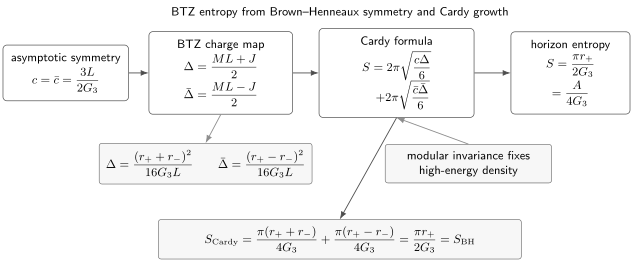
The BTZ entropy match has three inputs: the Brown–Henneaux central charge , the charge map and , and the Cardy formula for the high-energy density of states in a modular-invariant CFT. The output is .
Why this matters
Section titled “Why this matters”For a black hole, the gravitational entropy is geometric:
In three dimensions the horizon “area” is the horizon circumference,
So the BTZ entropy is
A microscopic explanation should identify a quantum Hilbert space and count the states responsible for this entropy.
AdS/CFT gives such a count. The boundary theory is a two-dimensional CFT. Its asymptotic density of states is not arbitrary; modular invariance of the torus partition function relates the high-temperature regime to the low-temperature vacuum. The result is the Cardy formula.
The astonishing point is that the resulting entropy depends only on the central charge and the conserved charges. Since Brown and Henneaux fixed the central charge from asymptotic symmetry, the entropy follows.
CFT on the cylinder
Section titled “CFT on the cylinder”Put the CFT on a spatial circle of radius :
The Hamiltonian and angular momentum are
The shifts by and are not optional. They are the Casimir-energy shifts coming from the map between the plane and the cylinder.
For parity-invariant Einstein gravity in AdS,
The global AdS vacuum corresponds to
Then the cylinder energy is
which matches the mass of global AdS.
This is the first place where the shift visibly matters.
The Cardy formula
Section titled “The Cardy formula”For a unitary, modular-invariant two-dimensional CFT with sufficiently well-behaved low-energy spectrum, the high-energy density of states obeys the Cardy formula. In the microcanonical form relevant for rotating BTZ black holes,
where
and the formula is valid when the shifted weights are large compared with the vacuum scale.
It is often cleaner to define
Then
The labels and are conventional; some authors interchange them. What matters is the pair of independent Virasoro sectors.
Sketch of the modular derivation
Section titled “Sketch of the modular derivation”The Euclidean finite-temperature CFT lives on a torus. For a nonrotating ensemble, the partition function is
The torus modular parameter is purely imaginary,
Modular invariance states that the torus partition function is invariant under
For imaginary , this relates
Thus the high-temperature limit is related to the low-temperature limit .
At low temperature, the partition function is dominated by the vacuum. For ,
so the modular-transformed partition function gives
The thermal entropy is
so
This is the canonical Cardy formula for a parity-invariant CFT on a circle of radius .
The rotating case is the same logic applied separately to left- and right-moving sectors.
Rotating ensemble and chiral temperatures
Section titled “Rotating ensemble and chiral temperatures”For a rotating BTZ black hole, the boundary density matrix is
It is useful to write this in chiral form. Define
Then the canonical Cardy entropy is
For ,
The terms cancel, leaving
This is the Bekenstein–Hawking entropy of the rotating BTZ black hole.
Microcanonical match
Section titled “Microcanonical match”Now do the same calculation in microcanonical language. The BTZ charge map is
Using
we get
and
Therefore
and
Insert these into Cardy’s formula:
With
we have
and similarly
Thus
This is the exact Bekenstein–Hawking entropy.
Nonrotating BTZ as a warm-up
Section titled “Nonrotating BTZ as a warm-up”For ,
The shifted weights are equal:
Cardy’s formula gives
Using ,
Again,
Extremal BTZ and chiral Cardy
Section titled “Extremal BTZ and chiral Cardy”In the extremal limit
Then
in our naming convention. The entropy is entirely carried by one chiral sector:
In microcanonical form,
Then
Extremal BTZ is therefore a particularly clean example of a chiral high-energy state in a two-dimensional CFT.
What exactly is being counted?
Section titled “What exactly is being counted?”The most conservative answer is:
In AdS gravity, Brown–Henneaux boundary conditions imply that the asymptotic symmetry algebra is two copies of the Virasoro algebra with central charge . The BTZ black hole has definite values of the charges and . If the quantum theory is a modular-invariant CFT with the appropriate spectrum, then Cardy’s formula gives the degeneracy of states with those charges.
This is a microscopic entropy in the boundary description. It does not necessarily display individual horizon microstates in a local bulk basis. In fact, one of the lessons of holography is that a local bulk description is often the wrong language for counting all the states.
The entropy match is nevertheless extremely strong: the same number is obtained from the horizon area and from universal CFT asymptotics.
Why the match is universal
Section titled “Why the match is universal”The calculation used only three ingredients:
- the asymptotic symmetry algebra of AdS gravity;
- the charge map between BTZ parameters and Virasoro zero modes;
- modular invariance of the boundary CFT partition function.
This is why the BTZ entropy calculation is so robust. It does not depend on knowing a Lagrangian for the boundary CFT, nor on supersymmetry, nor on weak coupling.
At the same time, this robustness has a cost: the Cardy formula gives a degeneracy, not a simple list of bulk microstates. It counts states from the boundary perspective.
Conditions and caveats
Section titled “Conditions and caveats”The Cardy formula is universal, but not magic. Its use assumes a suitable two-dimensional CFT.
Important assumptions include:
- a well-defined Hilbert space on the circle;
- modular invariance of the torus partition function;
- a normalizable vacuum;
- sufficiently sparse or controlled low-energy spectrum in the regime of interest;
- large enough charges for the asymptotic formula to apply.
For semiclassical BTZ black holes, the relevant limit is
This is the black-hole regime. Small conical defects and light states require more detailed information about the CFT spectrum.
Another caveat is that pure three-dimensional gravity may not be a fully consistent standalone quantum theory with exactly the spectrum one might naively expect. In string-theoretic AdS examples, additional sectors are often present. The Cardy match is universal, but the microscopic interpretation can differ among theories.
Relation to the Hawking–Page transition
Section titled “Relation to the Hawking–Page transition”For global AdS, the boundary CFT lives on a circle. Thermal AdS and Euclidean BTZ are two different bulk fillings of the same boundary torus. The Hawking–Page transition is a modular transition between which cycle of the boundary torus is contractible in the bulk.
In the CFT, the same physics is encoded in modular invariance:
This is one reason AdS/CFT is so sharp: the gravitational saddle competition and the CFT modular transformation are two views of the same torus geometry.
Dictionary checkpoint
Section titled “Dictionary checkpoint”The entropy calculation can be summarized as:
This is the AdS/CFT black-hole entropy match in its most compact form.
Common confusions
Section titled “Common confusions”“Cardy’s formula counts gravitons in the BTZ exterior.”
Section titled ““Cardy’s formula counts gravitons in the BTZ exterior.””Not exactly. Pure three-dimensional gravity has no local graviton modes. Cardy’s formula counts boundary CFT states with the same conserved charges as the BTZ black hole. The bulk interpretation may involve boundary gravitons, quotient sectors, stringy degrees of freedom, or other microscopic variables depending on the full theory.
“The shift is a convention that can be ignored.”
Section titled ““The c/24c/24c/24 shift is a convention that can be ignored.””The shift is physically meaningful on the cylinder. It accounts for the vacuum Casimir energy. Without it, global AdS would not map to the CFT vacuum correctly.
“The entropy depends on , because rotating BTZ has two horizons.”
Section titled ““The entropy depends on r−r_-r−, because rotating BTZ has two horizons.””The left and right sectors separately depend on , but the sum in the entropy depends only on :
The outer horizon controls the Bekenstein–Hawking entropy.
“The Cardy formula is exact for every energy.”
Section titled ““The Cardy formula is exact for every energy.””No. It is an asymptotic high-energy formula. In special theories there can be exact refinements or protected versions, but the usual Cardy formula is a universal asymptotic statement.
“The match proves pure Einstein gravity in AdS is a complete quantum theory.”
Section titled ““The match proves pure Einstein gravity in AdS3_33 is a complete quantum theory.””No. The entropy match is a powerful consistency check, but the existence and uniqueness of a fully consistent pure-gravity CFT dual is a deeper question. The Cardy calculation tells us what any suitable dual must reproduce in the black-hole regime.
Exercises
Section titled “Exercises”Exercise 1: The nonrotating Cardy match
Section titled “Exercise 1: The nonrotating Cardy match”For , show directly that the Cardy formula reproduces
Solution
For ,
and
With ,
Both sectors contribute equally, so
Exercise 2: Rotating BTZ entropy
Section titled “Exercise 2: Rotating BTZ entropy”Starting from
derive the BTZ entropy.
Solution
Using ,
and
Therefore
Exercise 3: Canonical Cardy formula
Section titled “Exercise 3: Canonical Cardy formula”Use
with
to reproduce the BTZ entropy.
Solution
For Einstein gravity,
Then
The expression in parentheses is
Hence
Exercise 4: The role of the vacuum shift
Section titled “Exercise 4: The role of the vacuum shift”Show that global AdS maps to the CFT vacuum if
Solution
The charge map is
For global AdS,
But
Therefore
which gives
The same argument gives . Thus global AdS maps to the CFT vacuum.
Further reading
Section titled “Further reading”- J. L. Cardy, Operator Content of Two-Dimensional Conformally Invariant Theories.
- A. Strominger, Black Hole Entropy from Near-Horizon Microstates.
- S. Carlip, What We Don’t Know about BTZ Black Hole Entropy.
- M. Bañados, C. Teitelboim, and J. Zanelli, The Black Hole in Three Dimensional Space Time.
- J. D. Brown and M. Henneaux, Central Charges in the Canonical Realization of Asymptotic Symmetries.