
Virasoro Symmetry and Boundary Gravitons
The previous pages used the Brown–Henneaux central charge and the Cardy formula to explain why the BTZ black-hole entropy is counted by a two-dimensional CFT. This page fills in a structural point that is just as important: in gravity, the would-be gauge transformations at infinity become genuine physical symmetries. Their charges form two Virasoro algebras.
This is the origin of boundary gravitons.
In ordinary general relativity, many metric fluctuations are pure gauge. In three-dimensional Einstein gravity, this statement is especially sharp: there are no local propagating gravitons. Yet asymptotically gravity is not empty. The boundary conditions allow “large” diffeomorphisms that act nontrivially at infinity. These transformations have finite canonical charges, and those charges create physical states.
The slogan is
Instead,
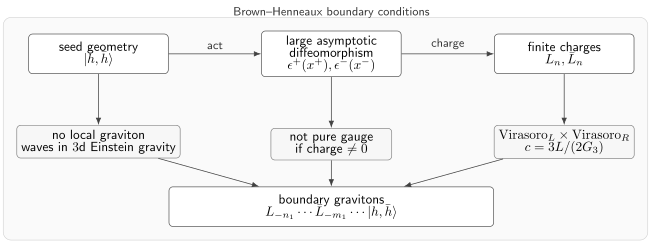
Brown–Henneaux boundary conditions enlarge the exact isometries of global to two Virasoro algebras of asymptotic symmetries. The non-global modes and , with , create boundary gravitons: physical gravitational descendants rather than local propagating gravitons.
Why this matters
Section titled “Why this matters”Boundary gravitons are one of the cleanest lessons of .
They teach us that:
- gauge transformations can become physical when they act nontrivially at the boundary;
- the Hilbert space of quantum gravity is not determined only by local bulk fields;
- the CFT stress tensor is not merely dual to a bulk graviton field, but to the canonical charges of asymptotic geometry;
- descendants in the CFT vacuum module have a precise gravitational interpretation.
This is also the first place where looks very different from higher-dimensional AdS/CFT. In with , the global conformal group is finite-dimensional, whereas in two boundary dimensions the local conformal transformations generate the infinite-dimensional Virasoro algebra.
The miracle is not that has more local bulk degrees of freedom. It has fewer. The miracle is that its boundary degrees of freedom are extraordinarily powerful.
Exact symmetries versus asymptotic symmetries
Section titled “Exact symmetries versus asymptotic symmetries”The exact isometry group of is
This is the global conformal group of a two-dimensional Lorentzian CFT. If this were the whole story, would be special but not spectacular.
The Brown–Henneaux result is stronger. The allowed diffeomorphisms that preserve asymptotically boundary conditions form two copies of the Virasoro algebra,
with central charges
The exact isometries are the global subalgebra generated by
The other modes are not exact Killing vectors of the vacuum geometry. They are asymptotic symmetries: they preserve the allowed falloff conditions at infinity and act nontrivially on the phase space.
This distinction is worth making slowly.
An exact Killing vector satisfies
for a particular metric . It maps the metric to itself.
An asymptotic symmetry vector satisfies a weaker condition:
is allowed to change the subleading terms in the asymptotic expansion, but it does not spoil the boundary conditions. It maps one allowed asymptotically metric to another.
Thus the asymptotic symmetry group acts on the space of states, not merely on one background.
Brown–Henneaux boundary conditions
Section titled “Brown–Henneaux boundary conditions”Use global-like coordinates near the boundary,
The Brown–Henneaux boundary conditions say, roughly, that the metric approaches global fast enough to define finite charges but slowly enough to allow stress-tensor excitations at the boundary. In one common radial coordinate , the leading behavior is
with subleading components constrained so that the boundary metric remains a cylinder.
In Fefferman–Graham language, a locally metric has the structure
with
For pure three-dimensional Einstein gravity, the expansion terminates. There is no independent tower of local normalizable bulk modes. The coefficient is essentially the boundary stress-tensor data, subject to conservation and trace conditions.
That finite expansion is one of the practical reasons is so exact.
The asymptotic vector fields
Section titled “The asymptotic vector fields”The asymptotic diffeomorphisms preserving the Brown–Henneaux falloffs are parametrized by two arbitrary functions,
At large radius, the corresponding vector field has the schematic form
The leading boundary action is therefore
These are precisely local conformal transformations of a two-dimensional Lorentzian CFT.
Expanding in Fourier modes,
gives vector fields associated with and .
Classically, the vector fields obey the Witt algebra,
and similarly for the barred sector. The central extension appears not in the naive Lie bracket of vector fields, but in the Poisson brackets of the canonical charges.
Charges and the Virasoro algebra
Section titled “Charges and the Virasoro algebra”A diffeomorphism generated by is pure gauge only if its canonical charge vanishes. In asymptotically AdS gravity, the charge associated with an asymptotic symmetry can be finite and nonzero.
For Brown–Henneaux boundary conditions, the charges obey
with
This is the Virasoro algebra in the convention where the global subalgebra has no central term. Equivalently, if one uses the more common CFT commutator
then the definition of differs by the standard vacuum shift. Both conventions are common; the important physics is the same.
The central term is classical from the bulk point of view. Since
large central charge corresponds to weakly coupled three-dimensional gravity.
What is a boundary graviton?
Section titled “What is a boundary graviton?”A boundary graviton is a physical metric excitation obtained by acting with a nontrivial Brown–Henneaux asymptotic symmetry on a background such as global .
Because three-dimensional Einstein gravity has no local graviton polarizations, these excitations are not wave packets moving through the bulk. They are boundary degrees of freedom encoded in the subleading asymptotic metric data.
In the CFT, they are stress-tensor descendants. The global vacuum corresponds to the CFT vacuum . Acting with Virasoro lowering modes gives descendants:
The modes with annihilate the vacuum, while measures energy and generate the global conformal transformations. Therefore the genuine vacuum boundary-graviton descendants begin at .
A typical state in the vacuum module has the form
The total cylinder energy above the vacuum is determined by the level,
These are gravitational excitations, but they are not local bulk gravitons.
Large diffeomorphisms are not pure gauge
Section titled “Large diffeomorphisms are not pure gauge”It is tempting to say: “If a boundary graviton is generated by a diffeomorphism, it must be gauge.”
The trap is that not all diffeomorphisms are gauge redundancies. Small diffeomorphisms that vanish sufficiently fast at the boundary are gauge. Large diffeomorphisms that act nontrivially on the boundary data and carry nonzero charges are physical symmetries.
This distinction appears throughout gauge theory and gravity. In electromagnetism, a gauge parameter that approaches a nonzero function at infinity can generate a global charge. In gravity, an asymptotic diffeomorphism can generate energy, momentum, angular momentum, or a Virasoro charge.
The boundary graviton is physical because the associated charge does not vanish.
Equivalently, the symplectic form on the reduced phase space gives these modes nonzero norm after quotienting by true gauge transformations.
The stress tensor as asymptotic metric data
Section titled “The stress tensor as asymptotic metric data”The holographic stress tensor is the cleanest way to see the boundary graviton in the dictionary.
In Fefferman–Graham gauge for ,
The renormalized stress tensor is determined by and local terms. For a flat boundary metric, schematically,
Thus the data that define boundary gravitons are precisely stress-tensor data in the CFT.
For locally solutions obeying Brown–Henneaux boundary conditions, the general solution can be parametrized by two functions,
which correspond to the chiral components of the CFT stress tensor,
Constant values describe global , conical defects, and BTZ black holes, depending on the range. Nonconstant functions describe boundary-graviton excitations of those geometries.
Relation to the vacuum character
Section titled “Relation to the vacuum character”If the only perturbative excitations around global are boundary gravitons, the one-loop perturbative partition function is controlled by the vacuum Virasoro character.
The left-moving vacuum descendants are generated by modes with , so their counting is encoded in
Including both chiralities gives
This formula is a useful perturbative statement around thermal . It is not, by itself, a full nonperturbative theory of quantum gravity. A full CFT partition function must also obey modular invariance and have a sensible spectrum. BTZ black holes and possibly other saddles or states are needed for the high-energy sector.
This is an important moral: boundary gravitons are real, but they are not the whole story of quantum gravity.
Boundary gravitons versus BTZ black holes
Section titled “Boundary gravitons versus BTZ black holes”Boundary gravitons are Virasoro descendants of a given classical background. BTZ black holes correspond to different classical states, with nonzero zero-mode charges.
The CFT dictionary is roughly:
| Bulk object | CFT interpretation |
|---|---|
| global | vacuum state on the cylinder |
| boundary graviton | Virasoro descendant |
| conical defect | light primary-like geometry, within limits |
| BTZ black hole | heavy state or thermal saddle |
| Virasoro orbit | family generated by large conformal transformations |
This table is schematic. In a complete quantum theory, one must specify the CFT spectrum, not merely the classical geometries.
Still, the distinction is powerful. Boundary gravitons are descendants. BTZ black holes are associated with high-energy states whose degeneracy is captured by the Cardy formula.
Chern–Simons viewpoint
Section titled “Chern–Simons viewpoint”Three-dimensional Einstein gravity with negative cosmological constant can be written as a Chern–Simons theory with gauge group
The level is
The Brown–Henneaux central charge becomes
This formulation makes the absence of local propagating degrees of freedom manifest: Chern–Simons theory is topological in the bulk. But on a manifold with boundary, Chern–Simons theory induces boundary dynamics. With Brown–Henneaux-type boundary conditions, this boundary dynamics is related to chiral current algebra and, after imposing constraints, to Virasoro/Liouville-type structures.
This is another way to say the same thing:
The coadjoint-orbit picture
Section titled “The coadjoint-orbit picture”The functions and transform under boundary conformal transformations like stress tensors:
where
is the Schwarzian derivative.
The inhomogeneous Schwarzian term is the classical imprint of the central charge. It means that even the vacuum stress tensor transforms nontrivially under large conformal transformations. Geometrically, Virasoro transformations move us along coadjoint orbits of the asymptotic symmetry group.
This language is more advanced than needed for most calculations, but it gives a compact conceptual picture:
Dictionary checkpoint
Section titled “Dictionary checkpoint”The main translations from this page are:
| Boundary CFT | Bulk AdS gravity |
|---|---|
| global conformal group | exact isometries of global |
| Virasoro symmetry | Brown–Henneaux asymptotic symmetry algebra |
| central charge | |
| stress tensor | subleading asymptotic metric data |
| Virasoro descendants of the vacuum | boundary gravitons |
| primary heavy states | new geometries such as BTZ-like saddles, when semiclassical |
| vacuum character | perturbative boundary-graviton partition function |
The key lesson is that the stress tensor is not merely another operator in . Its symmetry algebra controls a large part of the gravitational phase space.
Common confusions
Section titled “Common confusions”“Boundary gravitons are ordinary gravitons living near the boundary.”
Section titled ““Boundary gravitons are ordinary gravitons living near the boundary.””No. They are not local graviton wave packets. Three-dimensional Einstein gravity has no local graviton polarizations. Boundary gravitons are physical excitations generated by large diffeomorphisms with nonzero boundary charges.
“All diffeomorphisms are gauge, so boundary gravitons are fake.”
Section titled ““All diffeomorphisms are gauge, so boundary gravitons are fake.””Small diffeomorphisms are gauge redundancies. Large diffeomorphisms that act nontrivially at the boundary and carry finite charges are physical symmetries. The charge is the diagnostic.
“The Virasoro algebra is just the isometry algebra of AdS.”
Section titled ““The Virasoro algebra is just the isometry algebra of AdS3_33.””The isometry algebra is only
The full Virasoro algebra is the asymptotic symmetry algebra. It acts on the phase space of asymptotically geometries, not as exact Killing vectors of one fixed metric.
“Boundary gravitons alone account for BTZ black-hole entropy.”
Section titled ““Boundary gravitons alone account for BTZ black-hole entropy.””Not by themselves. Boundary gravitons describe perturbative descendants around a background. BTZ entropy is the high-energy density of states of the CFT and is captured by Cardy universality under suitable assumptions. A complete theory needs a full modular-invariant spectrum, not just the vacuum descendants.
“The same Virasoro story should exist in all AdS dimensions.”
Section titled ““The same Virasoro story should exist in all AdS dimensions.””No. The infinite-dimensional Virasoro enhancement is special to two-dimensional CFTs and three-dimensional gravity. Higher-dimensional AdS/CFT has stress-tensor Ward identities and graviton dynamics, but not a Brown–Henneaux Virasoro algebra as the generic asymptotic symmetry group.
Exercises
Section titled “Exercises”Exercise 1: The global subalgebra has no central term
Section titled “Exercise 1: The global subalgebra has no central term”Using
show that the central term vanishes for .
Solution
The central term is proportional to
For , this factor is
Thus the central term vanishes on the global subalgebra. This is why generate the exact global conformal transformations rather than genuine boundary-graviton descendants of the vacuum.
Exercise 2: Why does a boundary graviton have nonzero energy?
Section titled “Exercise 2: Why does a boundary graviton have nonzero energy?”Explain why a mode generated by is not pure gauge, even though it is generated by a diffeomorphism in the bulk.
Solution
A diffeomorphism is pure gauge only if the corresponding canonical charge vanishes. Brown–Henneaux transformations with modes outside the global subalgebra act nontrivially at the boundary and have nonzero Virasoro charges.
In the CFT language, is a descendant created by the stress tensor. It has cylinder energy above the vacuum because
Thus it is a genuine state in the Hilbert space, not a redundancy.
Exercise 3: Stress-tensor transformation and the Schwarzian
Section titled “Exercise 3: Stress-tensor transformation and the Schwarzian”Suppose the vacuum has in a plane coordinate . Under a conformal transformation , the stress tensor transforms as
What does this imply about large conformal transformations of the AdS vacuum?
Solution
If , the transformed stress tensor is generally
Therefore a large conformal transformation can produce nonzero stress-tensor data even when starting from the vacuum. In the bulk, this corresponds to moving along the Brown–Henneaux boundary-graviton phase space. Only transformations with vanishing Schwarzian in the relevant frame, namely global conformal transformations, leave the vacuum stress tensor invariant.
Exercise 4: Boundary gravitons and the vacuum character
Section titled “Exercise 4: Boundary gravitons and the vacuum character”Why does the perturbative vacuum character begin with modes rather than ?
Solution
The CFT vacuum is invariant under the global conformal group. In particular,
up to the conventional cylinder vacuum shift. Thus does not create an independent vacuum descendant. The first nontrivial stress-tensor descendant is
and similarly for the barred sector. This is why the vacuum character contains
rather than a product starting at .
Further reading
Section titled “Further reading”- J. D. Brown and M. Henneaux, Central Charges in the Canonical Realization of Asymptotic Symmetries: An Example from Three Dimensional Gravity.
- O. Coussaert, M. Henneaux, and P. van Driel, The Asymptotic Dynamics of Three-Dimensional Einstein Gravity with a Negative Cosmological Constant.
- M. Bañados, Three-Dimensional Quantum Geometry and Black Holes.
- A. Maloney and E. Witten, Quantum Gravity Partition Functions in Three Dimensions.
- S. Carlip, Quantum Gravity in 2+1 Dimensions.