
Momentum Relaxation, Lattices, and Disorder
The previous page isolated the central obstruction to finite DC resistivity in a clean finite-density metal:
A strongly coupled horizon can dissipate local excitations extremely efficiently, but it cannot violate an exact boundary conservation law. If translations are exact, total momentum is conserved. If the electric current overlaps with momentum, a uniform electric field accelerates the whole charged fluid. The resulting delta function in is not a quasiparticle effect; it is hydrodynamics.
This page is about the mechanisms that remove the bottleneck. Real materials have ionic lattices, disorder, boundaries, phonons, impurities, dislocations, and often emergent spatial order. Holographic models must therefore answer a very practical question:
The answer is not unique. There are literal holographic lattices, random sources, linear axions, Q-lattices, helical Bianchi lattices, massive-gravity models, and horizon-fluid formulae. They are not interchangeable. Each implements a different idealization of how momentum leaves the low-energy electronic fluid. The art is to know what physical question each model is good for.
Throughout this page, is the number of boundary spatial dimensions, so the bulk has dimension . Spatial indices are . We use for charge density and reserve for electrical resistivity.
Translation breaking in the boundary theory
Section titled “Translation breaking in the boundary theory”Let the clean theory be deformed by static spatial sources,
The local Ward identity for momentum is schematically
The first term is the force from external electromagnetic fields. The second term is the force exerted by the spatially varying background source. Integrating over space gives
If is constant, translations remain unbroken and the last term vanishes. If is periodic, random, helical, or otherwise spatially dependent, the electronic fluid can transfer momentum to that background.
This formula is the boundary-side anchor for every construction below. A holographic lattice is not added because we like complicated black holes. It is added because a finite-density current cannot decay unless the right-hand side of this Ward identity contains a momentum sink.
There are two logically different kinds of translation breaking.
Explicit breaking means the Hamiltonian itself is not translationally invariant. A lattice source, impurity potential, random chemical potential, and axion source are examples. Momentum is not conserved.
Spontaneous breaking means the Hamiltonian is translationally invariant, but the state chooses a spatial pattern. A crystal, charge-density wave, and striped phase are examples. Momentum is still conserved in the microscopic theory, but the ordered phase has phonons, and transport depends on pinning, phase relaxation, and defects. We will return to spontaneously modulated phases later. On this page, the focus is explicit breaking.
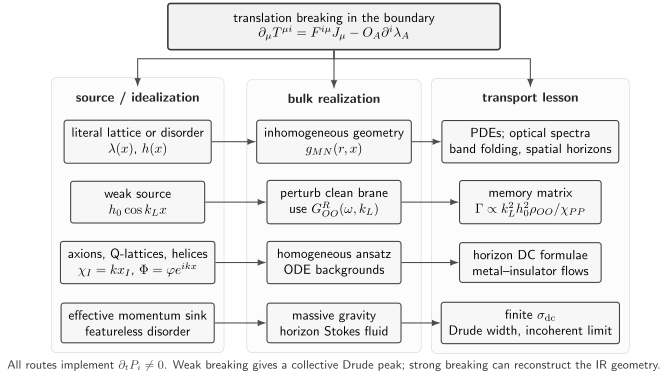
Common holographic mechanisms for explicit translation breaking. Literal lattices and disorder are closest to the boundary physics but typically require inhomogeneous bulk PDEs. Axions, Q-lattices, and helical lattices preserve enough symmetry to reduce the bulk problem to ODEs. Massive gravity and horizon Stokes formulae isolate the universal consequences of momentum relaxation directly in the gravitational variables.
Weak momentum relaxation: universal first, microscopic second
Section titled “Weak momentum relaxation: universal first, microscopic second”When translation breaking is weak, there is a clean separation of time scales:
Here is the local equilibration time of the strongly interacting fluid, and is the momentum relaxation rate. The system first becomes locally thermal, then much later loses its total momentum. In this regime the conductivity has a hydrodynamic Drude peak even without quasiparticles:
The coherent DC resistivity is therefore
provided the Drude contribution dominates over the incoherent background .
The memory-matrix formula computes directly from the clean theory. Suppose
Then
At leading order in ,
For a one-dimensional periodic source,
this becomes
The physics is beautifully sharp. The lattice supplies a momentum . Momentum can relax only if the clean strongly coupled state has low-energy spectral weight at that wavevector.
For a finite- critical geometry, low-energy excitations scale toward , so fixed nonzero spectral weight is often exponentially suppressed:
For a semi-local IR, spectral weight can remain available at nonzero momentum. If
then finite-temperature scaling gives
in the coherent regime.
Literal holographic lattices
Section titled “Literal holographic lattices”The most direct holographic implementation is to impose a spatially dependent boundary source. Examples include
for an ionic chemical-potential lattice, or
for a neutral scalar lattice. The bulk fields then depend on both the radial coordinate and boundary position:
This is physically transparent and technically brutal. The Einstein equations become nonlinear coupled PDEs. The payoff is realism: one can study optical conductivity, band folding, Umklapp physics, strong lattice potentials, and spatially resolved bulk horizons.
A minimal scalar-lattice setup is
with near-boundary source
At small , one can perturb around the homogeneous charged black brane. At finite , the background itself must be solved as an inhomogeneous geometry. The optical conductivity is then extracted from linearized inhomogeneous perturbations with infalling horizon conditions.
Literal lattices teach several lessons.
First, weak-lattice calculations reproduce the memory-matrix answer in the appropriate regime. This is a strong consistency check: the gravitational perturbation problem knows about the same nearly conserved momentum mode.
Second, at stronger lattice strength the optical conductivity need not look like a simple Drude peak plus a featureless background. Holographic lattice computations can show a low-frequency Drude-like regime and an intermediate-frequency scaling regime. Such results are intriguing because similar two-regime optical conductivities appear in some strange-metal data, though this similarity should be treated as suggestive rather than decisive.
Third, a lattice affects fermion spectral functions in a way that is not simply conventional band theory. For weak periodic potentials, spectral weight can be rearranged across multiple Brillouin zones through Umklapp processes. In a non-quasiparticle state, there is no general theorem that the single-particle spectral function must look like nearly free bands decorated by finite lifetimes.
The drawback is obvious. Literal lattices are costly. They are excellent when the spatial structure itself is the object of study, but overkill when one only wants the DC conductivity or the leading effect of momentum relaxation.
Linear axions
Section titled “Linear axions”The simplest homogeneous model of momentum relaxation introduces neutral scalar fields with shift symmetries,
and takes the background profile
A minimal bulk action is
The scalar sources depend on position, so translations are explicitly broken. Yet the stress tensor is homogeneous and isotropic, because the gradients are constant:
Therefore the background metric and gauge field can remain functions of only:
This is the great virtue of axion models. They retain homogeneous ODEs while relaxing momentum.
The linear axions are not a literal ionic lattice. A scalar source that grows linearly with is not periodic and is not globally well-defined on a torus. What makes the construction useful is that the shift symmetry makes only the gradient physical. The model is best viewed as an analytically controlled homogeneous sink for momentum, not as a microscopic crystal.
In a broad class of EMD-axion models,
with
the DC conductivities in often take the horizon-data form
Here and are evaluated at the horizon. The first term in is the incoherent conductivity. The second term is the momentum-drag contribution regulated by axion-induced relaxation.
These formulae are a kind of holographic magic trick: to compute the boundary DC transport, one evaluates data at the horizon. But the magic is not arbitrary. It follows from radially conserved electric and heat currents plus horizon regularity.
Q-lattices
Section titled “Q-lattices”A Q-lattice is another homogeneous way to encode a periodic source. Introduce a complex scalar with a global phase symmetry,
and take
The scalar itself depends periodically on , but the stress tensor can be homogeneous because it depends on phase-invariant combinations such as and . The bulk equations again reduce to ODEs.
The boundary interpretation is closer to a periodic lattice than the linear-axion model: a global internal rotation compensates a spatial translation. The source breaks translations explicitly while preserving a diagonal combination of translation and internal phase rotation in the bulk ansatz.
Q-lattices are especially useful for studying metal-insulator transitions. Depending on the IR scaling dimension of the lattice deformation, the translation-breaking source can be irrelevant, marginal, or relevant in the deep interior. If it is irrelevant, the low-temperature geometry remains close to the clean fixed point and the metal is coherent. If it is relevant, the lattice backreacts on the IR geometry, and the system can flow to an insulating state.
A useful way to phrase the criterion is:
whereas
The second case is no longer a weak momentum-relaxation problem. The conductivity is not governed by a small alone; it is a property of a new, translation-broken infrared geometry.
Helical lattices and Bianchi VII symmetry
Section titled “Helical lattices and Bianchi VII symmetry”In , one can break translations in one direction while keeping the bulk equations homogeneous by using a helical structure. Define one-forms
A source such as
breaks ordinary translations in , but preserves a combination of translation in and rotation in the plane. This is a Bianchi VII homogeneous structure.
The point is not that nature is usually helical in this exact way. The point is that the helix gives a controlled laboratory for strong explicit translation breaking. It allows one to study fully backreacted lattice physics using ODEs rather than PDEs.
Helical models can produce anisotropic metal-insulator behavior. In some regimes the conductivity along the helix direction vanishes as a power law at low frequency, while the transverse directions remain metallic. This kind of anisotropic “quantum smectic” behavior is hard to mimic with simple isotropic quasiparticle intuition.
Massive gravity and the Higgsing of translations
Section titled “Massive gravity and the Higgsing of translations”In the holographic dictionary, boundary momentum conservation is tied to bulk diffeomorphism invariance. More precisely, the boundary stress tensor is sourced by the boundary metric, and its conservation follows from invariance under boundary coordinate transformations.
If translations are broken explicitly, the bulk graviton can acquire an effective mass in the spatial directions. This motivates massive-gravity models of momentum relaxation. A common schematic form is
where is a fixed reference tensor and is built from matrix invariants of .
In a Stückelberg language, massive gravity is closely related to scalar fields with spatial profiles. The axion model is often the healthier and more transparent way to implement the same physical idea: the graviton eats the spatial scalar modes, and momentum is no longer conserved.
Massive-gravity models are useful because they produce simple analytic black branes with finite DC conductivity. They can be interpreted as effective descriptions of featureless momentum relaxation, often closer to disorder than to a clean periodic lattice.
A famous lesson from these models is that in certain locally critical EMD backgrounds the DC resistivity can track the entropy density:
If the entropy density is Sommerfeld-like,
then
This is an appealing mechanism for linear resistivity, but it is not a theorem about all strange metals. It relies on the translation-breaking strength not acquiring its own strong temperature dependence and on the relevant locally critical IR structure.
Disorder
Section titled “Disorder”A random potential can be represented by a source with
where the overline denotes disorder averaging. In the weak-disorder regime, the memory-matrix formula becomes
This equation shows why disorder can be more efficient than a single lattice wavevector. A periodic lattice probes spectral weight at one or a few values. Disorder samples a continuum of momenta.
For finite- scaling theories, low-energy fixed- spectral weight may still be suppressed, so weak disorder can be ineffective at the lowest temperatures unless it is relevant. For semi-local criticality, nonzero-momentum spectral weight is much more available, making disorder a powerful relaxation channel.
Strong disorder is harder. The bulk dual has spatially random boundary conditions. One must solve inhomogeneous Einstein equations with random sources, or derive effective horizon-fluid equations after constructing the disordered black hole. This is a frontier-style problem because disorder can change the IR fixed point itself. Once that happens, it is no longer meaningful to compute transport by perturbing the clean geometry.
Three regimes should be kept distinct:
The last regime is the most realistic for many bad metals, but also the least analytically controlled.
Horizon DC formulae and Stokes flow
Section titled “Horizon DC formulae and Stokes flow”One of the most powerful developments in holographic transport is the realization that DC conductivities of broad classes of inhomogeneous black holes can be computed by solving a forced fluid problem on the horizon.
The logic is simple. At zero frequency, the bulk electric and heat currents are radially conserved. Therefore the currents measured at the boundary can be evaluated at the horizon. Horizon regularity then translates the boundary electric field and thermal gradient into a set of constraint equations for horizon variables.
For homogeneous axion models, this collapses to algebraic formulae such as
For a genuinely inhomogeneous horizon, it becomes a Stokes problem. Schematically, one solves for a horizon velocity , an electric potential correction , and a pressure :
The boundary DC currents are horizon averages of local horizon currents:
This is one of the cleanest bridges between holography and hydrodynamics. A disordered or latticed black hole has a horizon that behaves like a viscous charged fluid moving through an inhomogeneous landscape. The DC conductivity is a property of that horizon fluid.
Metal-insulator transitions from lattice relevance
Section titled “Metal-insulator transitions from lattice relevance”A clean holographic metal can become insulating when translation breaking is relevant in the IR. This is a geometric statement.
In the UV, a lattice is a deformation of the boundary theory. In the bulk, it is a field profile sourced near the boundary. Whether it matters at low temperature depends on how that profile behaves as it flows toward the horizon. If the profile dies off in the deep IR, the lattice is irrelevant and the black brane remains effectively translationally invariant at low energies. If it grows, the lattice reconstructs the IR geometry.
A rough diagnostic is the low-temperature scaling of the DC conductivity. In a coherent weak-lattice metal,
is large. In an incoherent or insulating phase, the horizon conductivity itself can vanish as
or the optical conductivity can show a power-law pseudogap,
Holographic insulators are often “algebraic” rather than hard-gapped. This means that there may be no sharp gap scale, but the spectral weight still vanishes as a power law in the IR.
Do not confuse the following three notions:
They can look similar in a narrow temperature range, but they are physically different.
What these models do and do not claim
Section titled “What these models do and do not claim”Holographic translation-breaking models are not microscopic descriptions of actual crystals. They are controlled models of strongly coupled finite-density matter with mechanisms for momentum loss. The hierarchy is worth stating plainly.
A literal lattice is closest to a crystal potential. It is technically expensive and usually bottom-up.
A linear axion model gives homogeneous momentum relaxation. It is analytically powerful, but not a literal lattice.
A Q-lattice or helical lattice keeps enough symmetry to make strong lattice effects tractable. It is a controlled toy model of periodic translation breaking.
A massive-gravity model captures the symmetry consequence of broken translations in an effective way. It is useful for universal transport mechanisms, especially when microscopic spatial structure is unimportant.
A disordered geometry is closest to random potentials, but it is technically demanding and can involve new disordered fixed points.
The robust lessons are hydrodynamic and structural: current overlaps with momentum; weak translation breaking gives a collective Drude peak; relaxation rates are governed by low-energy spectral weight at finite momentum; DC conductivities can often be read from horizon data; strong translation breaking can reconstruct the IR geometry.
The non-robust lessons are model-specific exponents, numerical scaling windows, and detailed claims about particular materials.
Worked example: linear-axion DC conductivities
Section titled “Worked example: linear-axion DC conductivities”Consider a -dimensional boundary theory dual to a -dimensional EMD-axion bulk:
Take
and an isotropic charged black brane,
The charge density is the radially conserved Maxwell flux,
To compute , perturb the solution by a constant electric field in the direction:
and include the coupled metric and axion perturbations
The electric current is radially conserved:
At the boundary, this is . At the horizon, regularity in ingoing coordinates fixes the singular part of in terms of . The remaining Einstein constraint fixes algebraically in terms of :
Substituting the regular horizon data into gives
Using the entropy density
in units with , this becomes
The same method with a thermal drive
uses a second radially conserved quantity, the heat current . Horizon regularity gives
These formulas display the expected weak-relaxation divergence. As , momentum becomes conserved and the coherent DC conductivities diverge. The finite term is the intrinsic horizon conductivity that remains after removing momentum drag.
Common pitfalls
Section titled “Common pitfalls”Pitfall 1: Treating every translation-breaking model as a literal lattice.
Linear axions, Q-lattices, helical lattices, and massive gravity are different idealizations. They can agree in universal weak-relaxation limits but differ at strong breaking.
Pitfall 2: Forgetting the Ward identity.
Momentum relaxation is not a vague statement about “scattering.” It is encoded by
Without such a term, a finite-density clean metal has singular DC conductivity.
Pitfall 3: Reading as a quasiparticle lifetime.
In hydrodynamic holographic metals, is the lifetime of total momentum. It need not be the lifetime of any quasiparticle.
Pitfall 4: Assuming DC and optical conductivity are equally easy.
DC transport can often be computed from horizon data. Optical conductivity generally requires solving the full fluctuation problem.
Pitfall 5: Calling every bad metal an insulator.
A metal with large momentum relaxation, an incoherent metal, and an algebraic insulator are distinct IR structures.
Pitfall 6: Over-interpreting linear resistivity.
Holography supplies several routes to : Planckian momentum relaxation, entropy-tracking in locally critical phases, disorder near criticality, and model-specific lattice relevance. A single exponent is weak evidence unless accompanied by correlated predictions for thermoelectric response, optical conductivity, and spectral weight.
Exercises
Section titled “Exercises”Exercise 1: Ward identity and momentum loss
Section titled “Exercise 1: Ward identity and momentum loss”Let
where is translationally invariant. Use the fact that generates translations to show
Solution
Translations act as
Because is translationally invariant,
The perturbation gives
Using
we obtain
Integrating by parts and assuming boundary terms vanish,
Thus a constant source does not relax momentum, while a spatially varying source does.
Exercise 2: Weak periodic lattice
Section titled “Exercise 2: Weak periodic lattice”For
show that the leading relaxation rate is proportional to times the low-frequency spectral weight of at .
Solution
From Exercise 1,
In Fourier space, this is proportional to plus the mode at . The memory-matrix formula gives
Therefore
up to a convention-dependent numerical factor from the cosine normalization.
Exercise 3: Why linear axions are homogeneous
Section titled “Exercise 3: Why linear axions are homogeneous”Consider two axions in ,
with action contribution
Show that the axion stress tensor is independent of and for a homogeneous isotropic metric.
Solution
The gradients are constants:
The axion stress tensor contains only products of gradients,
For a homogeneous metric and homogeneous dilaton , the quantities
are constant and isotropic. Therefore depends on only. The scalar sources break translations, but the bulk equations for the background remain ODEs.
Exercise 4: Coherent divergence from the axion formula
Section titled “Exercise 4: Coherent divergence from the axion formula”Use
to explain why restores the clean-limit infinite conductivity at nonzero density.
Solution
The parameter controls the strength of explicit translation breaking. When , the axion profiles become constant and no longer break translations. At nonzero charge density, current overlaps with the conserved momentum.
The formula gives
as if . Thus diverges. The finite term remains, but it is subleading compared with the momentum-drag contribution.
Exercise 5: Resistivity from an spectral exponent
Section titled “Exercise 5: Resistivity from an AdS2AdS_2AdS2 spectral exponent”Suppose a weak lattice couples to an operator whose semi-local IR spectral function obeys
Use finite-temperature scaling to estimate the temperature dependence of in the coherent regime.
Solution
The memory-matrix formula gives
At finite temperature, is replaced by the only IR scale , so
Hence
In the coherent regime,
so
up to slowly varying thermodynamic prefactors.
Exercise 6: Explicit versus spontaneous breaking
Section titled “Exercise 6: Explicit versus spontaneous breaking”A charge-density wave forms with wavevector in a translationally invariant Hamiltonian. Is total momentum conserved? Why can the DC conductivity still be finite in a real material?
Solution
If the Hamiltonian is exactly translationally invariant and the charge-density wave forms spontaneously, total momentum is still conserved. The state breaks translations, but the microscopic conservation law remains. The ordered phase has a Goldstone mode: the sliding phase or phonon of the density wave.
In an ideal clean system, sliding can contribute to singular transport. In a real material, the density wave is typically pinned by weak explicit translation breaking from an ionic lattice, impurities, disorder, or commensurability effects. Pinning gaps the sliding mode and allows momentum to relax, making the DC conductivity finite.
Further reading
Section titled “Further reading”- S. A. Hartnoll, A. Lucas, and S. Sachdev, Holographic Quantum Matter, sections 5.5—5.10, for weak and strong momentum relaxation, memory matrices, mean-field models, and exact horizon methods.
- J. Zaanen, Y. Liu, Y.-W. Sun, and K. Schalm, Holographic Duality in Condensed Matter Physics, chapter 12, for translation breaking, holographic lattices, Bianchi VII helices, massive gravity, and crystallization.
- G. T. Horowitz, J. E. Santos, and D. Tong, work on optical conductivity in holographic lattices, for early fully inhomogeneous lattice computations.
- A. Donos and J. P. Gauntlett, work on Q-lattices, helical lattices, and horizon DC conductivities.
- R. A. Davison, B. Goutéraux, M. Blake, and collaborators, for axion models, massive gravity, incoherent transport, and diffusion-focused formulations.
- T. Andrade and B. Withers, for the linear-axion model of momentum relaxation.