
Modular Flow and Bulk Locality
Guiding question. Entanglement wedge reconstruction tells us that bulk operators in can be represented on the boundary region . Can modular flow tell us how this representation is organized, and why it knows about bulk locality?
The previous pages explained subregion duality in increasingly refined languages: HKLL reconstruction in the causal wedge, JLMS relative entropy in the entanglement wedge, quantum error correction, tensor-network toy models, and operator-algebra quantum error correction. Modular flow is the common technical thread tying these pictures together.
For an ordinary finite-dimensional density matrix , the modular Hamiltonian is
and modular flow acts on an operator by
This looks like time evolution, but it is not generated by the physical Hamiltonian. It is generated by the reduced density matrix of a region and a state. In quantum field theory this is usually a highly nonlocal transformation. In special cases, such as a Rindler wedge in the vacuum or a ball-shaped region in the CFT vacuum, modular flow becomes geometric. In holography, JLMS implies that boundary modular flow and bulk modular flow agree inside the entanglement wedge, up to the central area operator. This is the origin of several explicit reconstruction formulas.
A useful slogan is:
The slogan is powerful, but it is also dangerous if taken too literally. Modular flow is often nonlocal, state-dependent, and difficult to compute. Its value is that it provides a precise algebraic diagnostic of which bulk observables belong to which boundary region.
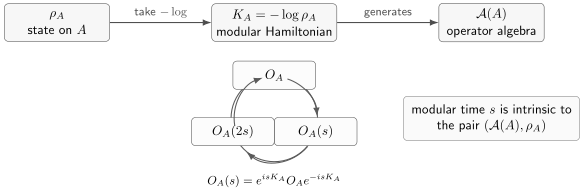
Given a state , the modular Hamiltonian generates an intrinsic flow on the operator algebra of . The orbit is generally not ordinary time evolution; it is state- and region-dependent.
1. Modular flow in finite dimensions
Section titled “1. Modular flow in finite dimensions”Let be a faithful density matrix on a finite-dimensional Hilbert space . Faithful means that has no zero eigenvalues, so is well-defined. The modular Hamiltonian is
The modular flow of an operator is the one-parameter automorphism
It preserves products and adjoints:
The generator is the commutator with :
If
then
For a matrix unit ,
Thus modular flow rotates off-diagonal density-matrix coherences by phases determined by entropy weights. Diagonal operators commute with and are modular zero modes.
The same structure appears for a bipartite pure state. Suppose
Then
The modular Hamiltonians and have the same nonzero spectrum. The full modular generator acting on the pure state is often written as
It annihilates the state:
This identity is a finite-dimensional shadow of Tomita–Takesaki theory. It is also the algebraic reason why modular flow can relate an operator on one side of an entanglement cut to a mirror-like operator on the other side.
2. Tomita–Takesaki theory in one page
Section titled “2. Tomita–Takesaki theory in one page”In continuum quantum field theory and gravity, one should not begin with a tensor factor Hilbert space. One begins with an operator algebra and a state . Assume for the moment that is cyclic and separating for :
- cyclic means that vectors of the form , with , are dense in the Hilbert space;
- separating means that if , then .
Define an antilinear operator by
The polar decomposition of is
Here is the modular operator and is the modular conjugation. Modular flow is
Tomita–Takesaki theory says, among other things, that
and
where is the commutant of . This is the algebraic generalization of the finite-dimensional relation between a subsystem and its complement.
In holography, is often the algebra associated with a boundary region , while is associated with the complementary region , possibly with shared center data. The modular operator is not merely a technical device. It tells us how the state and the algebra fit together.
3. Modular Hamiltonians are usually nonlocal
Section titled “3. Modular Hamiltonians are usually nonlocal”The notation
is deceptively simple. In a many-body system, is usually a complicated many-body operator. In a continuum QFT, is generally nonlocal and has domain subtleties. There is no general reason for to be an integral of a local density.
There are, however, famous special cases.
For the vacuum of a relativistic QFT restricted to the right Rindler wedge , the Bisognano–Wichmann theorem gives a geometric modular Hamiltonian:
The modular flow is a Lorentz boost.
For the vacuum of a CFT restricted to a ball of radius centered at , the modular Hamiltonian is also local:
This result follows by a conformal map from the causal diamond of the ball to a hyperbolic cylinder. In the bulk, the same transformation maps the entanglement wedge of the ball to an AdS-Rindler wedge. The modular flow is generated by a Killing vector that vanishes on the RT surface.
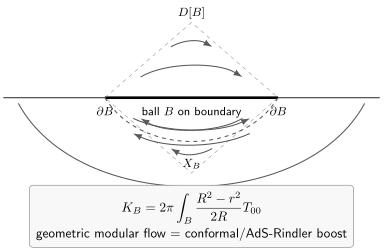
For a ball-shaped region in the CFT vacuum, modular flow is geometric. On the boundary it preserves the causal diamond of the ball; in the bulk it acts as an AdS-Rindler boost and vanishes on the RT surface. This special solvable case is the cleanest bridge between HKLL and modular reconstruction.
These geometric examples are invaluable because they let us see the physics explicitly. But they are exceptional. For a generic region or a generic state, modular flow is not a spacetime diffeomorphism. It is an abstract flow on the operator algebra.
That abstractness is precisely why modular flow is useful in black hole information. In an evaporating black hole or an entanglement wedge with complicated shape, there may be no simple geometric time coordinate. Modular flow nevertheless remains defined by the state and the algebra.
4. JLMS as equality of modular structures
Section titled “4. JLMS as equality of modular structures”Let be a boundary region and let be its entanglement wedge. The JLMS relation can be written, within an appropriate semiclassical code subspace, as a modular-Hamiltonian identity:
Here is the RT, HRT, or quantum extremal surface, and is the modular Hamiltonian of the bulk effective field theory restricted to the entanglement wedge. The dots include higher-derivative, counterterm, and higher-order quantum corrections. In the operator-algebra language of the previous page, the area term is central.
Now take a bulk operator in the entanglement wedge. If commutes with the central surface data, then the area term does not affect its modular commutator. JLMS implies schematically
where denotes a boundary representative of the bulk operator on region . Exponentiating,
This is the modular-flow form of entanglement wedge reconstruction. Boundary modular flow on implements bulk modular flow inside .
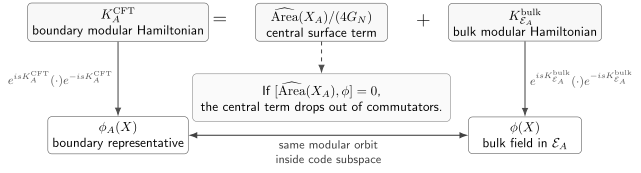
JLMS says that the boundary modular Hamiltonian equals the bulk modular Hamiltonian in the entanglement wedge plus a central geometric term. For ordinary local bulk fields away from the extremal surface, the central term drops out of commutators, so boundary and bulk modular flows agree within the code subspace.
This statement refines the phrase “the bulk operator is encoded in .” It says that the modular orbit of the operator is also encoded in . The encoding respects not only expectation values but the local algebraic structure associated with the wedge.
5. Modular frequency modes
Section titled “5. Modular frequency modes”A useful way to organize modular reconstruction is to decompose operators into modular frequency modes. Define
where
Formally, integration by parts gives
Thus is an eigenoperator of the modular-flow generator. In finite dimensions this is just a spectral decomposition with respect to the differences of modular energies. In QFT it is a distributional decomposition and must be treated more carefully, but the intuition is the same.
Bulk and boundary modular frequency modes can be matched using JLMS. If a boundary primary operator is dual to a bulk field , then one can form boundary modular modes
and bulk modular modes
The reconstruction problem becomes: find the boundary combination of that has the same correlators and commutators as inside the code subspace.
This is the modular-flow generalization of HKLL. In ordinary HKLL, one smears boundary operators over boundary spacetime using a kernel adapted to a causal wedge. In modular reconstruction, one smears boundary operators over boundary position and modular time:
Here
The kernel is not universal in the simple way the vacuum HKLL kernel is. It depends on the state, region, and bulk modular dynamics. But the formula displays the key conceptual advance: a point in the entanglement wedge can be reconstructed from operators in evolved in modular time.
6. Bulk locality from modular flow
Section titled “6. Bulk locality from modular flow”Why should modular flow know about bulk locality?
The short answer is that modular flow knows the entanglement wedge, and the entanglement wedge is the domain in which the boundary algebra acts as the bulk algebra. More explicitly, bulk locality imposes commutator constraints. A reconstructed operator should commute, inside the code subspace, with all operators reconstructible in the complementary wedge:
At the same time, it should have the correct bulk commutators and correlators with operators in . Modular flow packages these conditions because the modular Hamiltonian is built from the state restricted to the wedge. Matching modular flows is therefore a way of matching the wedge algebra.
For special ball-shaped regions in the vacuum, this reduces to AdS-Rindler HKLL. The boundary modular flow is a conformal boost, the bulk modular flow is an AdS-Rindler boost, and the smearing formula can be written geometrically. For general regions, the flow is nonlocal, but the algebraic statement persists.
This is also why modular flow is useful near extremal surfaces. The causal wedge may fail to reach a bulk point, so ordinary causal reconstruction from is inadequate. But the entanglement wedge can be larger. Modular evolution by explores directions in operator space that are invisible to simple causal propagation.
7. Petz recovery as modular reconstruction
Section titled “7. Petz recovery as modular reconstruction”Quantum recovery maps provide another route from relative entropy to reconstruction. Let
be the channel that encodes a code state into the boundary and then restricts to . In a simplified notation,
Given a reference state , the Petz recovery channel is
This formula is a noncommutative analogue of Bayes’ rule. The factors of and are modular factors. They say: recover information by comparing how the reference state looks before and after the noisy channel.
A more robust version, the twirled Petz map or universal recovery channel, averages over modular time. Schematically,
for a suitable probability density . The precise form of is less important here than the conceptual fact: recovery is controlled by modular evolution in the code and boundary algebras.
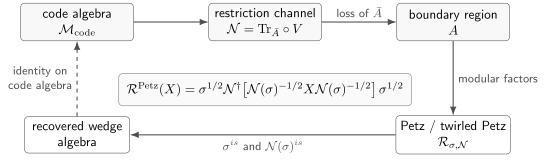
Petz-type recovery treats restriction to as a noisy channel. The recovery map is built from modular factors of a reference state before and after the channel. Universal recovery channels add an average over modular time, making the connection between relative entropy, modular flow, and entanglement wedge reconstruction explicit.
This point clarifies why relative entropy was so central in JLMS. If relative entropy is preserved under restriction to , then the restriction channel has lost no information about the relevant algebra. Petz-type maps are explicit recovery maps for that information. In holography, the recovered algebra is the algebra of the entanglement wedge.
8. Modular zero modes and the modular Berry connection
Section titled “8. Modular zero modes and the modular Berry connection”An operator is a modular zero mode if
Zero modes generate transformations that preserve the modular Hamiltonian. They are the stabilizer directions of modular flow. In finite dimensions, any operator diagonal in the eigenbasis of is a zero mode. In QFT and holography, zero modes include more interesting geometric and edge-mode data.
When the region or the state varies, the modular Hamiltonian changes. Comparing modular Hamiltonians for nearby regions is not completely canonical because one may rotate the zero-mode basis without changing . This is analogous to Berry phases in quantum mechanics, where eigenvectors have a phase ambiguity. The modular Berry connection keeps track of how modular frames are parallel transported as the region changes.
In holography, the zero-mode ambiguity is related to the choice of local frame near the RT or QES surface. Roughly speaking, the modular Hamiltonian determines a local boost around the extremal surface, while zero modes encode transformations that commute with this boost. The modular Berry curvature can therefore probe bulk geometric data.
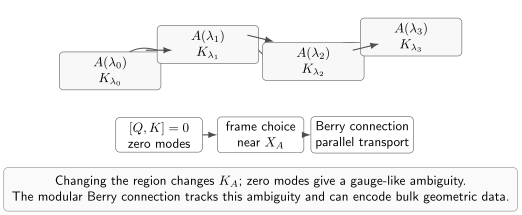
Changing the region changes the modular Hamiltonian . Zero modes commute with , so they represent a frame ambiguity. The modular Berry connection tracks how this frame changes; holographically it is related to edge-mode frames near the extremal surface.
This material is more advanced than what is needed for islands, but it is conceptually important. It shows that modular Hamiltonians do not merely reconstruct local fields; families of modular Hamiltonians can encode geometric information about the bulk itself.
9. What modular flow does and does not prove
Section titled “9. What modular flow does and does not prove”Modular flow is powerful, but several caveats are essential.
First, modular flow is not usually physical time evolution. In thermal equilibrium with
we have
so modular flow is proportional to ordinary time evolution. But for a generic subregion state, is not the physical Hamiltonian.
Second, modular reconstruction is not generally computationally simple. Writing
is only useful if we understand the modular flow and the kernel. For generic strongly coupled states, this is extremely difficult. The formula is conceptually sharp even when practically hard.
Third, exact bulk locality is not a property of full quantum gravity. Local bulk fields are perturbative, code-subspace observables. They must be gravitationally dressed, and the dressing usually reaches the boundary. Modular flow helps organize the approximate local algebra in a semiclassical code subspace; it does not magically produce exact gauge-invariant point operators in quantum gravity.
Fourth, the equality of boundary and bulk modular flows is a code-subspace statement. If the code subspace becomes too large, backreaction changes the extremal surface, the area operator fluctuates significantly, and a single fixed reconstruction map may fail.
Fifth, modular flow can reconstruct operators in an island in the same algebraic sense as other entanglement wedge operators. This does not mean that an observer in the radiation bath can send local signals into the island or directly see the black hole interior. Reconstruction is an encoded, fine-grained statement about an algebra of observables.
10. Why this page completes the reconstruction module
Section titled “10. Why this page completes the reconstruction module”The reconstruction module has moved through several layers:
- HKLL shows how to represent causal-wedge fields using boundary operators.
- JLMS shows that boundary and bulk relative entropies agree in the entanglement wedge.
- Entanglement wedge reconstruction promotes this equality to operator reconstruction.
- Holographic QEC explains why multiple boundary regions can represent the same bulk operator.
- Tensor-network codes make the redundancy visible in solvable toy models.
- OAQEC explains centers, area operators, and quantum-corrected entropy.
- Modular flow explains how the wedge algebra is dynamically organized by the state.
The next module, on islands and replica wormholes, uses all of these ideas. After the Page time, the radiation region has an entanglement wedge that includes an island . The precise statement is not that Hawking quanta locally carry a readable message. It is that the algebra associated with includes, in the appropriate code subspace, operators supported in . Modular flow and recovery maps are among the sharpest ways to formulate what that inclusion means.
Common pitfalls
Section titled “Common pitfalls”Pitfall 1: Thinking modular flow is always geometric.
It is geometric for Rindler wedges and CFT balls in the vacuum, and in a few other highly symmetric cases. Generically it is nonlocal.
Pitfall 2: Confusing modular time with boundary time.
Modular time is generated by . Boundary time is generated by the CFT Hamiltonian. They coincide only in special thermal or geometric cases.
Pitfall 3: Ignoring the area term in JLMS.
The area term is central for the wedge algebra, so it often drops out of commutators with local bulk fields. But it is essential in entropy formulas and when the center fluctuates.
Pitfall 4: Treating Petz recovery as a practical decoder.
Petz-type maps are conceptually explicit recovery maps. They can still be computationally expensive or require detailed knowledge of the state.
Pitfall 5: Treating modular reconstruction as exact nonperturbative locality.
The reconstruction of local bulk fields is a semiclassical, code-subspace statement. Exact quantum gravity is expected to be more subtle.
Exercises
Section titled “Exercises”Exercise 1. Modular flow of a matrix unit
Section titled “Exercise 1. Modular flow of a matrix unit”Let
For , show that
Which are modular zero modes if all are distinct?
Solution
The modular Hamiltonian is
Therefore
and
Thus
A modular zero mode satisfies for all , hence
If all are distinct, this implies . The zero modes are then the diagonal matrix units and their linear combinations.
Exercise 2. Local modular Hamiltonian for a CFT ball
Section titled “Exercise 2. Local modular Hamiltonian for a CFT ball”For a CFT vacuum reduced to a ball of radius centered at the origin, the modular Hamiltonian is
Show that the weight multiplying vanishes at the entangling surface. What is the physical meaning of this vanishing in the geometric-flow picture?
Solution
The weight is
At the entangling surface, , so
In the geometric-flow picture, modular flow preserves the causal diamond of the ball. The entangling surface is the fixed surface of the flow on the boundary, and the corresponding bulk RT surface is the fixed surface of the AdS-Rindler boost. The vanishing of the weight reflects that the modular-flow vector field vanishes at the entangling surface.
Exercise 3. JLMS and modular commutators
Section titled “Exercise 3. JLMS and modular commutators”Assume the code-subspace identity
where is central. Let be a bulk operator in the entanglement wedge satisfying
Show that the boundary and bulk modular commutators agree.
Solution
Using the assumed identity,
Expanding the commutator gives
Since , this reduces to
Thus the infinitesimal modular flows agree on . Exponentiating gives equality of the modular orbits, within the code subspace and to the order at which the JLMS identity is valid.
Exercise 4. Modular frequency eigenoperators
Section titled “Exercise 4. Modular frequency eigenoperators”Let
and define formally
Assuming boundary terms vanish, show that
Solution
Differentiate the modular-flow orbit:
Therefore
Now compute
Integrating by parts and dropping boundary terms,
The boundary term vanishes by assumption, so
Thus is an eigenoperator of the modular generator with modular frequency .
Exercise 5. Petz map for erasing a product subsystem
Section titled “Exercise 5. Petz map for erasing a product subsystem”Let the channel be erasure of subsystem :
Take a product reference state
Show that the Petz map reconstructs by appending :
Solution
For the partial-trace channel,
The adjoint channel with respect to the trace inner product is
The Petz map gives
Since ,
Multiplying the factors gives
Thus, for a product reference state, Petz recovery simply restores the erased subsystem in its reference state. In holographic reconstruction the channel and reference state are much more complicated, but the same modular-sandwich structure remains.
Further reading
Section titled “Further reading”- Daniel L. Jafferis, Aitor Lewkowycz, Juan Maldacena, and S. Josephine Suh, Relative Entropy Equals Bulk Relative Entropy.
- Thomas Faulkner and Aitor Lewkowycz, Bulk Locality from Modular Flow.
- Jordan Cotler, Patrick Hayden, Geoffrey Penington, Grant Salton, Brian Swingle, and Michael Walter, Entanglement Wedge Reconstruction via Universal Recovery Channels.
- Chi-Fang Chen, Geoffrey Penington, and Grant Salton, Entanglement Wedge Reconstruction using the Petz Map.
- Horacio Casini, Marina Huerta, and Robert C. Myers, Towards a Derivation of Holographic Entanglement Entropy.
- Bartlomiej Czech, Lampros Lamprou, Samuel McCandlish, and James Sully, Modular Berry Connection.
- Thomas Faulkner, Min Li, and Huajia Wang, A Modular Toolkit for Bulk Reconstruction.
- Edward Witten, Notes on Some Entanglement Properties of Quantum Field Theory.