
JT Gravity and the Schwarzian
Guiding question. Why do so many controlled calculations of islands and replica wormholes use Jackiw–Teitelboim gravity, and what is the Schwarzian mode that makes nearly AdS gravity dynamical?
The island formula is conceptually general, but explicit computations require a model where three things are simultaneously under control:
- the gravitational entropy term,
- the semiclassical matter entropy,
- the backreaction of Hawking radiation on the geometry.
Jackiw–Teitelboim gravity, usually called JT gravity, is the simplest model with all three ingredients. Its metric is locally fixed to AdS, so it has no propagating gravitons. But it is not trivial. The dilaton measures the transverse area of a near-extremal black hole, the boundary of nearly AdS has a physical reparametrization mode, and that mode is governed by the Schwarzian action.
In this page we build the JT toolkit needed for the later Page-curve and replica-wormhole pages. The main formulas are
and
The first says that JT gravity is two-dimensional dilaton gravity. The second says that the metric is locally AdS. The third says that a point in two-dimensional gravity carries black-hole entropy through the dilaton. The fourth says that the physical boundary mode of nearly AdS is a reparametrization with Schwarzian dynamics.
1. Why JT gravity is the island laboratory
Section titled “1. Why JT gravity is the island laboratory”In a higher-dimensional near-extremal charged or rotating black hole, the near-horizon region often contains a long AdS throat. The area of the transverse sphere is not constant along the throat. After reducing on the angular directions, that varying area becomes a two-dimensional scalar field: the dilaton.
Schematically,
The dilaton remembers the size of the transverse space. For an ordinary black hole the Bekenstein–Hawking entropy is area over . In the two-dimensional reduction, the same statement becomes
where is the dilaton evaluated at the horizon. The constant gives the extremal entropy , while the varying part gives the near-extremal entropy above extremality.
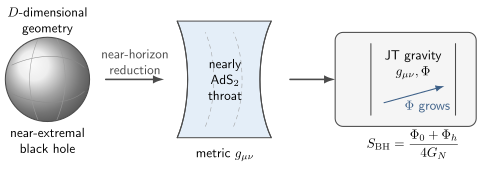
A near-extremal black hole can develop a long nearly AdS throat. Dimensional reduction on the transverse directions gives a two-dimensional metric plus a dilaton , which measures the transverse area. The extremal entropy is encoded in , while the varying dilaton controls the entropy above extremality.
This is why JT gravity is not just a random toy model. It captures the universal low-energy dynamics of a broad class of near-extremal black holes. It is also simple enough that the gravitational path integral, the Schwarzian boundary mode, and many matter entropies can be handled explicitly.
There is one important warning. JT gravity is not a complete microscopic theory of a single conventional AdS/CFT system. Its nonperturbative completion is closely related to matrix ensembles, and this creates factorization questions discussed later in the course. For island computations, however, JT gravity is invaluable because it gives a precise semiclassical arena where the generalized-entropy prescription can be evaluated.
2. The JT action and its conventions
Section titled “2. The JT action and its conventions”There are many normalization conventions in the literature. We will use a convention in which the Euclidean JT action is
Here:
- is the two-dimensional metric;
- is the dynamical dilaton;
- is a constant topological dilaton;
- is the extrinsic curvature of the asymptotic boundary;
- denotes local boundary counterterms;
- is the matter theory coupled to the JT geometry.
The constant-dilaton part is topological:
where is the Euler characteristic. This factor is important in replica wormholes and higher-topology sums because it weights different topologies by powers of .
The dynamical part is the term . Varying with respect to gives
Thus every classical solution is locally AdS with unit AdS radius. The dilaton does not make the metric locally fluctuate; instead, it controls boundary dynamics, entropy, and backreaction.
Varying the metric gives the dilaton equation. In a schematic Lorentzian convention, it has the form
up to sign changes from Euclidean versus Lorentzian conventions. The important point is physical: matter stress-energy does not change the local curvature constraint , but it changes the dilaton and the embedding of the boundary. In nearly AdS, backreaction is mostly the dynamics of the boundary clock.
3. Classical solutions: AdS and the JT black hole
Section titled “3. Classical solutions: AdS2_22 and the JT black hole”The Poincare patch of AdS is
A simple vacuum dilaton profile is
The divergence near reflects the fact that the two-dimensional description is glued to a UV region or a boundary system. The constant fixes the renormalized boundary value of the dilaton and becomes the coefficient of the Schwarzian action.
The eternal JT black hole can be written as
The horizon is at . Regularity of the Euclidean geometry gives
The black-hole entropy is
Equivalently, if
then the near-extremal entropy and energy scale as
up to an additive choice of the zero of energy. This linear-in-temperature entropy is one of the universal signatures of the nearly AdS throat.
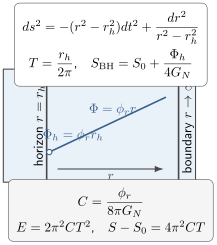
The JT black-hole metric is locally AdS, but the dilaton is nontrivial. The horizon value contributes to the black-hole entropy, while the renormalized boundary value controls the Schwarzian coupling .
Notice the division of labor. The metric knows about causal structure and temperature. The dilaton knows about entropy and backreaction. This is exactly what makes JT gravity so efficient for Page-curve calculations.
4. Pure AdS is too symmetric
Section titled “4. Pure AdS2_22 is too symmetric”AdS has a peculiarity that is crucial for black-hole information. The boundary of AdS is one-dimensional, and the asymptotic symmetry group contains arbitrary reparametrizations of boundary time,
But the exact AdS geometry preserves only a finite-dimensional subgroup,
Thus the pattern is
The modes in the quotient
are the soft boundary modes of nearly AdS. They are not ordinary bulk gravitons. They are fluctuations of how the physical boundary curve sits inside the fixed AdS geometry.
A convenient way to impose the nearly AdS boundary conditions is to draw a cutoff curve in Poincare AdS:
with induced proper length
The parameter is the physical boundary time, while is the Poincare time seen by the bulk coordinates. Different functions describe different boundary trajectories.
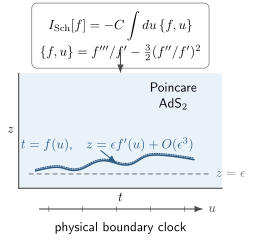
In nearly AdS, the bulk metric is locally fixed, but the cutoff boundary curve is dynamical. The reparametrization is the physical boundary mode. Evaluating the JT boundary action on this curve gives the Schwarzian action.
This boundary mode is the gravitational degree of freedom that controls low-energy dynamics, correlator backreaction, shock waves, and chaos in nearly AdS systems.
5. The Schwarzian action
Section titled “5. The Schwarzian action”Evaluating the JT action on the nearly AdS boundary curve gives an effective action for the reparametrization :
where
is the Schwarzian derivative. The coefficient is
in the convention used above.
The Schwarzian has two key properties.
First, it is invariant under projective transformations
This is the residual redundancy of AdS.
Second, it penalizes deviations from exact motion. It is therefore the effective action for the pseudo-Goldstone mode associated with the breaking of reparametrization symmetry.
At finite temperature, one often writes the thermal boundary coordinate as
so that
For the thermal saddle ,
This reproduces the near-extremal thermodynamics
and therefore
The dots include one-loop measure factors and possible matter contributions. The leading thermodynamic dependence is controlled by the Schwarzian.
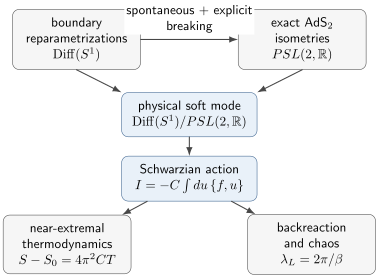
The nearly AdS boundary mode lives in reparametrizations modulo . The Schwarzian action is the universal low-energy action for this pseudo-Goldstone mode and controls the near-extremal thermodynamics.
6. Matter, baths, and evaporation
Section titled “6. Matter, baths, and evaporation”JT gravity by itself describes a nearly AdS gravitational region. To model Hawking radiation and islands, one couples it to matter and often to a nongravitating bath.
A typical setup has
The matter sector is frequently a two-dimensional CFT because entanglement entropies of intervals are known explicitly. For an interval in flat space, the vacuum entropy is
In Lorentzian coordinates and curved backgrounds, the formula is dressed by light-cone separations and Weyl factors, but the basic point remains: in two dimensions, can be computed precisely enough to extremize .
The bath is usually nongravitating. This is not a cosmetic choice. It gives the radiation region an ordinary Hilbert-space meaning, so is a standard von Neumann entropy. The gravitational region supplies the black hole and possible islands; the bath stores the Hawking radiation.
Transparent or absorbing boundary conditions allow energy to leave the AdS gravitational region. Reflecting boundary conditions would instead keep the black hole in equilibrium.
In JT gravity, the local curvature remains even with matter, but the boundary trajectory and dilaton respond to stress-energy. This is why many evaporating JT models can be treated as conformal transformations of simple AdS or black-hole geometries, with the nontrivial physics carried by the dilaton and Schwarzian boundary mode.
7. Generalized entropy in JT gravity
Section titled “7. Generalized entropy in JT gravity”The island formula in two-dimensional JT gravity is especially transparent because a codimension-two surface is a point. If the island boundary consists of points , then the gravitational part of the generalized entropy is
Thus
The quantum extremal surface condition is simply endpoint extremization:
In words, the dilaton gradient balances the endpoint dependence of the matter entropy. This is the JT version of the general QES equation
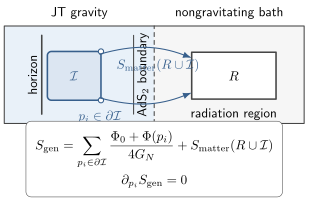
In JT gravity an island boundary is a set of points. Each endpoint contributes to the generalized entropy, while the matter term is the entropy of the union . The QES equation balances the dilaton gradient against the variation of .
For many island examples the dominant endpoint lies near the horizon. This statement should not be overinterpreted. The invariant content is not the coordinate location of the endpoint, but the fact that the endpoint solves the QES equation and that the corresponding island saddle has smaller generalized entropy than the no-island saddle.
8. A schematic endpoint equation
Section titled “8. A schematic endpoint equation”To see the structure, suppose a one-sided island has a single relevant endpoint coordinate . Write
The QES equation is
The first term is classical and geometric. The second is quantum and nonlocal. The equation can have no solution, one solution, or several solutions depending on the radiation region, the state, and the matter theory.
After solving the endpoint equation, one still has to compare saddles:
This is the same extremize-then-minimize logic as the previous page, now specialized to the dilaton formula.
9. The Schwarzian as backreaction of the boundary clock
Section titled “9. The Schwarzian as backreaction of the boundary clock”A useful physical picture is that the Schwarzian is the action for the boundary clock. Matter falling into or escaping from the JT region changes the relation between boundary time and bulk time. This is the two-dimensional remnant of gravitational backreaction.
In pure AdS, a boundary reparametrization is nearly a gauge redundancy. In nearly AdS, the cutoff boundary and dilaton boundary condition make this mode physical. Correlators of matter operators inserted at the boundary are therefore dressed by the fluctuating map .
For a boundary operator of dimension , the vacuum two-point function dressed by a reparametrization has the schematic form
Integrating over with the Schwarzian action produces gravitational corrections to boundary correlators. In particular, out-of-time-order correlators display maximal chaos with Lyapunov exponent
in the semiclassical Schwarzian regime. This same backreaction physics underlies shock-wave calculations and the sensitivity of near-horizon modes to time translations.
For islands, the Schwarzian is less visible in the final one-line formula, but it is part of what makes the semiclassical JT path integral calculable. It controls the boundary dynamics, the thermal ensemble, and the gravitational dressing of matter correlators used in replica computations.
10. Disk partition function and density of states
Section titled “10. Disk partition function and density of states”The Schwarzian path integral gives the leading disk partition function of JT gravity. Up to a conventional normalization,
The corresponding density of states behaves as
At high enough energy within the near-extremal regime, this gives
The factor is the large extremal degeneracy. The square-root entropy above extremality is the microcanonical form of the linear-in-temperature entropy.
This disk result is not the whole nonperturbative theory. Once one sums over topologies, JT gravity is related to a matrix integral. That topic belongs to the later pages on replica wormholes, Euclidean wormholes, ensemble averaging, and factorization. For now, the key lesson is simple: the same model that gives a clean black-hole thermodynamics also supplies a controlled gravitational path integral.
11. Why JT is enough, and why it is not everything
Section titled “11. Why JT is enough, and why it is not everything”JT gravity is enough for many lessons because it contains:
- a black-hole entropy term;
- a horizon and Hawking temperature;
- semiclassical matter fields with computable entropies;
- boundary backreaction through the Schwarzian;
- a gravitational path integral with replica saddles;
- QES endpoints whose generalized entropy can be explicitly extremized.
It is not everything because:
- it has no propagating gravitons;
- its geometry is locally fixed to AdS;
- it is usually tied to near-extremal physics;
- its nonperturbative completion has ensemble-like features;
- it does not by itself solve the microscopic factorization problem of a single UV-complete holographic theory.
This is the right balance. JT gravity is not the final theory of black holes. It is the cleanest solvable arena in which the modern fine-grained entropy rules become concrete.
12. Connection to the next pages
Section titled “12. Connection to the next pages”The next page will compute the Page curve in JT gravity. The ingredients from this page will appear there as follows:
with computed from two-dimensional conformal field theory and the endpoint positions determined by extremization. The no-island saddle reproduces the Hawking growth. The island saddle gives a late-time answer controlled by the remaining black-hole entropy.
The replica-wormhole page will then explain where this prescription comes from in the gravitational replica path integral. In JT gravity, the limit of the replica geometry is especially explicit, and the fixed points of the replica symmetry become the island endpoints.
13. Common pitfalls
Section titled “13. Common pitfalls”Pitfall 1: “JT gravity is trivial because .”
The local metric has no propagating degrees of freedom, but the theory is not trivial. The dilaton, boundary trajectory, topology, and matter backreaction carry the physics relevant for entropy and islands.
Pitfall 2: “The Schwarzian is an arbitrary boundary term.”
The Schwarzian is the effective action obtained by evaluating the JT boundary action under nearly AdS boundary conditions. It encodes the physical boundary reparametrization mode.
Pitfall 3: “The dilaton is just a spectator field.”
No. The dilaton determines black-hole entropy, controls the Schwarzian coupling, and appears directly in the QES equation.
Pitfall 4: “An island endpoint in JT is a literal area surface.”
In two-dimensional gravity, codimension-two surfaces are points. The “area” term is replaced by the dilaton entropy at those points.
Pitfall 5: “JT islands prove every detail of realistic four-dimensional evaporation.”
They prove something more precise and more limited: in a controlled semiclassical gravitational model, the fine-grained entropy of radiation is computed by QES/island saddles and can follow a Page curve.
Exercises
Section titled “Exercises”Exercise 1. Curvature constraint
Section titled “Exercise 1. Curvature constraint”Vary the JT action with respect to the dilaton and show that the classical metric has constant negative curvature.
Solution
The dynamical dilaton appears in the bulk as
Varying gives
Since is arbitrary in the bulk, the equation of motion is
Thus the metric is locally AdS with unit AdS radius. The nontrivial dynamics are in the dilaton, boundary mode, matter, and topology.
Exercise 2. Schwarzian derivatives
Section titled “Exercise 2. Schwarzian derivatives”Compute the Schwarzian derivative of
and of
Solution
For ,
Therefore
For , a direct calculation gives
With ,
This is the identity used to evaluate the thermal Schwarzian saddle.
Exercise 3. JT black-hole thermodynamics
Section titled “Exercise 3. JT black-hole thermodynamics”For
show that the temperature is and compute the entropy.
Solution
Near , write . Then
After Wick rotation , the near-horizon metric is
Set
Then
Regularity requires to have period , so
The entropy is the dilaton entropy at the horizon:
Exercise 4. Endpoint extremization in a toy JT island
Section titled “Exercise 4. Endpoint extremization in a toy JT island”Suppose an island endpoint has coordinate and the generalized entropy is approximated by
where and . Find the QES equation and solve for .
Solution
Extremizing gives
Hence
so
The endpoint exists inside the assumed interval if
The exercise illustrates the balance between the classical dilaton gradient and the quantum matter-entropy gradient.
Exercise 5. Entropy above extremality
Section titled “Exercise 5. Entropy above extremality”Using
compute and . Then write .
Solution
The canonical energy is
The entropy is
Solving for gives
Thus
This is the leading semiclassical JT density-of-states entropy above extremality.
Further reading
Section titled “Further reading”- R. Jackiw, “Lower Dimensional Gravity,” Nucl. Phys. B 252 (1985) 343.
- C. Teitelboim, “Gravitation and Hamiltonian Structure in Two Spacetime Dimensions,” Phys. Lett. B 126 (1983) 41.
- A. Almheiri and J. Polchinski, “Models of AdS Backreaction and Holography,” arXiv:1402.6334.
- J. Maldacena, D. Stanford, and Z. Yang, “Conformal Symmetry and Its Breaking in Two Dimensional Nearly Anti-de-Sitter Space,” arXiv:1606.01857.
- P. Saad, S. H. Shenker, and D. Stanford, “JT Gravity as a Matrix Integral,” arXiv:1903.11115.
- A. Almheiri, T. Hartman, J. Maldacena, E. Shaghoulian, and A. Tajdini, “Replica Wormholes and the Entropy of Hawking Radiation,” arXiv:1911.12333.
- A. Almheiri, T. Hartman, J. Maldacena, E. Shaghoulian, and A. Tajdini, “The Entropy of Hawking Radiation,” arXiv:2006.06872.